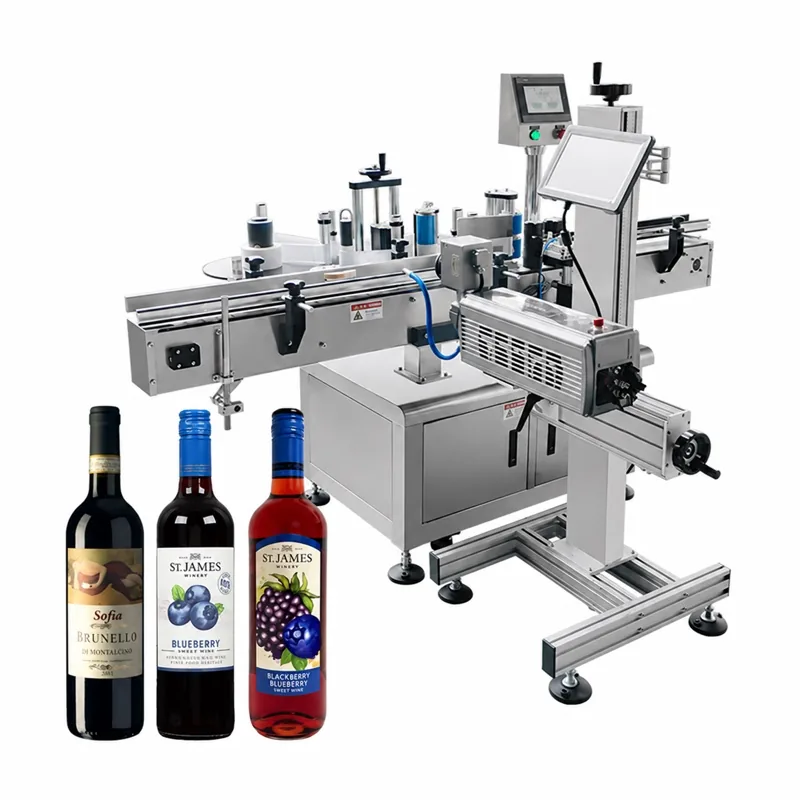
Running tapered Burgundy wine glass or cold-filled craft beer bottles through a standard dry-bottle wrap belt causes immediate label edge wrinkling, condensation slip, and skewed front-to-back spacing that fails retail shelf standards. Winery, brewery, and craft spirits packaging lines must solve three engineering problems simultaneously: managing 2°C to 6°C brite-tank condensation on wet glass, compensating for conical bottle taper without creasing textured cotton paper, and registering front, back, and neck labels within ±0.5 to ±1.0 mm relative to glass mold seams or embossed crests.
Within our bottle labeling machine application hub and the broader industrial labeling machine architecture, beverage alcohol labeling systems divide into four mechanical architectures based on line speed, label format, and wet-surface preparation.
| Machine Architecture | Throughput Window | Label Formats Supported | Orientation & Wipe Method | Wet-Bottle Capability | Typical Winery / Brewery Fit |
|---|---|---|---|---|---|
| 3-Roller Indexing Inline (Single-Web Alternating) | 20–50 BPM | Front + Back on single liner (or 360° wrap) | Pneumatic 3-roller star cradle + sponge pinch | High (with infeed air knife + wet-tack PS) | Boutique wineries, mobile bottling trucks, craft spirits |
| Dual-Head 3-Roller / Inline Orientation | 40–90 BPM | Separate Front + Back + Neck/Medallion | Servo 3-roller + optical seam/notch sensor | High (air knife + wet-tack PS) | Mid-size wineries, regional craft breweries |
| Continuous Inline Wrap-Belt | 60–180 BPM | Single wrap-around or partial wrap | Timing screw + side wrap belt + compliant pad | Moderate (dry glass or pre-dried cans/bombers) | 12 oz / 22 oz craft beer bottles & straight Bordeaux |
| Rotary Turret (PS or Casein Wet-Glue) | 150–800+ BPM | Front + Back + Shoulder Neck + Foil | Cam/servo bottle plates + optical orientation | Highest (casein wet glue bonds directly to sweating glass) | High-speed commercial breweries & large estate wineries |
Bordeaux vs Burgundy bottle geometry and the taper wrinkling limit
Standard 750 mL wine and 330–650 mL beer bottles fall into two geometric classes that dictate both applicator head tilt and label die-cut artwork:
1. Straight-wall cylindrical glass (Bordeaux, Hock/Riesling, 12 oz Heritage/Longneck beer)
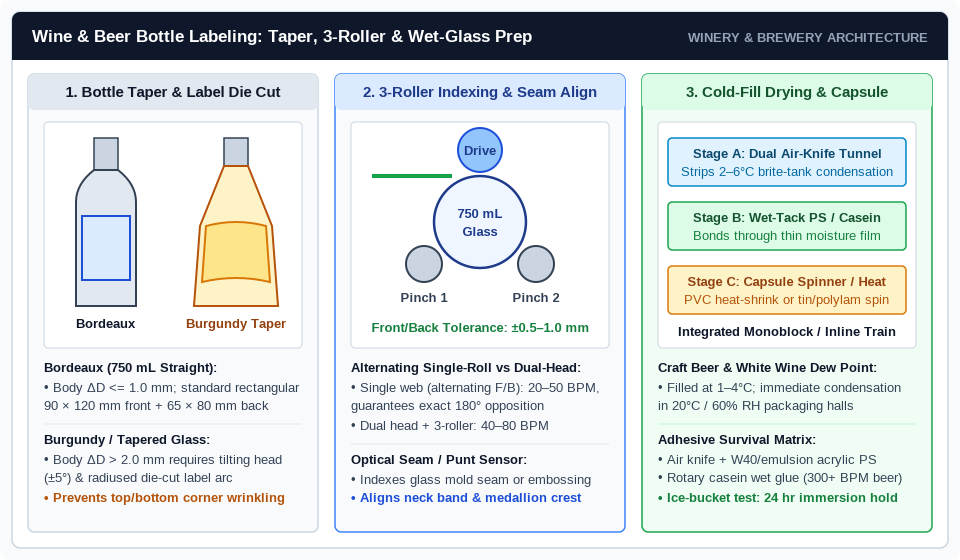
A standard 750 mL Bordeaux wine bottle has a nominal body diameter of $D \approx 75.0\text{ to }76.5\text{ mm}$ with a straight vertical sidewall zone of roughly $180\text{ mm}$ height. Because the diameter delta between the top and bottom of the label panel is $\Delta D \le 1.0\text{ mm}$, standard rectangular labels (such as a $90 \times 120\text{ mm}$ front label and $65 \times 80\text{ mm}$ back label) wrap around the glass cylinder with zero differential surface velocity between the top and bottom label edges.
2. Conical and tapered glass (Burgundy, Champagne, tapered craft spirits)
Burgundy, Pinot Noir, Chardonnay, and sparkling Champagne bottles feature a continuous conical taper extending from the base up into the shoulder. Across a $100\text{ mm}$ vertical label zone on a tapered bottle, the top diameter ($D_{\text{top}}$) is often $2.5\text{ to }6.0\text{ mm}$ smaller than the bottom diameter ($D_{\text{bot}}$).
When a rectangular label is wrapped onto a frustum cone, the bottom edge of the bottle travels a longer circumferential arc ($\pi D_{\text{bot}}$) than the top edge ($\pi D_{\text{top}}$). If you apply a straight rectangular paper label across that diameter delta, the top edge slackens and buckles into diagonal pleats (“taper wrinkling”).
Calculate the exact die-cut label arch radius ($R_{\text{arc}}$ at the bottom label edge) required for a tapered bottle using the frustum cone development equation:
$$R_{\text{arc}}\text{ (mm)} = \frac{D_{\text{bot}}}{D_{\text{bot}} - D_{\text{top}}} \times H_{\text{label}}$$
Worked example: Tapered 750 mL Burgundy / Reserve bottle
- Measured bottle diameter at bottom of label zone: $D_{\text{bot}} = 80.0\text{ mm}$
- Measured bottle diameter at top of label zone ($H_{\text{label}} = 95\text{ mm}$ higher): $D_{\text{top}} = 76.0\text{ mm}$ ($\Delta D = 4.0\text{ mm}$)
- Required die-cut radius of curvature for the bottom edge of the label: $$R_{\text{arc}} = \frac{80.0}{80.0 - 76.0} \times 95 = 20 \times 95 = 1,900\text{ mm}$$
Engineering rules of thumb for tapered glass:
- If $\Delta D \le 1.2\text{ mm}$ across the label height: Run a standard rectangular die-cut label with a ±3° to ±5° mechanical tilt adjustment on the dispensing peel plate.
- If $\Delta D = 1.5\text{ to }3.0\text{ mm}$: Tilt the dispensing head to match the glass taper angle ($\theta_{\text{taper}} = \arctan\left(\frac{D_{\text{bot}} - D_{\text{top}}}{2 H_{\text{label}}}\right)$), reduce vertical label height ($H_{\text{label}} \le 85\text{ mm}$), and use a split-roller compliant sponge wipe pad.
- If $\Delta D > 3.0\text{ mm}$ (heavy taper or neck collar wrap): You must curve (arch) the top and bottom edges of the die-cut label on the converter die per the $R_{\text{arc}}$ formula above so the flat label develops into a frustum cone without wrinkling.
3-roller indexing vs dual-head inline vs rotary orientation
Unlike a continuous spin-in-place wrap belt (covered in our round bottle labeling machine guide), premium wine and craft beer bottles require exact 180-degree opposition between the front and back labels without scuffing heavy matte-varnished or gold-foiled paper stocks.
1. Single-web alternating front/back on a 3-roller station (20–50 BPM)
For boutique wineries, mobile bottling trailers, and distilleries running 20 to 50 BPM, the most accurate and cost-effective architecture is a single dispensing head with a 3-roller pneumatic indexing cradle using a single roll of alternating front and back labels:
- The label converter prints the front label and back label alternately on the same release liner web, separated by a pre-calculated pitch gap corresponding to the half-circumference of the 750 mL bottle.
- An infeed timing screw or starwheel indexes the glass bottle against a driven rubber drive roller while two pneumatic pinch rollers close in to form a rigid three-point triangle.
- As the bottle spins without axial slip, the single peel plate dispenses the front label, pauses across the exact calibrated arc length, and dispenses the back label onto the opposite side within ±0.5 to ±1.0 mm spacing accuracy.
- Advantage: You only buy, load, and align one dispensing head, and front-to-back label height alignment is locked into the converter’s printing plate.
2. Dual-head 3-roller or rotary orientation with optical seam / punt sensing (40–300+ BPM)
When front and back labels are supplied on separate rolls—or when you must add a third neck wrap / shoulder medallion label aligned to an embossed glass crest or away from the vertical glass mold seam—the machine uses separate servo heads and an optical or mechanical orientation sensor:
- Bottom punt notch indexing: Many spirit and reserve wine bottles mold a small triangular notch in the bottom base heel. A mechanical dog or optical sensor in the bottle base plate locks into the punt notch before label application.
- Optical mold-seam / embossing sensor: A fiber-optic or vision camera scans the rotating bottle wall during the first 180 degrees of rotation on the 3-roller station (or rotary turret), detects the vertical glass mold parting seam or raised glass crest, and triggers the servo heads so the front label centers directly below the crest while themold seam is hidden under the label edge. (Compare turret mechanics in our rotary vs inline labeling machine guide.)
Solving cold-fill brite-tank condensation (1–6°C wet glass)
Carbonated craft beer, cider, sparkling wine, and cold-stabilized white wines are filled at $1^\circ\text{C}\text{ to }6^\circ\text{C}$ ($34^\circ\text{F}\text{ to }43^\circ\text{F}$). The moment a $3^\circ\text{C}$ glass bottle exits the filler/crowner into a $22^\circ\text{C}$, 60% relative humidity packaging hall (where the atmospheric dew point is $13.9^\circ\text{C}$), a continuous film of liquid condensation forms on the glass exterior.
If you attempt to apply a standard dry-room pressure-sensitive paper label onto a sweating $3^\circ\text{C}$ beer bottle, the hydrophobic adhesive skids on the water layer and peels off inside the case packer. Breweries and wineries solve wet-bottle labeling using one of three proven engineering trains (analyzed in depth in our hot-melt vs wet-glue vs pressure-sensitive comparison):
- Dual centrifugal air-knife drying tunnel + wet-tack pressure-sensitive adhesive (
20–250 BPM):- Mount an enclosed 304 stainless steel dual air-knife blow-off tunnel (5.5 to 11 kW regenerative blower with 360° slotted air knives angled downward at 30°) immediately upstream of the labeler infeed worm screw.
- Keep the conveyor travel distance between the air-knife exit and the labeler peel plate under 1.0 to 1.5 meters ($< 3\text{ seconds}$ transit time) so atmospheric moisture does not re-condense on the cold glass before label contact.
- Specify a wet-tack emulsion acrylic or rubber-resin PSA paired with wet-strength paper (70–90 gsm treated with wet-strength resin) or 50 µm BOPP film.
- Rotary cut-and-stack casein wet-glue labeling (
150–800+ BPM):- Commercial breweries running high-speed glass lines bypass air-knife drying by using aqueous casein cold glue at 22–28°C. Casein protein absorbs surface condensation water directly into the adhesive matrix to tack 65 gsm wet-strength paper labels at 500+ BPM, then cures into an ice-water-resistant bond.
- Full-body shrink sleeve + low-pressure steam tunnel (
60–300+ BPM):- Craft breweries packaging 12 oz, 16 oz, and 22 oz bottles or cans with 360-degree graphics drop a 45–50 µm PETG sleeve over the wet container and pass it through a steam shrink tunnel, where surface moisture has zero impact on mechanical shrink lock.
Integrating PVC heat-shrink capsules vs tin/polylaminate foil spinners
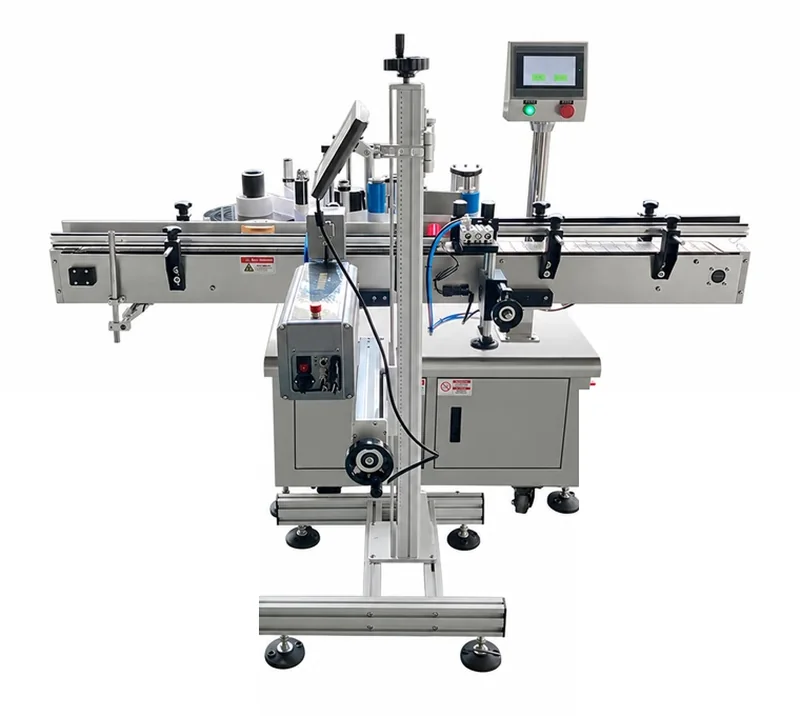
On wine and spirits lines, neck closure decoration (applying the decorative capsule over the cork or ROPP screwcap) takes place immediately upstream of the 3-roller body labeler on the same monoblock or inline conveyor:
- PVC / PETG heat-shrink capsules: A capsule dispenser drops a pre-formed heat-shrink cap over the corked bottle neck (or a tamper-evident neck band applicator cuts a sleeve from roll stock). A vertically reciprocating 1.2 to 2.2 kW radiant electric bell heater (or compact horizontal hot-air tunnel) descends over the neck for 0.8 to 1.5 seconds at $160–200^\circ\text{C}$, shrinking the capsule smoothly without wrinkling.
- Tin, aluminum, and polylaminate capsules: Non-heat-shrinkable metal capsules require a pneumatic or rotary multi-head foil spinner. Spinning elastic rings or motorized smoothing rollers close around the rotating bottle neck, pressing the soft tin or polylaminate skirt tightly into the glass neck bead groove with zero thermal energy.
Failure modes, root causes, and corrective actions
| Failure Mode / Symptom | Root Cause on Wine & Beer Glass | Corrective Engineering Action |
|---|---|---|
| Diagonal wrinkles at top/bottom edge on Burgundy bottles | Straight rectangular label applied across a tapered glass zone where $\Delta D > 1.5\text{ mm}$. | Adjust dispensing head tilt to match bottle taper angle, move label lower onto the straighter heel section, or die-cut an arched label radius ($R_{\text{arc}}$). |
| Label edge lifting or sliding on cold craft beer bottles | Condensation water film (> 15 µm) trapped under adhesive; air knife located too far upstream (> 2 m). | Relocate air-knife blow-off nozzle within 0.8–1.2 m of labeler peel plate, angle knives downward at 30°, and switch to W40/wet-tack acrylic adhesive. |
| Vertical crease down center of heavy textured wine paper | Uncoated 90–110 gsm cotton/laid estate paper absorbed ambient cellar humidity (> 70% RH) and expanded across the grain before application. | Store wine label rolls in sealed poly bags at 45–55% RH until loading, specify horizontal grain-short stock, and increase 3-roller sponge pinch pressure by 0.1 MPa. |
| Front-to-back spacing drift (> ±2 mm) on 3-roller station | Wet glass slipping against worn polyurethane drive roller, or bottle out-of-roundness ($\Delta D > 1.5\text{ mm}$) from glass mold wear. | Replaceglazed polyurethane drive roller with grooved shore 60A rubber, verify 0.4–0.5 MPa pneumatic pinch cylinder pressure, and calibrate encoder pitch. |
| Air blisters over vertical glass mold parting seam | Raised glass mold seam prevents stiff paper or film from wetting out along the seam ridge. | Enable optical seam orientation to place the glass mold seam in the gap between front and back labels, or use softer Shore 20A compliant wipe rollers. |
Specification checklist for winery and brewery RFQs
Prepare these five line details with our labeling machine RFQ checklist before messaging LINEVO engineers on WhatsApp (and if you also package aluminum beverage cans on a dual-format line, review our can and tin labeling machine guide):
- Bottle drawings across all SKUs: Provide bottle diameter ($D_{\text{bot}}$ and $D_{\text{top}}$ across the label zone), overall height, and glass style (Bordeaux, Burgundy, Hock, Champagne, 12 oz / 22 oz beer, or custom spirit).
- Label configuration: State whether Front and Back labels are printed alternating on a single roll or on separate rolls, plus any neck collar, shoulder medallion, or tax-strip stamp requirements.
- Fill temperature and surface condition: Confirm product temperature at labeler infeed ($2–6^\circ\text{C}$ cold fill vs $18–22^\circ\text{C}$ ambient wine) to size upstream air-knife drying capacity.
- Capsule / closure decoration: Specify whether the machine must integrate a capsule dispenser + radiant shrink head, a tin/polylam foil spinner, or ROPP cap orientation.
- Optical registration: State whether labels must align to an embossed glass crest, screen-printed graphic, bottom punt notch, or glass mold seam.
Common questions
Should a small-to-midsize winery print front and back labels on one roll or two separate rolls?
For wineries running 20 to 50 BPM on a 3-roller indexing labeler, printing the front and back labels alternating on a single roll is almost always the better choice. A single-web alternating setup eliminates the cost of a second dispensing head, halves roll-threading time during vintage changeovers, and guarantees that the vertical height relation between the front and back label never drifts out of alignment. Separate front and back rolls are preferred above 60 BPM on dual-head inline or rotary machines.
How do you stop wine labels from peeling off in an ice bucket?
Ice-bucket durability depends on three factors installed together: first, apply the label onto dry or thoroughly air-knifed glass so the adhesive achieves 100% micro-contact wet-out and cures for at least 24 hours before immersion; second, specify a wet-strength paper facestock impregnated with melamine or polyamide resin so paper fibers do not swell when soaked; third, pair that facestock with a permanent ice-bucket-grade emulsion acrylic or casein wet glue.
Can one labeling machine handle both 750 mL wine bottles and 12 oz / 16 oz craft beer cans?
Yes. Many craft beverage producers run a 3-roller inline pressure-sensitive labeling machine for 330 mL, 500 mL, and 750 mL cylindrical and mildly tapered bottles alongside 12 oz and 16 oz aluminum beverage cans. Switching between 66 mm diameter aluminum cans and 75 mm wine bottles takes 10 to 15 minutes by adjusting the conveyor guide rails, setting the 3-roller pinch stop, and selecting the saved label-gap recipe on the HMI touchscreen.
What is the maximum bottle taper a pressure-sensitive labeler can handle without curved labels?
On a standard 750 mL glass bottle, a diameter difference ($\Delta D = D_{\text{bot}} - D_{\text{top}}$) of up to 1.2 to 1.5 mm across an 80 to 100 mm label height can usually be absorbed by tilting the dispensing head 2° to 4° and using a compliant dual-durometer sponge roller. Once the diameter taper exceeds 2.0 mm across the label panel, a straight rectangular paper label will develop edge pleats unless the label converter die-cuts the label with a matching frustum arch radius.
Related Guides & Specifications
Container Label Size, Wrap Coverage, and Shrink Sleeve Layflat Calculator
Calculate bottle label circumference, partial wrap arc, shrink sleeve layflat width, film shrink percentage, and tapered jar chord distortion for RFQs.
Learn moreWater Bottle Labeling Machines: PET Wrap-Around, Roll-Fed BOPP, and Shrink Sleeve
Compare pressure-sensitive wrap, roll-fed BOPP hot-melt, and shrink sleeve water bottle labelers for thin-wall PET, sparkling water, and glass lines.
Learn moreJar Labeling Machines: Wrap-Around, Front-and-Back, and Tamper-Evident Configurations
Select a jar labeling machine for wide-mouth glass and plastic jars: wrap-around vs front-back, taper draft angles, L-clip tamper strips, and neck bands.
Learn moreCan and Tin Labeling Machines: Chime Clearance, Wall Dent Prevention & Format Selection
Select can and tin labeling machines for 12/16 oz aluminum beverage cans, steel food tins, and aerosols across wrap PS, shrink sleeve, and hot-melt.
Learn moreRelated Equipment & Guides
Automatic Labeling Machines: How to Choose by Container, Label and Speed
Choose an automatic labeling machine by container shape, label type and speed. Compare labeler types, accuracy tiers and the checks to run on your samples.
Learn moreWrap-Around and Pressure-Sensitive Labeling Machines: Web Kinematics & Line Selection
Engineering guide to wrap-around and pressure-sensitive labeling machines: web tension, peel plate geometry, wrap belt vs 3-roller kinematics, and line selection.
Learn moreBottle Labeling Machines: How to Choose by Container Material, Shape, and Line Speed
Select a bottle labeling machine by container material (glass, PET, HDPE), shape (round, flat, oval, square, tapered), surface condensation, and line speed.
Learn moreRound Bottle Labeling Machines: Continuous Wrap Belt vs. 3-Roller Indexing
Select a round bottle labeling machine by comparing continuous wrap belts vs 3-roller indexing, web speed equations, bottle pitch spacing, and machine parameters.
Learn moreRotary vs. Inline Labeling Machines: Turret Kinematics, Speed & Changeover
Compare rotary carousel turret vs inline linear labeling machines across speed ratings (50-150 vs 150-600+ BPM), bottle plates, starwheel changeover, and layout.
Learn moreHot-Melt Glue vs Wet-Glue vs Pressure-Sensitive Labeling Machines
Compare roll-fed hot-melt glue, cut-and-stack wet/cold glue, and pressure-sensitive labeling machines across unit label cost, line speed, changeover, and TCO.
Learn moreWater Bottle Labeling Machines: PET Wrap-Around, Roll-Fed BOPP, and Shrink Sleeve
Compare pressure-sensitive wrap, roll-fed BOPP hot-melt, and shrink sleeve water bottle labelers for thin-wall PET, sparkling water, and glass lines.
Learn moreJar Labeling Machines: Wrap-Around, Front-and-Back, and Tamper-Evident Configurations
Select a jar labeling machine for wide-mouth glass and plastic jars: wrap-around vs front-back, taper draft angles, L-clip tamper strips, and neck bands.
Learn moreCan and Tin Labeling Machines: Chime Clearance, Wall Dent Prevention & Format Selection
Select can and tin labeling machines for 12/16 oz aluminum beverage cans, steel food tins, and aerosols across wrap PS, shrink sleeve, and hot-melt.
Learn more