Choosing the Right Water Bottle Labeler Architecture {#three-water-labeling-architectures}
Bottled water packaging spans two extremes: high-speed commodity PET still water lines where the wrong web architecture wastes film and erodes unit margin, and multi-SKU regional spring, alkaline, functional, or glass mineral water lines where slow changeovers cause costly line downtime. Within our industrial labeling machines engineering system and our container-first bottle labeling machines hub, selecting a water bottle labeler comes down to choosing among three distinct application technologies: pressure-sensitive (PS) wrap-around/front-back, rotary roll-fed BOPP hot-melt, and full-body or neck-band shrink sleeve.
| Water Line Category | Primary Labeling Architecture | Typical Speed Tier | Core & Roll Envelope | Key Engineering Advantage |
|---|---|---|---|---|
| Multi-SKU Spring & Glass Mineral Water | Pressure-sensitive wrap-around or dual-head front/back | 50–200 BPM linear; 200–400 BPM rotary | 76 mm core; 300–400 mm max OD | 15–30 min changeover (5–15 min tool-free); crystal-clear no-label look |
| High-Volume Still & Sparkling PET Water | Rotary roll-fed BOPP hot-melt (120–160°C lap-end glue) | Up to 250 BPM (12-station) to 600+ BPM | 152 mm core; 600 mm max OD (100 m/min web) | Zero release-liner waste; lowest per-bottle film cost on long runs |
| Contoured Functional & Vitamin Water | Full-body shrink sleeve + 180–200°F steam shrink tunnel | 50–400 BPM (up to 54,000 BPH rotary) | 40–70 μm PETG (78% shrink) or OPS (75%) | 360° contour fit + integrated cap tamper seal; immune to condensation |
1. Pressure-Sensitive Wrap-Around & Front/Back Water Bottle Labelers
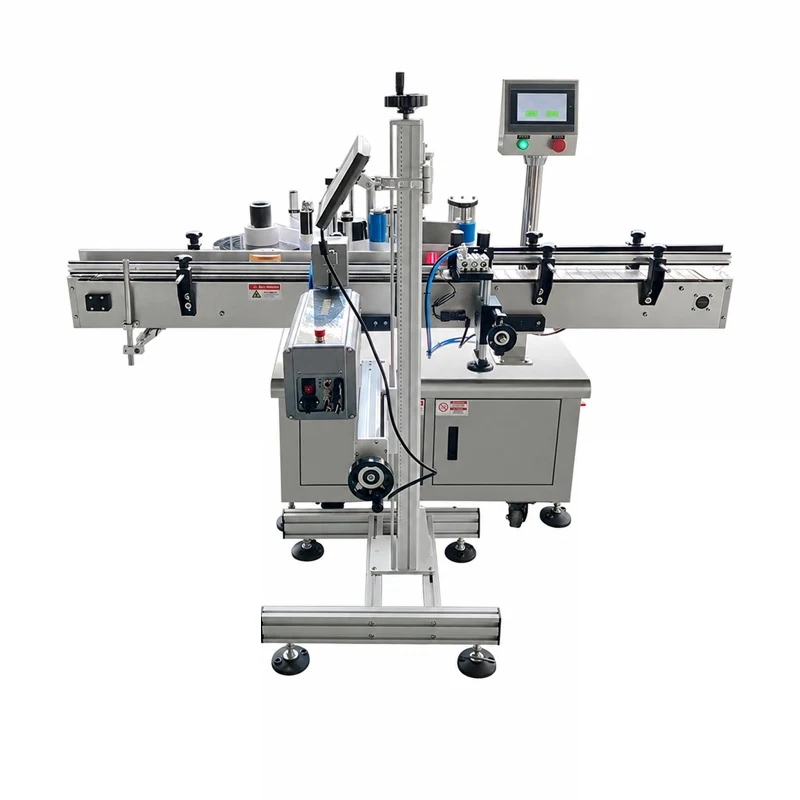
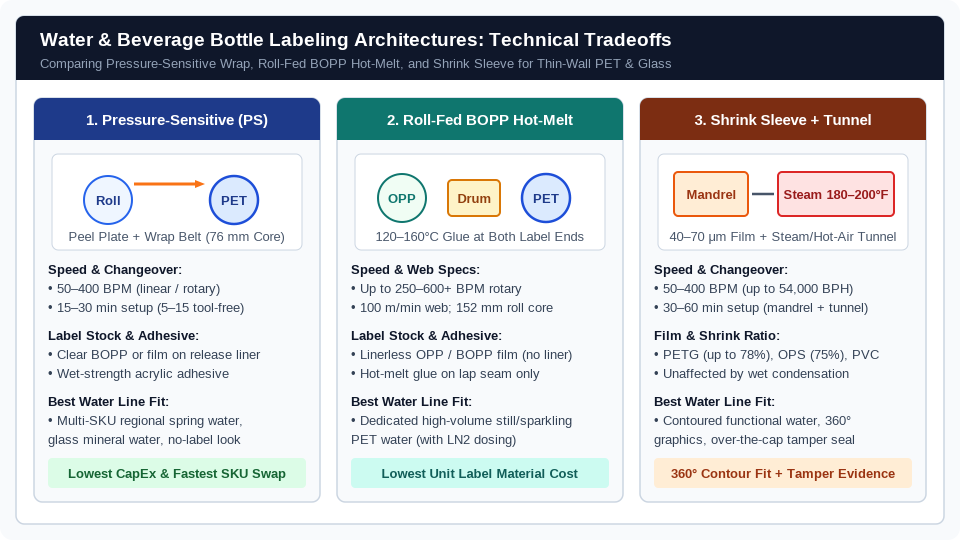
A wrap-around pressure-sensitive labeler dispenses pre-die-cut self-adhesive labels from a 76 mm (3-inch) core and 300 mm outer-diameter supply roll across a sharp peel plate onto the passing bottle. On cylindrical PET or glass water bottles, a motorized side wrap belt spins the container against a compliant foam backing pad to wipe the label around 360 degrees. On square, rectangular, or flask-shaped water bottles, a dual-head linear configuration with an overhead top hold-down belt applies separate front and back panels simultaneously.
Pressure-sensitive equipment covers low-volume semi-automatic lines (30 to 60 BPM), mid-speed linear lines (60 to 200 BPM), and rotary pressure-sensitive turrets (200 to 400+ BPM). Its primary engineering advantages on water lines are:
- Fast format changeovers taking 15 to 30 minutes on standard linear machines and 5 to 15 minutes on tool-free digital-handwheel frames, with zero glue pots, solvent cleanup, or vacuum drum change parts.
- Optical clarity for premium glass sparkling and still mineral water using 50-micron clear BOPP film on a smooth PET release liner to achieve a crystal-clear “no-label look” without hot-melt glue seams.
- Placement accuracy of ±1.0 mm on linear wrap systems and ±0.5 mm to ±0.8 mm on 3-roller indexing or servo-turret machines, keeping automatic label waste below 2%.
2. Rotary Roll-Fed BOPP Hot-Melt Labeling Machines
High-volume still and carbonated PET water lines running 250 mL, 500 mL, and 1.5 L bottles at sustained speeds from 150 BPM to 600+ BPM almost universally deploy rotary roll-fed BOPP hot-melt labelers. Instead of die-cut labels on a siliconized release liner, the machine feeds a continuous, linerless web of biaxially oriented polypropylene (OPP/BOPP) film, paper-plastic composite, or pearlized film from a large 600 mm outer-diameter roll wound on a 152 mm (6-inch) inner core.
During operation, a servo-driven infeed roller meters the continuous film web by tracking printed eye-marks at web output speeds up to 100 m/min (supporting conveyor line speeds of 25 to 30 m/min). A precision rotary cutter drum shears each individual label (430 mm to 750 mm length and 140 mm to 180 mm height on standard 12-station turrets, or smaller formats for 330 mL/500 mL bottles) and transfers the cut sheet by vacuum to a heated glue roller. The glue roller applies a narrow vertical stripe of 120°C to 160°C hot-melt adhesive strictly to the leading and trailing edges of the label. As the bottle rotates on its cam/servo platform, the leading glue stripe tacks to the PET wall, the film wraps tightly under tension around the body, and the trailing glue stripe bonds over the leading edge to form a clean lap seal with ±1.0 mm registration accuracy.
Because linerless OPP film is 35 to 45 microns thick with zero backing paper to purchase or dispose of, roll-fed hot-melt cuts consumable cost dramatically and extends single-roll run time across multiple hours of production.
3. Full-Body Shrink Sleeve & Tamper-Evident Neck Banders
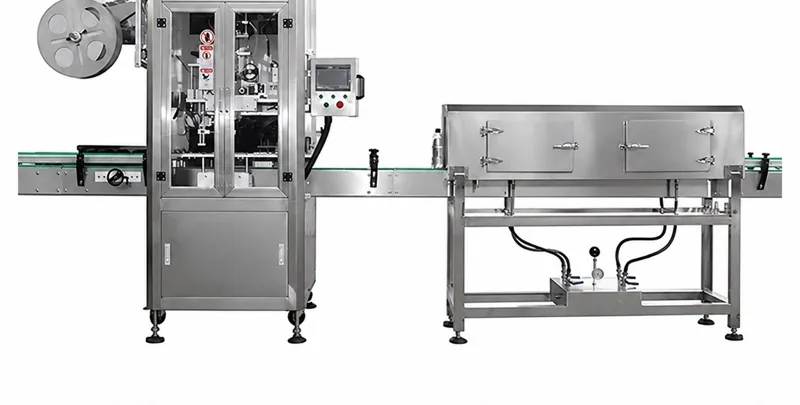
Functional waters, electrolyte beverages, flavored sparkling waters, and hourglass-contoured bottles often require 360-degree top-to-bottom graphics or an integrated over-the-cap tamper seal. A shrink sleeve labeling machine unwinds tubular film (40 to 70 microns thick), opens the layflat tube over a machined forming mandrel, rotary-cuts each sleeve to eye-mark registration, and shoots the sleeve down over the bottle at 50 to 400 BPM (with multi-head rotary sleeve systems reaching up to 54,000 bottles per hour).
After application, the bottle passes through a 180°F to 200°F (82°C to 93°C) steam shrink tunnel at conveyor speeds up to 70 ft/min. Steam provides uniform 360-degree latent heat transfer without overheating the filled water or distorting thin PET walls. PETG film delivers up to 78% shrink ratio (initiating shrink at 158°F to 176°F), OPS delivers up to 75%, and PVC delivers up to 64% (initiating at 122°F to 140°F). When only a perforated tamper-evident cap seal is required on a bottle that already carries a body label, a compact neck bander paired with a dry electric hot-air tunnel (176°F to 392°F) shrinks a short band around the closure at 100 to 500 BPM.
Thin-Wall PET Rigidity, Petaloid Bases & Nitrogen (LN2) Dosing {#thin-wall-pet-rigidity}
Modern 500 mL still water bottles are blow-molded from ultra-lightweight PET preforms (often 8 g to 11 g) with horizontal strengthening ribs and a thin waist. If an unpressurized thin-wall bottle enters a wrap-around belt or a rotary roll-fed vacuum drum, mechanical wiping force deflects the sidewall inward, causing diagonal label wrinkles, vertical skew, and open lap seams.
Beverage engineering teams stabilize thin-wall PET water bottles through three coordinated measures:
- On still water lines, an automated liquid nitrogen (LN2) micro-doser injects a precise droplet of liquid nitrogen (-196°C) into the bottle neck immediately before the capper turret. Once sealed, the nitrogen expands approximately 700-fold into inert gas, pressurizing the bottle to 1.2 to 1.8 bar so the container enters the water bottle labeler as a firm, drum-tight cylinder that resists wrap-belt and glue-drum compression.
- On sparkling water lines, CO2 carbonation naturally rigidifies the PET bottle, but internal pressure causes slight diametral expansion (creep). Labels are applied after filling and capping so the film matches the expanded circumference, and on roll-fed BOPP lines, matching the polypropylene film orientation to the PET bottle allows the label band to contract slightly if internal pressure drops in cold storage.
- On linear pressure-sensitive wrap labelers running unpressurized or lightly pressurized bottles, replacing rigid rubber backing plates with soft closed-cell silicone sponge pads and spring-loaded top hold-down rollers prevents ovalizing the container during spin-in-place wiping.
Managing Cold-Fill Condensation & Clear-on-Clear Sensor Physics {#condensation-and-adhesives}
Carbonated sparkling water and chilled spring water are routinely filled at 4°C to 10°C to maximize CO2 solubility and reduce foaming. As soon as chilled glass or PET bottles exit the filler enclosure into ambient plant air, moisture condenses on the outer wall.
Standard permanent acrylic adhesives (-20°C to +80°C service range) require a dry surface to wet out; on wet bottles, water droplets trapped beneath a clear BOPP label emulsify standard adhesives and create cloudy white patches alongside lifted leading edges. Furthermore, transparent labels on transparent water bottles produce a baseline defect rate of 6.1% when lines lack proper optical sensing and drying.
To hold <2% waste on chilled or transparent water bottles, specify:
- Dual-stage centrifugal air knives with contoured nozzle manifolds mounted 1.5 to 2.5 meters upstream of the labeler infeed to shear bulk water droplets from the label panel zone before the bottle reaches the timing screw.
- Wet-strength acrylic pressure-sensitive adhesives specifically formulated to displace residual boundary-layer moisture and survive ice-bucket immersion without edge curl.
- Ultrasonic or capacitive fork gap sensors on the label applicator head (instead of standard optical through-beam sensors) whenever dispensing clear unprinted BOPP labels on clear PET release liners, or high-speed contrast sensors capable of detecting a 5% contrast differential at web speeds above 3 m/s when running printed registration marks.
Water Bottle Labeler Architecture Comparison Table {#roll-fed-vs-ps-vs-sleeve-table}
| Selection Parameter | Pressure-Sensitive Wrap / Front-Back | Rotary Roll-Fed BOPP Hot-Melt | Full-Body Shrink Sleeve + Tunnel |
|---|---|---|---|
| Typical Line Speed | 50–200 BPM linear; 200–400+ BPM rotary | Up to 250 BPM (12-station) to 600+ BPM (24–48 station rotary) | 50–400 BPM linear/rotary (up to 54,000 BPH on multi-head rotary) |
| Label Material & Gauge | 50–60 μm BOPP film or paper on siliconized glassine/PET liner | 35–50 μm linerless OPP/BOPP or pearlized film (zero release liner) | 40–70 μm tubular PETG (up to 78% shrink), OPS (75%), or PVC (64%) |
| Roll Core & Max OD | 75/76 mm (3 in) core; 300–400 mm max OD | 152 mm (6 in) core; up to 600 mm max OD (100 m/min max web speed) | 152 mm or 254 mm core on dual-reel unwind stand |
| Adhesive / Bonding Method | Pre-coated permanent or wet-strength acrylic | 120–160°C hot-melt glue applied only at leading & trailing lap ends | Mechanical thermal contraction in 180–200°F (82–93°C) steam tunnel |
| Placement Accuracy | ±1.0 mm linear wrap; ±0.5–0.8 mm 3-roller/rotary | ±1.0 mm circumferential & vertical lap registration | ±1.0–1.5 mm vertical cut/shoot registration prior to shrink |
| SKU Changeover Time | 15–30 min standard (5–15 min tool-free) | 25–45 min (vacuum drum pads, cutter setup, feed worm) | 30–60 min (forming mandrel swap + steam nozzle tuning) |
| Power & Utility Load | 0.3–2.5 kW electric; dry compressed air if wiper-equipped | ~8.0 kW electric (includes glue melter & drum heaters), 380V 3-phase | Applicator 2–4 kW + steam generator (or 12–24 kW electric tunnel) |
| Ideal Bottled Water Profile | Multi-SKU spring water, glass mineral water, private-label co-packing | High-volume 330 mL / 500 mL / 1.5 L still & sparkling PET water | Contoured functional/vitamin water, 360° branding, cap tamper seal |
High-Speed Line Synchronization & Regulatory Compliance {#line-synchronization}
On modern water lines, the rotary rinsed-filled-capped monoblock discharges bottles onto a single-file air conveyor or flat-top slat conveyor leading to the water bottle labeler and downstream shrink-wrapper or case packer. Because effective packaging line throughput runs at 70% to 85% of rated speed (60% to 75% typical OEE), the labeler must be specified with a rated mechanical top speed at least 20% to 25% higher than the filler’s nominal BPM and buffered by 2 to 5 minutes of serpentine conveyor accumulation.
When integrating a shrink sleeve applicator and steam tunnel into a water line, continuous motion through the steam tunnel is mandatory: if a downstream case-packer jam stops bottles inside a 180°F to 200°F steam chamber, the stationary PET bottles will overheat and deform within seconds. High-speed sleeve lines therefore interlock an infeed stopper pneumatic gate ahead of the sleeve head with an automatic steam dump louver and post-tunnel accumulation table so the tunnel clears completely before pausing.
For bottled water sold in the United States, nutrition facts, mineral content declarations, and bottler address statements on the Information Panel must comply with FDA 21 CFR § 101.2 (requiring placement immediately contiguous and to the right of the Principal Display Panel in at least 1/16-inch type height). High-speed lines running over 200 BPM typically mount a UV or CO2 laser coder or continuous inkjet (CIJ) head directly on the labeler frame to print production date, time, and lot traceability codes at full web speed, while high-speed lines running 600+ CPM require label converters to hold ±0.1 mm die-cut dimensional tolerance. You can verify your converter’s roll wind orientation and calculate exact shift roll changes using our label roll unwind direction chart and calculator.
Cold-Fill & Thin-Wall Sample Trial Verification on Water Lines {#fat-verification}
Before locking in a water bottle labeler configuration, run sample containers through these four water-specific verification checks during pre-order laboratory trials and Factory Acceptance Testing (FAT):
- Pressurized vs. Unpressurized PET Hoop Deflection Test: Run both empty/unpressurized and LN2-dosed (1.2 to 1.8 bar) 8–11 g PET bottles through the wrap station or rotary vacuum drum to verify zero sidewall buckling or horizontal rib creasing at target surge speed (+20% to +25% above nominal filler BPM).
- Chilled Condensation & Air-Knife Stripping Trial: Fill test bottles at 4°C to 10°C, pass them through the dual-stage centrifugal air-knife manifold, and inspect clear BOPP film applications after 24 hours of cold storage to confirm zero emulsion blushing or trailing-edge lift.
- Hot-Melt Lap-Seal & Adhesive Trade-Off Audit: When evaluating rotary roll-fed BOPP against pressure-sensitive wrap, compare 120°C to 160°C hot-melt lap shear strength and consumable economics in our hot-melt vs. wet-glue vs. pressure-sensitive comparison, and verify exact wrap coverage using our container label size and coverage calculator.
- Steam Tunnel Emergency Stop & Dump-Louver Interlock: On full-body shrink sleeve water lines, trigger a simulated downstream case-packer jam at 180°F to 200°F tunnel operating temperature to verify the infeed pneumatic gate and automatic steam exhaust louvers clear and protect thin-wall PET bottles without thermal distortion.
Planning a new still, sparkling, or mineral water bottling line? Review our complete labeling machine RFQ checklist, compare sibling applications in our jar labeling machine guide and round bottle labeling guide, and message LINEVO engineers on WhatsApp with your bottle drawings and target BPM.
Frequently Asked Questions {#faq}
When does a bottled water plant switch from pressure-sensitive wrap to roll-fed BOPP hot-melt labeling?
Pressure-sensitive wrap-around labelers are more economical for lines running under 150 to 200 BPM, frequent SKU changeovers (15 to 30 minutes), or premium “no-label look” clear BOPP on glass mineral water. Dedicated PET still and sparkling water lines running above 200 to 250 BPM on long single-SKU shifts switch to rotary roll-fed BOPP hot-melt labelers because linerless OPP film eliminates release-liner waste, runs 600 mm OD rolls on 152 mm cores, and cuts unit label material cost by 35% to 50%.
How do you prevent ultra-lightweight PET water bottles from crushing during wrap-around labeling?
Lightweight 500 mL PET still water bottles (often blown at 8 to 11 grams preform weight) lack the hoop strength to resist standard wrap-belt pressure when unpressurized. Bottling lines dose a controlled drop of liquid nitrogen (LN2) into the headspace immediately before capping; as the nitrogen vaporizes, it pressurizes the sealed bottle to 1.2 to 1.8 bar, turning the thin PET wall into a rigid cylinder before it enters the water bottle labeler.
Why do clear BOPP labels bubble or turn milky on chilled water bottles?
Chilled water filled below the ambient dew point condenses a microscopic water layer on the bottle exterior. If a standard emulsion acrylic adhesive is applied over moisture, trapped water droplets emulsify the adhesive (causing whiteness or “water blushing”) and create unbonded blisters. Combining dual high-velocity air knives upstream of the labeler with a wet-strength solvent or specialty acrylic adhesive on clear BOPP film prevents blushing and edge lift.
Why are steam shrink tunnels preferred over hot-air tunnels on filled PET water bottles?
Steam shrink tunnels operate at 180°F to 200°F (82°C to 93°C) with high latent heat transfer, shrinking 40 to 70 micron PETG or OPS sleeves evenly around contoured water bottles in a few seconds without overheating or deforming the thin-wall PET container. Electric hot-air tunnels run hotter (176°F to 392°F) with lower heat capacity, which is well suited for dry tamper-evident neck bands but risks localized distortion on thin-wall filled PET bodies.
Related Guides & Specifications
Container Label Size, Wrap Coverage, and Shrink Sleeve Layflat Calculator
Calculate bottle label circumference, partial wrap arc, shrink sleeve layflat width, film shrink percentage, and tapered jar chord distortion for RFQs.
Learn moreJar Labeling Machines: Wrap-Around, Front-and-Back, and Tamper-Evident Configurations
Select a jar labeling machine for wide-mouth glass and plastic jars: wrap-around vs front-back, taper draft angles, L-clip tamper strips, and neck bands.
Learn moreWine and Beer Bottle Labeling Machines: Taper, 3-Roller & Wet-Glass Guide
Select wine and beer bottle labeling machines for Bordeaux and Burgundy glass, 3-roller front/back/neck registration, cold brite-tank condensation, and capsules.
Learn moreCan and Tin Labeling Machines: Chime Clearance, Wall Dent Prevention & Format Selection
Select can and tin labeling machines for 12/16 oz aluminum beverage cans, steel food tins, and aerosols across wrap PS, shrink sleeve, and hot-melt.
Learn moreRelated Equipment & Guides
Automatic Labeling Machines: How to Choose by Container, Label and Speed
Choose an automatic labeling machine by container shape, label type and speed. Compare labeler types, accuracy tiers and the checks to run on your samples.
Learn moreWrap-Around and Pressure-Sensitive Labeling Machines: Web Kinematics & Line Selection
Engineering guide to wrap-around and pressure-sensitive labeling machines: web tension, peel plate geometry, wrap belt vs 3-roller kinematics, and line selection.
Learn moreShrink Sleeve Labeling Machines: How to Match Applicator, Film and Shrink Tunnel
Specify a shrink sleeve labeling machine by sleeve format, layflat width, film shrink ratio and steam or electric tunnel. Compare speeds and sample test steps.
Learn moreBottle Labeling Machines: How to Choose by Container Material, Shape, and Line Speed
Select a bottle labeling machine by container material (glass, PET, HDPE), shape (round, flat, oval, square, tapered), surface condensation, and line speed.
Learn moreLabel Roll Unwind Direction Chart (#1 to #8) and Roll Length Calculator
Interactive #1 to #8 label winding direction chart (wound out vs wound in), eye-mark guide, and roll length, OD, core size, and shift roll calculator.
Learn moreContainer Label Size, Wrap Coverage, and Shrink Sleeve Layflat Calculator
Calculate bottle label circumference, partial wrap arc, shrink sleeve layflat width, film shrink percentage, and tapered jar chord distortion for RFQs.
Learn moreRound Bottle Labeling Machines: Continuous Wrap Belt vs. 3-Roller Indexing
Select a round bottle labeling machine by comparing continuous wrap belts vs 3-roller indexing, web speed equations, bottle pitch spacing, and machine parameters.
Learn moreHot-Melt Glue vs Wet-Glue vs Pressure-Sensitive Labeling Machines
Compare roll-fed hot-melt glue, cut-and-stack wet/cold glue, and pressure-sensitive labeling machines across unit label cost, line speed, changeover, and TCO.
Learn moreJar Labeling Machines: Wrap-Around, Front-and-Back, and Tamper-Evident Configurations
Select a jar labeling machine for wide-mouth glass and plastic jars: wrap-around vs front-back, taper draft angles, L-clip tamper strips, and neck bands.
Learn more