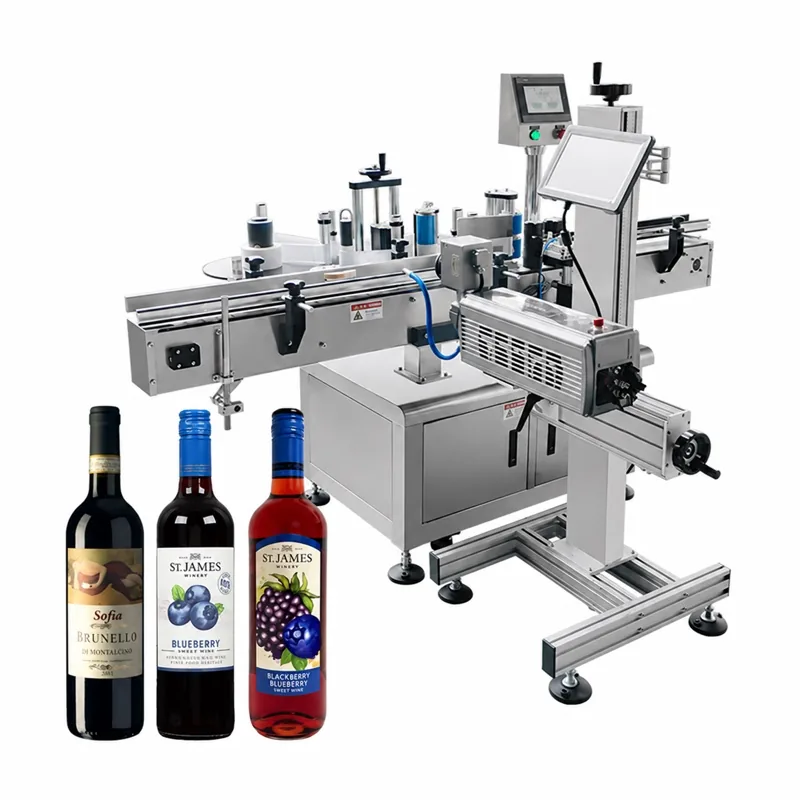
Scope of Pressure-Sensitive and Wrap-Around Labeling Systems
Within the broader family of industrial labeling machines, choosing the right pressure-sensitive (self-adhesive) architecture prevents costly label rejects, adhesive waste, and unplanned changeover downtime across beverage, pharmaceutical, personal care, and food lines. Unlike wet-glue machines that meter liquid adhesive onto cut paper blanks or shrink sleeve and tamper-evident labelers that shrink polymer tubes in a 150 to 200 degrees Celsius thermal tunnel, a pressure sensitive labeling machine feeds a continuous web of pre-printed, die-cut labels carried on a siliconized release liner. Because adhesive bonding occurs on contact under roller pressure, line startup requires zero adhesive warm-up and leaves no solvent or water cleanup between shifts.
A wrap around labeling machine applies this pressure-sensitive dispensing head to cylindrical containers, glass wine and sauce bottles, HDPE nutraceutical jars, aluminum cans, and pharmaceutical vials, by combining web feed synchronization with a rotational wrapping mechanism. Depending on how the container is stabilized and rotated past the peel tip, self-adhesive equipment divides into four distinct mechanical sub-architectures:
- Continuous inline wrap-belt labelers, which roll round containers along a stationary foam backplate at 100 to 400 bottles per minute (BPM).
- Three-roller indexing wrap labelers, which clamp each cylindrical container between three tangent rollers to achieve +/-0.5 mm overlap registration and zero vertical spiral drift.
- Dual-head front-and-back labelers, which lock flat, oval, rectangular, and square containers under an overhead hold-down belt while applying two panels simultaneously at 80 to 250 BPM.
- Rotary carousel turret labelers, which transfer containers through pitch-matched feed screws and starwheels onto cam- or servo-driven bottle plates to run 150 to 600+ BPM.
This hub establishes the mechanical engineering principles shared by all pressure-sensitive heads, web tension regulation, peel-plate delamination physics, face-stock and adhesive selection, and speed derating, and provides the decision matrix to route your specification to our dedicated engineering guides on round bottle wrap-around vs 3-roller labelers, front-and-back double-side labeling machines, and rotary vs inline labeling machine architectures.
| Sub-Architecture | Target Container Shape | Published Speed Band | Placement Accuracy | Primary Selection Trigger |
|---|---|---|---|---|
| Continuous Inline Wrap-Belt | Round cylinders (partial wrap <300 deg) | 100-400 BPM (0-150 BPM single-head) | +/-1.0 mm | High linear throughput with zero starwheel change parts |
| 3-Roller Indexing Station | Round cylinders (360-deg overlap or tapered) | 30-120 BPM | +/-0.5 to 1.0 mm | Eliminates spiral overlap drift and registers mould seams |
| Front & Back Double-Side | Flat, oval, square, rectangular, & round | 80-250 BPM (up to 300 LPM) | +/-0.8 to 1.0 mm | Requires synchronous side chains + overhead top holding belt |
| Rotary Carousel Turret | Round, oval, or shaped (1-3 labels/bottle) | 150-600+ BPM (240 BPM on 16-station) | +/-0.5 to 1.0 mm | Clamped turret bottle plates for high-speed multi-label dress |
Web Path Kinematics: Unwind Tension, Gap Sensing, and Peel Plate Physics
Every self adhesive labeling machine executes a high-speed start-stop (or velocity-modulated) cycle for each container that crosses the product detector. At 150 BPM with a 100 mm label pitch, the web drive motor must accelerate the silicone liner from rest to 30 to 40 meters per minute, dispense exactly one label length plus the ~3 mm inter-label gap, and decelerate to a repeatable stop within a 400-millisecond window. Holding +/-0.5 mm to +/-1.0 mm placement accuracy across an entire 300 mm to 400 mm outer-diameter (OD) label reel requires closed-loop control across four mechanical zones.
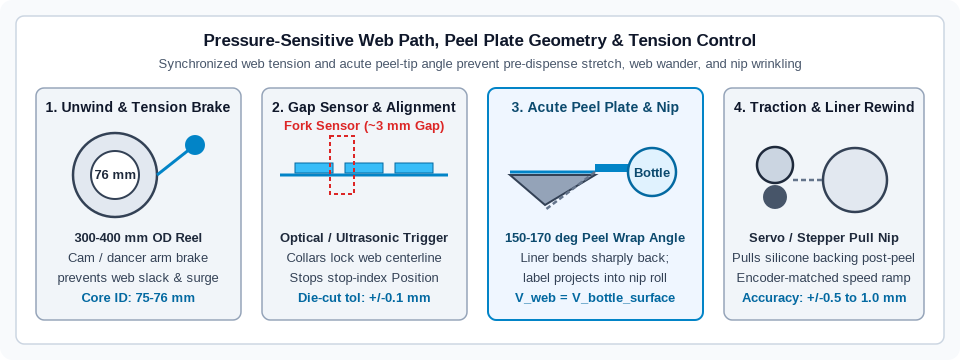
1. Unwind Reel Inertia and Tension Braking
Industrial label reels are wound on 75 mm or 76 mm (3-inch) inner-diameter (ID) cores with outer diameters ranging from 300 mm on compact tabletop frames to 400 mm on floor-standing inline applicators. A full 400 mm roll weighs several kilograms and carries high rotational inertia, whereas a nearly depleted 90 mm roll spins with minimal resistance. Without active tension compensation, a sudden servo acceleration pulls excess web off a heavy reel (creating slack loops that wander diagonally across the rollers) or over-tensions the web when the brake drags.
Equipment builders prevent tension transients using a spring-loaded dancer arm coupled to a mechanical cam brake or magnetic particle brake. As the servo pull roller accelerates the web, the dancer arm pivots against its spring preload, releasing the unwind brake just enough to let the reel pay out smoothly. As the dispense cycle ends, the dancer arm returns to its home position and re-engages the brake so the reel cannot overrun. Field misalignment audits consistently identify two unwind errors as primary root causes of crooked labels:
- Excessive web tension, which elastically stretches thin film labels (such as 50-micron BOPP or PE) before they reach the peel tip; once transferred onto the bottle wall, the film relaxes and causes edge curling or micro-wrinkling.
- Insufficient web tension or off-center core mounting, which allows the liner to weave laterally between guide collars and enter the peel plate at a diagonal angle.
2. Gap Sensing and Stop-Index Repeatability
Between the unwind dancer and the peel plate, the web passes through a slotted fork sensor that detects the leading edge of each die-cut label across the ~3 mm matrix gap. Standard paper and opaque film labels use infrared photoelectric fork sensors that measure opacity differences between the two-layer label-plus-liner stack and the single-layer glassine or PET liner. When running clear-on-clear transparent BOPP or PET labels, where optical transmission changes by less than 5% across the gap, photoelectric sensors misfire or double-feed. Clear film applications require either an ultrasonic fork sensor (which detects the acoustic impedance step of the thickness change) or a capacitive gap sensor, while metallic foil or black registration-mark webs use high-frequency contrast sensors.
For high-speed lines running above 300 to 600 containers per minute, label converters must hold die-cut dimensional tolerances within +/-0.1 mm and maintain consistent silicone release values along the web. Any burr or adhesive bleed in the die-cut gap alters the release force at the peel edge and shifts the stop-index point on the container.
3. Peel Plate Geometry and Velocity Matching
Delamination occurs at the tip of the peel plate (also called the stripping plate or beak). The silicone liner wraps around the nose of the plate through an acute turn angle of 150 to 170 degrees, pulled backward by the motorized traction nip roller toward the waste rewind mandrel. Because the label face stock is stiffer in bending than the thin silicone release coating, the label cannot follow the sharp radius of the peel tip. Instead, the leading edge of the label projects straight forward across a 2 mm to 4 mm air gap into the nip between the moving container and the primary press roller or wrap belt.
To lay the label flat without buckling or tearing, the linear velocity of the dispensing web ($V_{\text{web}}$) must match the tangential surface velocity of the container ($V_{\text{container}}$) at the exact moment of nip contact:
$$V_{\text{web}} = V_{\text{container}} \quad \text{Within } \pm 1%$$
- If $V_{\text{web}} > V_{\text{container}}$, the head pushes excess label material into the nip before the bottle advances, creating a transverse buckle or trapped air blister near the leading edge.
- If $V_{\text{web}} < V_{\text{container}}$, the moving bottle drags the label off the liner faster than the servo feeds it, skewing the label tail or snapping the web on thin paper liners.
Physical maintenance of the peel plate edge is equally critical. A nicked, burred, or adhesive-fouled peel tip causes hesitant liner release; one side of the label releases a fraction of a millisecond later than the other, imparting a yaw angle that spirals around the container circumference.
Four Pressure-Sensitive Machine Configurations Compared
Selecting the right inline wrap labeling machine or multi-head system starts with container cross-section, wrap coverage angle, and required sustained throughput. Table 1 compares the four core pressure-sensitive architectures using verified manufacturer specifications.
| Machine Configuration | Container Geometry & Coverage | Published Speed Band | Placement Accuracy | Drive & Power Envelope | Typical Changeover Time |
|---|---|---|---|---|---|
| Continuous Inline Wrap-Belt Labeler | Straight cylindrical bottles, jars, cans, vials; partial or full wrap (up to 95-100% circumference) | 100-400 BPM (high-speed lines); 0-120 to 150 BPM (compact single-head frames) | +/-1.0 mm | 0.3-0.75 kW, 220V/110V 50/60 Hz; footprint ~1750x870x1100 mm to 2000x1280x1400 mm (160 kg) | 15-20 min (roller spacing system requires zero starwheel change parts) |
| 3-Roller Indexing Wrap Labeler | Cylindrical bottles requiring 360-deg overlapping labels, slightly tapered jars, or mould-seam indexing | 30-120 BPM (indexed stop-and-spin cycle) | +/-0.5 to 1.0 mm (zero vertical spiral drift) | 0.75-1.25 kW servo head + pneumatic 3-roller clamping actuator | 15-20 min (pneumatic stroke and roller center adjustment via handwheel) |
| Front-and-Back Double-Side Labeler | Flat, oval, square, rectangular, and cylindrical bottles (with optional wrap module); 60-70% two-panel coverage | 80-150 BPM (standard frames); 120-250 BPM (heavy-duty 2.5 kW frames; up to 300 LPM on small stable bottles) | +/-0.8 to 1.0 mm | 0.75-2.5 kW; footprint ~2280x1500x1500 mm to 3000x1400x1750 mm (280-320 kg) | 20-25 min (differential dividing wheel + top belt height + dual head handwheels) |
| Rotary Carousel Turret Labeler | Round, shaped, oval, or contoured glass/PET bottles requiring 1 to 3 simultaneous labels (front, back, neck) | 150-600+ BPM (e.g., 240 BPM on a 16-station, 3-head turret) | +/-0.5 to 1.0 mm (cam or servo pocket lock) | 6.5 kW, 440V 3-phase (16-station frame, 350+ kg SS 304 construction) | 30-60 min (requires feed screw and infeed/outfeed starwheel swap per bottle OD) |
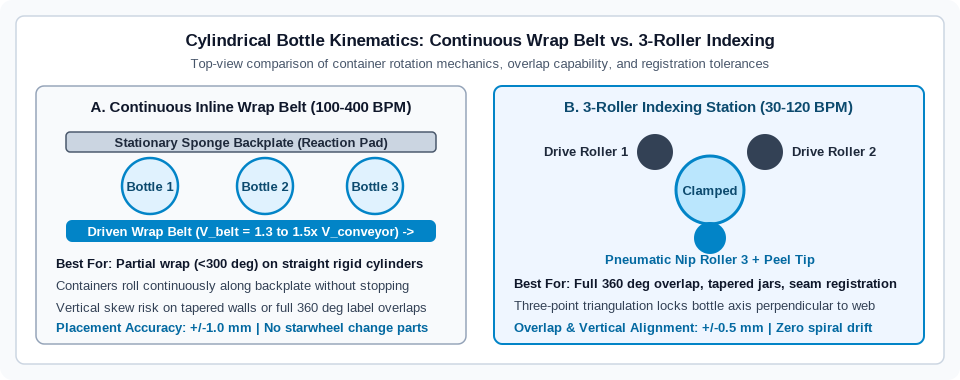
Wrap-Around Methods: Banding, Three-Point Roller Positioning, and Barrier Guides
Within cylindrical wrap-around applications, engineers choose between four mechanical wrapping methods depending on container rigidity and tolerance requirements:
- Continuous Belt Banding: As the spaced bottle enters the peel zone, its leading edge catches the projecting label tip. Immediately downstream, a motorized flat rubber or closed-cell foam wrap belt presses the container against a stationary spring-loaded sponge backplate. Because the wrap belt runs at roughly 1.3 to 1.5 times the conveyor velocity, the container spins around its vertical axis while translating forward, rolling the label around its circumference like a continuous band. This method delivers the highest inline throughput (100 to 400 BPM) and requires zero change parts across bottle diameters from 15 mm to 85 mm.
- Three-Point (3-Roller) Positioning: When a full-wrap label overlaps its own leading edge by 5 mm to 15 mm, any slight tilt of the bottle on the conveyor causes the trailing end to climb or drop relative to the leading edge, a defect known as barber-poling or spiral mismatch. A 3-roller station stops the bottle briefly against two driven support rollers while a pneumatically actuated third roller swings inward to clamp the bottle across three equidistant tangent lines. Because the three parallel rollers force the cylinder axis perpendicular to the label web throughout the spin, trailing-edge overlap aligns within +/-0.5 mm.
- Barrier and Orientation Labeling: Containers with moulded glass seams, side handles, or embossed logos use an optical or mechanical barrier stop inside the 3-roller nest. The rollers spin the container until a contrast sensor or lug detector locates the seam, then trigger the peel head at a programmed angular offset so the label lands squarely between mould lines.
- Tamper-Evident Wrap and L-Clip Sealing: Pharmaceutical vials and specialty food jars often combine a circumferential body wrap with a top-extending security tab or L-clip that folds over the cap edge, providing visual proof of closure integrity without requiring a separate heat-shrink tunnel.
For a complete engineering breakdown of belt-to-conveyor speed ratios, bottle spacing pitch equations, and 3-roller dwell-time budgets, see our spoke guide on the round bottle labeling machine.
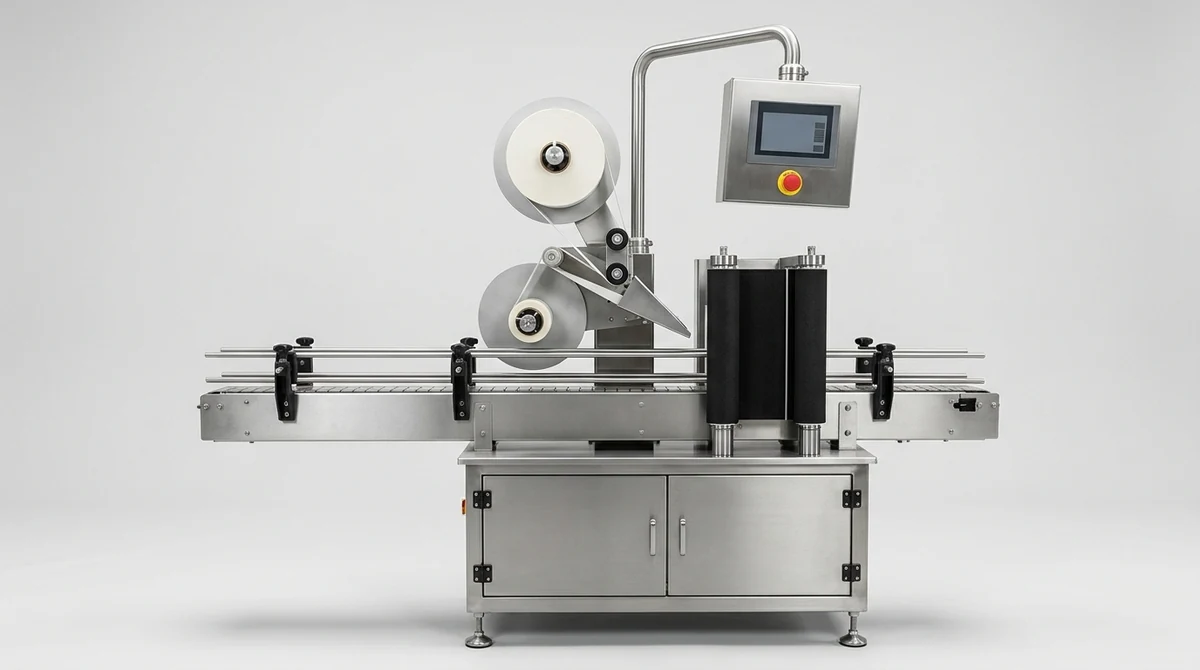
Front-and-Back vs. Wrap-Around Economics on Jar and Bottle Lines
Packaging teams launching a new rigid container frequently debate whether to specify a single full-wrap label or separate front and back panels. Published comparative benchmarks for jar and bottle lines quantify the operational and capital trade-offs between the two approaches:
- Surface Coverage and Speed: A wrap-around labeler covers 95% to 100% of the cylindrical wall using a single label web and one dispensing head, running up to 100 labels per minute (LPM) on standard jar frames and 150 to 400 BPM on high-speed bottle frames. A front-and-back machine covers 60% to 70% of the container periphery across two discrete panels at 85 to 90 LPM on base frames (upgradeable to 100 to 120 LPM on standard dual-applicator frames or 120 to 250 BPM on heavy-duty 2.5 kW frames).
- Capital, Operating, and Maintenance Costs: In comparative jar-line evaluations, an automatic wrap-around machine represents an initial equipment investment of $40,000 to $50,000 with hourly operating costs of $12 to $15/hr, monthly maintenance of $300 to $400, and a typical payback window of 12 to 18 months. A comparable front-and-back system carries an initial investment of $35,000 to $45,000, hourly operating costs of $14 to $17/hr (reflecting twin web replenishment and dual-head wear parts), monthly maintenance of $400 to $500, and a 15- to 20-month return on investment.
- Setup and Changeover: Single-web wrap-around machines average 15 to 20 minutes per SKU changeover because operators thread one liner path and set one peel plate. Dual-head front-and-back machines require 20 to 25 minutes to synchronize both left and right dispensing heads, adjust the double-sided centering chains, and set the overhead top holding belt height.
When container geometry is non-round, such as flat shampoo bottles, oval personal-care containers, or square edible-oil bottles, a wrap belt cannot roll the product. Those formats require the four-stage orientation train detailed in our front and back labeling machine guide.
Label Stock, Adhesives, and Container Surface Energy
Even a mechanically rigid labeler with servo-synchronized drives will generate high reject rates if the label face stock, adhesive chemistry, and container wall stiffness are mismatched. Industry production studies tracking defect rates across container geometries and label substrates reveal a nearly fourfold spread in baseline scrap rates.
| Container or Label Variable | Observed Defect Rate | Primary Mechanical & Material Failure Modes | Engineering Countermeasure |
|---|---|---|---|
| Square / Flat Rigid Bottles | 1.9% | Slight yaw rotation before overhead belt lock; leading-edge air pockets on wide flat panels | Double-sided synchronous centering chains + two-stage press and contoured sponge rollers |
| Round Cylindrical Bottles | 2.8%-3.2% | Trailing-edge overlap step (spiral drift) on +/-1 mm bottle diameter variance or tapered glass | 3-roller stop-and-spin triangulation for 360-deg wraps; spring-loaded backplate for partial wraps |
| Oval & Irregular Containers | 5.6% | Compound curvature causes center buckling or edge flagging; flexible HDPE walls compress under nip | High-flexibility BOPP film (9/10 rating) + calibrated spring-top belt pressure or pre-press stabilization |
| Transparent Film Labels (Clear-on-Clear) | 6.1% | Optical gap sensor mis-triggers; micro-bubbles (“silvering”) visible through clear face stock | Ultrasonic or capacitive fork gap sensor + wet-out clear acrylic adhesive + high-durometer compliant wipe |
| Metallic Foil & Rigid Polyester Labels | 7.4% | Low conformability (4/10 flexibility for rigid PET) causes wing-up / edge lift on small diameters | High-tack rubber adhesive + reduced peel-tip wrap radius + heated or extended dwell wrap belt |
Matching Face Stock Flexibility and Adhesive Tack to Substrate Dyne Level
Three material parameters govern whether a dispensed label stays bonded without flagging (edge lift) after leaving the compression belt:
- Face Stock Conformability vs. Container Radius: Biaxially oriented polypropylene (BOPP) film rates 9/10 on mechanical flexibility, allowing it to conform around tight cylindrical radii (such as 15 mm to 30 mm vials and lip-balm tubes) and slightly crowned oval panels without springing back. Rigid polyester (PET) film and heavy metallic laminates rate 4/10 on flexibility; their high flexural modulus stores elastic bending energy when wrapped around diameters below 40 mm, pulling the trailing edge away from the container wall within hours of packaging.
- Container Surface Energy (Dyne Level): Clean glass and corona-treated PET containers exhibit high surface energy (above 42 to 45 dynes/cm), allowing standard permanent acrylic adhesives to wet out rapidly. By contrast, untreated polyethylene (HDPE/LDPE) and polypropylene (PP) containers have low surface energy, typically below 38 dynes/cm. Applying a standard general-purpose acrylic adhesive to a low-energy HDPE bottle or a cold, condensation-covered beverage container results in immediate edge curl or label slide under the wrap belt. Low-energy polyolefins require aggressive rubber-based hot-melt adhesives or modified high-tack acrylic formulations designed for <38 dynes/cm surfaces.
- Plastic Wall Compression and Static Charge: Thin-walled PET water bottles and squeezable HDPE personal-care bottles deflect inward when subjected to excessive wrap-belt or wiper-roller preload. A 1 mm diameter compression during wrapping alters the effective circumference by $\pi \approx 3.14\text{ mm}$, shifting the trailing overlap and creating diagonal wrinkles as the bottle rebounds. Furthermore, polymer film webs peeling off PET liners at high speed generate static charges that attract airborne dust or cause thin film leading edges to cling prematurely to the bottle wall before reaching the nip roller. Integrating passive carbon-fiber ionizing brushes or active anti-static bars immediately downstream of the peel plate neutralizes web charge on high-speed film lines.
For detailed adhesive chemistry trade-offs across permanent, removable, high-tack, freezer, and cryogenic temperature windows, see our label adhesive types selection guide.
Sustained Throughput, Accuracy Tiers, and Barcode Readability
When sizing a wrap around labeler for an integrated packaging line, engineers must distinguish between nameplate maximum speed (measured on ideal, small-format test cylinders with short labels) and sustained shift output. Across industrial packaging operations, real-world sustained throughput averages 70% to 90% of rated maximum speed, with 80% to 90% representing the optimal continuous operating band that balances line efficiency against mechanical wear and web splice downtime.
Running a machine continuously at 100% of nameplate speed leaves zero surge capacity to clear upstream filler accumulation tables and accelerates wear on polyurethane drive rollers and sponge wrap pads. Field maintenance data demonstrates that worn drive rollers, glazed traction nips, or degraded applicator pads can cut effective line output by 25%, reducing a nominal 200 BPM line to 150 BPM due to slip-induced spacing faults and reject stops.
Placement accuracy requirements are similarly tied to downstream automated inspection and warehouse sorting systems:
- Standard Commercial Tier (+/-2 to 3 mm): Achieves a 99.0% to 99.5% barcode first-read rate, acceptable for manual case packing and non-indexed shipping drums.
- High-Precision Industrial Tier (+/-1 to 1.5 mm): Achieves a 99.5% to 99.9% barcode first-read rate. Because automated conveyor sortation and vision verification gates require a minimum 99.5% barcode first-read rate, +/-1.0 mm to +/-1.5 mm is the baseline specification for retail beverage, food, and household goods lines.
- Ultra-Precision Pharmaceutical Tier (+/-0.5 to 1 mm): Achieves greater than 99.9% barcode first-read performance, mandatory for small-diameter parenteral vials, ampoules, and serialized pharmaceutical packs where a 1.5 mm vertical skew clips the quiet zone of a GS1 DataMatrix or linear symbol verified under ISO/IEC 15417.
On regulated pharmaceutical and medical-device lines, pressure-sensitive labelers also integrate missing-label luminescence sensors, online camera verification, single-bottle pneumatic reject rams, and HMI audit trails governed by FDA 21 CFR Part 11. For thermal-transfer overprinting (TTO) or real-time variable barcode printing prior to application, compare these primary labelers with print and apply and applicator systems.
Architecture Routing Matrix: Choosing Your Spoke Specification
Use the engineering decision paths below to move from this hub to the exact mechanical specification for your container format and line speed:
- Path 1: Cylindrical Bottles, Jars, Cans, and Vials (15 mm to 120 mm Diameter) Choose between a continuous inline wrap belt (100 to 400 BPM, partial wrap or standard overlap at +/-1.0 mm) and a 3-roller indexing station (30 to 120 BPM, full 360-degree overlap or mould-seam orientation at +/-0.5 mm). See our round bottle labeling machine guide, labeling speed BPM and pitch calculator, and label roll unwind direction chart.
- Path 2: Flat, Oval, Rectangular, and Square Containers (One, Two, or Three-to-Four Panels) Container orientation prior to peel contact governs reject rates on non-round bodies. See our front and back labeling machine guide for dividing wheels, rigid centering chains, top hold-down belts, and two-stage wiping, or our square and flat bottle labeling machine guide for three-panel, four-panel, and corner-wrap geometry.
- Path 3: Line Speed Above 150 BPM, Adhesive Method Comparison, or Multi-Label Dress (Neck + Front + Back) Above 150 to 600+ BPM, or when applying simultaneous front, back, and neck labels, compare 16-station turrets in our rotary vs inline labeling machine guide and evaluate hot-melt vs wet-glue vs pressure-sensitive labeling.
- Path 4: Line Integration, Factory Acceptance Testing (FAT), and Total Cost of Ownership Review our bottle labeling machine hub, how to choose a labeling machine, industrial labeling machine FAT and troubleshooting manual, and labeling machine cost and ROI to build your RFQ sample pack.
Compile your container samples, label roll drawings, and target line speed with our labeling machine RFQ checklist and message LINEVO packaging engineers on WhatsApp to specify the right labeling head and schedule a factory sample trial.
Common questions
What is the difference between a wrap around labeling machine and a pressure sensitive labeling machine?
Pressure-sensitive (self-adhesive) describes the adhesive technology: labels come pre-coated with tacky adhesive on a siliconized backing web and delaminate over a sharp peel plate without glue pots or heat tunnels. A wrap around labeling machine is the cylindrical-container configuration of a pressure-sensitive labeler, adding a motorized wrap belt or three-roller spin station downstream of the peel plate to roll the dispensed label around a round bottle, jar, or vial.
When does a cylindrical bottle require a 3-roller station instead of a continuous inline wrap belt?
A continuous wrap belt rolls the container against a stationary sponge backplate while moving forward, which works reliably for partial wraps (up to 300 degrees) on straight-walled cylinders. When a label wraps 360 degrees with an overlapping tail, when the container wall has a slight taper, or when a fiber-optic sensor must index a mould seam or handle lug before dispensing, a 3-roller station is required to clamp the bottle at three tangent points and eliminate vertical spiral drift.
Can a front-and-back double-side labeler also run round wrap-around bottles?
Yes, provided the machine is equipped with a bolted-on wrap-around belt module downstream of one dispensing head. On a dual-head machine (rated at 80 to 150 BPM on standard frames or 120 to 250 BPM on 2.5 kW heavy-duty frames), operators lock out one dispensing head, retract the opposite wiper assembly, and engage the side wrap belt so cylindrical SKUs can run on the same conveyor as flat and oval containers.
Why do clear film and metallic pressure-sensitive labels experience higher reject rates than paper labels?
Standard optical gap sensors rely on light attenuation difference between the label+liner stack and the bare silicone liner, so transparent BOPP or PET labels require ultrasonic or capacitive fork sensors to prevent missed triggers. In addition, rigid polyester or metallic foils (rated 4/10 on conformability compared with 9/10 for BOPP) resist tight container radii and exhibit edge lift or blistering if web tension and two-stage sponge wiping pressure are not calibrated.
In This Section
Label Roll Unwind Direction Chart (#1 to #8) and Roll Length Calculator
Interactive #1 to #8 label winding direction chart (wound out vs wound in), eye-mark guide, and roll length, OD, core size, and shift roll calculator.
Learn moreLabeling Speed (BPM), OEE Surge Capacity, and Web Pitch Calculator
Calculate required labeling machine surge BPM, line OEE headroom, label web dispensing velocity in m/min, container pitch, and matched conveyor speed.
Learn moreIndustrial Labeling Machine FAT Checklist, Maintenance, and Troubleshooting Manual
Execute a 30-minute Factory Acceptance Test (FAT), follow a 6-tier preventive maintenance schedule, and resolve 12 common labeling machine defects.
Learn moreRound Bottle Labeling Machines: Continuous Wrap Belt vs. 3-Roller Indexing
Select a round bottle labeling machine by comparing continuous wrap belts vs 3-roller indexing, web speed equations, bottle pitch spacing, and machine parameters.
Learn moreFront and Back Labeling Machines: Dual-Head Sync & Top Hold-Down Mechanics
Engineering guide to front and back double-side labeling machines: centering chains, overhead top holding belts, dual servo heads, and flat or oval bottle specs.
Learn moreSquare and Flat Bottle Labeling Machine: 1-Panel, 2-Panel, and 3-Panel Wrap Selection
Specify square and flat bottle labeling machines by panel geometry, twin centering chains, overhead hold-down belts, corner wipe rollers, and recessed panel rules.
Learn moreRotary vs. Inline Labeling Machines: Turret Kinematics, Speed & Changeover
Compare rotary carousel turret vs inline linear labeling machines across speed ratings (50-150 vs 150-600+ BPM), bottle plates, starwheel changeover, and layout.
Learn moreHot-Melt Glue vs Wet-Glue vs Pressure-Sensitive Labeling Machines
Compare roll-fed hot-melt glue, cut-and-stack wet/cold glue, and pressure-sensitive labeling machines across unit label cost, line speed, changeover, and TCO.
Learn moreLabel Adhesive Types: Permanent, Removable, High-Tack, and Freezer Guide
Compare permanent, removable, high-tack, freezer, and cryogenic label adhesives by tack, peel, application temperature, surface energy, and ASTM tests.
Learn moreRelated Guides & Specifications
Shrink Sleeve Labeling Machines: How to Match Applicator, Film and Shrink Tunnel
Specify a shrink sleeve labeling machine by sleeve format, layflat width, film shrink ratio and steam or electric tunnel. Compare speeds and sample test steps.
Learn moreBottle Labeling Machines: How to Choose by Container Material, Shape, and Line Speed
Select a bottle labeling machine by container material (glass, PET, HDPE), shape (round, flat, oval, square, tapered), surface condensation, and line speed.
Learn moreVial & Pharmaceutical Labeling Machines: Vertical vs. Horizontal Selection
Select a vial labeling machine or pharmaceutical labeler for 8-30 mm vials, ampoules, syringes, and dropper bottles with cGMP 21 CFR 211.130 controls.
Learn moreSemi-Automatic & Tabletop Labelers: Benchtop Selection & ROI Crossover
Compare semi automatic labeling machines and tabletop bottle labelers (10-40 BPM) against automatic inline payback, cradle vs. tamp fixtures, and TCO math.
Learn moreLabel Automation and Custom Packaging Line Labeling Integration
Engineering guide to label automation and inline labeling system integration across fillers, cappers, accumulation tables, PLC sync, and vision reject gates.
Learn moreRelated Equipment & Guides
Automatic Labeling Machines: How to Choose by Container, Label and Speed
Choose an automatic labeling machine by container shape, label type and speed. Compare labeler types, accuracy tiers and the checks to run on your samples.
Learn moreShrink Sleeve Labeling Machines: How to Match Applicator, Film and Shrink Tunnel
Specify a shrink sleeve labeling machine by sleeve format, layflat width, film shrink ratio and steam or electric tunnel. Compare speeds and sample test steps.
Learn moreBottle Labeling Machines: How to Choose by Container Material, Shape, and Line Speed
Select a bottle labeling machine by container material (glass, PET, HDPE), shape (round, flat, oval, square, tapered), surface condensation, and line speed.
Learn moreLabel Roll Unwind Direction Chart (#1 to #8) and Roll Length Calculator
Interactive #1 to #8 label winding direction chart (wound out vs wound in), eye-mark guide, and roll length, OD, core size, and shift roll calculator.
Learn moreLabeling Speed (BPM), OEE Surge Capacity, and Web Pitch Calculator
Calculate required labeling machine surge BPM, line OEE headroom, label web dispensing velocity in m/min, container pitch, and matched conveyor speed.
Learn moreIndustrial Labeling Machine FAT Checklist, Maintenance, and Troubleshooting Manual
Execute a 30-minute Factory Acceptance Test (FAT), follow a 6-tier preventive maintenance schedule, and resolve 12 common labeling machine defects.
Learn moreRound Bottle Labeling Machines: Continuous Wrap Belt vs. 3-Roller Indexing
Select a round bottle labeling machine by comparing continuous wrap belts vs 3-roller indexing, web speed equations, bottle pitch spacing, and machine parameters.
Learn moreFront and Back Labeling Machines: Dual-Head Sync & Top Hold-Down Mechanics
Engineering guide to front and back double-side labeling machines: centering chains, overhead top holding belts, dual servo heads, and flat or oval bottle specs.
Learn moreSquare and Flat Bottle Labeling Machine: 1-Panel, 2-Panel, and 3-Panel Wrap Selection
Specify square and flat bottle labeling machines by panel geometry, twin centering chains, overhead hold-down belts, corner wipe rollers, and recessed panel rules.
Learn moreRotary vs. Inline Labeling Machines: Turret Kinematics, Speed & Changeover
Compare rotary carousel turret vs inline linear labeling machines across speed ratings (50-150 vs 150-600+ BPM), bottle plates, starwheel changeover, and layout.
Learn moreHot-Melt Glue vs Wet-Glue vs Pressure-Sensitive Labeling Machines
Compare roll-fed hot-melt glue, cut-and-stack wet/cold glue, and pressure-sensitive labeling machines across unit label cost, line speed, changeover, and TCO.
Learn morePressure Sensitive vs Shrink Sleeve: How to Choose for Your Container and Line
Compare pressure sensitive vs shrink sleeve labeling across container curves, label cost, steam or electric tunnel kW draw, footprint, and moisture resistance.
Learn moreIndustrial Labeling Machine Price and Total Cost of Ownership Guide
Transparent industrial labeling machine price breakdown from $2,000 semi-automatics to $500,000+ high-speed lines, plus hidden TCO drivers and payback math.
Learn moreHow to Choose an Industrial Labeling Machine: 7-Gate Selection Guide
Step-by-step labeling machine buying guide: 7 engineering gates from container geometry, surface energy, and unwind #1-#8 to speed headroom and line utilities.
Learn moreLabeling Machine RFQ Checklist and User Requirement Specification (URS)
Engineering labeling machine RFQ checklist and User Requirement Specification (URS) template covering container drawings, roll unwind #1-#8, CPM, and FAT rules.
Learn moreLabel Adhesive Types: Permanent, Removable, High-Tack, and Freezer Guide
Compare permanent, removable, high-tack, freezer, and cryogenic label adhesives by tack, peel, application temperature, surface energy, and ASTM tests.
Learn more