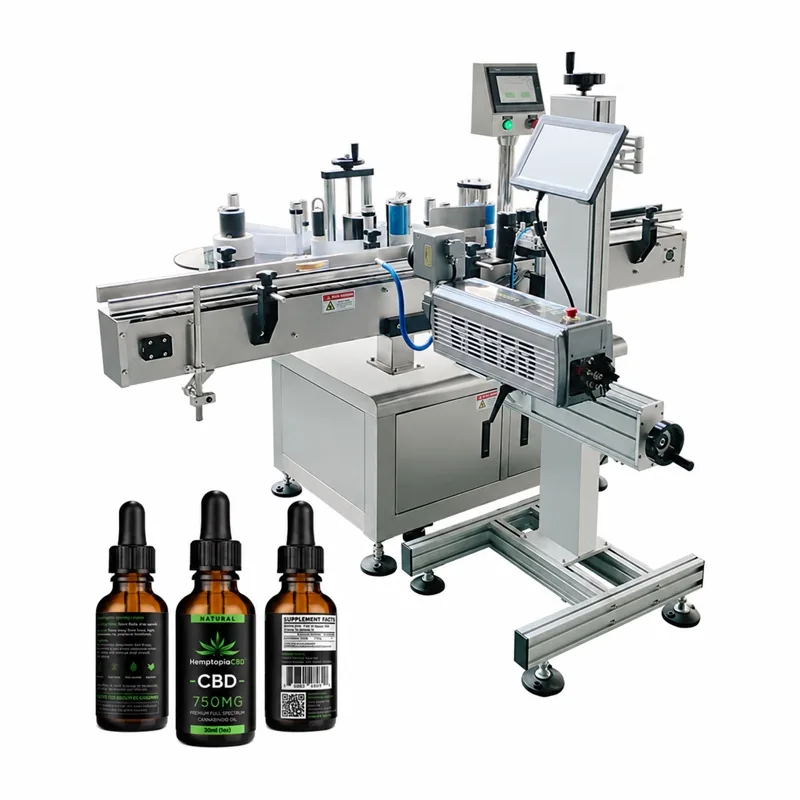
Knowing how to choose a labeling machine requires working sequentially from container geometry and wall physics to label web mechanics, derated speed headroom, changeover frequency, vision verification, and plant utilities. Buying a labeler by matching only a brochure speed number or a generic bottle photo causes chronic label wrinkling, adhesive edge lift, and costly changeover downtime once the machine is installed.
Across the major families of industrial labeling machines, each applicator head and container-handling frame solves a specific mechanical problem. A three-roller planetary wrap station that holds ±0.5 mm registration on a rigid glass wine bottle will crush a thin-walled PET water bottle or tip an unstable 10 mL pharmaceutical vial. By passing your packaging project through the seven engineering gates below, you can lock the exact machine architecture, drive class, sensor package, and line interface before issuing a vendor inquiry.
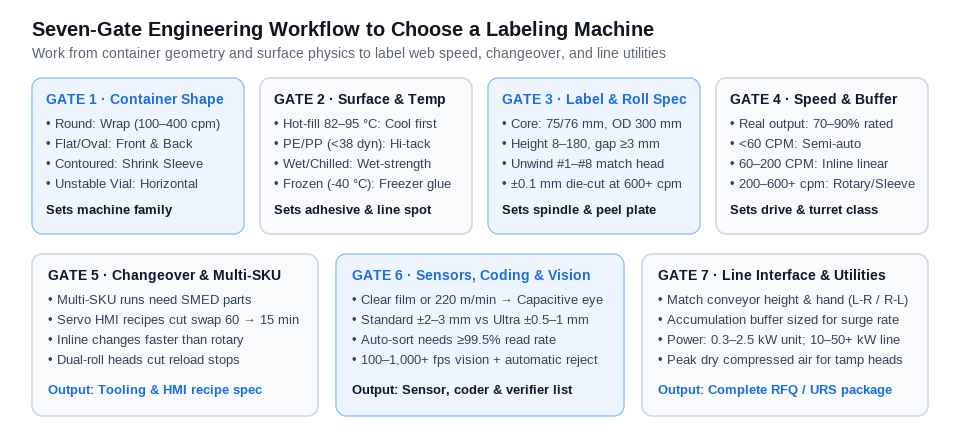
Overview of the 7-gate engineering selection workflow
Every packaging line constraint eliminates certain labeling architectures and mandates specific sub-assemblies. Use the summary matrix below to trace how each gate narrows your equipment specification.
| Selection Gate | Core Engineering Inputs | Primary Equipment Decision | Key Thresholds & Failure Prevention Rules |
|---|---|---|---|
| Gate 1: Container Geometry & Rigidity | Round, flat, oval, square, tapered cone, unstable small vial (Ø10–30 mm), or flat carton/pouch | Selects the machine family: wrap-around, twin-head front/back, horizontal roller-feed, shrink sleeve, or top/bottom belt | Unstable vials with high height-to-diameter ratio require horizontal roller cradle feed; tapered jars require a tilting applicator head |
| Gate 2: Surface Energy, Temperature & Moisture | Glass, PET, low-surface-energy PE/PP (<38 dynes/cm), hot-fill (82–95 °C), cold-fill (1–7 °C), frozen (-40 °C), washdown | Selects adhesive chemistry, line placement (before vs after cooling/drying), and SUS 304 vs 316L frame | Never apply standard pressure-sensitive labels to hot-filled PET before cooling; use high-tack rubber/modified acrylic on PE/PP <38 dynes/cm |
| Gate 3: Label Construction & Roll Unwind | Paper, BOPP, PET, PE, clear film, or PVC/PETG/OPS sleeve; core ID (75–76 mm), max OD (300 mm), gap (≥3 mm), unwind #1–#8 | Selects peel-plate geometry, mandrel cutter vs peel edge, and die-cut tolerance (±0.1 mm at 600+ CPM) | Mismatched unwind direction (#1–#8) prints or applies labels upside down; pairing matched stock with vision cuts defects from 3.2% to 0.15% |
| Gate 4: Sustained Speed, Surge & Web Velocity | Target sustained CPM, upstream surge CPM, and label repeat length (L_label + L_gap) | Selects automation class (<60, 60–200, 200–600+ CPM), inline vs rotary turret, and servo web drive speed (m/min) | Real output runs at 70%–90% of nameplate rating; size continuous demand at 80%–85% of rated machine capacity |
| Gate 5: SKU Count & Changeover Frequency | Number of container/label SKUs, shifts per day, and acceptable setup window (15 min vs 60 min) | Selects inline linear vs starwheel rotary, SMED tool-free brackets, digital position counters, and dual-roll splicing | Upgrading from 60-min manual to 15-min SMED changeover cuts setup downtime by 75% (150 hours/year saved across 200 swaps) |
| Gate 6: Sensors, Coding & Vision Inspection | Opaque vs clear film, lot/date/UDI coding (TTO, CIJ, laser), placement tolerance tier (±0.5–3 mm), barcode read rate | Selects optical vs capacitive/ultrasonic gap eye, coder integration, 100–1,000+ fps vision camera, and lock-out reject gate | Clear labels and 220 m/min webs require capacitive/ultrasonic sensors; automated warehouse sorting requires ≥99.5% barcode read rate |
| Gate 7: Line Handoffs & Facility Utilities | Conveyor height (830–875 mm or 33.25–39.25 in), hand (L→R / R→L), accumulation buffer, power (kW), air (CFM), steam | Selects through-conveyor vs dead-plate transfer, rotary accumulation table (0–8 RPM), PLC bus, and utility drops | Standalone labelers draw 0.3–2.5 kW; medium integrated lines draw 10–30 kW; high-speed lines or electric shrink tunnels draw 50+ kW |
Gate 1: Container geometry, rigidity, and application surfaces
Start by measuring every container in your current and 24-month planned SKU roster: body diameter or width (Ø15 to 200 mm typical inline range), overall height (30 to 300 mm), wall thickness, cross-sectional profile, and where the label sits on the package.
Matching container shape to machine architecture
- Rigid cylindrical bottles, jars, cans, and tins: Choose a round bottle labeling machine. For speeds between 60 and 200 BPM where moderate wrap overlap tolerance (±1 to 1.5 mm) is acceptable, a continuous wrap-belt station wipes the label around the cylinder as it moves forward. When full-circumference labels require tight overlap registration (±0.5 to 1 mm) without spiral drift, specify a 3-roller planetary indexing wrap station that traps the bottle between three rollers during rotation.
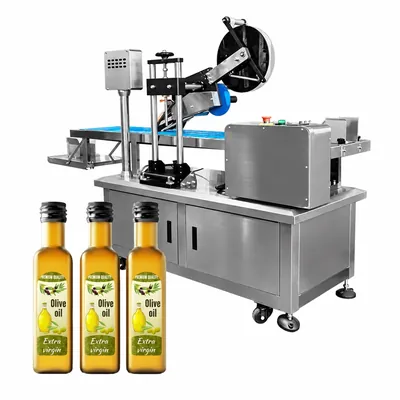
- Flat, oval, rectangular, and square containers: Choose a front and back labeling machine equipped with dual opposed dispensing heads, an entry alignment chain that squares the flat or oval body along the conveyor centerline, and a synchronized overhead top hold-down belt that locks the container against twisting (<2 degrees skew) while both panels are wiped down. Square edible-oil bottles and spirits decanters that require a single label wrapping across two or three flat faces use a twin-belt plus pneumatic wiper-arm configuration.
- Small-diameter, unstable cylindrical vials, ampoules, and syringes (Ø10 to 25 mm): Tall narrow containers with a small base footprint tip over on a standard flat-top chain conveyor. Specify a dedicated vial and pharmaceutical labeling machine using a horizontal roller-trunnion bed for ampoules and cartridges that cannot stand upright, or a vertical starwheel-pocket vial labeler when vials feed directly from a pharmaceutical tray loader or capping turret. For pilot batches under 40 to 50 BPM, compare semi-automatic and tabletop labelers.
- Complex 360-degree contoured bottles and full-body tamper-evident seals: Pressure-sensitive sheet stock cannot stretch around compound hourglass curves without darting and wrinkling. Select a shrink sleeve labeling machine that casts a tubular film sleeve over the container and shrinks it tightly to the contour inside a steam or electric tunnel. Compare trade-offs in our pressure-sensitive vs shrink sleeve guide.
- Flat pouches, lidded trays, clamshells, and shipping cartons: Choose a flat-belt top labeler, a C-frame top-and-bottom wipe-on system, or an end-of-line box and carton labeling machine using pneumatic tamp-blow or swing-arm applicators.
Handling thin-walled PET and tapered containers
Thin-walled beverage bottles flex inward under wrap-belt pressure unless they are labeled after filling and capping (when internal liquid head or carbonation pressure stiffens the sidewall) or supported by calibrated low-durometer sponge rollers. Tapered containers (such as yogurt tubs, condiment jars, and conical cosmetic bottles) require an applicator head mounted on a compound tilt-and-swivel column so the peel plate matches the container’s cone angle (1° to 10°); otherwise, a rectangular label will track upward and wrinkle across its leading edge.
Gate 2: Surface energy, filling temperature, and plant environment
Even when container geometry matches the frame, surface physics at the moment of application can cause labels to flag, blister, or slide off in transit.
Surface energy of plastics (dynes/cm) vs glass
Glass and polyester (PET) have high surface energy, allowing standard permanent acrylic adhesives to wet out cleanly. By contrast, untreated polyethylene (HDPE/LDPE) and polypropylene (PP) containers have low surface energy (below 38 dynes/cm). Standard acrylic adhesives peel or “flag” at the trailing edge of small HDPE bottles within 24 hours. When labeling untreated PE or PP containers, specify a high-initial-tack rubber-based (hot-melt) or modified high-tack acrylic adhesive designed for low-surface-energy polyolefins.
Thermal and moisture states at the labeling station
Audit the exact temperature and moisture state of the container wall when it reaches the labeler:
- Hot-fill lines (82 to 95 °C / 180 to 200 °F): Never apply a standard pressure-sensitive label directly out of a hot-fill capper before the container passes through a cooling tunnel. Thermal contraction of the bottle wall after application causes severe label wrinkling and adhesive ooze. If labeling warm containers is unavoidable, use heat-resistant PET or BOPP film stock paired with a high-shear acrylic adhesive, and blow-dry the bottle exterior after the cooling spray.
- Cold-fill and high-condensation lines (1 to 7 °C / 34 to 45 °F): Chilled beer, dairy, and juice bottles condense atmospheric moisture immediately upon leaving the filler. Paper labels absorb condensation, lose wet tensile strength, and tear during wipe-down. Specify BOPP or PE film labels with wet-strength or emulsion acrylic adhesives, install high-velocity ionized air knives immediately upstream of the peel plate, or use a rotary wet-glue/pressure-sensitive turret with heated wipe-down brushes.
- Blast-frozen packaging (down to -40 °C): Standard adhesives turn brittle and fracture below freezing. Apply all-temperature or freezer-grade adhesives to dry containers prior to blast freezing whenever possible, or select a specialized frost-tolerant sub-zero adhesive if labeling already-frozen cartons.
- Corrosive or heavy-washdown halls: Specify SUS 304 stainless steel frames for general dry and damp packaging, and upgrade to SUS 316L stainless steel with ≥3° self-draining sloped surfaces, Ra ≤0.4 to 0.8 µm polish, and IP65 enclosures in acidic food, saline, or sterile pharmaceutical washdown rooms.
Gate 3: Label construction, roll geometry, and unwind direction (#1 to #8)
A labeling machine is a web-handling system first and a bottle-handling system second. Mismatches between the label converter’s die-cutting specifications and the machine’s unwind spindle account for a large share of web breaks and misalignments.
Matching label facestock to container flexibility
| Label Facestock Material | Mechanical & Environmental Properties | Best-Fit Container & Line Applications |
|---|---|---|
| Coated / Uncoated Paper | Rigid, economical, low tear resistance when wet, zero stretch | Dry glass jars, wine bottles, dry nutraceutical canisters, corrugated shipping cartons (<200 CPM) |
| BOPP (Biaxially Oriented Polypropylene) | Moisture-, oil-, and chemical-resistant; high machine-direction tensile strength; minimal stretch (~2%–5%) | Rigid glass, PET, and HDPE beverage, sauce, edible oil, and personal care bottles (60–600+ CPM) |
| PE (Polyethylene) / Conformable Polyolefin | Flexible and squeezable (15%–30% elongation); conforms to flexing sidewalls without edge lift | Squeezable HDPE/LDPE cosmetic tubes, shampoo bottles, and personal care squeeze bottles |
| PET (Polyester) Film | High dimensional stability, heat resistance (up to 150 °C), and high tensile strength; available in clear “no-label look” | Hot-fill containers, industrial chemical drums, UL/durable rating plates, and high-speed clear-on-clear beverage labels |
| PVC, PETG, or OPS Shrink Film | Heat-shrinkable tubular film (50% to 78% transverse shrink ratio depending on polymer) | Full-body 360° contoured beverage cans/bottles and neck tamper-evident bands passed through steam or IR tunnels |
Core diameter, outer diameter, gap, and die-cut tolerances
When ordering rolls from your label printer, enforce four mechanical standards that match industrial unwind spindles (including LINEVO’s catalog configurations):
- Roll core inner diameter (ID): 75 to 76 mm (3 inches) standard industrial core. Never accept 25 mm (1 in) or 38 mm (1.5 in) desktop printer cores for an industrial machine; small cores create tight curl memory near the end of the roll that causes labels to pre-dispense off the liner.
- Maximum roll outer diameter (OD): 300 mm standard (some high-speed unwinds accept 350 to 400 mm with motorized dancer arms).
- Label dimensions and inter-label gap: Typical inline heads handle label heights (web widths) from 8 to 180 mm and label lengths from 12 to 300+ mm, with a mandatory minimum 3 mm gap (3 to 5 mm preferred) between die-cut labels on the release liner.
- High-speed die-cut and liner spec: On lines running 600+ CPM, require label converters to hold die-cut dimensional tolerances within ±0.1 mm on siliconized glassine (60 to 65 gsm) or PET film (23 to 36 µm) liner with zero nicked liner edges.
Locking roll unwind direction (#1 to #8)
Industry standard label roll unwind direction charts (#1 to #8) define whether labels are wound outside-wound (#1 to #4) or inside-wound (#5 to #8) and whether the top, bottom, right, or left edge of the artwork leads off the roll. A left-hand inline applicator and a right-hand applicator require opposite leading edges (typically #3 right-edge leading vs #4 left-edge leading for vertical bottle wrap). Confirm unwind #1–#8 against the machine’s web-threading diagram before printing plates are approved.
Gate 4: Sustained speed, surge headroom, and web velocity math
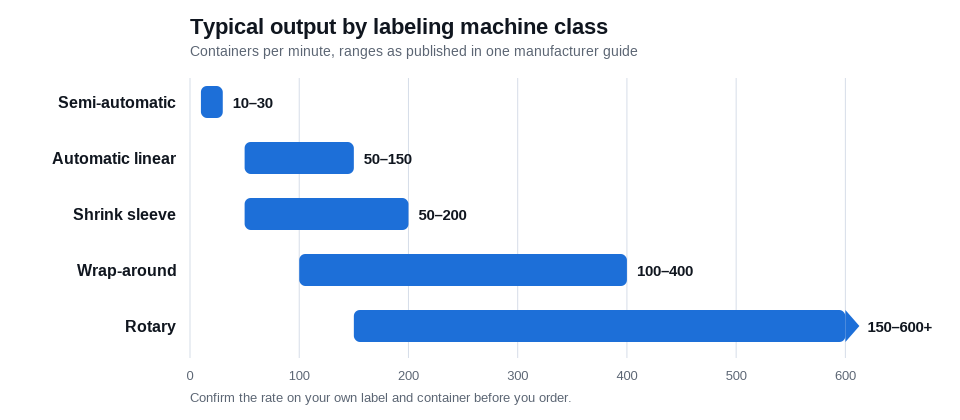
Brochure speed ratings describe the mechanical ceiling of a machine running a short, narrow paper label on an ideal small vial under laboratory conditions. In real plant operation, effective throughput runs at 70% to 90% of nameplate speed once container pitch gaps, adhesive peel dynamics, and roll splices are included.
The two sizing equations every buyer must run
First, apply the 80% to 85% derating rule of thumb to determine the minimum nameplate CPM rating for your machine:
CPM_rated_min = CPM_target_sustained / 0.80
Second, calculate the linear web dispensing velocity (v_web in meters per minute) required by your label length (L_label in mm) plus inter-label gap (L_gap in mm) at your required surge speed (CPM_surge):
v_web (m/min) = ((L_label + L_gap) × CPM_surge) / 1000
Worked selection example: why long labels cap CPM before the conveyor does
Suppose a beverage plant needs to label CPM_target_sustained = 180 bottles per minute (with a 210 BPM surge rate to drain upstream accumulation), comparing two bottle SKUs on the same line:
- SKU 1 (Neck/body spot label): L_label = 56 mm, L_gap = 4 mm (60 mm repeat pitch).
- Required web velocity at 210 BPM surge: v_web = (60 × 210) / 1000 = 12.6 m/min. Even a basic stepper applicator (rated to 25–30 m/min) can dispense this web easily.
- SKU 2 (Full wrap-around craft bottle label): L_label = 236 mm, L_gap = 4 mm (240 mm repeat pitch).
- Required web velocity at 210 BPM surge: v_web = (240 × 210) / 1000 = 50.4 m/min.
- If the buyer purchased a budget labeler whose dispensing head maxes out at 30 m/min web speed, that machine is physically limited to (30 × 1000) / 240 = 125 BPM on SKU 2, even if its brochure claims “up to 250 BPM”! To run SKU 2 at 210 BPM surge, the buyer must select a high-speed closed-loop servo applicator head rated for 60 to 220 m/min web speed.
Gate 5: Multi-SKU changeover frequency and SMED architecture
A line dedicated to a single water bottle SKU 24 hours a day can prioritize pure rotary speed over changeover speed. A contract packager or nutraceutical plant running 8 SKU changeovers per week faces completely different economics.
- Inline linear vs rotary turret changeover: As analyzed in our rotary vs inline labeling machine guide, linear conveyor machines adjust across container diameters and heights using guide rails, separator wheels, and wrap-belt handwheels without swapping heavy turret starwheels. Below 200 to 250 CPM, an inline linear servo machine is almost always more productive for high-mix multi-SKU plants.
- Single-Minute Exchange of Die (SMED) hardware: Replacing bolted brackets and trial-and-error photoeye setups with color-coded tool-free change parts, digital handwheel counters, and HMI-stored servo recipes reduces full changeover time from 60 minutes down to 15 minutes (a 75% reduction in setup downtime, recovering 150 production hours per year across 200 changeovers).
- Non-stop dual-roll splicing: At 300 BPM with a 120 mm label pitch, a standard 300 mm OD roll (holding roughly 3,000 to 4,500 labels) runs out every 10 to 15 minutes. Lines running above 200 to 250 CPM should specify dual-head tandem applicators (where Head B automatically takes over the instant Head A’s roll depletes or faults) or an automatic zero-downtime web splicer.
Gate 6: Sensors, variable coding, vision inspection, and accuracy tiers
Next, specify how the machine detects the label gap, prints batch data, and verifies finished quality before containers leave the frame.
Matching placement tolerance tiers to your product
Do not over-specify ±0.2 mm tolerances on a corrugated shipping case (which wastes budget on unnecessary camera servos), and do not accept ±3 mm tolerances on a recessed cosmetic jar panel (which causes immediate edge overhang and blistering). Specify one of the three industry tolerance tiers:
- Ultra-precision tier (±0.5 to ±1.0 mm): Required for small pharmaceutical vials, ampoules, recessed molded panels on cosmetic bottles, and narrow neck bands. Requires closed-loop servo drives (±0.01 mm internal precision, <1 ms response), precision-ground peel plates set 3 to 5 mm from the container wall, and drive rollers with TIR <0.005 in.
- High-accuracy retail tier (±1.0 to ±1.5 mm): Standard for retail beverage, food jars, wine bottles, nutraceutical canisters, and front-and-back shampoo bottles using servo applicators and top hold-down belts.
- Standard utility and logistics tier (±2.0 to ±3.0 mm): Appropriate for outer corrugated shipping cartons, shrink-wrapped trays, and pallet SSCC labels applied by print and apply labeling systems.
Gap sensors, date coders, and vision reject gates
- Optical vs capacitive/ultrasonic gap sensors: Standard optical fork sensors work on opaque paper and white BOPP labels below 150 m/min. Specify capacitive or ultrasonic gap sensors whenever you run clear transparent film labels on clear liner or when web speeds approach 220 m/min (see our ultrasonic vs. optical clear-label sensor guide and fix label wrinkling, bubbling, and flagging guide).
- Inline coding integration: Choose Thermal Transfer Overprinters (TTO) mounted on the intermittent or continuous web frame for high-resolution barcodes, QR codes, and multi-line ingredient blocks; Continuous Inkjet (CIJ) for high-speed non-contact lot/expiry printing; or UV/CO2/Fiber Laser coders for consumable-free permanent ablation coding.
- Vision verification and barcode grading: Pairing matched label stock with automated camera inspection (100 to 1,000+ fps) cuts label defect rates from 3.2% down to 0.15%. Where cartons or bottles enter automated warehouse sortation or retail distribution, specify an inline barcode verifier graded to ISO/IEC 15417:2007 (Code 128 symbology specification) and ISO/IEC 15416/15415 to enforce a ≥99.5% read rate, paired with a shift-register pneumatic reject pusher and a locked reject confirmation bin.
Gate 7: Line handoffs, floor footprint, and facility utilities
Finally, verify that the selected machine fits your physical packaging hall and connects cleanly to upstream and downstream equipment.
- Conveyor height, width, and hand (L→R vs R→L): Confirm operator-side flow direction (left-to-right or right-to-left) and match top-of-chain conveyor height across the line (typically 830 to 875 mm on standalone labelers or 33.25 to 39.25 inches / 845 to 997 mm on integrated 4.5-inch or 6-inch stainless line conveyors).
- Accumulation buffer: Place a rotary accumulation table (0 to 8 RPM, up to 300 lb load capacity) or mass-flow buffer upstream of the labeler so 45-second roll splices never stop the filler or capper. See our custom labeling line integration guide for buffer calculations.
- Electrical, pneumatic, and steam utilities:
- Standalone inline labelers: Typically draw 0.3 to 2.5 kW (for example, 0.75 kW / 1 HP / 2.0 Amp on a standard single-phase 220V AC 50/60 Hz front/back bottle labeler, or 1.5 to 2.5 kW with integrated coder and three-phase conveyor).
- Medium integrated packaging and labeling lines: Require 10 to 30 kW.
- High-speed lines or electric shrink sleeve tunnels: Require 50+ kW (or a regulated dry saturated steam supply for steam shrink tunnels).
- Compressed air: Pneumatic tamp-blow applicators, air-knife driers, and reject pushers require clean, dry regulated compressed air (typically 0.4 to 0.6 MPa / 60 to 90 PSI) sized for peak cycle CFM.
Once you have worked through all seven gates, verify exact label coverage and web velocity using our container label size and coverage calculator and labeling speed (BPM) and web pitch calculator, compare capital budgets in our industrial labeling machine cost guide, review how to audit vendors in our labeling machine manufacturer qualification guide, and copy the labeling machine RFQ checklist to message LINEVO engineers on WhatsApp.
Common questions
How do I choose between a wrap-around, front-and-back, and shrink sleeve labeling machine?
Choose a wrap-around labeler if your containers are rigid cylinders (glass, metal, or rigid PET/HDPE) and your artwork covers part or all of the straight sidewall. Choose a twin-head front-and-back labeler if your containers are flat, oval, rectangular, or square, or require separate front and back panels aligned to bottle seams. Choose a shrink sleeve machine if your container has complex 360-degree curves or requires a full-body tamper-evident seal shrunk over the closure.
How much speed headroom should I include when sizing a labeling machine?
Because real production output runs at 70% to 90% of nameplate speed ratings due to container spacing, adhesive transfer physics, and roll changes, size your machine so your sustained target CPM sits at 80% to 85% of the machine’s rated maximum speed. For example, if your filler runs at 160 BPM, select a labeling machine rated for at least 190 to 200 BPM.
When do I need a capacitive gap sensor instead of a standard optical label sensor?
Standard optical fork sensors detect light transmission differences between an opaque label and its liner, so they fail when running transparent “no-label-look” clear film labels on clear liner. Specify a capacitive or ultrasonic gap sensor whenever your SKU list includes transparent labels, metallized films, or high-speed webs approaching 220 meters per minute.
Should I choose an inline linear labeler or a rotary turret labeler?
Choose an inline linear labeler for sustained speeds up to 200 CPM and for multi-SKU operations that need fast 15-minute tool-free changeovers across different bottle shapes. Choose a rotary turret labeler when sustained line speeds exceed 200 to 250 CPM (up to 600+ CPM) or when wet, condensation-covered, or complex contoured glass bottles must be locked onto individual cam-driven bottle plates during application and brushing.
Related Guides & Specifications
Industrial Labeling Machine Price and Total Cost of Ownership Guide
Transparent industrial labeling machine price breakdown from $2,000 semi-automatics to $500,000+ high-speed lines, plus hidden TCO drivers and payback math.
Learn moreClear Label Sensor Selection: Capacitive vs Ultrasonic vs Optical
Engineering guide to clear label sensors on BOPP and PET films: why optical slot sensors drop to 68% and ultrasonic to 12% vs 100% capacitive accuracy at 220 m/min.
Learn moreHow to Fix Label Wrinkling, Bubbling, Flagging, and Axial Skew
Engineering troubleshooting guide to fix pressure-sensitive label wrinkling, air bubbling, edge flagging, and axial skew across bottle and carton labelers.
Learn moreLabeling Machine RFQ Checklist and User Requirement Specification (URS)
Engineering labeling machine RFQ checklist and User Requirement Specification (URS) template covering container drawings, roll unwind #1-#8, CPM, and FAT rules.
Learn moreRelated Equipment & Guides
Automatic Labeling Machines: How to Choose by Container, Label and Speed
Choose an automatic labeling machine by container shape, label type and speed. Compare labeler types, accuracy tiers and the checks to run on your samples.
Learn moreLabel Applicators & Print-and-Apply Systems: Actuation, Speed & Retrofit Guide
Compare pre-printed label applicators and print-and-apply systems across wipe-on, tamp-blow, air-blow, and corner-wrap actuation, web speed, and retrofits.
Learn moreWrap-Around and Pressure-Sensitive Labeling Machines: Web Kinematics & Line Selection
Engineering guide to wrap-around and pressure-sensitive labeling machines: web tension, peel plate geometry, wrap belt vs 3-roller kinematics, and line selection.
Learn moreShrink Sleeve Labeling Machines: How to Match Applicator, Film and Shrink Tunnel
Specify a shrink sleeve labeling machine by sleeve format, layflat width, film shrink ratio and steam or electric tunnel. Compare speeds and sample test steps.
Learn morePrint and Apply Labeling Systems: Thermal Engines, DPI, and PLC Integration
Select print and apply labeling machines across Zebra, Sato, and Datamax engines, 203 to 600 DPI printheads, EtherNet/IP handshakes, and ISO/IEC 15416 grading.
Learn moreBottle Labeling Machines: How to Choose by Container Material, Shape, and Line Speed
Select a bottle labeling machine by container material (glass, PET, HDPE), shape (round, flat, oval, square, tapered), surface condensation, and line speed.
Learn moreVial & Pharmaceutical Labeling Machines: Vertical vs. Horizontal Selection
Select a vial labeling machine or pharmaceutical labeler for 8-30 mm vials, ampoules, syringes, and dropper bottles with cGMP 21 CFR 211.130 controls.
Learn moreSemi-Automatic & Tabletop Labelers: Benchtop Selection & ROI Crossover
Compare semi automatic labeling machines and tabletop bottle labelers (10-40 BPM) against automatic inline payback, cradle vs. tamp fixtures, and TCO math.
Learn moreLabel Automation and Custom Packaging Line Labeling Integration
Engineering guide to label automation and inline labeling system integration across fillers, cappers, accumulation tables, PLC sync, and vision reject gates.
Learn moreHow to Qualify an Industrial Labeling Machine Manufacturer
How to evaluate an industrial labeling machine manufacturer: OEM vs integrator comparison, mechanical build audit, servo vs stepper drives, and FAT checklist.
Learn moreLabel Roll Unwind Direction Chart (#1 to #8) and Roll Length Calculator
Interactive #1 to #8 label winding direction chart (wound out vs wound in), eye-mark guide, and roll length, OD, core size, and shift roll calculator.
Learn moreContainer Label Size, Wrap Coverage, and Shrink Sleeve Layflat Calculator
Calculate bottle label circumference, partial wrap arc, shrink sleeve layflat width, film shrink percentage, and tapered jar chord distortion for RFQs.
Learn moreLabeling Speed (BPM), OEE Surge Capacity, and Web Pitch Calculator
Calculate required labeling machine surge BPM, line OEE headroom, label web dispensing velocity in m/min, container pitch, and matched conveyor speed.
Learn moreRound Bottle Labeling Machines: Continuous Wrap Belt vs. 3-Roller Indexing
Select a round bottle labeling machine by comparing continuous wrap belts vs 3-roller indexing, web speed equations, bottle pitch spacing, and machine parameters.
Learn moreFront and Back Labeling Machines: Dual-Head Sync & Top Hold-Down Mechanics
Engineering guide to front and back double-side labeling machines: centering chains, overhead top holding belts, dual servo heads, and flat or oval bottle specs.
Learn moreRotary vs. Inline Labeling Machines: Turret Kinematics, Speed & Changeover
Compare rotary carousel turret vs inline linear labeling machines across speed ratings (50-150 vs 150-600+ BPM), bottle plates, starwheel changeover, and layout.
Learn morePressure Sensitive vs Shrink Sleeve: How to Choose for Your Container and Line
Compare pressure sensitive vs shrink sleeve labeling across container curves, label cost, steam or electric tunnel kW draw, footprint, and moisture resistance.
Learn moreBox and Carton Labeling Machines: Top-Surface, Side Wipe-On & Corner-Wrap Guide
Select box and carton labeling machines across split-belt top labelers, side wipe-on case applicators, corner-wrap systems, and GS1 barcode clearance rules.
Learn moreIndustrial Labeling Machine Price and Total Cost of Ownership Guide
Transparent industrial labeling machine price breakdown from $2,000 semi-automatics to $500,000+ high-speed lines, plus hidden TCO drivers and payback math.
Learn moreClear Label Sensor Selection: Capacitive vs Ultrasonic vs Optical
Engineering guide to clear label sensors on BOPP and PET films: why optical slot sensors drop to 68% and ultrasonic to 12% vs 100% capacitive accuracy at 220 m/min.
Learn moreHow to Fix Label Wrinkling, Bubbling, Flagging, and Axial Skew
Engineering troubleshooting guide to fix pressure-sensitive label wrinkling, air bubbling, edge flagging, and axial skew across bottle and carton labelers.
Learn moreLabeling Machine RFQ Checklist and User Requirement Specification (URS)
Engineering labeling machine RFQ checklist and User Requirement Specification (URS) template covering container drawings, roll unwind #1-#8, CPM, and FAT rules.
Learn more