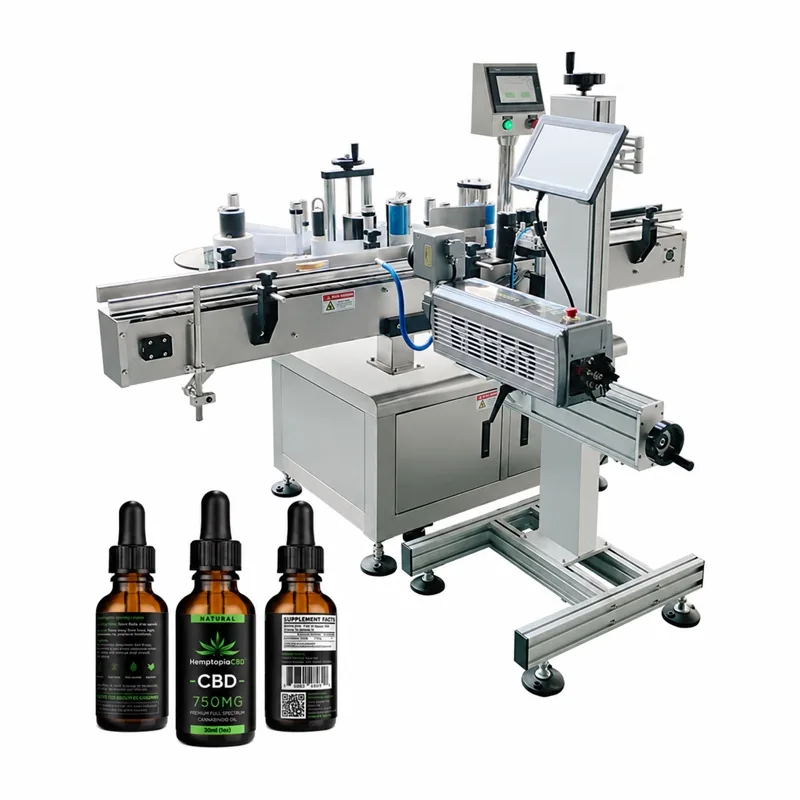
Mechanical Role of the Round Bottle Labeling Machine
Within the wrap-around and pressure-sensitive labelers family, selecting the right round bottle labeling machine prevents spiral overlap rejects, label wrinkling waste, and line downtime across beverage, pharmaceutical, nutraceutical, and food filling lines. While any industrial labeling machine must meter containers and dispense labels from a liner web, cylindrical containers introduce a specific kinematic requirement: once the leading edge of the pressure-sensitive label tacks onto the curved bottle wall at the peel tip, the container must rotate smoothly through 180 to 360+ degrees under controlled radial pressure to lay down the remainder of the label without trapped air pockets, axial skew, or trailing-edge flagging.
Two mechanical wrapping architectures dominate inline cylindrical labeling:
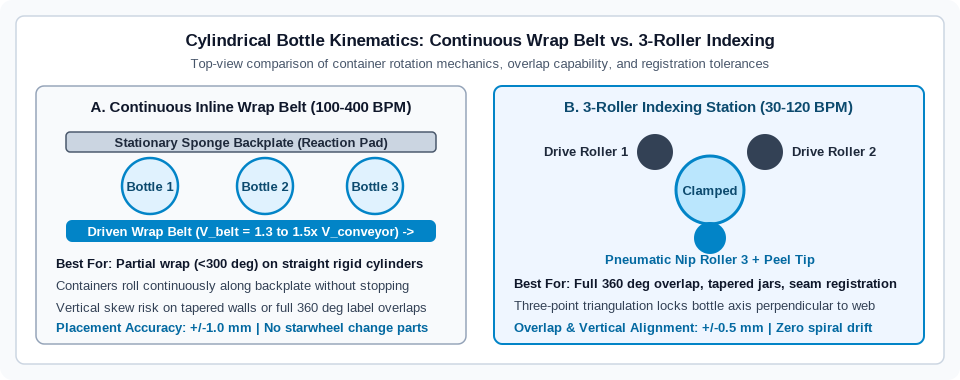
- Continuous Inline Wrap-Belt Systems, where spaced bottles translate continuously down the main conveyor and spin between a motorized flat wrap belt and a spring-loaded stationary sponge backplate at 100 to 400 bottles per minute (BPM).
- Three-Roller (3-Point) Indexing Systems, where each bottle pauses inside a triangular three-roller nest, spins at high angular velocity while clamped along three parallel contact lines, and exits at 30 to 120 BPM with +/-0.5 mm vertical overlap accuracy.
Choosing the wrong wrapping mechanism for your container tolerance and label wrap angle is the single most common specification error on cylindrical lines. A continuous wrap belt specified for a 360-degree overlapping paper label on blown glass jars will suffer chronic trailing-edge steps, whereas a 3-roller indexing station specified for a 180-degree partial wrap at 200 BPM creates an unnecessary line bottleneck.
| Wrapping Architecture | Container & Label Fit | Published Speed Band | Overlap & Vertical Accuracy | Changeover Tooling |
|---|---|---|---|---|
| Continuous Inline Wrap Belt | Straight rigid cylinders, partial wrap (<300 deg) | 100-400 BPM (high-speed); 0-150 BPM (standard) | +/-1.0 mm | Tool-free handwheels + roller spacing (15-20 min) |
| 3-Roller Indexing Station | Full 360-deg overlap, slight wall taper, or mould seam | 30-120 BPM (stop-and-spin cycle) | +/-0.5 mm (zero spiral drift) | Pneumatic 3-point roller adjustment (15-20 min) |
| Horizontal Roller-Cradle | Unstable small vials, ampoules, droppers (10-22 mm OD) | 50-250 BPM | +/-0.5 to 1.0 mm | Indexed roller chain cradle |
Continuous Wrap Belt vs. 3-Roller Positioning Kinematics
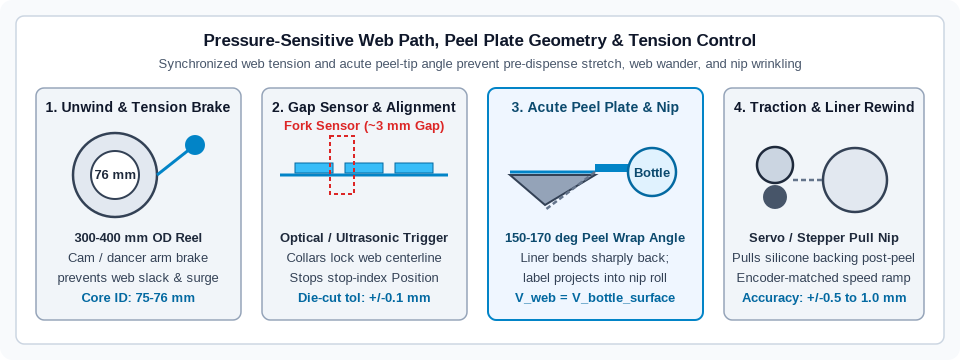
Both configurations share an upstream pressure-sensitive dispensing head, consisting of a 300 mm to 400 mm outer-diameter (OD) unwind reel on a 75 mm or 76 mm inner-diameter (ID) core, a dancer-arm tension brake, an optical or ultrasonic gap sensor (~3 mm inter-label gap), and a 150- to 170-degree acute peel plate, but diverge immediately after the peel tip.
1. Continuous Inline Wrap-Belt Mechanics (Banding Method)
In a continuous wrap around bottle labeler, containers travel single-file down a flat-top acetal or stainless-steel slat conveyor. A motorized roller-spacing assembly or dual rubber timing belts separate the incoming queue to a uniform pitch. As the leading face of the cylinder passes within 2 mm to 3 mm of the peel plate nose, the fork sensor triggers the servo drive roller to project the label leading edge into the nip between the bottle wall and the driven wrap belt.
The wrap station consists of a motorized endless flat belt (faced with high-friction cellular rubber or polyurethane) mounted on one side of the conveyor and a stationary compliant sponge backplate mounted on the opposite rail:
- Because the bottle is pinched between the moving wrap belt ($V_{\text{belt}}$) and the stationary backplate ($V_{\text{backplate}} = 0$), pure rolling kinematics dictate that the geometric center of the bottle translates forward at $V_{\text{center}} = 0.5 \cdot V_{\text{belt}}$ while the bottle spins around its vertical axis.
- To prevent the conveyor slats from dragging against the bottom of the spinning bottle, operators set the wrap belt linear velocity to approximately 1.3 to 1.5 times the main conveyor speed depending on backplate compliance.
- As the bottle rolls along the 300 mm to 500 mm length of the backplate pad, the label is ironed progressively around the circumference from leading edge to trailing tail without interrupting forward line motion.
Where Continuous Wrap Belts Excel: Partial-wrap labels covering 120 to 300 degrees of the circumference (where a 5 mm to 15 mm bare gap remains between ends), straight-walled rigid cylinders (aluminium cans, Drawn-and-Ironed tins, moulded HDPE pill packers), and high-throughput inline lines running 100 to 400 BPM.
Where Continuous Wrap Belts Fail: Because the bottle base rests loosely on moving conveyor slats while rolling against a soft foam pad, any slight tip during entry, or any +/-1.0 mm diameter ovality in blown glass or thin-wall PET, allows the bottle axis to pitch by 0.5 to 1.5 degrees. On a full 360-degree wrap where the trailing edge overlaps the leading edge, a 1-degree axial pitch on a 75 mm diameter bottle ($\text{circumference} \approx 235.6\text{ mm}$) causes a vertical mismatch of:
$$\Delta y = \pi \cdot D \cdot \tan(\theta) = 235.6\text{ mm} \times \tan(1^{\circ}) \approx 4.1\text{ mm}$$
That 4.1 mm step violates retail visual quality standards and causes adhesive edge flagging along the exposed corner.
2. Three-Roller (3-Point) Indexing Mechanics
A 3 roller positioning labeler eliminates axial pitch and spiral drift by replacing the continuous sponge backplate with a precision three-point clamping nest:
- Infeed & Stop: The spaced bottle advances into a pocket in front of two parallel, vertically mounted driven support rollers made of ground polyurethane or nitrile rubber.
- Triangulated Clamping: A pneumatic cylinder swings a third parallel pressure roller (mounted beside the peel plate beak) inward against the bottle wall. Contact across these three vertical tangent lines forces the cylindrical wall flush against the two support rollers and locks the bottle vertical axis strictly perpendicular to the label web path.
- Spin & Dispense: While the bottle spins in place on the three rollers at controlled tangential speed, the servo applicator feeds the label directly into the nip under the third roller. Because the bottle does not translate along a drag pad during application, 360-degree overlapping labels register head-to-tail within +/-0.5 mm to +/-1.0 mm.
- Optical Seam or Handle Registration (Barrier Mode): When a glass bottle carries a prominent vertical mould seam, embossed medallion, or side handle lug, a fiber-optic contrast sensor or mechanical finger scans the spinning container inside the 3-roller nest. Once the sensor detects the seam, the PLC delays label firing by a programmed millisecond offset so the label lands symmetrically between mould seams on every bottle.
Web Velocity, Bottle Pitch, and Throughput Engineering Calculations
Sizing a cylindrical bottle labeler for an existing filling and capping line requires verifying both linear web velocity and container pitch spacing.
1. Calculating Minimum Web Dispensing Speed ($V_{\text{web}}$)
For a round bottle of diameter $D$ (in mm), the full circumference is $C = \pi \cdot D$. If the label length is $L_{\text{label}}$ (in mm) with an inter-label matrix gap $g \approx 3\text{ mm}$, the web pitch per bottle is $P_{\text{web}} = L_{\text{label}} + g$.
To run at a target throughput of $N$ bottles per minute (BPM) on a continuous wrap-belt machine where containers are spaced at center-to-center conveyor pitch $P_{\text{bottle}}$ (typically $D + 80\text{ mm}$ to $D + 150\text{ mm}$ to allow clean sensor gating), the conveyor and web velocities relate by:
$$V_{\text{web}} = N \times P_{\text{bottle}} \times \left(\frac{\text{Wrap Factor}}{1000}\right) \quad [\text{m/min}]$$
Consider a practical sizing example for a 60 mm diameter nutraceutical bottle ($C = 188.5\text{ mm}$) carrying a 180 mm wrap-around label ($P_{\text{web}} = 183\text{ mm}$) at a target sustained rate of 120 BPM:
- Minimum web advance per minute just to feed 120 labels is $120 \times 0.183\text{ m} = 21.96\text{ m/min}$.
- Because bottles must maintain at least a 90 mm clear gap between containers for the product sensor and wrap belt entry ($P_{\text{bottle}} = 183\text{ mm} + 90\text{ mm} = 273\text{ mm}$), the instantaneous web dispensing velocity during the active dispense window must reach:
$$V_{\text{web, peak}} = 120\text{ BPM} \times 0.273\text{ m} = 32.76\text{ m/min}$$
If the applicator head uses a low-torque stepper motor whose torque drops off above 25 m/min, the head will lose steps and slip behind the bottle at 120 BPM, requiring a closed-loop AC servo drive head rated for 40 to 50 m/min peak web speed.
2. Budgeting for 3-Roller Dwell Time
On a 3-roller indexing machine, total cycle time per bottle ($T_{\text{cycle}} = 60 / N$) is the sum of three sequential phases:
$$T_{\text{cycle}} = t_{\text{index}} + t_{\text{clamp}} + t_{\text{spin}}$$
- Container infeed/outfeed transfer ($t_{\text{index}}$): Typically 0.20 to 0.30 seconds to clear the previous bottle and seat the incoming bottle against the drive rollers.
- Pneumatic roller actuation ($t_{\text{clamp}}$): Typically 0.08 to 0.12 seconds for the swing cylinder to close and stabilize before peel release (plus another 0.15 to 0.25 seconds if spinning for optical seam search).
- Label wrap rotation ($t_{\text{spin}}$): At a roller surface speed of 25 m/min ($417\text{ mm/s}$), wrapping a 180 mm label takes $180 / 417 \approx 0.43\text{ seconds}$.
Summing these gives $T_{\text{cycle}} \approx 0.25 + 0.10 + 0.43 = 0.78\text{ seconds/bottle}$, or a maximum mechanical rate of $60 / 0.78 \approx 77\text{ BPM}$ (dropping to 50 to 60 BPM when optical mould-seam registration is active). Consequently, when a project requires both 360-degree precision overlap and speeds above 120 to 150 BPM, engineers either run two inline 3-roller units in parallel or step up to a rotary turret architecture as analyzed in our rotary vs inline labeling machine comparison.
Published Technical Specifications: Round Bottle Labeler Classes
Table 1 consolidates verified manufacturer specifications across standard automatic inline round bottle labelers, roller-spaced high-speed round bottle machines, and small-vial horizontal/vertical configurations.
| Parameter | Standard Automatic Round Bottle Labeler | High-Speed Roller-Spaced Round Labeler (LINEVO LV-BSL 1S / LV-SL 2H) |
Heavy-Duty Servo Wrap-Around Line Class |
|---|---|---|---|
| Rated Speed Range | 0-120 bottles/min | Up to 150 bottles/min | 100-400 bottles/min |
| Sustained Operating Target (80-90% Band) | 95-108 BPM | 120-135 BPM | 80-360 BPM (format dependent) |
| Applicable Bottle Diameter | 20-80 mm (neck/body envelope) | 15-85 mm (no starwheel change parts required) | 25-120 mm (custom guide rail span) |
| Applicable Bottle Height | 50-200 mm | 30-250 mm | 40-350 mm |
| Label Height (Web Width) | 15-130 mm | 8-70 mm (standard head); up to 150 mm (tall head) | 10-180 mm |
| Minimum Label Length | 20 mm | 12 mm (with ~3 mm inter-label gap) | 15 mm |
| Label Roll Dimensions | 76 mm ID core / 300-350 mm OD | 75-76 mm ID core / 400 mm OD | 76 mm ID core / 350-400 mm OD |
| Placement Accuracy | +/-1.0 mm (3-roller: +/-0.5 mm) | +/-1.0 mm | +/-1.0 mm |
| Electrical & Power Rating | 0.3 kW, AC 220V/110V, 50/60 Hz | 0.75 kW, 1.5 Amp, 220V AC single-phase | 1.25-2.5 kW, 220V/380V |
| Conveyor Working Height | 750-850 mm adjustable | 830-875 mm adjustable | 800-900 mm adjustable |
| Overall Dimensions (L x W x H) & Weight | 2000 x 1280 x 1400 mm; 160 kg | 1750 x 870 x 1100 mm; ~180 kg | 2400 x 1350 x 1500 mm; 250-320 kg |
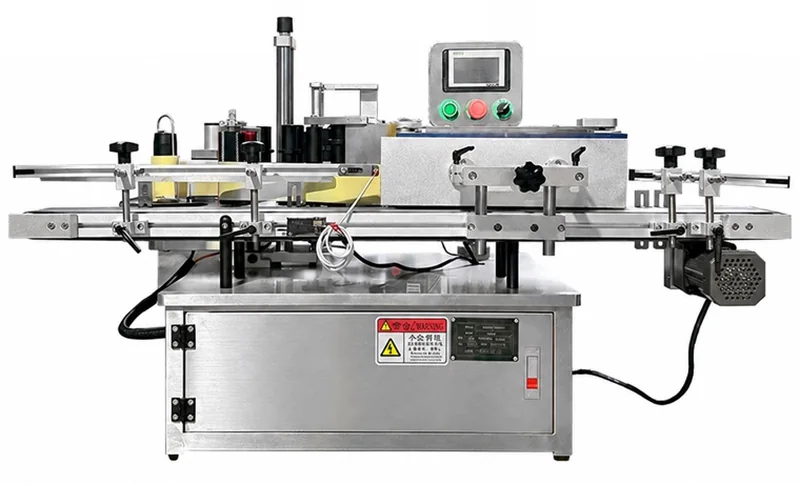
Failure Modes and Root-Cause Troubleshooting on Cylindrical Bottles
Field quality audits show that cylindrical round bottles average a 2.8% to 3.2% baseline labeling defect rate, higher than flat or square panels (1.9%) because circumferential wrapping magnifies small angular or dimensional errors over the full $\pi \cdot D$ path length. Table 2 maps the five most frequent round-bottle failure modes to their mechanical root causes and corrective settings.
| Observed Defect | Primary Mechanical or Material Cause | Corrective Engineering Action |
|---|---|---|
| Upward or Downward Spiral Overlap (“Barber-Poling”) | Bottle tilts during continuous wrap-belt contact, or blown glass/PET wall has >0.5 deg taper | Switch from continuous wrap belt to 3-roller clamping station; verify peel plate edge is perpendicular to conveyor bed within +/-0.1 deg using a machinist square |
| Leading-Edge Transverse Wrinkle or Buckle | Web dispensing speed ($V_{\text{web}}$) exceeds bottle tangential surface speed ($V_{\text{bottle}}$), pushing excess slack into nip | Reduce servo dispensing speed ratio by 2%-5% on HMI recipe; move peel plate beak within 2-3 mm of bottle tangent line |
| Trailing-Edge Flagging (Wing-Up Lift) | Stiff label stock (such as 4/10 flexibility PET or heavy paper) on small diameter (<30 mm) or low-energy HDPE/PP (<38 dynes/cm) | Specify 50-micron BOPP film (9/10 flexibility) with high-tack rubber or modified acrylic adhesive; increase wrap-belt length or 3-roller spin dwell by 0.15 s |
| Diagonal Web Wander & Vertical Height Drift | Insufficient unwind brake tension, off-center 76 mm core lock, or worn/glazed polyurethane traction roller | Calibrate dancer-arm cam brake preload; lock guide collars to web width +0.2 mm; resurface or replace glazed drive rollers (worn rollers cut effective speed by up to 25%) |
| Air Blisters (“Silvering”) Under Clear Film | Trapped air pockets on thin-wall PET bottles that compress under excessive wrap-belt pressure, or uneven backplate foam | Reduce wrap-belt compression gap so thin PET walls compress by <0.3 mm; replace worn sponge backplate with dual-durometer closed-cell foam; verify ultrasonic gap sensor timing |
Special Cylindrical Cases: Small Vials, Tapered Jars, and Tamper Seals
Not every round container can run upright on a standard flat-top conveyor:
- Unstable Small-Diameter Vials, Ampoules, and Syringes (10 mm to 22 mm OD): Glass vials, CBD dropper bottles, and lip-balm tubes with high center-of-gravity ratios tip over if pushed across conveyor dead plates. For upright handling at 50 to 150 BPM, machines replace flat guide rails with a synchronized timing screw (feed worm) or pocketed starwheel. Alternatively, horizontal roller-cradle labelers lay ampoules, test tubes, and mascara cylinders on their sides inside an indexed roller-chain conveyor, spinning each tube beneath an overhead peel plate at 100 to 250 units per minute.
- High-Taper Containers and Contoured Bottles: When a container wall tapers by more than 2 to 3 degrees from shoulder to base, a flat rectangular cut label cannot wrap around the cone without wrinkling along its tighter edge. Mild tapers require custom arched (“banana-cut”) die-cut labels run on a 3-roller station; steep tapers or full-body hourglass curves require transitioning to shrink sleeve and tamper-evident labelers.
- Modular Retrofit Onto Existing Conveyors: If your plant already operates an indexed filling conveyor with stable bottle spacing, you can mount a standalone automatic label applicator paired with a bolt-on motorized side wrap belt rather than purchasing a full-frame conveyorized labeler.
Sample-Trial & Overlap Verification on Cylindrical Containers
Before signing off on Factory Acceptance Testing (FAT) or locking in a round bottle labeler configuration, covered in detail in our how to choose a labeling machine guide and labeling machine RFQ checklist, run sample containers through these five cylindrical verification checks:
- 50-Bottle Spiral Overlap (“Barber-Pole”) Audit: Run a continuous 50-bottle sample burst at target operating speed (80% to 90% of nameplate BPM) and measure the vertical head-to-tail step on 360-degree overlapping labels; verify whether a continuous wrap belt holds your visual specification (±1.0 mm) or whether wall taper requires a 3-roller indexing nest (±0.5 mm). You can pre-calculate exact wrap circumference and overlap margins using our container label size and coverage calculator.
- Peak Web Velocity & Bottle Pitch Verification: Using our labeling speed (BPM) and web pitch calculator, verify that the servo dispensing drive sustains peak linear web speed ($V_{\text{web, peak}}$) at your required inter-bottle sensor gap without stepper motor torque drop-off.
- Optical Seam or Handle Registration Trial: When running blown glass bottles with prominent vertical mold seams, silk-screened medallions, or side handles, test the fiber-optic contrast sensor inside the 3-roller station to verify consistent millisecond firing delay and registration accuracy.
- Multi-Format Changeover Check: If the same packaging line must also run flat, oval, or square bottles alongside round containers, evaluate a dual-head front and back labeling machine equipped with an auxiliary wrap-around belt station and verify 15- to 20-minute tool-free handwheel setup.
- Vision Barcode & Regulatory Compliance Check: Confirm whether your quality system requires missing-label luminescence verification, online vision barcode grading per ISO/IEC 15417, single-bottle reject tracking, or electronic recipe audit logs compliant with FDA 21 CFR Part 11.
Prepare your cylindrical container dimensions, label wrap angle, and target BPM with our labeling machine RFQ checklist and message LINEVO engineers on WhatsApp to receive a complete engineering layout and sample trial plan.
Common questions
Why does a full-wrap label spiral upward or downward on a round bottle?
Spiral drift (barber-poling) occurs when the bottle axis tilts slightly relative to the peel plate or when the container wall has a 0.5- to 1.5-degree mold taper. Over a 250 mm circumference, a 1-degree axial tilt produces a 4.4 mm vertical offset between the leading and trailing label edges. Switching from a continuous wrap belt to a 3-roller positioning station clamps the cylinder against two parallel support rollers and one pneumatic pressure roller, holding overlap alignment within +/-0.5 mm.
How do you calculate the required web dispensing speed for a round bottle labeler?
On a continuous wrap-belt labeler, the label web dispensing velocity must equal the tangential surface velocity of the rotating bottle in the nip. When a bottle rolls without slipping against a stationary sponge backplate, the bottle center advances at half the wrap-belt speed, and the surface speed at the contact nip equals the wrap-belt linear speed (typically 20 to 40 meters per minute for 100 to 150 BPM lines).
Do automatic round bottle sticker labelers require starwheel change parts for different bottle diameters?
No. Unlike rotary turret machines that require a custom feed screw and starwheel set per bottle diameter, inline round bottle labelers use a motorized roller spacing wheel or dual side timing belts plus handwheel-adjustable guide rails. Operators can transition across container diameters from 15 mm to 85 mm in 15 to 20 minutes without swapping change parts.
What is the minimum bottle diameter an inline round bottle labeler can run?
Standard vertical-trunnion inline round bottle labelers handle container diameters down to 15 mm to 20 mm (such as 10 mL essential-oil droppers, lip-balm tubes, and parenteral vials) with label heights from 8 mm to 70 mm and minimum label lengths of 12 mm. Unstable vials with height-to-diameter ratios above 4:1 often use a horizontal roller-link cradle conveyor or feed worm to prevent tipping.
Related Guides & Specifications
Label Roll Unwind Direction Chart (#1 to #8) and Roll Length Calculator
Interactive #1 to #8 label winding direction chart (wound out vs wound in), eye-mark guide, and roll length, OD, core size, and shift roll calculator.
Learn moreLabeling Speed (BPM), OEE Surge Capacity, and Web Pitch Calculator
Calculate required labeling machine surge BPM, line OEE headroom, label web dispensing velocity in m/min, container pitch, and matched conveyor speed.
Learn moreIndustrial Labeling Machine FAT Checklist, Maintenance, and Troubleshooting Manual
Execute a 30-minute Factory Acceptance Test (FAT), follow a 6-tier preventive maintenance schedule, and resolve 12 common labeling machine defects.
Learn moreFront and Back Labeling Machines: Dual-Head Sync & Top Hold-Down Mechanics
Engineering guide to front and back double-side labeling machines: centering chains, overhead top holding belts, dual servo heads, and flat or oval bottle specs.
Learn moreSquare and Flat Bottle Labeling Machine: 1-Panel, 2-Panel, and 3-Panel Wrap Selection
Specify square and flat bottle labeling machines by panel geometry, twin centering chains, overhead hold-down belts, corner wipe rollers, and recessed panel rules.
Learn moreRotary vs. Inline Labeling Machines: Turret Kinematics, Speed & Changeover
Compare rotary carousel turret vs inline linear labeling machines across speed ratings (50-150 vs 150-600+ BPM), bottle plates, starwheel changeover, and layout.
Learn moreRelated Equipment & Guides
Automatic Labeling Machines: How to Choose by Container, Label and Speed
Choose an automatic labeling machine by container shape, label type and speed. Compare labeler types, accuracy tiers and the checks to run on your samples.
Learn moreWrap-Around and Pressure-Sensitive Labeling Machines: Web Kinematics & Line Selection
Engineering guide to wrap-around and pressure-sensitive labeling machines: web tension, peel plate geometry, wrap belt vs 3-roller kinematics, and line selection.
Learn moreBottle Labeling Machines: How to Choose by Container Material, Shape, and Line Speed
Select a bottle labeling machine by container material (glass, PET, HDPE), shape (round, flat, oval, square, tapered), surface condensation, and line speed.
Learn moreContainer Label Size, Wrap Coverage, and Shrink Sleeve Layflat Calculator
Calculate bottle label circumference, partial wrap arc, shrink sleeve layflat width, film shrink percentage, and tapered jar chord distortion for RFQs.
Learn moreLabeling Speed (BPM), OEE Surge Capacity, and Web Pitch Calculator
Calculate required labeling machine surge BPM, line OEE headroom, label web dispensing velocity in m/min, container pitch, and matched conveyor speed.
Learn moreFront and Back Labeling Machines: Dual-Head Sync & Top Hold-Down Mechanics
Engineering guide to front and back double-side labeling machines: centering chains, overhead top holding belts, dual servo heads, and flat or oval bottle specs.
Learn moreRotary vs. Inline Labeling Machines: Turret Kinematics, Speed & Changeover
Compare rotary carousel turret vs inline linear labeling machines across speed ratings (50-150 vs 150-600+ BPM), bottle plates, starwheel changeover, and layout.
Learn moreWater Bottle Labeling Machines: PET Wrap-Around, Roll-Fed BOPP, and Shrink Sleeve
Compare pressure-sensitive wrap, roll-fed BOPP hot-melt, and shrink sleeve water bottle labelers for thin-wall PET, sparkling water, and glass lines.
Learn moreJar Labeling Machines: Wrap-Around, Front-and-Back, and Tamper-Evident Configurations
Select a jar labeling machine for wide-mouth glass and plastic jars: wrap-around vs front-back, taper draft angles, L-clip tamper strips, and neck bands.
Learn moreHow to Choose an Industrial Labeling Machine: 7-Gate Selection Guide
Step-by-step labeling machine buying guide: 7 engineering gates from container geometry, surface energy, and unwind #1-#8 to speed headroom and line utilities.
Learn moreLabeling Machine RFQ Checklist and User Requirement Specification (URS)
Engineering labeling machine RFQ checklist and User Requirement Specification (URS) template covering container drawings, roll unwind #1-#8, CPM, and FAT rules.
Learn more