Three decisions set the machine
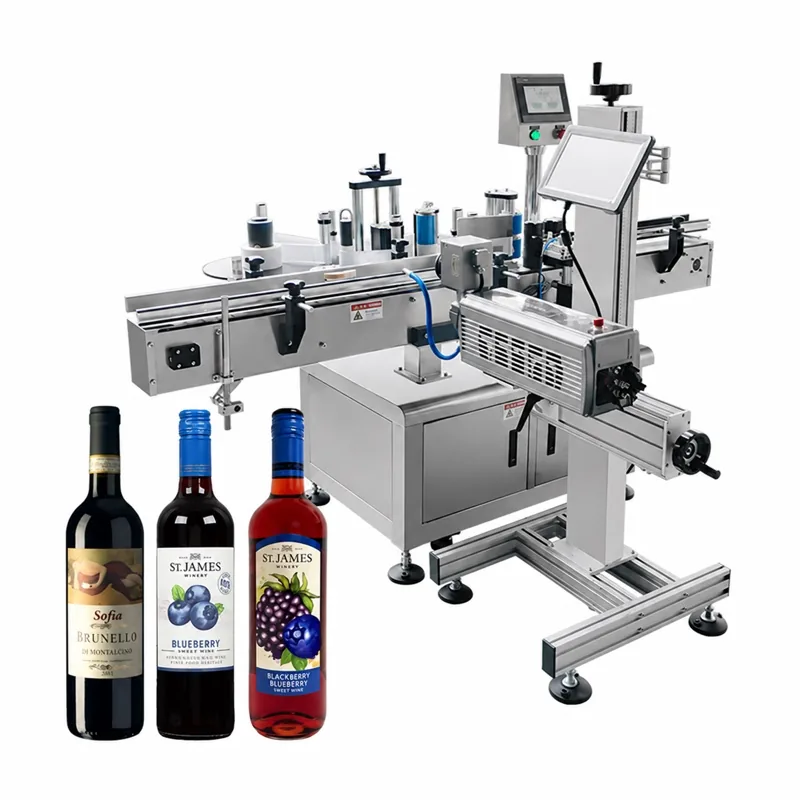
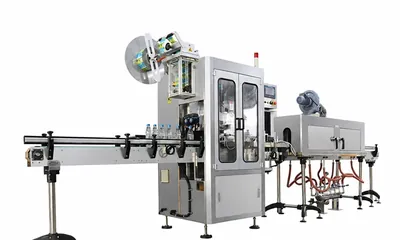
An automatic labeling machine takes containers from a conveyor and applies each label at controlled tension and speed without an operator touching individual packs. Mismatching the applicator head, container handling, or web feed speed to your container geometry causes chronic label skew, wrinkling, and costly line downtime—so three decisions narrow the field before any model is compared:
- The container: its material, shape and diameter or width, and whether it stands upright or lies on its side while labeled.
- The label and how it is applied: pressure-sensitive, shrink sleeve, hot-melt or wet-glue, or a label printed on the line.
- The speed and accuracy the line needs: containers per minute, and how far a label may sit from its target position.
Once those three are written down, the machine family follows. The sections below show how each decision maps to equipment, then which checks to run on your own samples. If you already know your container, go straight to bottle labeling machines; for unstable small-diameter glass, see vial and pharmaceutical labeling machines; and for cartons, cases and pallets, see label applicators and print-and-apply systems.
What every automatic labeler does
Whatever the configuration, an automatic labeler performs three tasks: it feeds or prints the label, senses and positions the container, and applies and secures the label.
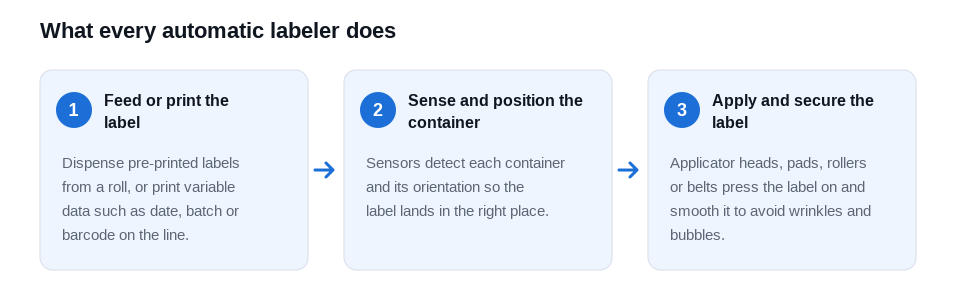
Feeding means dispensing pre-printed labels from a roll, or printing variable data such as dates, batch codes or barcodes. Sensing means detecting each container and its orientation so the label lands in the right place. Applying means using applicator heads, tamp pads, rollers or belts to press the label on and smooth it, so there are no wrinkles or air bubbles.
Choose the automation level first
The degree of automation sets how much operator time each container costs, and it narrows the machine family before shape or label are considered.
| Level | How it runs | Typical fit |
|---|---|---|
| Manual | The operator loads and aligns each container, then triggers the label by hand | Small batches, occasional labeling, laboratories |
| Semi-automatic | The operator places each container at the start; the machine feeds, aligns and applies the label on a button or foot switch | Medium volumes and many products without a fully integrated line |
| Fully automatic | Containers travel on a conveyor through the labeling station; the operator only inspects and reloads label rolls | Large-volume lines that need low labor per container and consistent quality |
In standard plant staffing models, semi-automatic operation requires one dedicated operator per station, whereas automatic inline machines require 0.5–1 operator because a single technician can monitor multiple stations; high-speed rotary lines typically assign one operator per line. Read those as planning figures and confirm staffing against your own line layout. When batch sizes are small or SKU changeovers happen several times a shift without a continuous filling conveyor, compare dedicated semi-automatic and tabletop labelers before committing to an inline conveyor frame.
Match the label application method to the container
The application method is the first split between machine families.
| Method | Best suited to | Check on your samples |
|---|---|---|
| Pressure-sensitive (self-adhesive) labels | Flat, cylindrical and irregular surfaces; bottles, household cleaner containers and pharmaceutical packs | Label stiffness and adhesive tack on the real container surface |
| Shrink sleeve | Irregular shapes, full-body artwork and tamper evidence | Film shrink behavior and print distortion after the shrink tunnel |
| Hot-melt or wet-glue labels | Applications that need a strong bond, including labels that must stay put through large temperature changes | Glue handling, cleaning effort and changeover time |
| Print-and-apply | Cartons, pallets and large cases that need variable data such as shipping or serialized labels | Print engine, applicator motion and barcode quality |
Pressure-sensitive labels are the most common choice. Shrink sleeves have their own page in the shrink sleeve labeling machines hub, and print-and-apply systems are covered in print-and-apply labeling systems. For round containers, the wrap-around and pressure-sensitive labelers hub explains the three-roller and belt options.
Match the machine layout to the container and the floor
Machines are also grouped by where the label goes and by how containers travel through them.
- By label position: flat labelers put labels on cartons, boxes and lids; side labelers apply them to the vertical walls of bottles, jars and cans, on one or more sides; corner labelers wrap tamper-evident labels around the edges where two faces meet; wrap-around labelers apply one label around the whole circumference of a cylindrical container.
- By container orientation: vertical machines label containers standing upright, which suits most round bottles, jars and cans; horizontal machines label containers lying on their side, which suits unstable or delicate items such as vials and ampoules.
- By layout: inline machines keep containers on a straight conveyor in continuous motion, which works for front-and-back labeling and basic wrap-around jobs; rotary machines carry each container in a turret pocket past fixed labeling stations, which suits high-speed plants where floor space is limited.
Small-diameter containers are the usual reason to choose a horizontal layout. Explore horizontal roller-indexing and vertical starwheel options in the vial and pharmaceutical labeling machines hub.
Representative automatic bottle labeler envelopes
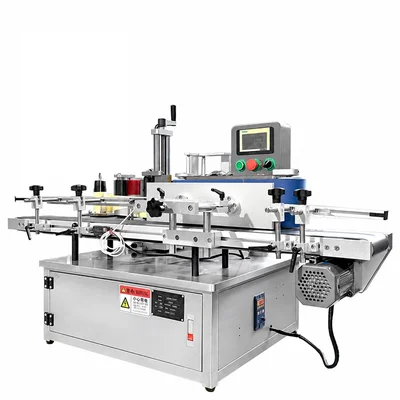
One manufacturer specification guide publishes the following baseline envelopes across the three primary linear bottle and pouch labeling frames:
| Machine Architecture | Applicable Containers | Published Speed Range | Compatible Container Dimensions | Rated Power & Voltage | Frame Dimensions & Weight |
|---|---|---|---|---|---|
| Fully automatic round bottle labeler | Cylindrical plastic and glass bottles across pharmaceutical, food, cosmetic, agrochemical, and oil lines | 0–120 bottles/min | Neck/body diameter 20–80 mm; height 50–200 mm | 0.3 kW (220 V / 110 V, 50/60 Hz) | 2000 × 1280 × 1400 mm; 160 kg |
| Automatic double-side labeler | Rectangular, square, flat cylindrical PET/glass/HDPE bottles, and gusseted stand-up pouches | 80–100 bottles/min | Diameter/width 15–200 mm; height 30–300 mm | 2.5 kW (AC 220 V, 50 Hz) | 3000 × 1400 × 1750 mm; 320 kg |
| Automatic flat-surface labeler | Square bottles, flat cylindrical bottles, flat glass/PET/HDPE flasks, boxes, pouches, and flat-wall tubs/jars | 50–200 bottles/min | Width 10–200 mm; height 10–80 mm | 1.25 kW (AC 220 V, 50 Hz) | 2000 × 1280 × 1400 mm; 190 kg |
For secondary cases and cartons downstream of primary bottling, published applicator benchmarks rate wipe-on merge units at 20–60 cases/min (±2–3 mm accuracy), tamp-blow units at 30–80 cases/min (±1.5–2 mm), contactless air-blow units at 40–100+ cases/min (±2–3 mm), and print-and-apply case systems at 15–50 cases/min (±1–2 mm).
Typical speed by machine class
Speed classes provide an initial engineering filter before sample testing. The ranges below reflect standard industrial throughput envelopes for each machine architecture.
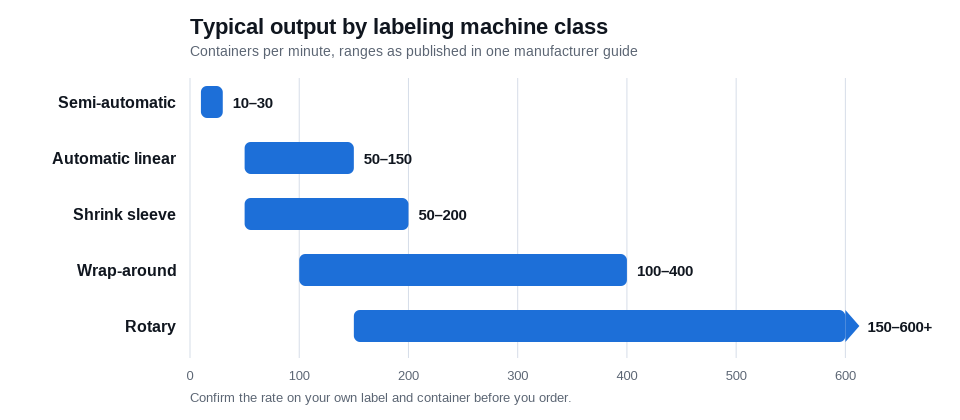
A semi-automatic machine suits low volumes across several products. An automatic linear machine covers medium volumes with consistent container shapes. A rotary labeler is the high-output option. Wrap-around and shrink sleeve classes are listed separately because the application method changes the achievable rate. When production demands still higher output on uniform small containers, multi-lane configurations multiply baseline capacity—dual-lane setups double throughput, quad-lane setups quadruple it, and matrix lines scale up to 8× baseline capacity when paired with synchronized lane dividers.
Turn a quoted speed into a number for your label
The quoted rate only holds if the label can be fed that fast. The label feed speed the machine needs is:
Label feed speed (m/min) = (label length + gap between labels, in mm) × containers per minute ÷ 1000
Example calculation (assuming a 120 mm label, a 4 mm gap and 100 containers per minute): (120 + 4) × 100 ÷ 1000 = 12.4 m/min. A longer label or a higher rate raises that figure, so ask the supplier for the label feed speed at your label length, not only the headline containers per minute. You can run your own container diameter, pitch spacing, and web velocity numbers interactively in the labeling speed BPM and pitch calculator and confirm roll feed orientation on the label roll unwind direction chart.
Accuracy tiers for label placement
Placement accuracy is specified as a distance from the target position, and for barcode labels it is tied to how reliably the code reads. Across industrial labeling configurations, registration performance divides into three engineering tiers:
| Tier | Placement accuracy | Barcode read rate | Typical motion & inspection hardware |
|---|---|---|---|
| Standard | ±2–3 mm | 99.0–99.5% | Open-loop stepper or pneumatic applicator (±0.1–0.5 mm actuator repeatability) with basic photoelectric triggering |
| High-precision | ±1–1.5 mm | 99.5–99.9% | Servo-driven applicator (±0.01 mm positioning, <1 ms response) with encoder-synchronized conveyor tracking |
| Ultra-precision | ±0.5–1 mm | above 99.9% | Closed-loop servo drive (±0.005 mm repeatability, S-curve acceleration) paired with 100–1,000+ fps vision feedback |
For automated sorting, the same guide gives 99.5% as the minimum barcode first-read rate, which sits at the top edge of the standard tier and the start of the high-precision tier. On pharmaceutical and high-speed retail lines, inline 5–20 megapixel vision cameras operating at 100 to 1,000+ frames per second analyze each applied label in under 1 ms, grading 1D and 2D barcodes against ISO/IEC 15416 and 15415 thresholds and feeding real-time positional corrections back to the servo drive without stopping the conveyor. Write your required tolerance and, if relevant, read rate into the enquiry so the quotation names the tier it is based on.
What moves the real result away from the brochure
Four factors account for most placement problems on a running line:
- Conveyor speed that is not constant: the most common cause of label misplacement, because the label is timed to container position.
- Container size variation: differences in height, width or position on the conveyor change the placement every cycle.
- Label stock: face stock stiffness, liner release force and adhesive tack all affect consistency. A label that is too stiff will not conform to a curved bottle, and low tack causes labels to fail at speed.
- Environment: cold reduces adhesive tack, and high humidity makes labels curl, which causes crooked labels and misfeeds.
Container and label materials to confirm
Labelers handle glass bottles, plastic containers in PET, HDPE and PP, metal cans, and, with specialized equipment, flexible pouches. Glass needs precise handling, and pouches are not a standard bottle-labeler job, so say which you have when you ask for a quotation.
Label stock matters as much as the container. Machines run paper labels in gloss, matte and specialty finishes, polypropylene and polyethylene films, vinyl, foil, and clear or transparent films, plus recyclable stocks. Clear labels need a capacitive or ultrasonic label sensor that can detect transparent film thickness steps rather than an optical slot sensor, so name the stock before the sensor is chosen.
- If your line runs transparent BOPP or PET film labels on a clear liner → prioritize a capacitive or ultrasonic gap sensor over a standard photoelectric fork sensor because light passes through both layers without a reliable contrast edge.
- If your line must feed automated warehouse sortation → specify a high-precision servo applicator (±1–1.5 mm) with inline ISO/IEC 15416 barcode verification to hold the minimum 99.5% first-read rate and avoid manual rework or retailer chargebacks.
Plan the line interface and OEE targets early
A labeler is usually one station between a filler, a capper and a packer. Labelers are commonly integrated with bottle fillers, cappers, conveyor systems and packaging machines, and some connect to ERP or MES systems via Industry 4.0 protocols. List the neighboring machines, the conveyor height and direction, and the space available for accumulation before and after the labeler. That list decides whether the machine can be added to an existing line or needs conveyor changes.
In one manufacturer’s throughput framework, world-class labeling stations track Overall Equipment Effectiveness (OEE) across three metrics: Availability ≥90%, Performance ≥95%, and Quality ≥99%, keeping unplanned downtime below 10% of scheduled production time. Upstream weigher or filler variation and downstream seal failures directly reduce effective labeling throughput if conveyors, encoders, and reject systems are not synchronized. Published upgrade case studies report 210% to 300% ROI with 12 to 36 month payback when replacing manual or open-loop stations with servo-driven applicators and inline vision—delivering typical throughput gains of 20% to 30%, labor reductions of 15% to 25%, and labeling error reductions of 80% to 90%. Compare capital tiers and payback drivers in the industrial labeling machine cost guide.
Keep placement accurate after delivery
Placement drifts when routine care is skipped. A maintenance rhythm that matches the failure modes on a labeler is:
- Each shift: remove adhesive residue and label scraps from sensors, rollers and conveyors, and clean the label path to prevent misfeeds.
- Weekly: check that label-presence sensors and container-detection photocells are aligned, calibrate label sensors and inspect applicator pads and rollers.
- Monthly: check drive belt tension so the machine speed stays consistent.
- About every 500 operating hours: lubricate bearings, chains and slide rails as the manufacturer recommends.
- Quarterly and annually: carry out a full mechanical inspection each quarter and calibrate servo drives each year on servo-driven machines.
Keeping spare label heads, drive belts and fuses on site shortens downtime when a part fails.
Run these checks on your own samples
A supplier’s speed and accuracy figures are measured on the supplier’s container and label. Before ordering, ask for a trial on yours and record:
- Position: measure label placement against the drawing across a run of containers, not one.
- Surface finish: look for wrinkles, bubbles and lifted edges after the label is wiped down.
- Speed: run at the target containers per minute with your label length, and note the rate that holds.
- Changeover: count the adjustments between SKUs and how they are set and recorded.
- Line interface: confirm conveyor height, guiding, accumulation space and the signals shared with neighboring machines.
If the labeler will sit between a filler and a packer, the labeling line integration page covers the interface points. For witness-test procedures and fault matrices, see the industrial labeling machine FAT and troubleshooting manual. The RFQ checklist lists the information a quotation needs, and how to choose an industrial labeling machine walks through the full comparison.
Common questions
When should I choose a fully automatic labeler instead of a semi-automatic one?
Choose fully automatic when containers already move on a conveyor and the volume is large enough that an operator placing each container is the bottleneck. Semi-automatic machines raise speed and accuracy over manual labeling without an integrated line, and suit medium volumes across many products.
How do pressure-sensitive and hot-melt labeling differ?
Pressure-sensitive machines apply pre-glued labels that stick under pressure. Hot-melt machines melt solid adhesive and apply it to the label or the container, then the adhesive cools and holds, which gives a strong bond.
Can one machine apply more than one label type?
Many machines can. Options include dual-roll capability for different labels, quick changeover between label types, multi-purpose application heads and digital settings for different configurations. Ask which of these your quotation includes.
Which information makes a quotation reliable?
The container material, shape and dimensions, the label type and size, the target containers per minute, the changeover frequency, the accuracy required, the floor space and the neighboring machines. These seven engineering inputs govern machine architecture, drive sizing, change-part tooling, and floor layout.
Containers LINEVO’s catalog already lists
LINEVO’s labeling catalog lists machines configured for wine and beer bottles, flat bottles for lotion and shampoo, sauce bottles and jars, honey jars, tins, square edible oil bottles, ampoules and vials, food boxes and shrink sleeve lines. Specifications for each are confirmed against your samples and set out in the quotation. Prepare your container, label and target speed parameters using our labeling machine RFQ checklist and send them directly on WhatsApp so LINEVO engineers can propose a labeling route and sample trial plan.
In This Section
Wrap-Around and Pressure-Sensitive Labeling Machines: Web Kinematics & Line Selection
Engineering guide to wrap-around and pressure-sensitive labeling machines: web tension, peel plate geometry, wrap belt vs 3-roller kinematics, and line selection.
Learn moreShrink Sleeve Labeling Machines: How to Match Applicator, Film and Shrink Tunnel
Specify a shrink sleeve labeling machine by sleeve format, layflat width, film shrink ratio and steam or electric tunnel. Compare speeds and sample test steps.
Learn moreBottle Labeling Machines: How to Choose by Container Material, Shape, and Line Speed
Select a bottle labeling machine by container material (glass, PET, HDPE), shape (round, flat, oval, square, tapered), surface condensation, and line speed.
Learn moreVial & Pharmaceutical Labeling Machines: Vertical vs. Horizontal Selection
Select a vial labeling machine or pharmaceutical labeler for 8-30 mm vials, ampoules, syringes, and dropper bottles with cGMP 21 CFR 211.130 controls.
Learn moreSemi-Automatic & Tabletop Labelers: Benchtop Selection & ROI Crossover
Compare semi automatic labeling machines and tabletop bottle labelers (10-40 BPM) against automatic inline payback, cradle vs. tamp fixtures, and TCO math.
Learn moreLabel Automation and Custom Packaging Line Labeling Integration
Engineering guide to label automation and inline labeling system integration across fillers, cappers, accumulation tables, PLC sync, and vision reject gates.
Learn moreRelated Equipment & Guides
Label Applicators & Print-and-Apply Systems: Actuation, Speed & Retrofit Guide
Compare pre-printed label applicators and print-and-apply systems across wipe-on, tamp-blow, air-blow, and corner-wrap actuation, web speed, and retrofits.
Learn moreWrap-Around and Pressure-Sensitive Labeling Machines: Web Kinematics & Line Selection
Engineering guide to wrap-around and pressure-sensitive labeling machines: web tension, peel plate geometry, wrap belt vs 3-roller kinematics, and line selection.
Learn moreShrink Sleeve Labeling Machines: How to Match Applicator, Film and Shrink Tunnel
Specify a shrink sleeve labeling machine by sleeve format, layflat width, film shrink ratio and steam or electric tunnel. Compare speeds and sample test steps.
Learn morePrint and Apply Labeling Systems: Thermal Engines, DPI, and PLC Integration
Select print and apply labeling machines across Zebra, Sato, and Datamax engines, 203 to 600 DPI printheads, EtherNet/IP handshakes, and ISO/IEC 15416 grading.
Learn moreBottle Labeling Machines: How to Choose by Container Material, Shape, and Line Speed
Select a bottle labeling machine by container material (glass, PET, HDPE), shape (round, flat, oval, square, tapered), surface condensation, and line speed.
Learn moreVial & Pharmaceutical Labeling Machines: Vertical vs. Horizontal Selection
Select a vial labeling machine or pharmaceutical labeler for 8-30 mm vials, ampoules, syringes, and dropper bottles with cGMP 21 CFR 211.130 controls.
Learn moreSemi-Automatic & Tabletop Labelers: Benchtop Selection & ROI Crossover
Compare semi automatic labeling machines and tabletop bottle labelers (10-40 BPM) against automatic inline payback, cradle vs. tamp fixtures, and TCO math.
Learn moreLabel Automation and Custom Packaging Line Labeling Integration
Engineering guide to label automation and inline labeling system integration across fillers, cappers, accumulation tables, PLC sync, and vision reject gates.
Learn moreHow to Qualify an Industrial Labeling Machine Manufacturer
How to evaluate an industrial labeling machine manufacturer: OEM vs integrator comparison, mechanical build audit, servo vs stepper drives, and FAT checklist.
Learn moreHow to Choose an Industrial Labeling Machine: 7-Gate Selection Guide
Step-by-step labeling machine buying guide: 7 engineering gates from container geometry, surface energy, and unwind #1-#8 to speed headroom and line utilities.
Learn moreLabeling Machine RFQ Checklist and User Requirement Specification (URS)
Engineering labeling machine RFQ checklist and User Requirement Specification (URS) template covering container drawings, roll unwind #1-#8, CPM, and FAT rules.
Learn more