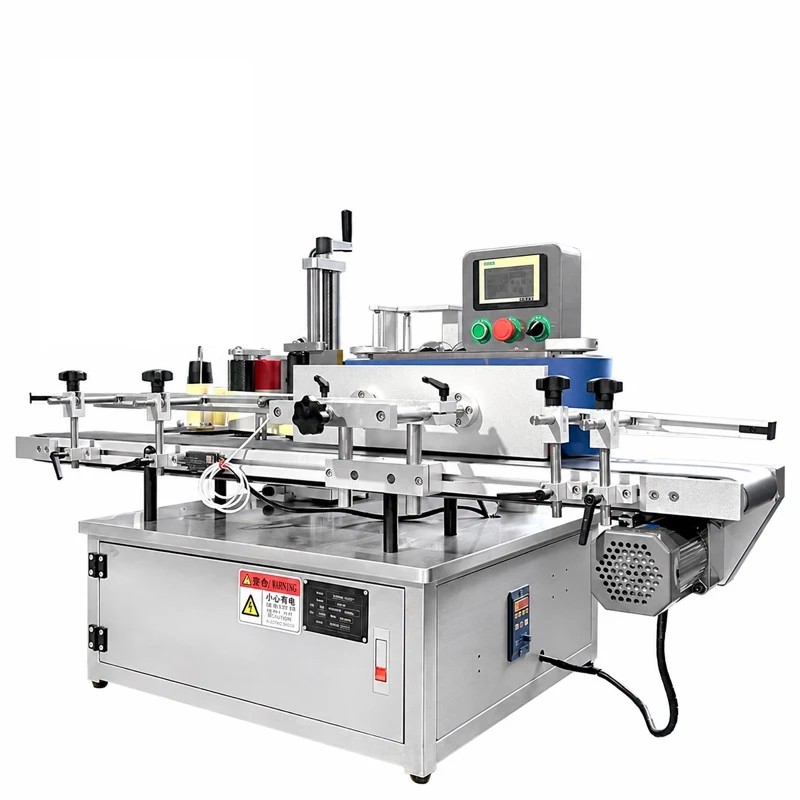
Selecting a vial labeling machine for small-diameter pharmaceutical, biotech, and cosmetic containers requires solving three mechanical problems that standard beverage labelers never encounter: container tipping on narrow 8–30 mm bases, thin-wall glass breakage under peel-plate wipe pressure, and adhesive edge lifting (flagging) around tight mandrel radii. When the transport geometry or label facestock is mismatched to the container’s center of gravity, lines suffer frequent glass jams, skewed graduation windows, and batch-record rejections under cGMP inspections.
Within the broader family of industrial labeling machines, pharmaceutical and small-bottle systems split into vertical starwheel or wrap-belt platforms for stable flat-bottom vials and horizontal roller-chain cradle platforms for unstable ampoules, syringes, and narrow tubes. This hub defines the engineering boundaries between vertical and horizontal handling, tight-mandrel adhesive and sensor selection, online variable-data coding, vision-guided single-unit rejection, and 21 CFR Part 211.130 / Part 11 validation requirements.
1. Small-Diameter Container Matrix & Transport Selection
Small cylindrical containers spanning 1 mL to 120 mL differ sharply in wall thickness, base flatness, and height-to-diameter aspect ratio. A moulded glass oral-liquid bottle or a 20 mL serum vial with a wide flat base can travel upright on a low-friction acetal tabletop chain, whereas a 1 mL glass ampoule or a pre-filled syringe with an extended plunger rod will topple immediately unless supported in a horizontal roller pocket or a positive starwheel carrier.
| Container Format | Typical Diameter & Volume | Stability & Geometry Challenge | Recommended Transport Architecture | Published Speed & Accuracy Range | Primary Sub-Guide |
|---|---|---|---|---|---|
| Flat-Bottom Injection Vials (ISO 2R–100H) | 16–30 mm OD (2–100 mL) | High aspect ratio on 2R/4R sizes; aluminum crimp cap overhang | Vertical feed-screw + starwheel pocket or inline wrap belt (V_belt synchronization) | 60–400 vials/min; ±0.5 to ±1.0 mm | This hub (Sections 2–6) |
| Thin-Wall Glass Ampoules (Tip-Off / Pull-Seal) | 10–22 mm OD (1–20 mL) | Narrow stem neck, fragile thin wall, unstable base when bumped | Horizontal roller-chain trunnion cradle or inclined starwheel tray-to-tray feed | 80–350 pcs/min (up to 600 max); ±1.0 mm | Ampoule & Syringe Labeling Machine |
| Pre-Filled Glass / COP Syringes | 8–20 mm barrel OD (0.5–10 mL; length ≤90 mm) | Cannot stand upright; projecting finger flange, needle shield, and plunger rod | Horizontal roller-chain cradle with flange relief groove or starwheel pocket carrier | 100–220 syringes/min (10–25 semi-auto); ±1.0 mm | Ampoule & Syringe Labeling Machine |
| Boston Round Dropper & Tincture Bottles | 18–45 mm OD (5–120 mL) | Rubber bulb / pipette cap shifts center of gravity upward; oily MCT or essential oil residue | Vertical inline conveyor with double-sided rigid centering chain + spring top press + 2-stage wipe | 80–220 bottles/min; ±1.0 mm | E-Liquid & Dropper Bottle Labeler |
| PET / LDPE Unicorn E-Liquid Squeeze Bottles | 15–40 mm OD (10–120 mL) | Thin flexible walls deform into an oval under excessive wrap-belt pressure | Vertical inline wrap belt with calibrated dual-stage sponge extrusion rollers | 80–200 bottles/min; ±1.0 mm | E-Liquid & Dropper Bottle Labeler |
| Oral Liquid Bottles & Small Vaccine Vials | 10–25 mm OD (2–30 mL) | Lightweight empty/filled mass causes bounce at peel tip | Vertical servo wrap-around with synchronized top hold-down belt or rotary turret | 30–180 pcs/min (compact) to 400 BPM (high-speed); ±1.0 mm | Wrap-Around & Pressure-Sensitive Labelers |
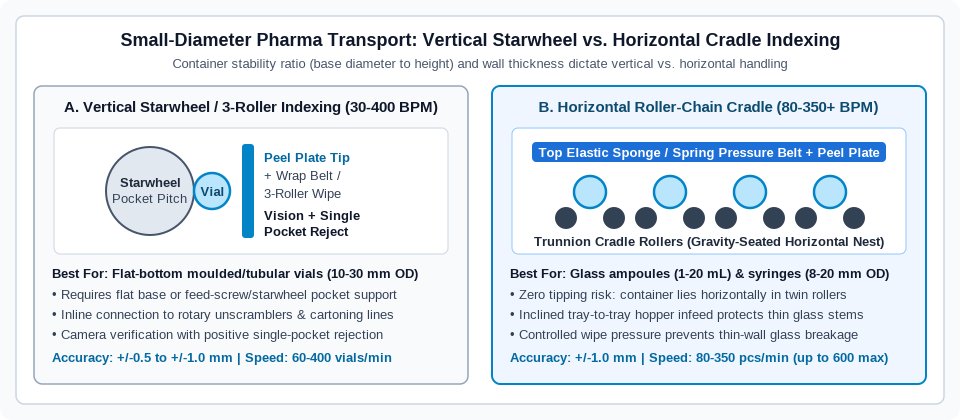
2. Vertical Starwheel & Wrap-Belt Transport vs. Horizontal Cradle Indexing
Choosing between vertical and horizontal container handling is the first architectural gate in pharmaceutical labeling specification. Both systems use servo-driven pressure-sensitive applicator heads, but they control container kinematics through fundamentally different mechanisms.
Vertical Vial Labeling Platforms (30 to 400 Vials/Min)
On a vertical pharmaceutical labeling machine, vials enter upright from a rotary unscrambler turntable, an upstream sterile capping/crimping discharge conveyor, or a dead-plate tray loader. Published manufacturer specifications for vertical vial series span three mechanical footprints:
- Compact servo inline vial labelers (30–180 pcs/min) are built on an 1800 × 800 × 1300 mm stainless-steel frame (200–260 kg, 600–800 W at 220V 50/60Hz). These units use a regulating spacer wheel or dual-side centering chain to pitch containers onto a vertical wrap-around belt, applying labels 15–100 mm wide by 15–80 mm (up to 300 mm) long with ±1 mm placement accuracy.
- Mid-speed three-roller and starwheel vial systems (50–200 pcs/min) serve full-circumference wrap labels or vials requiring precise optical window orientation. An indexing starwheel or three-roller triangulation station clamps the vial body while spinning it against a stationary peel plate, where three-point contact eliminates axial spiral drift (±0.5 mm overlap registration) even when glass wall tolerances vary slightly between cavity moulds.
- High-speed vertical vial labelers (up to 400 bottles/min) use continuous-motion feed screws and synchronized starwheel turrets (2500 × 1650 × 1300 mm, 2.5 kW, 350 kg net weight) to process 10–22 mm OD vials (20–120 mm height) with 10–90 mm tall by 10–80 mm long labels. At 400 vials/min, non-contact laser or camera sensors inspect every container inside the starwheel pocket so defective units can be diverted before discharge.
Horizontal Roller-Chain Cradle Platforms (80 to 350+ Pieces/Min)
When a container’s base-to-height ratio is too narrow to stand reliably or its bottom is rounded or obstructed by a plunger rod, upright conveying creates unacceptable tipping and glass-on-glass impact risk. Horizontal vial and ampoule labelers solve this by laying containers flat into twin-roller trunnion pockets carried on an indexed roller chain:
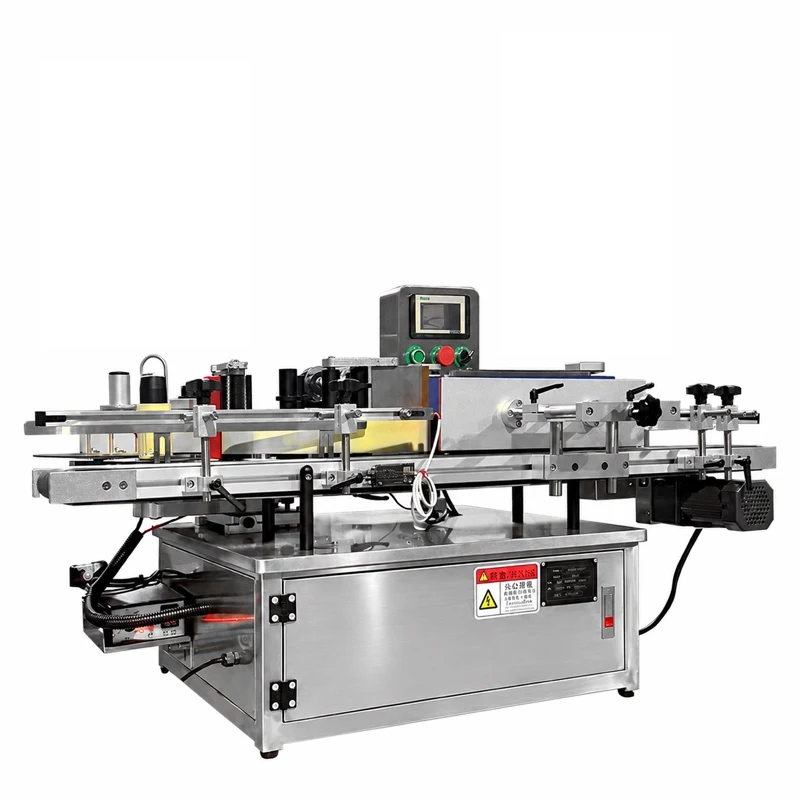
- Operators load full stainless-steel or plastic cassette trays of ampoules or small vials into an inclined infeed chute (80–220 vials/min on 2800 × 1450 × 1500 mm, 2500 W, 310 kg frames; or 100–300 pcs/min on 2040 × 690 × 1370 mm, 220 kg frames). A starwheel or eccentric separating wheel releases one container per chain pocket without stem-to-stem collision.
- As the roller chain advances beneath the dispensing peel plate, an overhead elastic sponge belt or spring-loaded pressing plate contacts the container cylinder, spinning it smoothly on its twin cradle rollers while wrapping the pressure-sensitive label around the barrel.
- Labeled containers climb an inclined discharge track and stack neatly into a receiving tray, allowing a single operator to manage tray-to-tray batch finishing without manual handling of individual glass units.
Worked Engineering Calculation: Web Feed Speed & Starwheel Pitch at 300 Vials/Min
To size the servo applicator drive and verify sensor response budget on a vertical starwheel vial labeler, engineers calculate the required label web velocity (v_web) and container pitch rate from the vial diameter (D), wrap coverage fraction, and target throughput (Q).
$$L_{\text{label}} = \pi \times D \times C_{\text{wrap}}$$
$$v_{\text{web}} = \frac{Q \times (L_{\text{label}} + g)}{60 \times 1000} \times k_{\text{sync}}$$
Example calculation (assuming a 2R injection vial with $D = 16\text{ mm}$ OD, $85%$ partial-wrap coverage to leave an inspection window, $g = 3\text{ mm}$ die-cut web gap, $Q = 300\text{ vials/min}$, and a $k_{\text{sync}} = 1.25$ intermittent peel-dwell factor):
- Circumference of the 16 mm vial: $\pi \times 16\text{ mm} = 50.27\text{ mm}$.
- Required label length for 85% (306°) wrap leaving a 7.5 mm clear liquid-inspection window: $L_{\text{label}} = 50.27 \times 0.85 \approx 42.7\text{ mm}$ (43 mm nominal die-cut length).
- Web pitch per label: $43\text{ mm} + 3\text{ mm} = 46\text{ mm}$.
- Average web feed speed at 300 vials/min (5 vials/sec): $5 \times 46\text{ mm/s} = 230\text{ mm/s} = 13.8\text{ m/min}$.
- Peak synchronous peel speed with 1.25 dwell factor: $v_{\text{web}} = 13.8 \times 1.25 = 17.25\text{ m/min}$.
- At 5 vials/sec, the total cycle window per vial is 200 ms, which requires a high-response servo applicator (published Siemens PLC + servo configurations reach up to 600 reactions/min) and a sub-millisecond gap sensor so leading-edge registration stays within ±0.5 to ±1.0 mm. You can model custom container diameters and line speeds in the labeling speed BPM and pitch calculator.
3. Tight-Mandrel Facestocks, Low-Migration Adhesives & Clear-Label Sensing
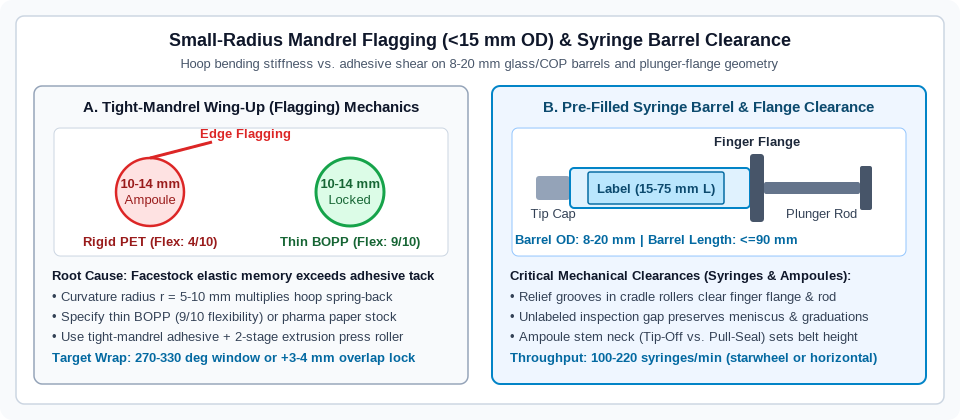
Applying a pressure-sensitive label to a 10–20 mm diameter glass or cyclic olefin polymer (COP) barrel places severe mechanical demand on the label construction. Because hoop bending stress scales inversely with container radius, a facestock that lies flat on a 75 mm nutraceutical jar will often spring open (“wing up” or “flag”) within hours on a 14 mm vial.
Facestock Flexibility & Tight-Mandrel Adhesive Selection
Published label material engineering guides rate common pharmaceutical facestocks by conformability, durability, and moisture resistance:
- Biaxially oriented polypropylene (BOPP, rated 9/10 for flexibility and 8/10 for durability) in 50 µm white or clear film conforms tightly to 10–25 mm radii without high elastic memory. In published pharmaceutical packaging case studies, replacing rigid film stock with conformable BOPP and pairing it with vision inspection reduced production defect rates from 3.2% to 0.15%.
- Polyester (PET, rated 4/10 for flexibility and 9/10 for durability) offers exceptional tear and chemical resistance, but its 4/10 flexibility rating creates strong restoring torque on narrow mandrels (<20 mm OD). It is prone to edge lift unless down-gauged (25–36 µm) and paired with an aggressive mandrel-hold adhesive.
- Lightweight pharmaceutical paper (60–70 g/m², rated 6/10 for flexibility) scores lower on wet durability (4/10) but exhibits low bending stiffness once creased over a sharp 1.0–1.5 mm peel-plate radius, making it a standard choice for dry-stored glass ampoules and folding-carton unit packs.
- Multi-layer booklet and hanger labels serve parenteral vials that must carry multi-language regulatory text or detachable patient-chart stickers. Because the step change in web thickness alters peel stiffness, the applicator requires a spring-loaded top hold-down and two-stage duplicate pressing rollers to iron down the trailing overlap edge.
- Low-migration and cryogenic adhesives are required for semi-permeable LDPE ophthalmic squeeze droppers or COP syringes, where low-leachable pharmaceutical acrylic adhesives must pass extractables and leachables testing. For biologics and vaccines stored at -20°C to -80°C (or liquid nitrogen vapor phase), specify glove-friendly cryogenic emulsion or hot-melt adhesives formulated for low-surface-energy borosilicate glass. See fix label wrinkling, bubbling, and flagging for mechanical peel-plate and wipe-roller remedies.
Optical vs. Ultrasonic & Capacitive Gap Sensors
Small pharmaceutical labels are frequently printed on clear-on-clear BOPP (no-label look with a transparent liquid inspection window) or carry variable-thickness Braille tactile dots and multi-layer booklet folds:
- Optical fork sensors (infrared or red LED) detect opacity contrast between a paper or white-film label and the siliconized glassine or PET liner. They fail on transparent clear-on-clear labels unless an opaque black registration eye-mark is printed on the web or liner.
- Ultrasonic and capacitive fork sensors measure acoustic attenuation or dielectric mass change between the single-layer liner (~36–50 µm) and the combined label-plus-liner stack (~90–140 µm). Either technology detects clear film labels, metallic foil stamps, and multi-layer booklet labels reliably at 300–400 BPM without printed eye-marks. Compare sensor response times and minimum gap widths in ultrasonic vs. optical clear label sensors.
4. Online Lot/Expiry Coding, Vision Inspection & Single-Container Rejection
In pharmaceutical packaging, a labeling machine is not merely a decorator; it functions as a controlled batch-identification and serialization node. Regulatory frameworks including U.S. FDA 21 CFR 211.130 and EU GMP Annex 15 require that variable batch data be printed and verified on the web prior to or immediately after container application, and that any non-conforming unit be positively removed from the line.
Thermal Transfer (TTO), Hot-Stamp & UV Laser Coding
Depending on line speed and data density, pharmaceutical labelers integrate one of three coding engines upstream of the peel plate (between the unwind reel and the dancer tension arm):
- Intermittent or continuous thermal transfer overprinters (TTO) use a 300 dpi (12 dots/mm) printhead synchronized to the servo web drive to print crisp alphanumeric lot numbers, expiration dates, GTINs, and GS1 2D DataMatrix serialization codes onto BOPP, PET, or coated paper labels at up to 300–400 pcs/min.
- Hot-stamp ribbon coders on entry-level and semi-automatic vial labelers (30–120 pcs/min) mount a pneumatic brass-type head that transfers dry resin ribbon ink (1–3 lines of batch/date characters) during the intermittent web dwell without liquid ink drying delays.
- UV and CO2 laser marking units on high-speed lines (300–600 pcs/min) use galvo-steered beams to ablate a pre-printed dark ink box on the label web, producing permanent, solvent-proof lot and 2D codes with zero ribbon consumables or ribbon-break stops.
Camera Vision Inspection & Positive Single-Pocket Rejection
Published U.S. FDA enforcement under 21 CFR § 211.130 mandates either 100% human inspection or validated electronic/electromechanical verification of correct labeling during finishing operations. Because human operators cannot reliably verify 2D DataMatrix grades or date characters above 60–80 vials/min, automated cGMP lines implement a three-stage closed-loop verification sequence:
- Pre-peel barcode and OCV/OCR inspection uses a high-speed machine-vision camera mounted between the printer and the peel plate to read the pre-printed NDC/GTIN barcode (verifying barcode quality under ISO/IEC 15417 or ISO/IEC 15415) and perform Optical Character Verification (OCV) on the newly printed lot and expiration date.
- Post-application presence and skew inspection uses a luminescent UV sensor or wrap-around camera to confirm that the label transferred cleanly onto the vial cylinder within ±1.0 mm vertical height and did not flag at the overlap seam.
- Shift-register tracking and positive reject verification ensure that when a fault is detected, the PLC shift register tracks that exact starwheel pocket or conveyor encoder count to the reject station. A pneumatic pusher cylinder or vacuum starwheel diverts the single defective vial into a locked stainless-steel reject bin, and a reject-confirmation sensor inside the chute verifies that the vial actually entered the bin. If the reject confirmation fails to trigger within the expected encoder window, the machine halts immediately so a faulty vial can never pass downstream to cartoning.
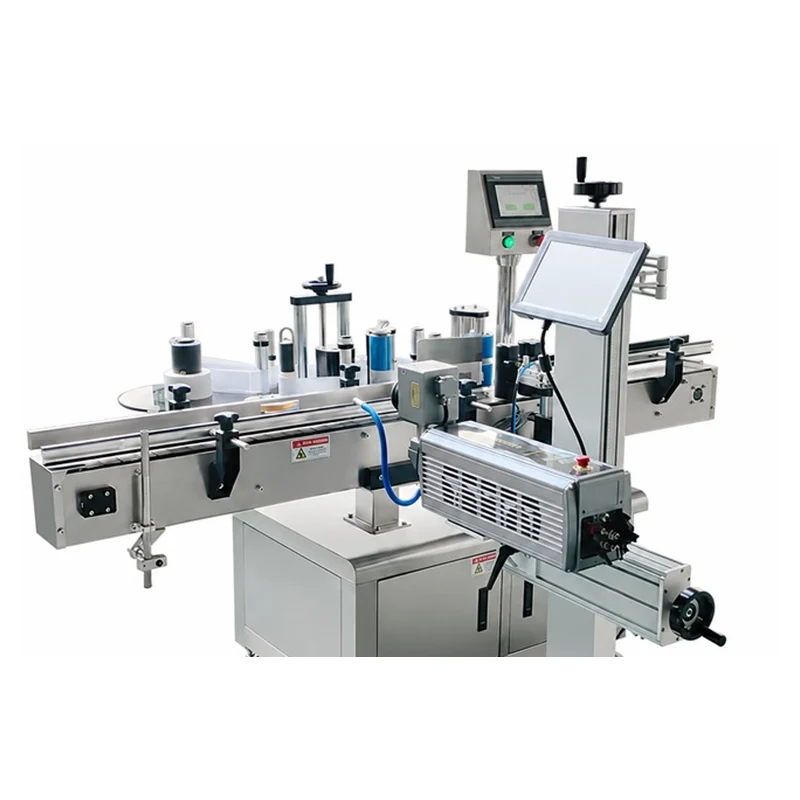
5. cGMP Compliance: 21 CFR Part 211.130, 211.132 & Part 11 Architecture
When specifying a cGMP pharma labeler for FDA- or EMA-regulated facilities, the mechanical frame, electrical enclosure, and PLC/HMI software must support formal qualification (DQ / IQ / OQ / PQ) and batch-record integrity:
- Line clearance and zero-trap sanitary construction under 21 CFR 211.130 prevent rogue vials or loose labels from a previous batch from hiding inside the machine. cGMP frames use SUS 304 (or SUS 316L cladding in washdown zones) with sloped tabletop surfaces, transparent polycarbonate safety doors with safety interlocks, and open-bottom conveyor beds where any dropped vial falls visibly to a catch tray.
- Tamper-evident OTC packaging under 21 CFR § 211.132 governs over-the-counter ophthalmic, nasal, and oral liquid products, requiring a distinctive indicator statement. Pharmaceutical labelers fulfill this either by applying a fragile tamper-evident cap-to-shoulder seal strip on a top-and-side wrap station or by pairing upstream with a tamper-evident neck band applicator.
- Electronic records and audit trails under FDA 21 CFR Part 11 guidance require role-based password authentication (Operator, Supervisor, QA, Administrator), automatic time-stamped audit trails recording every parameter change (who, what, old value, new value, timestamp), recipe lockouts, and non-editable PDF/CSV batch summary exports showing total containers fed, total accepted, and itemized reject counts.
- Factory Acceptance Testing (FAT) and validation documentation require running at least 30–60 minutes of continuous production on actual customer vials and label rolls before shipment, verifying splice recovery, low-label roll alarms, missing-code reject tests, and emergency-stop behavior. Review the complete acceptance test sequence in our industrial labeling machine FAT and troubleshooting manual.
6. Specialized Pharmaceutical & Small-Bottle Sub-Applications
Because container geometry dictates the mechanical infeed and wiping assembly, select the dedicated engineering guide below that matches your primary container format:
- Ampoule & Syringe Labeling Machine covers horizontal roller-chain cradle and starwheel machines (80–350+ pcs/min) for fragile 1–20 mL tip-sealed or pull-sealed glass ampoules and 0.5–10 mL (φ8–φ20 mm) pre-filled syringes, including peel-plate crush prevention, tray-to-tray cassette hoppers versus inline sterile filling integration, and plunger-rod or graduation-window clearance.
- E-Liquid & Dropper Bottle Labeler covers high-speed vertical wrap-around systems (80–220 vials/min) and upstream rotary filling-plugging-capping monoblocks (15–50 BPM) for 5–120 mL glass Boston round tincture/CBD droppers and squeezable PET/LDPE unicorn bottles, including anti-drip wall cleanliness, two-stage extrusion wiping, and tactile/booklet label handling.
- Semi-Automatic & Tabletop Labelers serves clinical trial batches, compounding pharmacies, and contract packagers running under 5,000 vials/day (10–40 pcs/min), comparing benchtop two-roller cradles and semi-automatic syringe fixtures against the 18–24 month payback crossover for inline automation.
7. Specifying Your Vial or Pharmaceutical Labeling Line
LINEVO’s equipment catalog includes dedicated vertical and horizontal labeling configurations for pharmaceutical vials, glass ampoules, oral liquid bottles, CBD/essential oil droppers, and e-liquid squeeze containers (including catalog series dession-205, dession-206, dession-207, dession-197, and dession-198). Because small-diameter stability, label unwind direction, and vision-reject timing depend on the exact container mass, glass wall tolerance, and label die-cut geometry, all final machine dimensions, starwheel change-part drawings, and throughput guarantees are engineered against physical container samples during quotation.
Before submitting your project brief, confirm your roll winding orientation (#1 through #8) in the label roll unwind direction chart, check wrap percentage and inspection-gap width in the container label size and coverage calculator, and compile your container drawings and cGMP validation requirements using the labeling machine RFQ checklist. When your sample pack is ready, message our LINEVO engineering team on WhatsApp to receive a custom transport layout and line-integration proposal.
Common questions
When should a pharmaceutical line use a horizontal labeler instead of a vertical vial labeling machine?
Use a horizontal roller-chain cradle labeler whenever the container cannot stand upright without tipping on an open conveyor, specifically 1–20 mL glass ampoules, pre-filled syringes (8–20 mm OD), centrifugally cast test tubes, or tall narrow vials whose height-to-diameter ratio exceeds 3.5:1 without starwheel pocket support. Flat-bottom injection vials (2R to 100H) that feed directly from vertical rotary unscramblers or tray loaders run more efficiently on vertical starwheel or wrap-belt systems.
Why do labels lift or flag on 2 mL and 5 mL vials after 24 hours in cold storage?
Label flagging on 10–16 mm diameter vials happens when the bending stiffness (elastic memory) of the facestock exceeds the shear and peel tack of the adhesive on a tight radius. Rigid 50 µm polyester (PET, rated 4/10 for flexibility in manufacturer material guides) tries to straighten out after application. Switching to conformable BOPP film (rated 9/10 for flexibility) or lightweight pharmaceutical paper with a high-initial-tack tight-mandrel adhesive and two-stage sponge wipe rollers eliminates delayed wing-up.
What does 21 CFR 211.130 require on an automated pharmaceutical vial labeling machine?
21 CFR 211.130 requires written procedures to prevent labeling and packaging mix-ups, physical or spatial separation from operations on other drug products, lot or control number identification on each unit, documented inspection of the packaging and labeling facility immediately before use (line clearance), and 100% inspection or validated electronic/electromechanical verification of correct labeling during finishing operations.
How fast do industrial vial and ampoule labeling machines run?
Industrial pharmaceutical labelers group into three speed classes: compact servo inline or benchtop semi-automatic stations running 30–180 pcs/min (600–1800 W), mid-speed horizontal tray-to-tray ampoule and dropper bottle machines running 80–220 vials/min (2.5 kW), and high-speed vertical starwheel or rotary turret vial labelers reaching 300–400+ bottles/min (2.5 kW).
In This Section
Ampoule & Syringe Labeling Machine: Horizontal Cradle & Starwheel Guide
Specify an ampoule labeling machine or pre-filled syringe labeler for 1-20 mL thin-wall glass ampoules and 8-20 mm syringe barrels with zero glass breakage.
Learn moreE-Liquid & Dropper Bottle Labeler: 5–120 mL Tincture & Vape Guide
Select an e liquid bottle labeling machine or dropper bottle labeler for 5-120 mL Boston round glass tinctures and PET/LDPE unicorn squeeze bottles.
Learn moreRelated Guides & Specifications
Wrap-Around and Pressure-Sensitive Labeling Machines: Web Kinematics & Line Selection
Engineering guide to wrap-around and pressure-sensitive labeling machines: web tension, peel plate geometry, wrap belt vs 3-roller kinematics, and line selection.
Learn moreShrink Sleeve Labeling Machines: How to Match Applicator, Film and Shrink Tunnel
Specify a shrink sleeve labeling machine by sleeve format, layflat width, film shrink ratio and steam or electric tunnel. Compare speeds and sample test steps.
Learn moreBottle Labeling Machines: How to Choose by Container Material, Shape, and Line Speed
Select a bottle labeling machine by container material (glass, PET, HDPE), shape (round, flat, oval, square, tapered), surface condensation, and line speed.
Learn moreSemi-Automatic & Tabletop Labelers: Benchtop Selection & ROI Crossover
Compare semi automatic labeling machines and tabletop bottle labelers (10-40 BPM) against automatic inline payback, cradle vs. tamp fixtures, and TCO math.
Learn moreLabel Automation and Custom Packaging Line Labeling Integration
Engineering guide to label automation and inline labeling system integration across fillers, cappers, accumulation tables, PLC sync, and vision reject gates.
Learn moreRelated Equipment & Guides
Automatic Labeling Machines: How to Choose by Container, Label and Speed
Choose an automatic labeling machine by container shape, label type and speed. Compare labeler types, accuracy tiers and the checks to run on your samples.
Learn moreWrap-Around and Pressure-Sensitive Labeling Machines: Web Kinematics & Line Selection
Engineering guide to wrap-around and pressure-sensitive labeling machines: web tension, peel plate geometry, wrap belt vs 3-roller kinematics, and line selection.
Learn moreAmpoule & Syringe Labeling Machine: Horizontal Cradle & Starwheel Guide
Specify an ampoule labeling machine or pre-filled syringe labeler for 1-20 mL thin-wall glass ampoules and 8-20 mm syringe barrels with zero glass breakage.
Learn moreE-Liquid & Dropper Bottle Labeler: 5–120 mL Tincture & Vape Guide
Select an e liquid bottle labeling machine or dropper bottle labeler for 5-120 mL Boston round glass tinctures and PET/LDPE unicorn squeeze bottles.
Learn moreClear Label Sensor Selection: Capacitive vs Ultrasonic vs Optical
Engineering guide to clear label sensors on BOPP and PET films: why optical slot sensors drop to 68% and ultrasonic to 12% vs 100% capacitive accuracy at 220 m/min.
Learn moreHow to Fix Label Wrinkling, Bubbling, Flagging, and Axial Skew
Engineering troubleshooting guide to fix pressure-sensitive label wrinkling, air bubbling, edge flagging, and axial skew across bottle and carton labelers.
Learn moreLabeling Machine RFQ Checklist and User Requirement Specification (URS)
Engineering labeling machine RFQ checklist and User Requirement Specification (URS) template covering container drawings, roll unwind #1-#8, CPM, and FAT rules.
Learn more