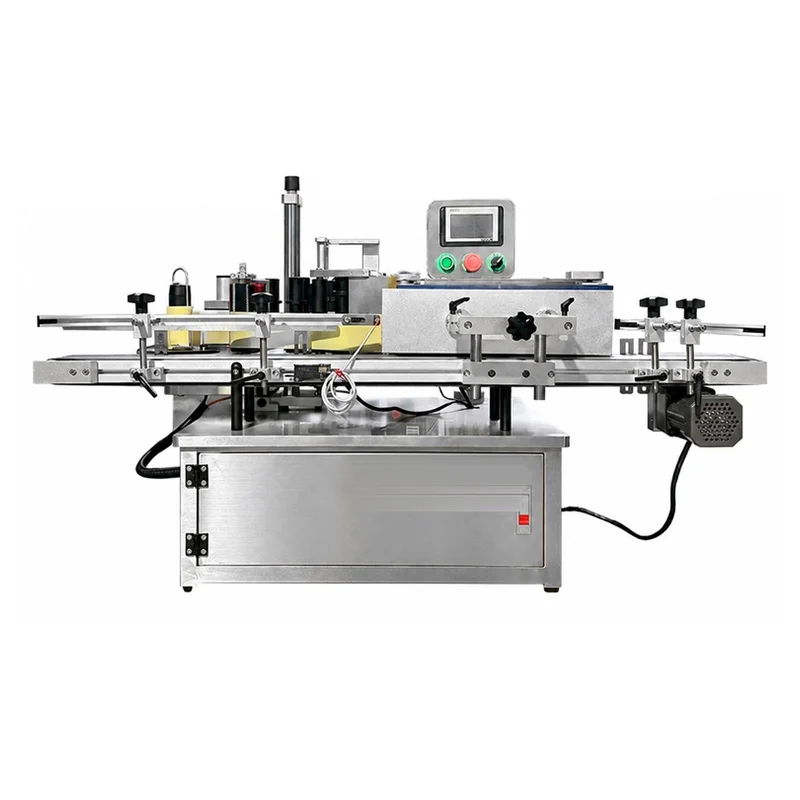
Applying a wrap-around label that rides 1 mm onto the double-seam chime of an aluminum beverage can or over-compressing an unpressurized 0.10 mm thin-wall bright can against a rigid wrap belt causes immediate edge flagging, container damage, high reject rates, and costly seamer downtime. Metal packaging across 12 oz and 16 oz aluminum craft beverage cans, corrugated 3-piece steel vegetable and soup tins, squat pet food cans, and high-pressure aerosol canisters requires specialized chime clearance and sidewall pressure control that differ sharply from glass or rigid HDPE bottles.
Within our bottle and container application hub and the broader industrial labeling machine architecture, can and tin labeling systems divide into four equipment families governed by container wall rigidity, chime geometry, and annual volume.
| Equipment Technology | Throughput Range | Primary Container Formats | Label Material & Bond | Chime / Bead Behavior | Economic & Operational Sweet Spot |
|---|---|---|---|---|---|
| Inline Wrap-Around Pressure-Sensitive (PS) | 30–150 CPM | 12/16 oz aluminum craft cans, pet food tins, spice tins, aerosols | 50 µm BOPP or paper on liner (full PSA coat) | Must clear top & bottom chimes by ≥ 1.5 mm each | Multi-SKU craft breweries, co-packers, < 10M cans/yr |
| 3-Roller Indexing Pressure-Sensitive | 25–60 CPM | Tapered tins, spot-labeled cans, seam-registered aerosols | Die-cut PS film/paper | High precision (±0.5–1.0 mm) vertical height lock | Specialty tins requiring weld-seam or valve registration |
| Full-Body Shrink Sleeve + Steam Tunnel | 60–300+ CPM | 12/16/19.2 oz standard & sleek aluminum beverage cans | 40–50 µm PETG/OPS tubular film (50–75% shrink) | Shrinks tightly over necked-in top shoulder up to chime | 360° neck-to-base billboard graphics on bright cans |
| Roll-Fed / Cut-and-Stack Hot-Melt + Lap Glue | 150–600+ CPM | 3-piece corrugated steel food tins (soup, vegetables, fish, paint) | 60–85 gsm paper or linerless BOPP + 120–160°C pickup glue | Hot-melt pickup dots bridge corrugated steel ribs | High-volume canneries (> 15M tins/yr); lowest unit label cost |
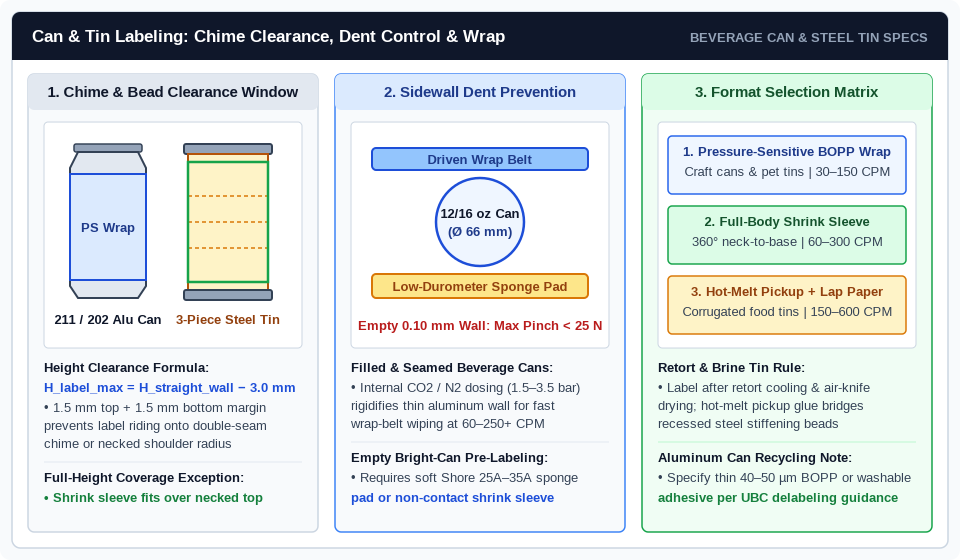
Top and bottom chime clearance geometry (H_label_max)
Every two-piece aluminum beverage can and three-piece steel food tin is sealed by rolling the can end curl together with the body flange to form a raised double-seam chime that protrudes radially outward by $1.0\text{ to }1.8\text{ mm}$ beyond the straight cylindrical sidewall. In addition, standard 211-body ($D = 66.0\text{ mm}$) aluminum beverage cans feature a necked-in top shoulder (tapering down to a 202-end diameter of $52.4\text{ mm}$) and a domed base heel.
If a pressure-sensitive or hot-melt paper wrap label is cut too tall, its top or bottom edge rides up onto the curved neck transition or hits the protruding metal chime rim. Because a non-shrink label cannot contract circumferentially onto a smaller neck radius, any portion of the label extending past the straight vertical wall flutes outward into an unbonded ruffle that catches on carton dividers and peels.
Use the straight-wall clearance equation to size maximum label height ($H_{\text{label_max}}$) and overlap wrap length ($L_{\text{wrap}}$):
$$H_{\text{label_max}}\text{ (mm)} = H_{\text{straight_wall}} - 2 \times C_{\text{margin}}$$
$$L_{\text{wrap}}\text{ (mm)} = \left( \pi \times D_{\text{can}} \right) + L_{\text{overlap}}$$
Where:
- $H_{\text{straight_wall}}$: Vertical height of the purely cylindrical sidewall between the bottom heel tangent and the top necked-in tangent (or top/bottom chime undercuts on a 3-piece steel tin).
- $C_{\text{margin}}$: Mandatory vertical clearance margin at both top and bottom edges ($1.5\text{ mm minimum per edge}$, or $3.0\text{ mm total height reduction}$) to absorb ±0.8 mm conveyor height tolerance and can flange variations.
- $L_{\text{overlap}}$: Trailing self-overlap seam ($5.0\text{ to }8.0\text{ mm}$ for pressure-sensitive BOPP on beverage cans; $8.0\text{ to }12.0\text{ mm}$ for hot-melt/wet-glue paper wraps on food tins).
Reference dimensional table for standard beverage and food cans
| Container Format | Body Diameter ($D_{\text{can}}$) | Overall Can Height | Straight Cylindrical Wall ($H_{\text{straight_wall}}$) | Recommended Max PS Label Height ($H_{\text{label_max}}$) | Full-Wrap Label Length ($L_{\text{wrap}}$ with 6 mm overlap) |
|---|---|---|---|---|---|
| 12 oz Standard Aluminum Can (211 × 413) | 66.0 mm | 122.2 mm | ~92.0 mm | 88.0–89.0 mm | 213–214 mm |
| 12 oz Sleek Aluminum Can (204 × 602) | 58.0 mm | 156.5 mm | ~127.0 mm | 123.0–124.0 mm | 188–189 mm |
| 16 oz Standard Pint Can (211 × 604) | 66.0 mm | 157.2 mm | ~127.0 mm | 123.0–124.0 mm | 213–214 mm |
| 300 × 407 Steel Food Tin (15 oz Standard) | 73.0 mm | 112.7 mm | ~103.5 mm (between chimes) | 99.0–100.5 mm | 235–238 mm |
| 307 × 113 Squat Pet Food / Tuna Tin | 83.3 mm | 44.5 mm | ~35.5 mm (between chimes) | 31.5–32.5 mm | 268–270 mm |
Engineering exception: If your brand requires full neck-to-base graphic coverage extending right up to the top double-seam chime across the necked-in shoulder of a 12 oz or 16 oz aluminum can, a flat wrap label physically cannot conform to the compound curve. Specify a 40 to 50 µm PETG shrink sleeve applicator paired with a saturated steam shrink tunnel so the film shrinks 22% radially onto the necked shoulder.
Preventing sidewall denting: empty bright cans vs filled pressurized cans
Two-piece drawn-and-ironed (D&I) aluminum beverage cans have an ultra-thin mid-wall gauge of $0.097\text{ to }0.120\text{ mm}$ ($97–120\ \mu\text{m}$). How the can responds to the radial pinch force of a round container wrap-around belt depends entirely on whether you label before or after filling and seaming:
1. Labeling filled, seamed, and pressurized cans (60–250+ CPM)
Once a beverage can is filled with carbonated beer, seltzer, or soda (or dosed with liquid nitrogen on still beverages) and double-seamed, internal headspace pressure of $1.5\text{ to }3.5\text{ bar}$ ($22\text{ to }50\text{ psi}$) turns the thin aluminum shell into a rigid pressure vessel.
- Filled pressurized cans easily withstand standard wrap-belt backing pad forces ($40–90\text{ N}$), allowing continuous inline wrap-around pressure-sensitive labelers to spin cans at 60 to 250+ CPM without denting.
- Cold-fill aluminum sweating: Because aluminum has a thermal conductivity of $205\text{ W/(m}\cdot\text{K)}$—more than 200 times higher than glass—cold-filled cans ($1–4^\circ\text{C}$) condense atmospheric water vapor instantaneously after leaving the seamer/rinser. You must install a high-velocity centrifugal air-knife blow-off dryer immediately ahead of a pressure-sensitive can labeler and specify a wet-tack emulsion acrylic adhesive on 50 µm BOPP film.
2. Pre-labeling empty unpressurized aluminum cans (< 25 N pinch limit)
Contract mobile canners and small taprooms sometimes pre-label empty, uncapped aluminum cans before sending them to the filler. Because an empty 0.10 mm aluminum wall has virtually zero hoop buckling resistance, compressing an empty can between a standard hard rubber wrap belt and a stiff backing pad by just $2.5\text{ mm}$ (generating $> 35\text{ N}$ radial force) permanently creases the sidewall, which then causes a catastrophic flange crush under the can seamer chuck.
Rule of thumb for empty aluminum cans:
- Always prefer post-fill, post-seam labeling whenever line layout permits.
- If you must pre-label empty cans on an inline wrap-around labeler, specify an ultra-soft open-cell Shore 15A–25A foam backing pad, set the gap between the wrap belt and backing pad to $D_{\text{can}} - 0.5\text{ mm}$ (limiting radial pinch force below $20–25\text{ N}$), or use a low-force 3-roller cradle / non-contact shrink sleeve applicator.
Corrugated steel food tins, pet food cans, and aerosol canisters
Three-piece steel food tins and aerosol cans introduce three specialized mechanical requirements that differ from aluminum beverage cans:
1. Bridging circumferential stiffening beads on 3-piece steel food tins
Retorted vegetable, soup, tomato, and pet food tins (such as 300 × 407 or 401 × 411 sanitary cans) roll circumferential stiffening ribs (“corrugations” or “beads”) into the steel body wall so the can does not collapse under vacuum after steam retort sterilization.
- High-speed canneries (
150–600+ CPM) use horizontal roll-through or vertical rotary hot-melt pickup + cold lap-glue paper labelers (see our hot-melt vs wet-glue vs pressure-sensitive guide). The machine applies two or three dots of $130–150^\circ\text{C}$ hot-melt pickup adhesive directly onto the flat steel zones above and below the corrugation beads, pulls a stiff 70–85 gsm paper label out of a magazine stack around the spinning tin, and seals the trailing paper-to-paper overlap seam with a cold PVA or hot-melt lap glue bar. Suspended under hoop tension between the top and bottom chimes, the paper wrap bridges cleanly over the recessed steel beads without dimpling. - Low-to-medium speed pressure-sensitive lines (
30–120 CPM): If you apply a self-adhesive label over a beaded steel food tin, avoid thin 40 µm flexible films (which sink into the bead grooves and form unsightly air channels). Instead, specify a stiff 75–90 gsm coated paper or 60 µm cavitated BOPP facestock and use top-and-bottom segmented wipe rollers that press the label onto the smooth top and bottom land zones while bridging the center corrugations.
2. Squat pet food and tuna cans (H / D < 0.6)
Squat tapered or straight-wall pet food, pâté, and seafood tins ($D = 83–99\text{ mm}$, height $= 35–48\text{ mm}$) have a low height-to-diameter aspect ratio that makes them unstable if pushed against a high-mounted side belt. Specify low-profile bottom guide rails set below the bottom chime (or between chimes) and a narrow wrap belt centered precisely at mid-wall height ($H / 2$) so the squat tin spins flat on the acetal tabletop chain without tipping on its chime rim.
3. Aerosol canisters: weld-seam registration and explosion-proof zones
Three-piece tinplate aerosol cans feature a raised vertical welded side seam and often a notched dome top rim requiring alignment with a spray-actuator cap.
- Use a 3-roller indexing station with an optical contrast or eddy-current weld-seam sensor to orient the aerosol can so the overlap seam of the label lands directly over the metal weld seam.
- If the labeler operates adjacent to a hydrocarbon propellant gassing room (LPG / butane / propane), verify whether plant safety classification requires ATEX / Class I Div 2 explosion-proof enclosures, brushless intrinsically safe sensors, and anti-static ionizing bars on the label web unwind.
Aluminum can recyclability and delabeling rules
Aluminum beverage cans are one of the highest-value recycled packaging streams globally, but thick polymer labels or heavy inks can reduce furnace metal yield during UBC (Used Beverage Can) decoating and remelting. When specifying labels for aluminum cans:
- Shrink sleeves: Use low-density floatable polyolefin (OPS/PO) or thin 40–45 µm PETG sleeves with dual vertical micro-perforations that allow mechanical delabelers at recycling facilities to strip the sleeve prior to shredding, or provide a consumer tear-strip.
- Pressure-sensitive wraps: Specify thin 40 to 50 µm polypropylene (BOPP) film rather than heavy paper or PVC, limiting total organic mass contribution to $< 3%–4%$ of empty can weight.
Failure modes, root causes, and corrective actions
| Failure Mode / Symptom | Root Cause on Metal Cans & Tins | Corrective Engineering Action |
|---|---|---|
| Top or bottom label edge curling / flagging (“chime riding”) | Label height ($H_{\text{label}}$) exceeds straight sidewall zone or conveyor guide height allows can to bounce vertically. | Reduce die-cut label height to maintain $\ge 1.5\text{ mm}$ clearance inside both top and bottom chimes, and install a top stabilizing guide rail over the can end. |
| Sidewall creases or dents on 12/16 oz aluminum cans | Empty unpressurized cans compressed by stiff rubber wrap belt ($> 30\text{ N}$ pinch force), or guide rails pinched at infeed timing screw. | Move labeler downstream of filler/seamer so internal pressure ($1.5–3.5\text{ bar}$) rigidifies the wall; on empty cans, use a soft Shore 20A foam backing pad with $< 0.5\text{ mm}$ interference. |
| Spiral “barber-poling” (overlap seam walks up or down by > 2 mm) | Wrap belt axis is tilted relative to tabletop conveyor plane, or tapered tin rolled on a flat vertical belt. | Level wrap-belt mounting brackets parallel to conveyor wear strips within $\pm 0.1\text{ mm}$ using a machinist square; for tapered tins, tilt peel plate to match cone angle. |
| Adhesive slip or edge lift on cold-filled brite cans | Residual seamer rinse water and $2^\circ\text{C}$ condensation film trapped under pressure-sensitive label. | Install a 5.5–7.5 kW dual centrifugal air-knife dryer within 1.0 m of labeler infeed and specify W40/emulsion acrylic cold-temp wet-tack adhesive. |
| Wrinkled channels across corrugated steel food tin beads | Thin flexible film pressed into recessed steel stiffening ribs by a full-height soft sponge roller. | Switch to stiff 75–85 gsm label paper or 60 µm rigid BOPP, and use split upper/lower wipe rollers that press only on the smooth top and bottom land zones. |
Specification checklist for can and tin labeler RFQs
Collect these five technical inputs using our labeling machine RFQ checklist before messaging our engineering team on WhatsApp (or compare related wine/beer glass configurations in our beer and wine bottle labeling guide and jar labeling machine guide):
- Can / tin dimensional specification: Industry can code (e.g., 211 × 413 standard 12 oz, 211 × 604 pint, 204 × 602 sleek, or 300 × 407 steel tin), exact body diameter ($D_{\text{can}}$), overall height, and straight cylindrical wall height between chimes/shoulders.
- Infeed container state: Specify filled & seamed (pressurized) vs empty bright can, product fill temperature ($^\circ\text{C}$), and whether cans exit a wet rinser, pasteurizer, or retort cooler upstream.
- Sidewall profile: Smooth aluminum/tinplate wall vs 3-piece corrugated stiffening beads vs tapered nesting tin.
- Label format and coverage: Partial spot label, 360° overlap wrap (with 5–10 mm lap seam), or full-body over-the-neck shrink sleeve.
- Target throughput and line integration: Nominal and surge CPM (cans per minute), existing tabletop chain width ($82.5\text{ mm}$ or $114.3\text{ mm}$), and whether downstream date-code laser/inkjet printing or can-end vision inspection is required.
Common questions
Should craft beverage cans be labeled empty before filling or full after seaming?
Labeling filled and seamed cans is strongly preferred for speeds above 40 CPM and for thin-wall 12 oz / 16 oz aluminum cans. Once filled and seamed, internal carbonation or liquid nitrogen dosing (1.5 to 3.5 bar) makes the thin aluminum wall rigid so it spins through an inline wrap belt at 60 to 250 CPM without denting, and labels are never exposed to filler foam spills or seamer chuck scuffing. Empty-can pre-labeling is used mainly by off-site warehouses or mobile canners with tight wet-side floor space, and requires low-durometer foam backing pads.
What is the maximum label height for a standard 12 oz and 16 oz aluminum beverage can?
On a standard 211-body ($66.0\text{ mm}$ diameter) 12 oz aluminum can ($122.2\text{ mm}$ total height), the straight cylindrical sidewall between the bottom heel curve and the top necked-in shoulder is approximately $92\text{ mm}$, giving a recommended pressure-sensitive wrap label height of 88.0 to 89.0 mm ($3.5\text{ in}$). On a standard 16 oz pint can ($157.2\text{ mm}$ total height), the straight wall is approximately $127\text{ mm}$, supporting a maximum wrap label height of 123.0 to 124.0 mm ($4.875\text{ in}$).
When should a food cannery use hot-melt paper wrap instead of pressure-sensitive labels?
Canneries running cylindrical 3-piece steel food tins (vegetables, beans, soup, condensed milk, or pet food) at volumes above 10 to 15 million cans per year use cut-and-stack hot-melt pickup + lap-glue paper labelers (or roll-fed hot-melt BOPP) because uncoated 70–80 gsm paper stacks cost 65% to 75% less per thousand cans than siliconized-liner pressure-sensitive labels, and heated pickup glue dots bridge recessed steel corrugation beads at 200 to 600+ CPM.
How do you prevent overlap seam flagging on small-diameter sleek cans and aerosol tins?
Small-diameter containers (such as 52–58 mm sleek cans and narrow 45–53 mm aerosol canisters) generate higher bending spring-back in the label facestock. To prevent the trailing overlap edge from lifting (“flagging”), use a conformable 50 µm BOPP film (or grain-short paper) rather than stiff thick stock, maintain a 6 to 8 mm film-to-film overlap zone, and verify that the wrap-around belt length is at least 1.8 to 2.2 times the can circumference so every overlap seam receives at least two full revolutions of rolling wipe pressure.
Related Guides & Specifications
Container Label Size, Wrap Coverage, and Shrink Sleeve Layflat Calculator
Calculate bottle label circumference, partial wrap arc, shrink sleeve layflat width, film shrink percentage, and tapered jar chord distortion for RFQs.
Learn moreWater Bottle Labeling Machines: PET Wrap-Around, Roll-Fed BOPP, and Shrink Sleeve
Compare pressure-sensitive wrap, roll-fed BOPP hot-melt, and shrink sleeve water bottle labelers for thin-wall PET, sparkling water, and glass lines.
Learn moreJar Labeling Machines: Wrap-Around, Front-and-Back, and Tamper-Evident Configurations
Select a jar labeling machine for wide-mouth glass and plastic jars: wrap-around vs front-back, taper draft angles, L-clip tamper strips, and neck bands.
Learn moreWine and Beer Bottle Labeling Machines: Taper, 3-Roller & Wet-Glass Guide
Select wine and beer bottle labeling machines for Bordeaux and Burgundy glass, 3-roller front/back/neck registration, cold brite-tank condensation, and capsules.
Learn moreRelated Equipment & Guides
Automatic Labeling Machines: How to Choose by Container, Label and Speed
Choose an automatic labeling machine by container shape, label type and speed. Compare labeler types, accuracy tiers and the checks to run on your samples.
Learn moreWrap-Around and Pressure-Sensitive Labeling Machines: Web Kinematics & Line Selection
Engineering guide to wrap-around and pressure-sensitive labeling machines: web tension, peel plate geometry, wrap belt vs 3-roller kinematics, and line selection.
Learn moreShrink Sleeve Labeling Machines: How to Match Applicator, Film and Shrink Tunnel
Specify a shrink sleeve labeling machine by sleeve format, layflat width, film shrink ratio and steam or electric tunnel. Compare speeds and sample test steps.
Learn moreBottle Labeling Machines: How to Choose by Container Material, Shape, and Line Speed
Select a bottle labeling machine by container material (glass, PET, HDPE), shape (round, flat, oval, square, tapered), surface condensation, and line speed.
Learn moreRound Bottle Labeling Machines: Continuous Wrap Belt vs. 3-Roller Indexing
Select a round bottle labeling machine by comparing continuous wrap belts vs 3-roller indexing, web speed equations, bottle pitch spacing, and machine parameters.
Learn moreHot-Melt Glue vs Wet-Glue vs Pressure-Sensitive Labeling Machines
Compare roll-fed hot-melt glue, cut-and-stack wet/cold glue, and pressure-sensitive labeling machines across unit label cost, line speed, changeover, and TCO.
Learn moreSteam Shrink Tunnel vs Electric Hot-Air and Infrared Tunnels
Compare low-pressure saturated steam shrink tunnels (180–200°F) against electric forced hot-air and radiant infrared shrink sleeve tunnels (176–500°F).
Learn moreWater Bottle Labeling Machines: PET Wrap-Around, Roll-Fed BOPP, and Shrink Sleeve
Compare pressure-sensitive wrap, roll-fed BOPP hot-melt, and shrink sleeve water bottle labelers for thin-wall PET, sparkling water, and glass lines.
Learn moreJar Labeling Machines: Wrap-Around, Front-and-Back, and Tamper-Evident Configurations
Select a jar labeling machine for wide-mouth glass and plastic jars: wrap-around vs front-back, taper draft angles, L-clip tamper strips, and neck bands.
Learn moreWine and Beer Bottle Labeling Machines: Taper, 3-Roller & Wet-Glass Guide
Select wine and beer bottle labeling machines for Bordeaux and Burgundy glass, 3-roller front/back/neck registration, cold brite-tank condensation, and capsules.
Learn more