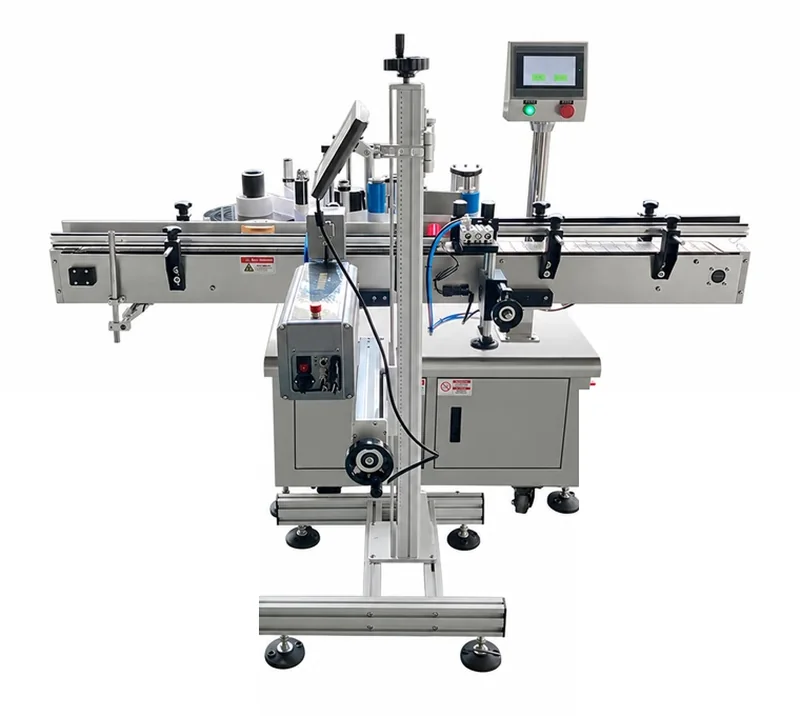
Selecting a semi automatic labeling machine or a tabletop bottle labeler gives contract packagers, craft beverage producers, clinical-trial pharmacies, and multi-SKU specialty chemical plants an immediate 3× to 5× speed jump over hand-sticking without the floor space or capital cost of a fully integrated conveyor line. However, keeping a benchtop station in service past its labor crossover volume (3,000 to 5,000 bottles/day), or pairing the wrong cradle fixture with tapered or squeezable containers, locks the plant into $40,000–$60,000 per year of avoidable manual loading labor, 5–8% label waste, and inconsistent placement tolerances.
Within our hierarchy of industrial labeling machines, semi-automatic and benchtop systems serve as both the entry tier for small-batch production (10–40 containers/min) and the technical proving ground where growing brands standardize label unwind directions, gap sensors, and adhesive specs before scaling to inline automation. This hub compares the four principal benchtop mechanical architectures, foot-pedal versus photoeye actuation, integrated hot-stamp batch coding, <5 minute tool-less changeovers, and the exact 3-year Total Cost of Ownership (TCO) crossover calculation against 50–150+ BPM automatic inline labelers.
1. Semi-Automatic & Tabletop Labeler Architecture Matrix
Not all benchtop machines move the container the same way. Industrial benchtop labeling machine configurations divide into four mechanical fixtures based on container cross-section, orientation requirements, and whether the container is hand-placed into a nest or fed along a short tabletop conveyor.
| Machine Class & Representative Models | Container Geometry & Size Scope | Mechanical Actuation & Wiping Method | Published Throughput & Placement Accuracy | Published Capital & Footprint Envelope | Best Production Fit |
|---|---|---|---|---|---|
| Horizontal 2-Roller Round Cradle (LV-50 / LV-50D) | Cylindrical bottles, cans, jars, tubes (φ15–120 mm OD; label 10–110 mm W × 20–300 mm L) | Operator places bottle horizontally on 2 rollers and pulls swing-arm press roller (photoeye or foot switch) | 15–40 pcs/min (operator-paced); ±0.5 to ±1.0 mm | $2,000–$5,000 (e.g. $2,390 listed for LV-50/50D); ~25–35 kg benchtop | Short-run round bottles (<2,500/day), frequent <3 min SKU swaps |
Circumferential Positioning Round Station (LV-80 / LV-130 / LV-822T / LV-41300) |
Round bottles requiring front-and-back labels or lug/seam alignment (φ35–100 mm OD; height 25–300 mm) | Three-roller vertical or horizontal clamping cradle + PLC encoder/mark sensor (single or double label switchable) | 15–30 pcs/min; ±0.5 to ±1.0 mm | $3,000–$12,000; 1250 × 900 × 900 mm (122 kg for LV-822T desktop) |
Wine bottles, dual-label cosmetic cylinders, registered neck/body wraps |
| Flat / Square Pneumatic Tamp-Suction Station (LV-60 / LV-30100) | Flat panels, square bottles, rectangular tins, boxes, pouches, concave/arc lids | Operator nests item in T-slot fixture + steps on foot pedal; vertical pneumatic suction pad tamps label (0.4–0.6 MPa air) | 10–30 pcs/min; ±0.5 to ±1.0 mm (fixture-dependent) | $2,500–$8,000; compact benchtop + shop air compressor | Flat panels, recessed jars, irregular flasks, medical device pouches |
| Tabletop Conveyor Wrap-Around (LV-SPS Benchtop Series / Compact Inline) | Round or stable containers traveling upright on a 3.25 in (~82 mm) tabletop fabric/acetal conveyor | Miniaturized inline conveyor lifted onto a workbench; side wrap belt + photoeye product trigger (max 4.5 in / 114 mm label height, <10 in roll OD) | 20–50 pcs/min; ±1.0 mm | $6,000–$15,000 (industrial semi-auto up to $30,000–$75,000) | Bridge tier between manual cradle loading and floor-standing inline lines |
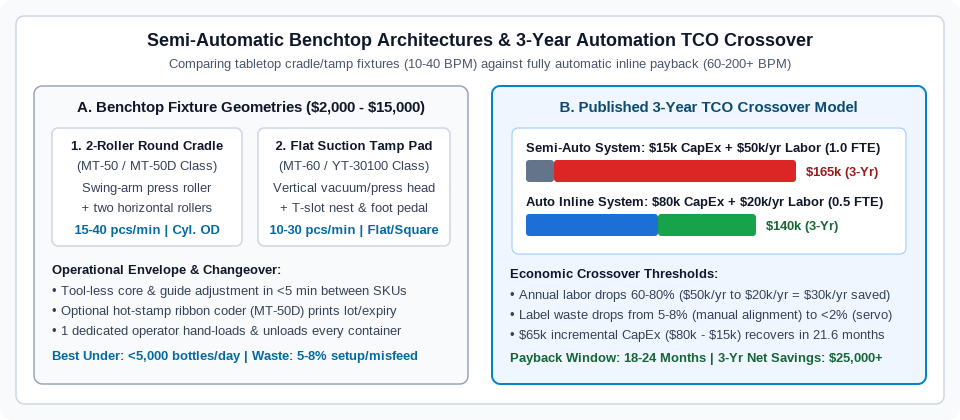
2. Round-Bottle Cradles vs. Flat Tamp Stations vs. Benchtop Conveyors
Understanding the mechanical constraints of each semi-automatic architecture prevents buyers from purchasing a benchtop unit that cannot physically handle their label height, roll diameter, or container wall taper.
Horizontal Two-Roller Round-Bottle Cradles (LV-50 & LV-80 Series)
On a horizontal semi auto wrap around labeler, the container lies on its side supported by two parallel polyurethane-coated drive rollers and an adjustable axial end-stop rod:
- Three-point contact physics lock the container in triangulation when the operator lowers the overhead swing-arm pressure roller onto the bottle cylinder. A stepper or servo motor drives the bottom rollers and peels the label web synchronously over a sharp stripping plate (using standard 76 mm / 3 inch inner core diameter and up to 250–280 mm max outer roll diameter).
- Single versus double-label circumferential positioning separates standard
LV-50two-roller cradles from upgraded three-roller positioning models (such as theLV-80,LV-130,LV-41300, andLV-822Tdesktop station), which add a pneumatic clamping roller and a fiber-optic registration sensor. Operators can toggle between single-label and front-plus-back double-label mode on the touchscreen HMI, setting the exact circumferential spacing in millimeters so a back nutrition panel lands 180° opposite the front brand label. - Taper limitations apply because horizontal cradle rollers are cylindrical and require a straight cylindrical container body. Significantly tapered jars or conical cups will walk axially against the end-stop during rotation unless the label is die-cut on a curved radius and applied on a vertical three-roller or tamp fixture.
Flat-Surface & Irregular-Panel Tamp Stations (LV-60 & LV-30100 Class)
When applying a label to a flat square bottle, a rectangular F-style jug, a cosmetic compact lid, or a slightly curved/concave surface that cannot roll, a two-roller cradle is unusable. Flat semi-automatic labelers replace the roller cradle with a vertical pneumatic peel-and-tamp cylinder:
- As the stepper motor advances the web over the peel plate, the peeled label is held flat against an overhead perforated vacuum-suction pad (driven by 0.4–0.6 MPa clean dry shop air).
- The operator slides the bottle or carton into a custom-positioned aluminum T-slot fixture nest directly beneath the pad and depresses the foot pedal.
- The vertical pneumatic cylinder strokes downward, pressing a compliant silicone or sponge pad against the container surface (replaceable with contoured pads for slightly curved or recessed panels) before retracting for the next cycle at 10–30 pcs/min.
Tabletop Conveyor vs. Floor-Standing Inline Envelope Limits
Engineering comparisons between compact tabletop conveyor labelers (LV-SPS benchtop series) and floor-standing automatic inline systems (LV-APS / LV-PSA series) highlight three physical boundaries that buyers must verify before ordering label rolls:
- Maximum label web height on tabletop conveyor machines is limited by compact peel plates and shorter vertical mast shafts to roughly 4.5 inches (~114 mm, or 120 mm on
LV-822Tdesktop units). Floor-standing automatic machines support standard 6.75 inch (~171 mm) and taller (200+ mm) web widths. - Maximum roll outside diameter (OD) on benchtop unwind spindles is kept under 10 inches (~254–280 mm around a 76 mm core) so the machine remains light enough for two technicians to lift onto a workbench (30–122 kg). Floor-standing inline machines carry 300–350 mm (12–14 inch) OD reels that hold 40–70% more labels per roll.
- Narrow tabletop conveyor beds typically use a 3.25 inch (~82 mm) fabric or acetal belt with manual hand-pack feed, whereas floor-standing inline frames mount wider 4.5 inch (114 mm) to 7.5 inch (190 mm) Delrin/stainless chains with motorized container-spacing wheels and caster wheels for moving between packaging lines. Compare full inline conveyor architectures in wrap-around and pressure-sensitive labelers and bottle labeling machines.
3. Actuation Modes, Integrated Date Coding & <5 Minute Tool-Less Changeovers
In high-mix, low-volume (HMLV) contract packaging, a small batch bottle labeler spends as much time being set up between SKUs as it spends running containers. Specifying the right trigger mode, batch coder, and sensor package determines daily net output.
Foot-Pedal Switch vs. Photoeye Automatic Triggering
Semi-automatic labelers provide two operator selectable actuation modes on the control panel:
- Foot-pedal actuation (Step Control) holds the web until the operator seats the container against the nest guides and depresses the foot switch. Foot-pedal mode is mandatory when handling awkward, lightweight, or multi-faceted containers (such as square bottles on an
LV-60tamp station or delicate glass vials) where premature triggering during hand placement would cause crooked labels. - Photoelectric sensor actuation (Auto-Sense Mode) on two-roller round cradles (
LV-50) uses an optical object sensor to detect the bottle the instant the operator drops it into the cradle and lowers the swing-arm press roller, firing the web feed automatically without foot fatigue and raising throughput from 15 pcs/min to 25–40 pcs/min.
Integrated Hot-Stamp Ribbon Batch Coding (LV-50D & LV-130)
Food, nutraceutical, cosmetic, and pharmaceutical regulations require a lot number, manufacturing date, and expiration date on every retail container. Rather than running containers through a separate inkjet conveyor after labeling, buyers can specify a coder-equipped benchtop model (such as the LV-50D or LV-130):
- A mechanical or pneumatic hot-stamp thermal ribbon coder mounts directly onto the label web path upstream of the peel plate.
- During the brief pause between container cycles, heated brass character blocks press a dry thermal transfer ribbon against the label, printing 1 to 3 lines of crisp, smudge-proof characters (Manufacturing Date, Expiry Date, Batch/Lot No.) with zero liquid ink mess or solvent odor.
<5 Minute Tool-Less Changeover & Clear-Label Sensing
Shop-floor changeover studies show that while unoptimized multi-head inline machines can take 30–60 minutes to re-thread and align (15 minutes with SMED quick-release tooling), a benchtop semi-automatic labeler completes a full SKU changeover in under 5 minutes:
- Release the spring-loaded core chuck, swap the 76 mm ID label roll, and thread the web through the tension rollers and peel plate (~90 seconds).
- Loosen the star-knob handwheels to slide the axial bottle stop rod and web-width guide rings to the new container’s ruler mark (~60 seconds).
- Dispense two test labels to set the gap sensor threshold (~60 seconds).
Standard benchtop machines ship with an optical (photoelectric) fork gap sensor that only detects opaque paper or white film labels. If your brand uses transparent clear-on-clear BOPP labels (and does not print a black registration bar on the liner), you must specify an ultrasonic or capacitive fork sensor upgrade when ordering the machine. Review the exact sensor selection criteria in our child guide on ultrasonic vs. optical clear label sensors.
4. The Volume & Labor Crossover Calculation: When to Upgrade to Inline Automation
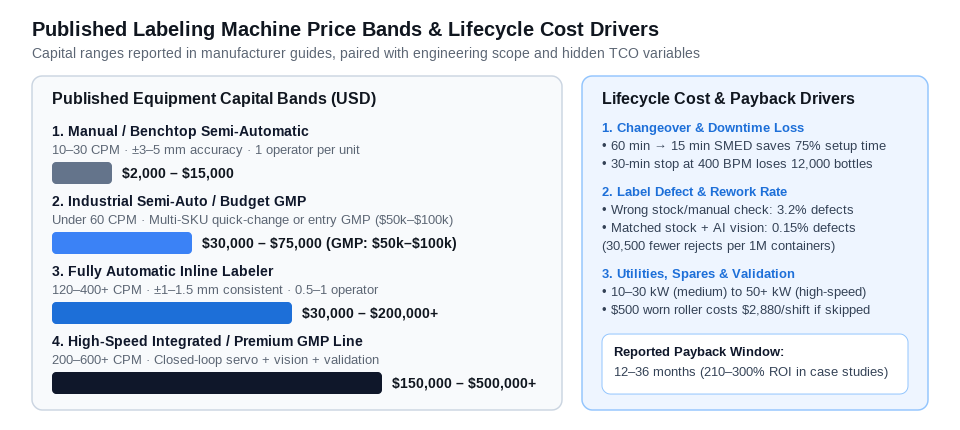
The most common financial mistake in packaging operations is buying a $2,500–$15,000 semi-automatic machine for a product line that already demands 8,000 to 20,000+ bottles per day, or conversely, overspending $80,000+ on a high-speed automatic line for a 1,000 bottle/day craft product.
Published Volume-Tier & Labor Benchmarks
Industrial TCO models establish clear operational boundaries between manual, semi-automatic, and automatic inline tiers:
- Below 5,000 bottles/day (10–30 BPM sustained), semi-automatic benchtop equipment ($2,000–$15,000 capital) is the economically optimal choice. A 3,000 bottle daily batch finishes in 2.0 to 3.5 hours at 15–25 BPM, leaving the operator free for filling, capping, and case packing during the remainder of the shift.
- From 5,000 to 50,000 bottles/day (50–150 BPM / 60–200 CPM), fully automatic inline labeling ($30,000–$150,000 capital) dominates. Whereas a semi-automatic station requires 1.0 full-time equivalent (FTE) operator continuously hand-feeding containers ($40,000–$60,000/year fully burdened labor per shift) and incurs 5–8% label waste, an automatic inline labeler connected to an upstream filler/capper requires only 0.5 FTE operator ($15,000–$25,000/year shared supervision for roll changes) and holds label waste under 2%.
- Above 50,000 bottles/day (200–600+ BPM), high-speed continuous inline or rotary turret systems ($150,000–$500,000+) with non-stop dual-unwind splicers and automated case packing are required.
Worked Engineering Calculation: 3-Year TCO Crossover & Payback Months
Using a 3-year Total Cost of Ownership (TCO) model, engineers can calculate the exact payback period (T_payback) and cumulative 3-year savings when upgrading from a semi-automatic station (Option A) to a fully automatic inline labeler (Option B).
$$\text{TCO}{3\text{-yr}} = C{\text{cap}} + 3 \times \left( C_{\text{labor}} + C_{\text{waste}} \right)$$
$$T_{\text{payback (months)}} = \frac{C_{\text{cap, auto}} - C_{\text{cap, semi}}}{\left( C_{\text{labor, semi}} - C_{\text{labor, auto}} \right) / 12}$$
Example calculation (for a single-shift operation comparing a $15,000 industrial semi-automatic system with $50,000/year dedicated operator labor against an $80,000 automatic inline system with $20,000/year shared operator labor):
- Option A (Semi-Automatic System, 15–30 BPM) carries an equipment capital (C_cap, semi) of $15,000 and annual operator labor (1.0 FTE) of $50,000/year ($150,000 over 3 years), yielding a 3-Year Total Cost (Capital + 3-Yr Labor) of $$15,000 + $150,000 = $165,000$ before counting the 5–8% vs. <2% label waste penalty.
- Option B (Automatic Inline System, 60–150+ BPM) carries an equipment capital (C_cap, auto) of $80,000 and annual operator labor (0.4–0.5 FTE shared line tender) of $20,000/year ($60,000 over 3 years, a 60% annual labor reduction saving $30,000/year), yielding a 3-Year Total Cost (Capital + 3-Yr Labor) of $$80,000 + $60,000 = $140,000$.
- Incremental capital investment is $$80,000 - $15,000 = $65,000$, and monthly labor savings equal $$30,000 / 12 = $2,500/\text{month}$. Capital payback is $T_{\text{payback}} = $65,000 / $2,500 = 26.0\text{ months}$ from labor alone, and when including the 3–6% reduction in label and container scrap (typically $4,000–$8,000/year on 2M+ bottles/year), payback compresses into the published 18 to 24 month window while delivering $25,000+ in net 3-year TCO savings ($90,000 cumulative labor reduction).
- Review detailed price tiers, hidden lifecycle costs, and maintenance budgets in our child guide on industrial labeling machine cost, and calculate your line’s target speed in the labeling speed BPM and pitch calculator.
5. Five-Gate Buyer’s Roadmap & Technical Guides Under This Hub
This hub anchors five engineering and procurement guides designed to take packaging teams from initial machine selection and sensor configuration through defect troubleshooting and vendor quotation. Use the decision links below to complete your specification:
- How to Choose an Industrial Labeling Machine walks through our 7-gate selection methodology, matching container geometry (round, square, flat, tapered, unstable vial), adhesive technology (pressure-sensitive, shrink sleeve, hot-melt, wet glue), and throughput class (10–30 BPM semi-auto vs. 60–400+ BPM automatic).
- Industrial Labeling Machine Cost & Price Guide breaks down published capital bands from $2,000–$15,000 benchtop units and $30,000–$75,000 industrial semi-automatic/entry-GMP systems to $30,000–$200,000+ automatic inline lines, plus spare parts, utilities, and changeover downtime math.
- Ultrasonic vs. Optical Clear Label Sensors explains why standard infrared optical fork sensors fail on clear-on-clear BOPP labels, metallic foil stamps, and multi-ply booklets, and how to specify ultrasonic or capacitive gap sensors on both benchtop and high-speed applicators.
- Fix Label Wrinkling, Bubbling, and Flagging diagnoses the four primary physical defects on semi-automatic cradles and inline wrap belts (axial taper skew, sponge-belt air trapping, tight-mandrel edge lift or flagging, and web-tension telescopy) with concrete mechanical adjustments and facestock flexibility ratings (BOPP 9/10 vs. PET 4/10).
- Labeling Machine RFQ Checklist provides the complete sample-pack and drawing checklist (container tolerances, roll core ID/max OD, unwind direction #1–#8, utilities, and FAT acceptance criteria) required to get an accurate engineering quote without post-order change fees.
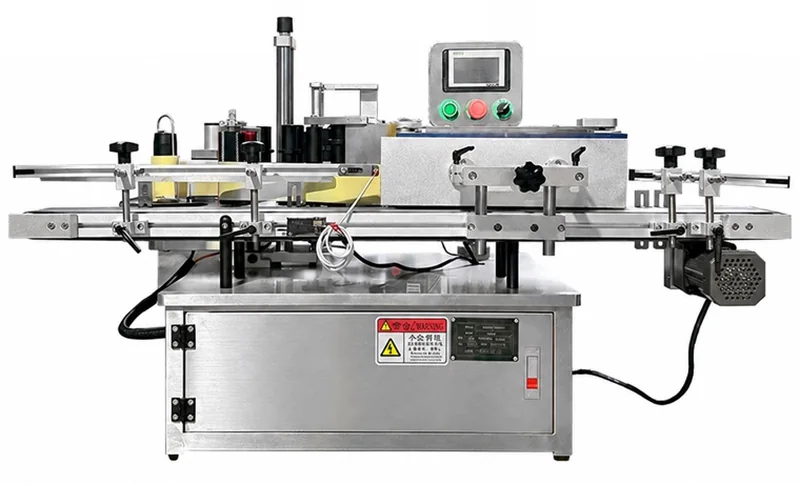
6. Preparing Your Container & Label Samples for Quotation
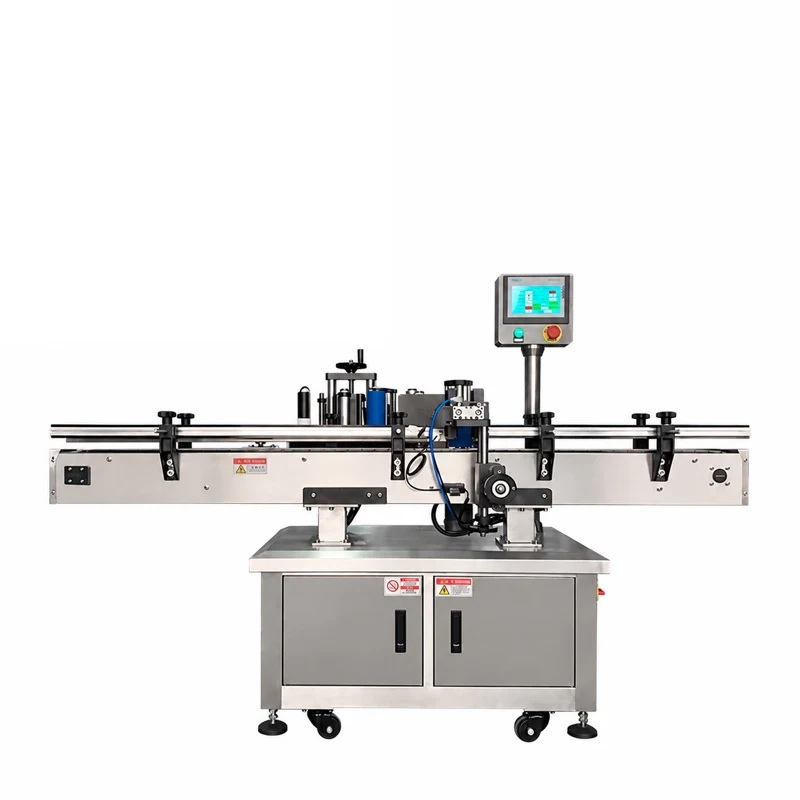
Whether you are ordering a compact semi-automatic station for a new product launch or evaluating the crossover to a fully automatic inline wrap-around or front-and-back system (such as LINEVO’s catalog series for round bottles, jars, vials, and specialty containers), confirming your label roll geometry up front prevents costly converter re-winds:
- Verify your roll winding orientation (#1 through #8, right-leading vs. left-leading edge) in the label roll unwind direction chart.
- Calculate maximum straight vertical panel height and partial- vs. full-wrap label length in the container label size and coverage calculator.
- For unstable small-diameter pharmaceutical vials, ampoules (10–22 mm OD), or dropper bottles (5–120 mL), review specialized horizontal and vertical starwheel handling in our vial and pharmaceutical labeling machines hub.
When you are ready to compare a semi-automatic benchtop setup against an inline automation proposal for your exact bottle and daily volume, compile your container specifications using the labeling machine RFQ checklist and message our LINEVO engineering team on WhatsApp.
Common questions
What is the real production speed of a semi-automatic bottle labeling machine?
Standard benchtop ratings run 15–40 pcs/min (and up to 50 pcs/min on small vials) for semi-automatic round-bottle cradles and tabletop conveyors. However, sustained shift throughput is governed by the human operator’s hand-loading rhythm, box unpacking, and repacking pace, which typically averages 12–25 bottles/min (720–1,500 bottles/hour) with 5–8% setup and misfeed label waste.
What is the difference between an LV-50 round-bottle cradle and an LV-60 flat-surface semi-automatic labeler?
An LV-50 (or LV-50D with a hot-stamp date coder) is a horizontal wrap-around cradle where the operator places a cylindrical bottle onto two parallel rollers and pulls down a swing-arm pressure roller to spin the bottle while the label peels and wraps. An LV-60 is a vertical tamp-press applicator where the operator places a flat, square, or rectangular container into a stationary T-slot positioning nest and presses a foot pedal so a pneumatic suction pad stamps the label flat onto the top panel.
Can a semi-automatic tabletop labeler apply front and back labels in a single pass?
Yes, provided you select a dual-label positioning model (such as the LINEVO LV-80, LV-130, LV-41300, or LV-822T desktop positioning labeler). When both front and back labels are printed alternating on a single release liner, the machine’s PLC uses a rotary encoder or optical mark sensor to peel the front label, advance the rotating bottle by a programmed circumferential delay (for example, 180 degrees), and apply the back label before releasing the bottle.
At what daily bottle volume should a plant upgrade from a semi-automatic labeler to an automatic inline labeling machine?
Production volume-tier analysis places the economic crossover at 3,000 to 5,000 bottles per day (or whenever a single semi-automatic station requires more than one full shift of dedicated operator labor). Above 5,000 bottles/day, upgrading from a $2,000–$15,000 benchtop unit ($50,000/yr operator labor) to an automatic inline labeler (60–200+ BPM, 0.5 operator labor at $20,000/yr) cuts labor costs by 60–80% and achieves full payback in 18–24 months.
In This Section
Industrial Labeling Machine Price and Total Cost of Ownership Guide
Transparent industrial labeling machine price breakdown from $2,000 semi-automatics to $500,000+ high-speed lines, plus hidden TCO drivers and payback math.
Learn moreHow to Choose an Industrial Labeling Machine: 7-Gate Selection Guide
Step-by-step labeling machine buying guide: 7 engineering gates from container geometry, surface energy, and unwind #1-#8 to speed headroom and line utilities.
Learn moreClear Label Sensor Selection: Capacitive vs Ultrasonic vs Optical
Engineering guide to clear label sensors on BOPP and PET films: why optical slot sensors drop to 68% and ultrasonic to 12% vs 100% capacitive accuracy at 220 m/min.
Learn moreHow to Fix Label Wrinkling, Bubbling, Flagging, and Axial Skew
Engineering troubleshooting guide to fix pressure-sensitive label wrinkling, air bubbling, edge flagging, and axial skew across bottle and carton labelers.
Learn moreLabeling Machine RFQ Checklist and User Requirement Specification (URS)
Engineering labeling machine RFQ checklist and User Requirement Specification (URS) template covering container drawings, roll unwind #1-#8, CPM, and FAT rules.
Learn moreRelated Guides & Specifications
Wrap-Around and Pressure-Sensitive Labeling Machines: Web Kinematics & Line Selection
Engineering guide to wrap-around and pressure-sensitive labeling machines: web tension, peel plate geometry, wrap belt vs 3-roller kinematics, and line selection.
Learn moreShrink Sleeve Labeling Machines: How to Match Applicator, Film and Shrink Tunnel
Specify a shrink sleeve labeling machine by sleeve format, layflat width, film shrink ratio and steam or electric tunnel. Compare speeds and sample test steps.
Learn moreBottle Labeling Machines: How to Choose by Container Material, Shape, and Line Speed
Select a bottle labeling machine by container material (glass, PET, HDPE), shape (round, flat, oval, square, tapered), surface condensation, and line speed.
Learn moreVial & Pharmaceutical Labeling Machines: Vertical vs. Horizontal Selection
Select a vial labeling machine or pharmaceutical labeler for 8-30 mm vials, ampoules, syringes, and dropper bottles with cGMP 21 CFR 211.130 controls.
Learn moreLabel Automation and Custom Packaging Line Labeling Integration
Engineering guide to label automation and inline labeling system integration across fillers, cappers, accumulation tables, PLC sync, and vision reject gates.
Learn moreRelated Equipment & Guides
Automatic Labeling Machines: How to Choose by Container, Label and Speed
Choose an automatic labeling machine by container shape, label type and speed. Compare labeler types, accuracy tiers and the checks to run on your samples.
Learn moreWrap-Around and Pressure-Sensitive Labeling Machines: Web Kinematics & Line Selection
Engineering guide to wrap-around and pressure-sensitive labeling machines: web tension, peel plate geometry, wrap belt vs 3-roller kinematics, and line selection.
Learn moreBottle Labeling Machines: How to Choose by Container Material, Shape, and Line Speed
Select a bottle labeling machine by container material (glass, PET, HDPE), shape (round, flat, oval, square, tapered), surface condensation, and line speed.
Learn moreIndustrial Labeling Machine Price and Total Cost of Ownership Guide
Transparent industrial labeling machine price breakdown from $2,000 semi-automatics to $500,000+ high-speed lines, plus hidden TCO drivers and payback math.
Learn moreHow to Choose an Industrial Labeling Machine: 7-Gate Selection Guide
Step-by-step labeling machine buying guide: 7 engineering gates from container geometry, surface energy, and unwind #1-#8 to speed headroom and line utilities.
Learn moreClear Label Sensor Selection: Capacitive vs Ultrasonic vs Optical
Engineering guide to clear label sensors on BOPP and PET films: why optical slot sensors drop to 68% and ultrasonic to 12% vs 100% capacitive accuracy at 220 m/min.
Learn moreHow to Fix Label Wrinkling, Bubbling, Flagging, and Axial Skew
Engineering troubleshooting guide to fix pressure-sensitive label wrinkling, air bubbling, edge flagging, and axial skew across bottle and carton labelers.
Learn moreLabeling Machine RFQ Checklist and User Requirement Specification (URS)
Engineering labeling machine RFQ checklist and User Requirement Specification (URS) template covering container drawings, roll unwind #1-#8, CPM, and FAT rules.
Learn more