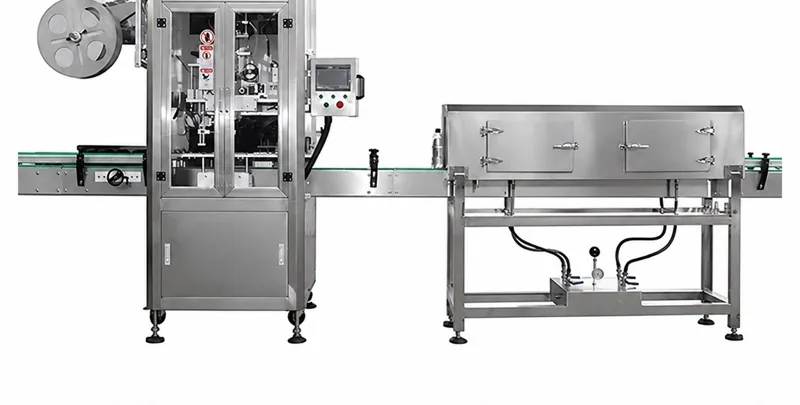
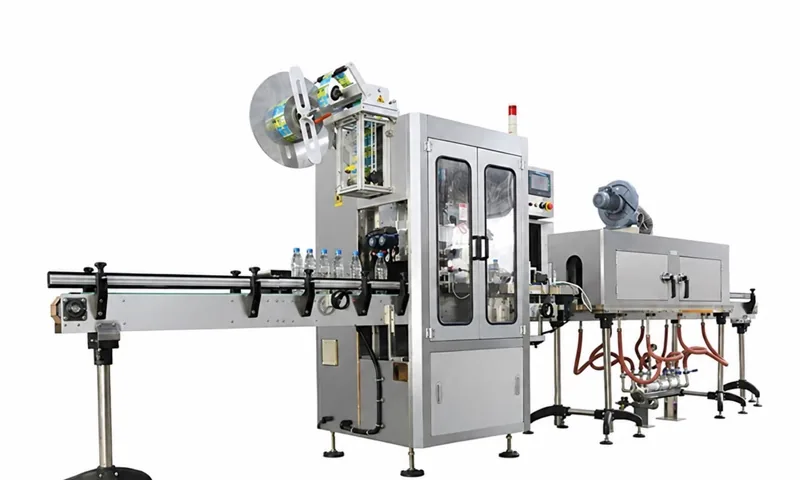
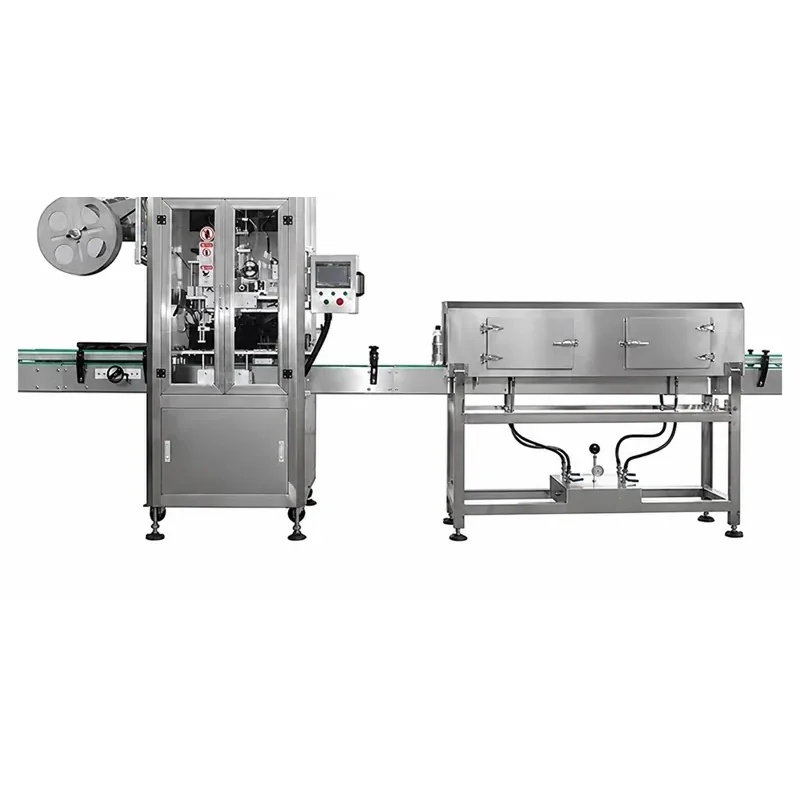
Pairing a high-speed sleeve applicator with the wrong shrink tunnel causes graphic distortion, unshrunk neck smiles, or melted thin-wall PET shoulders that force costly rework and line downtime. While the upstream sleeve applicator merely cuts and drops a loose polymer cylinder over the container, the heat shrink tunnel controls the actual thermodynamic phase change that locks PETG, PVC, OPS, or PLA film onto complex container contours.
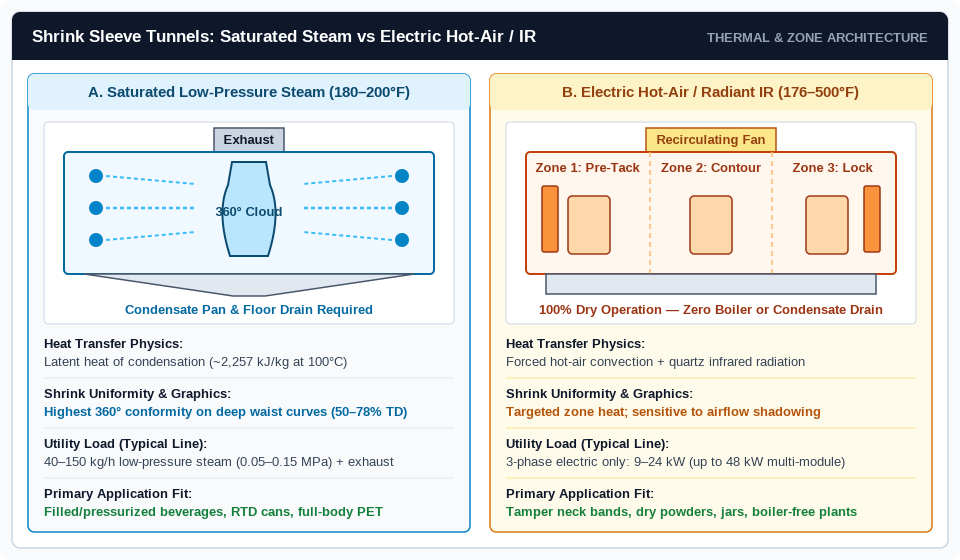
Within our shrink sleeve labeling machine hub and the broader industrial labeling machine architecture, industrial tunnels divide into two thermal transfer classes: saturated low-pressure steam shrink tunnels (180–200°F / 82–93°C) and dry electric heat shrink tunnels (176–500°F / 80–260°C, using forced hot-air convection, quartz infrared radiation, or hybrid zones). The head-to-head engineering matrix below defines where each tunnel architecture wins and where it fails.
| Engineering Parameter | Saturated Low-Pressure Steam Tunnel | Electric Forced Hot-Air Convection Tunnel | Electric Quartz Infrared (IR) / Hybrid Tunnel |
|---|---|---|---|
| Operating Chamber Temp | 180–200°F (82–93°C) saturated steam | 176–500°F (80–260°C) recirculating dry air | 250–500°F (120–260°C) radiant emitter zone |
| Heat Transfer Mechanism | Latent heat of condensation (~2,257 kJ/kg) | Sensible convective heat via directional louvers | Electromagnetic IR absorption + air circulation |
| Heat Flux Uniformity | 360° isotropic cloud (no directional shadowing) | Directional (requires multi-axis nozzle aiming) | Line-of-sight radiant (sensitive to ink color) |
| Max Transverse Shrink Fit | 50%–78% TD shrink (deep waists & full-body contours) | 15%–45% TD shrink (straight cylinders & neck bands) | 30%–55% TD shrink (thick pre-heated jars & cans) |
| Moisture Exposure | Wet (leaves 0.2–0.5 g condensate film on bottle) | 100% Dry (zero moisture added to container) | 100% Dry (zero moisture added to container) |
| Typical Utility Load | 40–150 kg/h steam at 0.05–0.15 MPa + 0.35 kW fan | 9–24 kW (single/3-zone) to 36–48 kW (6-zone) | 12–30 kW 3-phase electric (instant zone response) |
| Plant Infrastructure | Steam boiler/generator + exhaust duct + floor drain | Standard 3-phase electrical drop only | Standard 3-phase electrical drop only |
| Primary Container Fit | Pressurized/cold-fill beverages, RTD cans, contoured PET | Tamper neck bands, dry powders, spice jars, cartons | Pre-heating heavy glass jars, dark/metallized sleeves |
Thermodynamic physics: why 190°F steam shrinks faster than 350°F dry air
A frequent misconception during equipment specification is that electric hot-air tunnels shrink film more aggressively because their digital controllers display 300°F to 450°F (150–230°C), whereas a low-pressure steam shrink tunnel runs at only 180°F to 200°F (82–93°C). In practice, saturated steam transfers thermal energy into a 40 to 50 µm PETG or PVC sleeve five to eight times faster than dry air while exposing the underlying container to a much lower peak temperature.
1. Latent heat of condensation vs sensible air convection
When low-pressure saturated steam at $90^\circ\text{C}$ contacts a cold beverage bottle entering the tunnel at $4^\circ\text{C}$ to $20^\circ\text{C}$, water vapor condenses into a microscopic liquid film on the outer surface of the shrink sleeve. That phase change releases the latent heat of vaporization ($h_{fg} \approx 2,257\text{ kJ/kg}$ at $100^\circ\text{C}$), yielding a surface heat transfer coefficient of:
$$h_{\text{steam}} \approx 4,000\text{ to }12,000\text{ W/(m}^2\cdot\text{K)}$$
By contrast, forced hot-air convection relies on sensible heat transfer across a gaseous boundary layer, yielding:
$$h_{\text{hot-air}} \approx 40\text{ to }150\text{ W/(m}^2\cdot\text{K)}$$
Because steam delivers nearly two orders of magnitude higher surface heat conductance:
- Zero directional shadowing: Steam fills the tunnel chamber as a uniform 360-degree pressurized cloud. Every millimeter of the bottle circumference (leading face, trailing face, and deep pinched waist grooves) reaches the polymer glass-transition temperature ($T_g \approx 75–85^\circ\text{C}$ for PETG/PVC) at the exact same millisecond.
- No overheating of empty headspace: Because saturated atmospheric steam physically cannot exceed $212^\circ\text{F}$ ($100^\circ\text{C}$) without superheating, it never melts thin-wall PET bottle necks above the liquid fill line. In a $400^\circ\text{F}$ electric tunnel, a 3-second conveyor stop immediately warps empty PET bottle shoulders.
2. How multi-zone electric hot-air and radiant IR tunnels work
Electric heat shrink tunnels replace steam plumbing with finned stainless steel tubular heating elements, centrifugal recirculating blowers, or quartz infrared emitters divided into 1 to 6 independent temperature zones:
- Forced hot-air convection tunnels blow heated air ($80–260^\circ\text{C}$) through slotted stainless louver banks aimed at the bottom, middle, and top of the container. Operators adjust mechanical damper flaps and VFD blower speeds so the bottom edge of the sleeve tacks to the container base before the upper body shrinks upward.
- Quartz infrared (IR) radiant tunnels emit short- or medium-wave infrared energy that heats the film and container surface directly by radiation. However, dark black or navy ink absorbs IR radiation faster than white or clear film panels, which can cause localized graphic distortion (“burn-through”) on high-contrast artwork unless paired with high-velocity air circulation.
Utility load calculation: steam kg/h vs electric kW
Before selecting a tunnel, calculate your facility utility consumption and operating cost per hour using the thermal load equations below.
1. Steam tunnel consumption and boiler sizing (kg/h and kW equivalent)
A single-module stainless steam shrink tunnel (such as a $1,100\text{ to }1,800\text{ mm}$ chamber with 2 to 6 adjustable steam tube rows running at $0.05–0.15\text{ MPa}$ manifold pressure) consumes:
- Compact single-chamber steam tunnel (60–120 BPM): $\dot{m}_{\text{steam}} = 40\text{ to }70\text{ kg/h}$ of saturated steam plus a $0.35\text{ to }0.55\text{ kW}$ top exhaust blower.
- High-speed 6-row contour beverage steam tunnel (150–300+ BPM): $\dot{m}_{\text{steam}} = 80\text{ to }150\text{ kg/h}$ of saturated steam.
If your plant does not have a central natural-gas boiler house and you install a point-of-use electric steam generator next to the packaging line, convert the steam mass flow rate ($\dot{m}{\text{steam}}$ in $\text{kg/h}$) into required electrical generator power ($P{\text{boiler}}$ in $\text{kW}$) using feedwater enthalpy rise ($\Delta h \approx 2,600\text{ kJ/kg}$ from $15^\circ\text{C}$ water to saturated steam at $\eta = 95%$ efficiency):
$$P_{\text{boiler}}\text{ (kW)} = \frac{\dot{m}{\text{steam}}\text{ (kg/h)} \times 2,600\text{ kJ/kg}}{3,600\text{ s/h} \times 0.95} \approx 0.76 \times \dot{m}{\text{steam}}$$
Worked example: 150 BPM craft beverage can / bottle line
- Required tunnel steam flow: $\dot{m}_{\text{steam}} = 65\text{ kg/h}$ at $0.08\text{ MPa}$ ($11.6\text{ psi}$) regulated manifold pressure.
- Point-of-use electric steam generator load: $$P_{\text{boiler}} = 0.76 \times 65 = 49.4\text{ kW}\text{ (specify a 54 kW / 5 BHP steam generator)}$$
- If supplied from a central natural-gas plant boiler (at $$0.035/\text{kg}$ steam), the steam cost is only $$2.28/\text{hour}$.
2. Electric hot-air tunnel power draw (kW nameplate vs running duty cycle)
Electric shrink tunnels have zero water treatment, zero boiler blowdown, and zero condensate drain requirements. Their electrical power draw follows a two-stage curve:
- Warm-up peak load (first 15–20 minutes): Heating elements run at 100% nameplate rating, typically 9 to 15 kW on a single-zone tunnel (
LV-DZB-1135/ compact class) and 18 to 36 kW (up to 48 kW on dual-module 6-zone tunnels like theLV-G1Bmulti-zone class). - Steady-state running load ($P_{\text{run}}$): Once the double-walled insulated stainless chamber reaches setpoint, PID solid-state relays (SSRs) pulse the heaters at a 55% to 70% duty cycle:
$$P_{\text{run}}\text{ (kW)} = P_{\text{nameplate}} \times D_{\text{SSR}} + P_{\text{blowers}}$$
For a 3-zone $24\text{ kW}$ electric hot-air tunnel running at 62% heater duty cycle with $1.5\text{ kW}$ of recirculating blowers:
$$P_{\text{run}} = (24 \times 0.62) + 1.5 = 16.38\text{ kW average draw}$$
At an industrial electricity rate of $$0.12/\text{kWh}$, hourly energy cost is $$1.97/\text{hour}$ with zero water or drain plumbing.
Tunnel length and dwell time formula
Regardless of whether you choose steam or electric heat, a shrink sleeve requires 1.8 to 3.5 seconds of chamber dwell time ($t_{\text{dwell}}$) to relax molecular orientation smoothly without snap-back wrinkling. Calculate the minimum required heated tunnel chamber length ($L_{\text{tunnel}}$ in meters) from your conveyor speed ($v_{\text{conveyor}}$ in $\text{m/min}$):
$$L_{\text{tunnel}}\text{ (m)} = \frac{v_{\text{conveyor}}\text{ (m/min)} \times t_{\text{dwell}}\text{ (s)}}{60}$$
Worked sizing check: 200 BPM beverage line
- Container pitch on conveyor: $P_{\text{pitch}} = 115\text{ mm}$ ($0.115\text{ m}$)
- Conveyor speed: $v_{\text{conveyor}} = 200 \times 0.115 = 23.0\text{ m/min}$
- Target dwell time for a 50 µm PETG full-body contour sleeve: $t_{\text{dwell}} = 2.6\text{ s}$
- Required heated tunnel chamber length: $$L_{\text{tunnel}} = \frac{23.0 \times 2.6}{60} = 1.00\text{ m}\text{ (minimum)} \rightarrow \text{Specify a } 1.5\text{ m to } 1.8\text{ m}\text{ tunnel}$$
Rule of thumb: For speeds under 80 BPM, a single $1.2\text{ to }1.5\text{ m}$ tunnel chamber is sufficient. Between 100 and 220 BPM, specify a $1.8\text{ to }2.4\text{ m}$ multi-zone tunnel (or two $1.2\text{ m}$ modular tunnels in series). Above 250 BPM, use a $3.0\text{ to }4.5\text{ m}$ three-module steam tunnel with independent pre-tack, middle contour, and top-neck finishing manifolds.
Application decision rules: when to specify steam vs electric
Use these five container and plant rules to lock in the right tunnel type (and compare our pressure-sensitive vs shrink sleeve analysis if you are still evaluating sleeve film against self-adhesive labels):
- Full-body contoured beverages, dairy, and RTD aluminum cans: Always specify a low-pressure saturated steam shrink tunnel. Filled liquid containers act as an internal heat sink that absorbs excess thermal energy, while 180–200°F latent steam shrinks 50%–78% high-shrink PETG and OPS sleeves uniformly into deep waist curves without distorting barcodes or nutrition typography. (See our can and tin labeling machine guide and water bottle labeling guide.)
- Tamper-evident neck bands only: Specify a compact electric hot-air or radiant neck-zone tunnel (1.8 to 4.5 kW). Shrinking a 25 mm tall neck band over a bottle cap requires localized dry heat aimed only at the closure ring for 1.2 to 2.0 seconds; installing a steam boiler and condensate hood for a neck band is unnecessary capex and adds unwanted moisture around the cap threads. (See our tamper-evident neck band applicator guide.)
- Moisture-sensitive dry products (powders, spices, nutraceutical tablets, paperboard canisters): Specify an electric forced hot-air tunnel. Steam tunnels deposit residual moisture under cap skirts and require downstream air-knife blow-off dryers; dry electric convection keeps humidity out of hygroscopic products.
- Empty thin-wall plastic bottles labeled before filling: Avoid high-temperature electric tunnels and use either filled-bottle steam shrinking or a carefully baffled low-temperature steam tunnel with internal container air support. Empty PET walls warp above $75^\circ\text{C}$ when unbacked by liquid.
- Cold-filled glass bottles (
2–6°C): In a high-temperature electric IR/hot-air tunnel ($220^\circ\text{C}$), thermal shock can crack cold glass if the conveyor stops. Low-pressure steam ($85–92^\circ\text{C}$) eliminates glass thermal-shock breakage and heats the bottle surface gently.
Failure modes, root causes, and corrective actions
| Shrink Defect / Symptom | Root Cause in Tunnel | Corrective Engineering Action |
|---|---|---|
| “Smiling” (bottom or top sleeve edge curves upward at front/back faces) | Bottom of sleeve was not tacked first, allowing upper-zone heat to pull the unanchored bottom edge upward. | Aim Zone 1 (entry) bottom steam nozzles or lower hot-air louvers directly at the container base heel so the bottom 15 mm locks before middle/top zones fire. |
| Vertical wrinkling or “fish-eyes” in pinched bottle waist | Insufficient heat flux in the recessed waist zone, or film TD shrink percentage (< 50% PVC) cannot bridge container diameter delta. | Angle middle manifold steam tubes into the waist recess, open manifold needle valve by 15%, or switch from PVC/OPS to high-shrink 75–78% TD PETG film. |
| Graphic distortion / oval barcode stretching | Asymmetric left-to-right nozzle pressure in steam tunnel, or container not spinning on a motorized rotation conveyor when required. | Equalize left and right manifold pressure gauges (0.06–0.10 MPa), clean clogged steam orifices, or enable under-chain container spin belt on oval graphics. |
| Ballooning / air pockets trapped under full-body sleeve | Air trapped between sleeve and bottle wall expands faster than it can escape through the top neck opening as both ends seal simultaneously. | Specify twin micro-perforation vent holes in the sleeve applicator cutter head, and sequence tunnel heat strictly from bottom $\rightarrow$ middle $\rightarrow$ top. |
| Water spotting or wet carton flaps downstream of steam tunnel | Exhaust blower damper closed too far, or missing air-knife dryer between steam tunnel exit and case packer. | Balance top exhaust fan so steam plumes neither billow out the tunnel ends nor starve the chamber, and mount a 2.2–4.0 kW dual air-knife dryer after tunnel exit. |
Specification checklist for tunnel procurement
Include these five parameters from our labeling machine RFQ checklist when messaging LINEVO engineers on WhatsApp:
- Container material, wall thickness, and fill state: Empty vs filled, fill temperature ($^\circ\text{C}$), minimum and maximum body diameters ($D_{\text{min}}$ and $D_{\text{max}}$ in mm) to calculate required transverse shrink percentage.
- Sleeve film specification: Polymer family (PETG, PVC, OPS, or PLA), film thickness (35 to 70 µm), and coverage zone (tamper neck band, partial body, or 360° full-body over-the-cap).
- Line speed and conveyor height: Nominal and surge BPM, container pitch, and existing conveyor elevation ($850\text{ to }1,050\text{ mm}$ standard).
- Plant utilities available: Confirm whether central low-pressure steam + floor drain + roof exhaust stack are available at the drop point, or whether a skid-mounted electric steam generator or 100% dry electric tunnel is required.
- Stainless steel grade: Specify 304 stainless steel for standard beverage halls, or 316 stainless steel when plant washdown uses chlorinated or acidic sanitizers.
Common questions
Can a steam shrink tunnel run without a central plant boiler?
Yes. Packaging lines without a central boiler house pair the steam tunnel with a compact skid-mounted electric steam generator (typically 18 to 54 kW) positioned directly beside the conveyor. The generator connects to a standard 3-phase electrical drop and a softened city water line, producing regulated low-pressure steam (0.05 to 0.15 MPa) within 10 to 15 minutes of startup. You still need a floor drain for condensate and an exhaust duct over the tunnel hood.
Why do beverage plants prefer steam tunnels over electric hot-air tunnels for full-body sleeves?
Beverage bottles and cans are almost always labeled after filling and seaming, meaning the cold liquid inside the container acts as a massive heat sink. Saturated low-pressure steam at 180–200°F condenses instantaneously across the entire 360-degree surface, transferring latent heat evenly into the thin film before the cold liquid can chill the sleeve, and without directional airflow shadows or high-temperature hotspots that warp thin PET walls.
Do containers need an air-knife dryer after exiting a steam shrink tunnel?
If containers go directly from the steam shrink tunnel into cardboard case packing, multipack shrink bundling, or date-code inkjet printing, yes—you should install a high-velocity centrifugal air-knife blow-off dryer immediately after the tunnel exit. The air knife strips the thin condensate film left by the steam tunnel in under 1 second so shipping cartons do not absorb moisture and inkjet lot codes adhere cleanly.
How many zones should an electric heat shrink tunnel have for full-body containers?
While a single-zone electric tunnel is sufficient for simple tamper-evident neck bands or low-shrink cylindrical tubs under 50 BPM, full-body sleeves on contoured jars or bottles require a 3-zone to 6-zone recirculating electric tunnel (such as a 6-zone LV-G1B forced-convection architecture). Multi-zone control lets operators set a lower pre-tack temperature at the tunnel entry to anchor the bottom rim, a higher middle-zone temperature for waist conformity, and a controlled exit zone to lock the neck shoulder without wrinkling.
Related Guides & Specifications
Pressure Sensitive vs Shrink Sleeve: How to Choose for Your Container and Line
Compare pressure sensitive vs shrink sleeve labeling across container curves, label cost, steam or electric tunnel kW draw, footprint, and moisture resistance.
Learn moreTamper-Evident Neck Band Applicator: Overhang Geometry, Perforation & Line Integration
Specify automatic tamper-evident shrink neck band applicators for jars and bottles: cap overhang rules, vertical/T-perforation blades, and 21 CFR 211.132 compliance.
Learn moreRelated Equipment & Guides
Automatic Labeling Machines: How to Choose by Container, Label and Speed
Choose an automatic labeling machine by container shape, label type and speed. Compare labeler types, accuracy tiers and the checks to run on your samples.
Learn moreShrink Sleeve Labeling Machines: How to Match Applicator, Film and Shrink Tunnel
Specify a shrink sleeve labeling machine by sleeve format, layflat width, film shrink ratio and steam or electric tunnel. Compare speeds and sample test steps.
Learn moreBottle Labeling Machines: How to Choose by Container Material, Shape, and Line Speed
Select a bottle labeling machine by container material (glass, PET, HDPE), shape (round, flat, oval, square, tapered), surface condensation, and line speed.
Learn morePressure Sensitive vs Shrink Sleeve: How to Choose for Your Container and Line
Compare pressure sensitive vs shrink sleeve labeling across container curves, label cost, steam or electric tunnel kW draw, footprint, and moisture resistance.
Learn moreTamper-Evident Neck Band Applicator: Overhang Geometry, Perforation & Line Integration
Specify automatic tamper-evident shrink neck band applicators for jars and bottles: cap overhang rules, vertical/T-perforation blades, and 21 CFR 211.132 compliance.
Learn moreWater Bottle Labeling Machines: PET Wrap-Around, Roll-Fed BOPP, and Shrink Sleeve
Compare pressure-sensitive wrap, roll-fed BOPP hot-melt, and shrink sleeve water bottle labelers for thin-wall PET, sparkling water, and glass lines.
Learn moreCan and Tin Labeling Machines: Chime Clearance, Wall Dent Prevention & Format Selection
Select can and tin labeling machines for 12/16 oz aluminum beverage cans, steel food tins, and aerosols across wrap PS, shrink sleeve, and hot-melt.
Learn more