Why Container Physics Dictate Bottle Labeler Architecture {#container-first-selection}
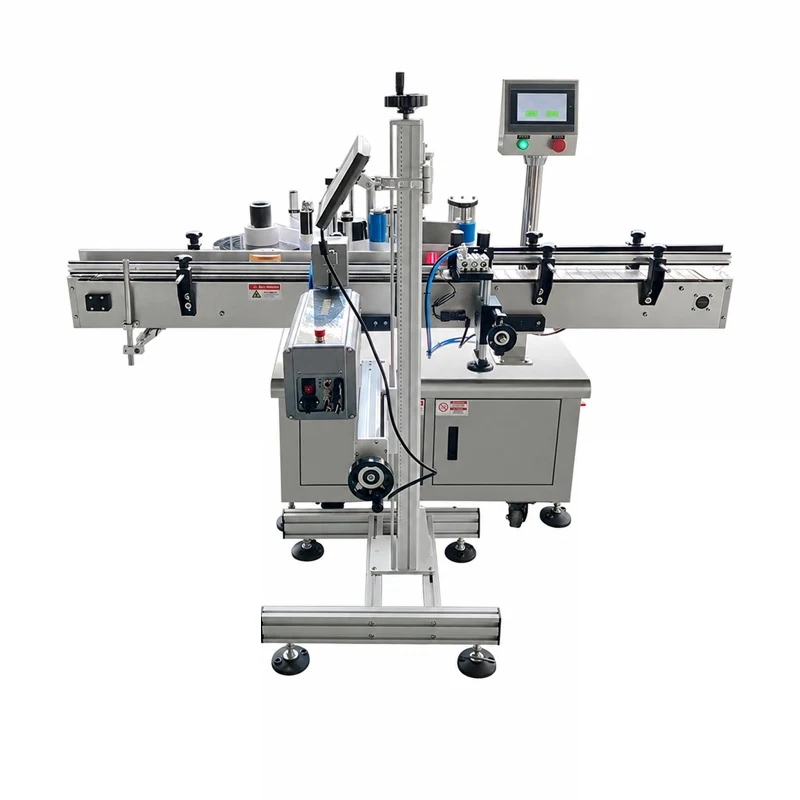
Selecting a bottle labeling machine by nameplate speed alone is the single most common cause of chronic label skew, edge flagging, unscheduled line downtime, and costly rejected bottles. Across beverage, food, personal care, and pharmaceutical plants, label-related defects account for 15% to 20% of all packaging line stoppages and waste. Within our broader industrial labeling machines engineering framework, this container-first hub routes buyers from physical bottle properties to the exact mechanical handling, web dispensing, and adhesive architecture required for stable production.
| Bottle Profile & Rigidity | Recommended Labeler Architecture | Rated Speed Range | Placement Accuracy | Baseline Uninspected Defect Rate |
|---|---|---|---|---|
| Cylindrical Rigid / Pressurized Round | Linear wrap belt, 3-roller indexer, or rotary roll-fed BOPP | 50–400 BPM (linear/rotary); up to 600+ BPM | ±1.0 mm wrap; ±0.5 mm 3-roller | 2.8–3.2% |
| Flat, Oval & Elliptical Squeeze Bottles | Dual-head linear front & back with chain aligner + top belt | 80–120 BPM standard; up to 300 BPM servo | ±0.8–1.0 mm | 1.9% (flat) to 5.6% (oval) |
| Square, Rectangular & Multi-Faceted | Front/back + corner wiper or 3-panel U-wrap system | 50–200 BPM | ±0.8–1.0 mm | 1.9% |
| Tapered, Contoured & Full-Body Decorated | Tilted-head arched PS or shrink sleeve + steam tunnel (180–200°F) | 50–400 BPM (up to 54,000 BPH rotary sleeve) | ±1.0–1.5 mm | Dependent on shrink ratio (up to 78% PETG) |
| Unstable Small Vials & Dropper Bottles | Horizontal trunnion roller cradle or vertical starwheel turret | 100–300 BPM | ±0.5–1.0 mm | <2.0% with positive pocket control |
Every bottle presents four physical variables to the labeling station:
- Cross-sectional geometry and sidewall draft angle, which govern whether the container can be spun against a single wrap belt, locked under a dual-chain overhead press belt for two-sided application, or enclosed in a heat-shrunk film sleeve.
- Wall rigidity and polymer surface energy, which determine whether wiper pressure will buckle a thin-wall PET bottle or whether low-energy HDPE (<38 dynes/cm) will reject standard acrylic adhesives.
- Surface moisture and fill temperature, which separate dry ambient labeling from cold-fill beverage condensation (4°C to 12°C) and hot-fill sauce pasteurization (82°C to 90°C).
- Net sustained line velocity and SKU changeover frequency, which establish the boundary between semi-automatic tabletop fixtures (10 to 30 BPM), automatic inline linear systems (50 to 200 BPM), and continuous rotary turrets (150 to 600+ BPM).
Bottle Geometry & Mechanical Handling Architectures {#bottle-geometry-architectures}
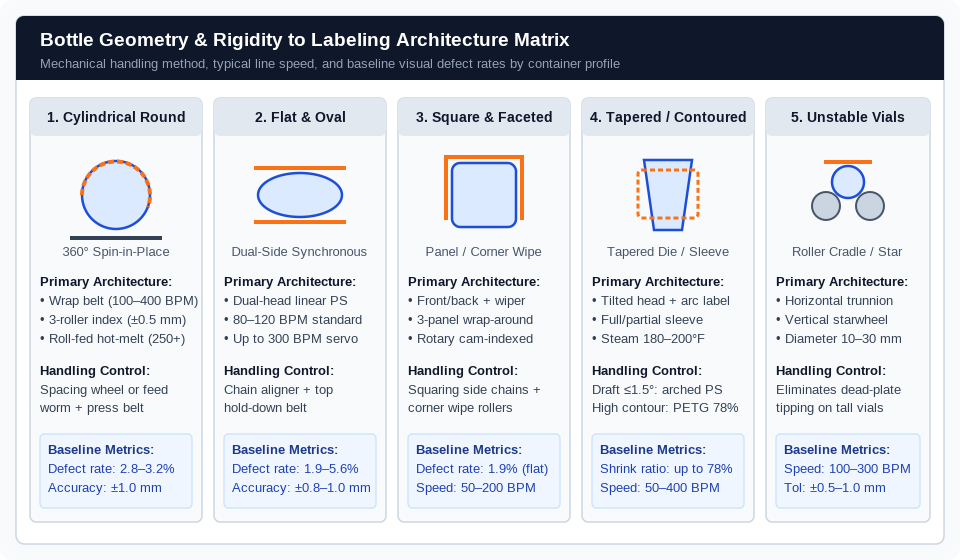
Before a label web ever reaches the peel plate, the transport system must present the bottle at a constant linear velocity with zero pitch, yaw, or rotational slip. Production quality data from beverage and consumer-goods lines shows that baseline label defect rates (prior to adding camera vision rejection) vary significantly by container geometry: square and flat-panel bottles average 1.9% defects, standard cylindrical round bottles average 2.8% to 3.2%, oval and irregular contoured bottles reach 5.6%, transparent film-on-clear-bottle combinations average 6.1%, and metallic or reflective containers reach 7.4%. Matching the mechanical transport to the container cross-section closes these gaps.
1. Cylindrical Round Bottles (Full Wrap, Partial Wrap, or 3-Roller Index)
Rigid and semi-rigid round bottles (20 mm to 120 mm diameter) with straight vertical sidewalls are the simplest geometry to run. In a continuous wrap-around pressure-sensitive labeler, an infeed spacing wheel or timing worm separates incoming bottles onto a flat-top Delrin or stainless conveyor chain. As the bottle leading edge triggers the product photodetector, the servo applicator dispenses the label leading edge onto the cylinder wall while a motorized side wrap belt (backed by a compliant sponge pressure pad) rolls the bottle through 360 degrees against a stationary backrest.
Continuous belt-wrap stations run 100 to 400 BPM at ±1.0 mm vertical and overlap registration. When a round bottle requires either zero-overlap butt-seam registration within ±0.5 mm, orientation relative to a glass mold seam, or simultaneous front and back labels from a single web on thick glass (such as 750 mL Bordeaux wine bottles or amber apothecary rounds), a three-roller indexing station is used instead. Two driven support rollers and a pneumatic swing-arm pressure roller clamp the bottle in a three-point planetary cradle, spinning it at an exact surface-speed match while the label wipes down without vertical drift.
2. Flat, Oval, and Elliptical Bottles (Dual-Head Linear with Top Hold-Down)
Shampoo flasks, motor oil quarts, household detergent bottles, and oval nutraceutical containers cannot be spun on a conveyor. They require a dual-head front-and-back bottle labeling machine equipped with two synchronized stages ahead of the peel plates:
- Dual-side chain aligners (motorized vertical side belts or angled roller guides) that center the oval or flat cross-section along the conveyor centerline and square its major axis parallel to direction of travel.
- An overhead synchronized top hold-down belt (sponge-faced timing belt driven at a 1:1 ratio with the main conveyor) that presses down on the bottle cap or shoulder before the container releases from the chain aligner, locking its orientation through both the left and right dispensing heads.
Standard industrial front-and-back inline systems (such as the LINEVO LV-BSL 2S) operate at 80 to 120 containers per minute in baseline configurations and scale up to 300 BPM on compact stable bottles with servo screw or roller spacing. Placement accuracy holds ±0.8 mm to ±1.0 mm across label heights from 8 mm to 180 mm.
3. Square, Rectangular, and Multi-Faceted Bottles
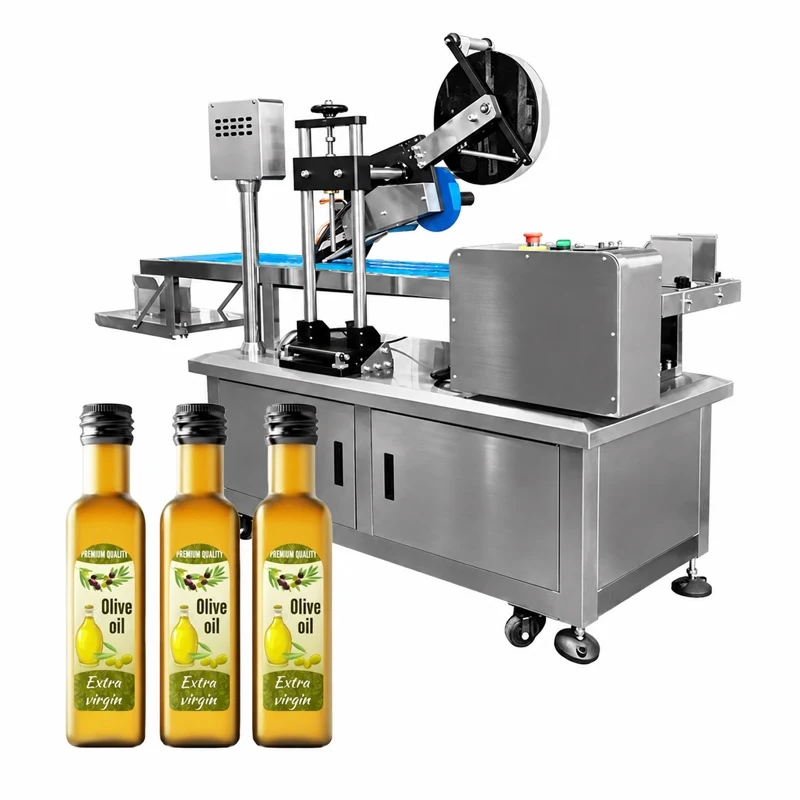
Square glass culinary oil bottles, spirits decanters, and rectangular chemical jugs require either two-panel opposing application, three-panel U-wrap application, or four-panel wrap-around wiping. Because square corners create air pockets if a label is wiped with a flat brush alone, square bottle labelers combine squaring side chains with articulated spring-loaded wiper fingers or pneumatic dual-roller corner wipe assemblies that press the label onto the front panel first, then iron the wings around the 90-degree radii onto the side panels.
4. Tapered, Contoured, and Full-Body Decorated Bottles
When a bottle has a conical sidewall taper (draft angle exceeding 1.0° to 1.5°), a rectangular label fed horizontally will climb toward the narrower diameter and wrinkle along the trailing edge. Packaging engineers solve tapered geometry in one of two ways:
- For moderate single-plane tapers (such as tapered glass jars or sloped-shoulder beverage bottles), die-cutting the pressure-sensitive label in a calculated curved arc (“banana label”) and tilting the applicator head on a multi-axis pitch jack to match the sidewall angle.
- For compound curves, pinched waists, or 360-degree top-to-bottom decoration, deploying a shrink sleeve labeling machine that drops a 40 to 70 micron tubular film sleeve over the bottle and shrinks it tightly inside a 180°F to 200°F (82°C to 93°C) steam tunnel. PETG shrink film provides up to 78% transverse shrink ratio, conforming cleanly around severe neck-to-body transitions.
5. Unstable Small-Diameter Vials, Ampoules, and Dropper Bottles
Small cylindrical containers with diameters between 10 mm and 30 mm (essential oil droppers, 2 mL to 20 mL injectable vials, lip balm tubes, and diagnostic reagent tubes) have a high center of gravity or rounded bottom corners that tip on flat conveyors. Dedicated vial and dropper bottle labelers replace flat belt transport with either a horizontal roller trunnion conveyor (cradling each tube horizontally between stainless steel rollers at 100 to 300 BPM) or a vertical indexing starwheel that captures upright dropper bottles in machined Delrin pockets throughout the wrap cycle.
Container Material & Surface Physics: Glass, PET, and HDPE {#material-surface-physics}
The physical interaction between bottle wall, adhesive layer, and label facestock determines whether a label stays bonded through warehousing, cold-chain transport, and consumer use.
| Bottle Substrate | Typical Surface Energy | Structural & Thermal Behavior | Recommended Facestock & Adhesive Pairing | Critical Machine Adjustment |
|---|---|---|---|---|
| Flint & Amber Glass | High (>45 dynes/cm clean; reduced by hot-end/cold-end mold coatings) | Rigid wall; heavy mass; prone to mold parting-line seams and condensation on cold fills | Paper, BOPP, or textured estate stocks with permanent acrylic (-20°C to +80°C), wet-strength acrylic, or wet cold-glue | Heavy-duty feed worm or starwheel pitch control; servo seam orientation (±2° to ±5°) if avoiding parting lines |
| Thin-Wall PET (Still & Sparkling) | Medium-High (~42 dynes/cm) | Compressible when unpressurized; expands slightly under carbonation or nitrogen dosing | Clear or white BOPP film (50–60 μm) for PS; 35–50 μm linerless OPP for hot-melt; 40–50 μm PETG/OPS for shrink sleeve | Low-durometer foam wrap pad; label after capping and nitrogen dosing so internal pressure rigidifies the sidewall |
| HDPE & Polypropylene (PP) | Low (<38 dynes/cm untreated) | Flexible squeeze wall; slight post-mold shrinkage and outgassing if filled warm | Conformable PE or polypropylene film with high-tack rubber-based or LSE-modified acrylic adhesive | Matched film-to-bottle modulus (“squeeze-friendly” PE label on PE bottle) plus dual-side top-belt stabilization |
| Frosted, Silicone-Coated, or Metallic Bottles | Variable / Low effective contact area | High optical reflectivity triggers false photoelectric gap/product sensor trips | High-tack aggressive rubber/acrylic adhesive; ultrasonic or capacitive gap sensing for clear/metallic webs | Fiber-optic contrast sensors rated for ≥5% contrast differential at 3+ m/s web speeds, or mechanical/ultrasonicfork sensors |
Addressing Wet Condensation, Hot-Fill, and Cold-Chain Environments
Surface temperature and moisture at the moment of application dictate adhesive rheology and upstream drying requirements:
- Chilled water, beer, and ready-to-drink beverages filled at 4°C to 12°C condense atmospheric moisture immediately after leaving the filler bowl. Standard emulsion acrylic adhesives hydroplane on that microscopic water film, causing labels to slide or blister. Production lines combine dual high-velocity air knives ahead of the labeler with either wet-strength acrylic pressure-sensitive adhesives (formulated for wet application and ice-bath immersion), rotary cold-glue wet-adhesive paper labeling, or shrink sleeve application where mechanical film shrinkage holds the sleeve independent of surface tack.
- Pre-chilled and frozen containers (<10°C down to -40°C) require freezer-grade acrylic or hot-melt rubber adhesives engineered with a low glass-transition temperature so the bond does not turn brittle in blast freezers.
- Hot-fill sauces, juices, and condiments filled at 82°C to 90°C in PET bottles must pass through a cooling tunnel before pressure-sensitive labeling, or be labeled using heat-stabilized BOPP facestock that resists shrink-back as the container cools and pulls an internal vacuum.
Speed Tiers, Effective OEE Sizing, and Label Waste Economics {#speed-tiers-oee}
When sizing a bottle labeling machine, engineering teams must distinguish between instantaneous mechanical rating (the speed at which the servo drive can dispense labels over a 60-second sprint) and effective shift throughput. Across industrial packaging operations, effective throughput achieves 70% to 85% of rated machine speed. Typical packaging lines operate at 60% to 75% Overall Equipment Effectiveness (OEE), while world-class plants with automated splicing and upstream/downstream accumulation reach 85%+ OEE.
For example, a bottle labeler rated at 200 BPM delivers 140 to 170 BPM of net output in a standard production environment (150 BPM at 75% OEE, or 72,000 bottles per 8-hour shift). To size your labeler with adequate surge capacity so it never starves the case packer or backs up the filler, divide your required shift output by effective_minutes × 0.75 and specify a machine whose mechanical rating is 20% to 30% above the filler’s nominal speed.
| Production Volume Tier | Rated Speed Range | Effective Net Output (at 70–85% OEE) | Primary Machine Architecture | Typical Changeover Time | Labor & Waste Benchmark |
|---|---|---|---|---|---|
| Low / Batch Volume | 10–60 BPM | 7–50 BPM (3,000–20,000 bottles/shift) | Semi-automatic tabletop wraparound or foot-pedal applicator | 5–10 minutes | 1 dedicated operator per unit; ±1.5–2.0 mm accuracy |
| Medium / Multi-SKU Inline | 60–200 BPM | 45–170 BPM (22,000–80,000 bottles/shift) | Automatic linear wrap-around or dual-head front-and-back PS labeler | 15–30 minutes (5–15 min with tool-free digital handwheels & recipe memory) | 0.5–1 operator per line; label waste drops from 5–8% (manual) to <2% at ±1.0–1.5 mm accuracy |
| High-Speed Dedicated Line | 200–600+ BPM | 150–510+ BPM (72,000–240,000+ bottles/shift; rotary sleeve up to 54,000 BPH) | Continuous rotary cam/servo turret (PS, cold-glue, or roll-fed hot-melt) or high-speed rotary shrink sleeve | 30–60 minutes (starwheel change parts, mandrel swap, or shrink tunnel adjustment) | 1 operator overseeing integrated block; dual-unwind non-stop roll splicing mandatory |
At speeds above 250 BPM, stopping the line every 20 to 30 minutes to thread a new 300 mm OD pressure-sensitive label roll destroys OEE. High-speed bottle labelers solve this either by mounting dual supply reels with automatic zero-downtime web splicers, by running roll-fed BOPP hot-melt reels up to 600 mm outer diameter on 152 mm cores, or by specifying larger 400 mm to 500 mm servo-unwound PS supply reels. You can calculate exact roll run time, linear web speed, and shift roll consumption using our interactive label roll unwind direction chart and roll calculator.
Representative Bottle Labeler Envelopes & Technical Specifications {#representative-machine-envelopes}
To assist plant layout and utility planning, the table below summarizes verified industry-standard machine envelopes across the four primary linear and rotary bottle labeling classes, alongside how LINEVO configures custom-engineered systems.
| Machine Class | Rated Speed | Container Size Envelope | Label Web & Roll Specifications | Power & Footprint Benchmark | LINEVO Configuration Approach |
|---|---|---|---|---|---|
| Automatic Linear Round Bottle Wrap Labeler | 0–120 BPM (high-speed servo wrap configurations up to 200 BPM) | Diameter: 20–80 mm (extended rails to 120 mm); Height: 50–200+ mm | Core ID: 75/76 mm; Max Roll OD: 300 mm; Placement accuracy: ±1.0 mm | 0.3–0.75 kW, 220V/380V; ~2000 × 1280 × 1400 mm; ~160 kg | Configured on request to buyer bottle drawings with spacing wheel, feed worm, or 3-roller indexing |
| Automatic Double-Side (Front & Back) Bottle Labeler | 80–120 LPM standard (up to 300 BPM on small stable containers) | Width/Dia: 15–200 mm; Height: 30–300 mm; Conveyor height: 830–875 mm | Label height: 8–180 mm; Min length: ≥12 mm; Die-cut gap: ≥3 mm; Core: 76 mm; Max OD: 300 mm; Accuracy: ±0.8–1.0 mm | 0.75–2.5 kW; ~3000 × 1400 × 1750 mm; ~320 kg | Configured on request with chain aligner, overhead top hold-down belt, and optional swing-in wrap belt |
| Flat & Square Panel Bottle Labeler | 50–200 BPM | Width: 10–200 mm; Thickness/Height: 10–80+ mm | Core ID: 76 mm; Max Roll OD: 300 mm; Baseline flat-panel defect rate: 1.9% | 1.25 kW; ~190 kg compact stainless chassis | Configured on request with pneumatic corner wipers or 3-panel U-wrap brush assemblies |
| Rotary Roll-Fed Hot-Melt BOPP Bottle Labeler | Up to 250 BPM (12-station round) to 600+ BPM (multi-turret) | Round & square beverage/water bottles; Conveyor speed: 25–30 m/min | Label height: 140–180 mm; Length: 430–750 mm; Max web speed: 100 m/min; Core ID: 152 mm; Max OD: 600 mm; Glue temp: 120–160°C; Accuracy: ±1.0 mm | 8.0 kW (including hot-melt tank & drum heaters), 380V 3-phase | Engineered to line layout with vacuum cutter drum, servo registration eye-mark control, and LN2 integration |
Application & Architecture Sub-Guides by Bottle Category {#bottle-application-pathways}
Because beverage, food, and multi-format container lines face distinct regulatory, thermal, and container-handling constraints, we maintain dedicated engineering selection guides for the core bottle applications and machine sub-families:
| Application / Machine Guide | Primary Container Profiles | Core Engineering Focus |
|---|---|---|
| Water Bottle Labeling Machines | Thin-wall still & sparkling PET (250 mL to 5 L) and glass mineral water | Comparing pressure-sensitive wrap, roll-fed BOPP hot-melt (120–160°C lap-end gluing), and full-body shrink sleeve; LN2 dosing for sidewall rigidity and wet condensation control |
| Jar Labeling Machines | Wide-mouth glass & plastic jars for sauces, honey, jam, and cosmetics | Managing sidewall draft angles, ±2° to ±5° mold-seam orientation, L-clip and neck-band tamper evidence, and 21 CFR § 101.2 food Information Panel rules |
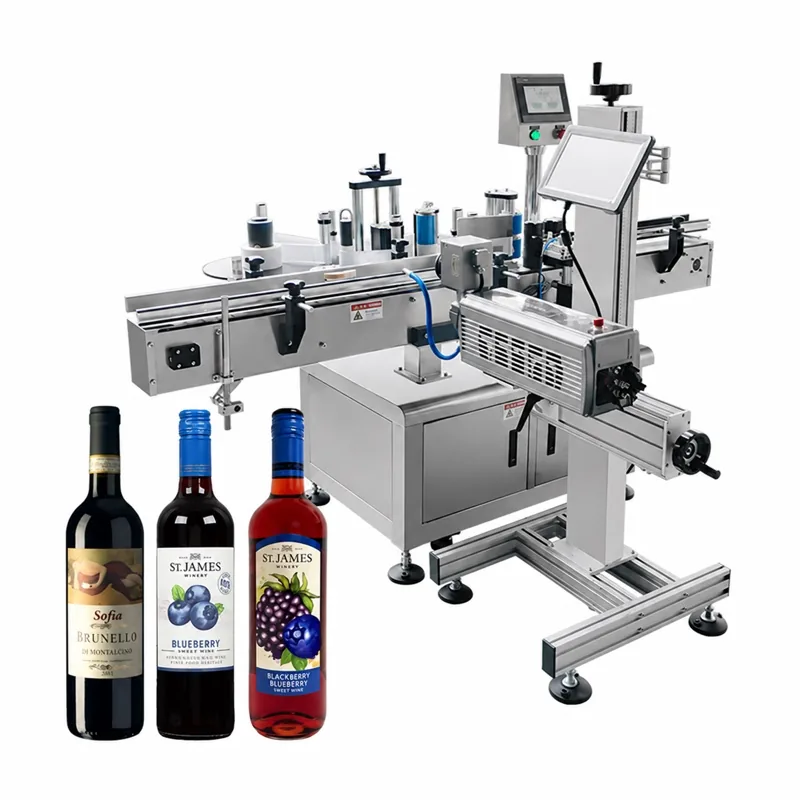
| Beer and Wine Bottle Labeling | 330–750 mL glass Bordeaux, Burgundy, tapered punt, and craft beer bottles | Three-roller butt-seam and front/back/neck registration, wet cold-fill condensation wiping, and capsule/medallion orientation |
| Can and Tin Labeling Machines | Aluminum beverage cans, three-piece sanitary food tins, and composite canisters | Seam-clearance guide rails, bright-stack condensation handling, and high-speed wrap-around vs shrink-sleeve decoration |
| Round Bottle Labeling Machines | Cylindrical glass, PET, HDPE, and metal bottles (15 mm to 150 mm diameter) | Continuous side-belt wrap vs. three-roller planetary indexing (±0.5 mm registration), feed worm vs. spacing wheel pitch control |
| Front and Back Bottle Labeling Machines | Flat, oval, rectangular, square, and tapered dual-panel bottles | Synchronized dual-chain alignment, overhead top hold-down belts, and opposing left/right servo peel-plate dispensing |
| Container Label Size & Coverage Calculator | Cylindrical, oval, square, and tapered bottles | Interactive circumference, wrap percentage, overlap margin, and maximum straight-panel height calculator |
For pharmaceutical and OTC liquid bottles governed by FDA Current Good Manufacturing Practice, packaging lines must also enforce physical separation, lot/control coding, and documented pre-run line clearance under 21 CFR § 211.130, as well as distinctive tamper-evident neck bands or breakable closures under 21 CFR § 211.132.
Sample-Trial & Factory Acceptance (FAT) Verification for Bottle Lines {#fat-verification}
Before releasing a bottle labeling machine for export crating, run a physical sample trial and witnessed Factory Acceptance Test (FAT) on 50 to 100 filled, capped production containers and actual converter-wound label rolls across these five verification checkpoints:
- Center-of-gravity and thin-wall stability check: Run both the lightest thin-wall PET bottle and the tallest or most tapered glass SKU through the timing screw, chain aligner, and overhead hold-down belt at target and surge BPM to verify zero bottle rocking, tipping, or sidewall ovalization during wipe-down.
- Condensation and surface-energy bond test: Replicate actual infeed wall conditions (ambient dry vs 4°C to 12°C cold-fill condensation after dual air-knife stripping, or untreated <38 dyne/cm HDPE) and inspect 50 labeled containers after 24 hours for trailing-edge lift or micro-bubbling.
- Clear-film and splice registration test: Confirm the unwind direction (#1 through #8) and verify that ultrasonic or capacitive gap sensors hold ±0.8 mm to ±1.0 mm registration across roll splices and speed ramps without missing clear-on-clear labels.
- Accumulation recovery and surge-speed endurance: Run a continuous 30-minute endurance trial at the +20% to +25% surge catch-up speed to confirm that the 2 to 5 minute accumulation buffer drains cleanly after a simulated 45-second roll splice without snapping the release liner.
- Coder and single-bottle fault rejection challenge: Pass deliberate fault samples (missing label, skewed barcode, and blank lot code) through the TTO/CIJ/laser coder and vision station to verify 100% positive pneumatic diversion into the locked reject bin.
Use our labeling machine RFQ checklist to organize your URS package, size your wrap panels with the container label size and coverage calculator, and message LINEVO engineers on WhatsApp for a tailored bottle line configuration.
Frequently Asked Questions {#faq}
What is the real production output of a 200 BPM bottle labeling machine?
In continuous plant operation, effective throughput typically reaches 70% to 85% of the nameplate mechanical rating once roll splices, upstream filler micro-stops, and format changeovers are factored in. At a typical packaging line OEE of 60% to 75%, a 200 BPM automatic bottle labeler delivers 140 to 170 bottles per minute of net salable output.
Why do pressure-sensitive labels lift at the edges on HDPE and polypropylene bottles?
Untreated high-density polyethylene (HDPE) and polypropylene (PP) have low surface energy below 38 dynes/cm, which prevents standard general-purpose acrylic adhesives from wetting out across the plastic wall. Specifying a high-tack rubber-based adhesive or a modified low-surface-energy acrylic formulation prevents edge flagging and delamination.
When should a bottle line switch from a linear wrap-around labeler to a rotary bottle labeler?
Linear wrap-around and dual-head front-and-back machines handle single-lane speeds from 50 to 200 BPM with 15 to 30 minute changeovers. A rotary cam-indexed or servo-turret bottle labeler becomes necessary when sustained line speed exceeds 200 to 250 BPM (up to 600+ BPM), when multi-label neck, body, and back registration must hold ±0.5 mm under positive bottle control, or when wet glass bottles require cold-glue or hot-melt application.
How do bottle labeling machines prevent tall, narrow dropper and vial bottles from tipping?
Containers with a base-diameter-to-height ratio below 1:4 tip easily when crossing conveyor dead plates. Industrial vial and dropper labelers eliminate tipping by transferring bottles either onto a horizontal trunnion roller indexing chain where containers lie flat during 360-degree wrap application, or into a vertical starwheel pocket turret that grips the cylinder wall throughout peel-and-wipe.
Can one automatic bottle labeling machine run both round and flat bottles?
Yes, provided the machine is built on a dual-head front-and-back chassis equipped with an overhead top hold-down belt AND a swing-in motorized wrap-around belt station. On flat or oval bottles, the top belt locks the container while the left and right heads apply front and back panels; on round bottles, one head is disabled while the wrap belt spins the cylinder against the active peel plate.
In This Section
Container Label Size, Wrap Coverage, and Shrink Sleeve Layflat Calculator
Calculate bottle label circumference, partial wrap arc, shrink sleeve layflat width, film shrink percentage, and tapered jar chord distortion for RFQs.
Learn moreWater Bottle Labeling Machines: PET Wrap-Around, Roll-Fed BOPP, and Shrink Sleeve
Compare pressure-sensitive wrap, roll-fed BOPP hot-melt, and shrink sleeve water bottle labelers for thin-wall PET, sparkling water, and glass lines.
Learn moreJar Labeling Machines: Wrap-Around, Front-and-Back, and Tamper-Evident Configurations
Select a jar labeling machine for wide-mouth glass and plastic jars: wrap-around vs front-back, taper draft angles, L-clip tamper strips, and neck bands.
Learn moreWine and Beer Bottle Labeling Machines: Taper, 3-Roller & Wet-Glass Guide
Select wine and beer bottle labeling machines for Bordeaux and Burgundy glass, 3-roller front/back/neck registration, cold brite-tank condensation, and capsules.
Learn moreCan and Tin Labeling Machines: Chime Clearance, Wall Dent Prevention & Format Selection
Select can and tin labeling machines for 12/16 oz aluminum beverage cans, steel food tins, and aerosols across wrap PS, shrink sleeve, and hot-melt.
Learn moreRelated Guides & Specifications
Wrap-Around and Pressure-Sensitive Labeling Machines: Web Kinematics & Line Selection
Engineering guide to wrap-around and pressure-sensitive labeling machines: web tension, peel plate geometry, wrap belt vs 3-roller kinematics, and line selection.
Learn moreShrink Sleeve Labeling Machines: How to Match Applicator, Film and Shrink Tunnel
Specify a shrink sleeve labeling machine by sleeve format, layflat width, film shrink ratio and steam or electric tunnel. Compare speeds and sample test steps.
Learn moreVial & Pharmaceutical Labeling Machines: Vertical vs. Horizontal Selection
Select a vial labeling machine or pharmaceutical labeler for 8-30 mm vials, ampoules, syringes, and dropper bottles with cGMP 21 CFR 211.130 controls.
Learn moreSemi-Automatic & Tabletop Labelers: Benchtop Selection & ROI Crossover
Compare semi automatic labeling machines and tabletop bottle labelers (10-40 BPM) against automatic inline payback, cradle vs. tamp fixtures, and TCO math.
Learn moreLabel Automation and Custom Packaging Line Labeling Integration
Engineering guide to label automation and inline labeling system integration across fillers, cappers, accumulation tables, PLC sync, and vision reject gates.
Learn moreRelated Equipment & Guides
Automatic Labeling Machines: How to Choose by Container, Label and Speed
Choose an automatic labeling machine by container shape, label type and speed. Compare labeler types, accuracy tiers and the checks to run on your samples.
Learn moreWrap-Around and Pressure-Sensitive Labeling Machines: Web Kinematics & Line Selection
Engineering guide to wrap-around and pressure-sensitive labeling machines: web tension, peel plate geometry, wrap belt vs 3-roller kinematics, and line selection.
Learn moreShrink Sleeve Labeling Machines: How to Match Applicator, Film and Shrink Tunnel
Specify a shrink sleeve labeling machine by sleeve format, layflat width, film shrink ratio and steam or electric tunnel. Compare speeds and sample test steps.
Learn moreLabel Roll Unwind Direction Chart (#1 to #8) and Roll Length Calculator
Interactive #1 to #8 label winding direction chart (wound out vs wound in), eye-mark guide, and roll length, OD, core size, and shift roll calculator.
Learn moreContainer Label Size, Wrap Coverage, and Shrink Sleeve Layflat Calculator
Calculate bottle label circumference, partial wrap arc, shrink sleeve layflat width, film shrink percentage, and tapered jar chord distortion for RFQs.
Learn moreRound Bottle Labeling Machines: Continuous Wrap Belt vs. 3-Roller Indexing
Select a round bottle labeling machine by comparing continuous wrap belts vs 3-roller indexing, web speed equations, bottle pitch spacing, and machine parameters.
Learn moreFront and Back Labeling Machines: Dual-Head Sync & Top Hold-Down Mechanics
Engineering guide to front and back double-side labeling machines: centering chains, overhead top holding belts, dual servo heads, and flat or oval bottle specs.
Learn moreWater Bottle Labeling Machines: PET Wrap-Around, Roll-Fed BOPP, and Shrink Sleeve
Compare pressure-sensitive wrap, roll-fed BOPP hot-melt, and shrink sleeve water bottle labelers for thin-wall PET, sparkling water, and glass lines.
Learn moreJar Labeling Machines: Wrap-Around, Front-and-Back, and Tamper-Evident Configurations
Select a jar labeling machine for wide-mouth glass and plastic jars: wrap-around vs front-back, taper draft angles, L-clip tamper strips, and neck bands.
Learn moreWine and Beer Bottle Labeling Machines: Taper, 3-Roller & Wet-Glass Guide
Select wine and beer bottle labeling machines for Bordeaux and Burgundy glass, 3-roller front/back/neck registration, cold brite-tank condensation, and capsules.
Learn moreCan and Tin Labeling Machines: Chime Clearance, Wall Dent Prevention & Format Selection
Select can and tin labeling machines for 12/16 oz aluminum beverage cans, steel food tins, and aerosols across wrap PS, shrink sleeve, and hot-melt.
Learn more