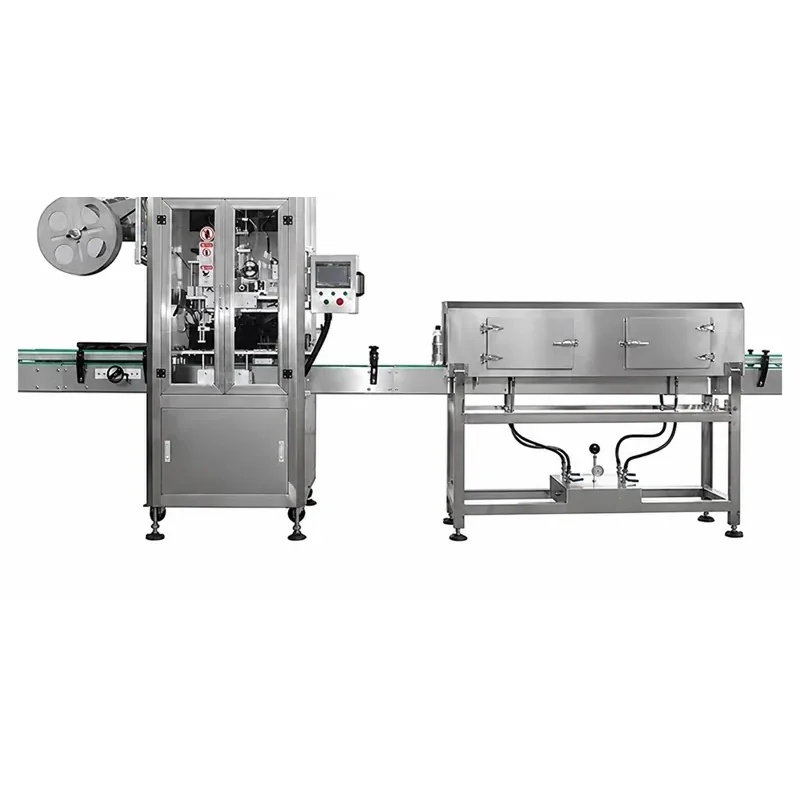
Mis-sizing the sleeve cut length or cap-to-neck step overhang on a tamper-evident neck band applicator produces bands that slip off the closure crown without breaking the perforation, creating retail rejection and regulatory compliance failures. Unlike full-body decorative sleeves that rely on large surface friction across the bottle body, a tamper-evident neck band must form a rigid mechanical interlock across a narrow 25 to 60 mm vertical zone spanning the closure cap and the container neck ring.
Within our shrink sleeve labeling machine hub and the broader industrial labeling machine architecture, dedicated neck band applicators are compact, cantilevered mandrel sleevers designed to roll directly over an existing conveyor between the capping machine and the primary body labeler. The specification table below outlines the four industrial machine tiers by speed, cap diameter window, and perforation capability.
| Machine Tier | Throughput Range | Cap Diameter Window | Cut Length Range | Film Gauge Window | Typical Packaging Lines |
|---|---|---|---|---|---|
| Compact Cantilevered Inline | 30–80 BPM | Ø 18–85 mm | 15–65 mm | 35–60 µm PVC/PETG | Craft hot sauce, honey jars, dropper tinctures, spices |
| Mid-Speed Servo Mandrel | 80–150 BPM | Ø 20–125 mm | 15–100 mm | 35–70 µm PETG/PVC/PLA | Condiment jars, salad dressing, OTC nutraceutical packers |
| Wide-Mouth Tub & Jar Bander | 40–100 BPM | Ø 70–160 mm | 20–85 mm | 45–80 µm PETG/OPS | Peanut butter, protein powder tubs, dairy & gelato pints |
| High-Speed Dual-Mandrel / Rotary | 150–300+ BPM | Ø 22–95 mm | 15–80 mm | 35–55 µm PETG/PVC | High-speed beverage bottles, ready-to-drink cold-fill lines |
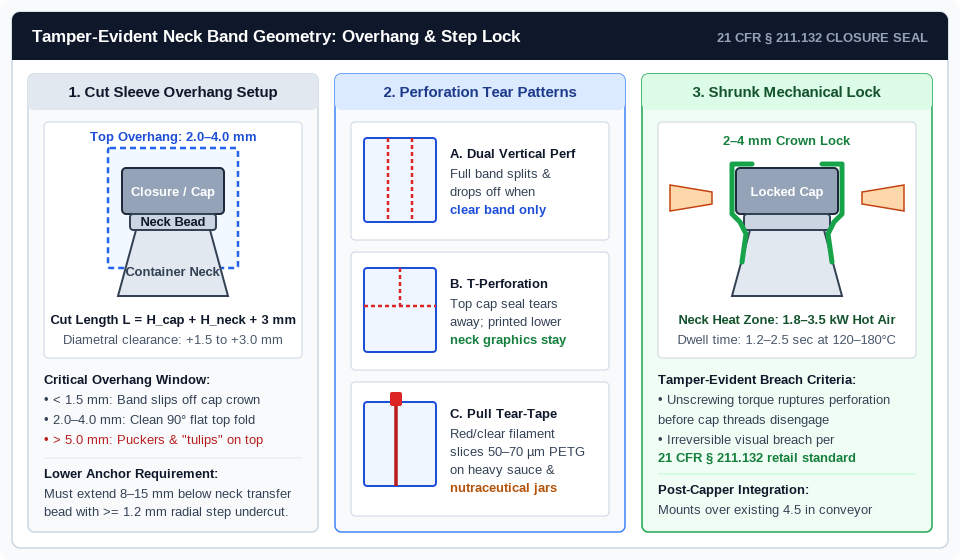
Regulatory context: 21 CFR § 211.132 and retail tamper-evidence
For over-the-counter (OTC) drug products, dietary supplements, and retail food jars, tamper-evident neck banding is governed by the engineering principles codified in 21 CFR § 211.132 (Tamper-Evident Packaging Requirements). Under federal regulation, a tamper-evident package must have one or more indicators or barriers to entry which, if breached or missing, can reasonably be expected to provide visible evidence to consumers that tampering has occurred.
Crucially, regulatory guidance and retail food-safety audits enforce two technical conditions on heat-shrunk neck bands:
- Irreversible mechanical breach upon opening: The band cannot slide intact over the cap threads or be stretched off and reapplied. Unscrewing or prying off the closure must rupture the perforated film bridge before the cap unseals.
- Distinctive visual or structural feature: Plain, unprinted clear cellulose or plastic bands that can be easily substituted with generic hardware-store shrink tubing do not satisfy strict 21 CFR § 211.132 OTC criteria unless they carry a distinctive printed logo, registered mark, or specialized tear-tape / perforation architecture that cannot be duplicated after opening.
Cap-to-neck step geometry and the 2-to-4 mm overhang rule
A neck band applicator cuts a flat layflat film tube, opens it over a bullet-shaped forming mandrel, and shoots the open cylinder downward until it rests on a mechanical stop (either the top crown of the cap or the bottle shoulder). To guarantee that the shrunk band locks the cap to the bottle without sliding upward, three dimensional equations must be satisfied simultaneously.
1. Layflat width and diametral clearance ($W_{\text{LF}}$)
Measure the maximum outside diameter across the closure knurling or jar lug rim ($D_{\text{cap_max}}$ in mm). Add a diametral clearance ($\Delta D_{\text{clear}}$) of $1.5\text{ to }3.0\text{ mm}$ so the cut sleeve drops freely over the cap at high speed without catching on closure ribs:
$$W_{\text{LF}}\text{ (mm)} = \frac{\pi \times \left( D_{\text{cap_max}} + \Delta D_{\text{clear}} \right)}{2}$$
Worked calculation: 63 mm lug cap on a glass pasta sauce jar
- Measured outer diameter across cap lugs: $D_{\text{cap_max}} = 65.5\text{ mm}$
- Target clearance for 100 BPM drop reliability: $\Delta D_{\text{clear}} = 2.5\text{ mm}$ (target sleeve ID $= 68.0\text{ mm}$)
- Required film layflat width: $$W_{\text{LF}} = \frac{3.1416 \times (65.5 + 2.5)}{2} = \frac{3.1416 \times 68.0}{2} = 106.8\text{ mm}\text{ (specify } 107\text{ mm layflat)}$$
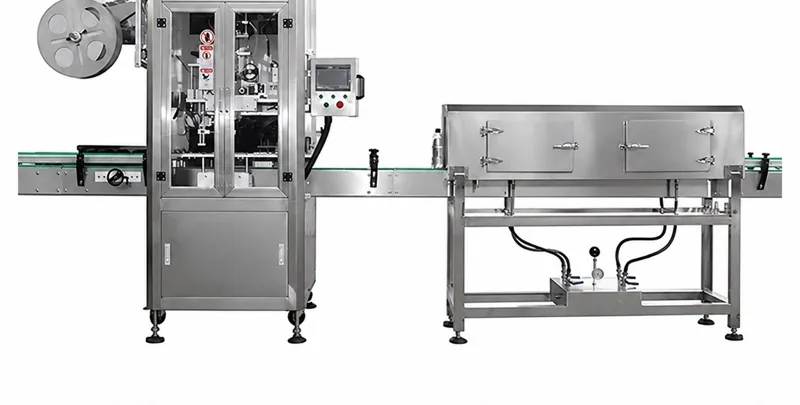
2. Cut length and the 2.0 to 4.0 mm top overhang window ($L_{\text{cut}}$)
When the sleeve shrinks in the heat zone, the top edge must fold inward 90 degrees onto the flat top crown of the cap, while the bottom edge must tuck tightly underneath the bottle’s neck transfer bead (or cap skirt undercut):
$$L_{\text{cut}}\text{ (mm)} = h_{\text{over}} + H_{\text{cap}} + H_{\text{neck_anchor}} + \Delta L_{\text{MD_shrink}}$$
Where:
- $h_{\text{over}}$ (Top overhang above cap crown): Must be held strictly between $2.0\text{ mm and }4.0\text{ mm}$.
- If $h_{\text{over}} < 1.5\text{ mm}$: Axial machine-direction (MD) shrinkage pulls the top edge down off the cap corner radius, leaving a straight cylinder that a consumer can slide upward over the cap without tearing the perforation.
- If $h_{\text{over}} > 5.0\text{ mm}$: The excess film gathers on top of the cap and puckers upward into an unsightly, stiff ruffle (“tuliping” or “dog-earing”) that snags case-packer dividers.
- $H_{\text{cap}}$: Vertical height of the closure skirt ($12\text{ to }28\text{ mm}$ typical).
- $H_{\text{neck_anchor}}$: Vertical distance below the cap skirt that locks beneath the glass or PET neck transfer ring ($8\text{ to }15\text{ mm}$ typical).
- $\Delta L_{\text{MD_shrink}}$: Compensation for longitudinal film shrinkage during heating ($1.0\text{ to }2.0\text{ mm}$ for PETG/PVC).
3. Radial step undercut requirement ($\Delta R_{\text{undercut}} \ge 1.2\text{ mm}$)
A shrink band cannot lock onto a flush cylinder that has no undercut below the cap. The container neck below the closure skirt must step inward radially by at least $1.2\text{ to }2.5\text{ mm}$ (or feature a protruding neck transfer bead) so the shrunk lower rim of the band forms a positive mechanical hook against upward pull. If your container uses a flush straight-wall cosmetic cap where $D_{\text{cap}} = D_{\text{body}}$ with zero neck step, a shrink band will slide unless it is anchored by a pre-applied hot-melt tack dot or replaced with an L-shaped tamper-evident pressure-sensitive security label (see our jar labeling machine guide).
Perforation blade architectures and tear-strip engineering
A tamper-evident band must survive shipping vibration and case drop tests intact, yet tear effortlessly when the consumer twists the cap. That balance is controlled by the perforation blade assembly mounted directly above the forming mandrel inside the neck band applicator:
1. Dual vertical perforation (full band removal)
Two opposing vertical perforating wheels score the film tube along the machine direction before the rotary cutter slices the band. When the consumer twists the cap or pulls a vertical tab, the band splits from top to bottom and falls completely off the bottle.
- Best for: Clear unprinted bands on hot sauce, honey, salad dressing, and liquor bottles where no part of the neck band is meant to remain on the bottle after opening.
- Blade pitch rule: Use a $1.5\text{ mm cut} / 1.0\text{ mm tie}$ (or $2.0\text{ mm cut} / 0.8\text{ mm tie}$) tooth profile for 40 to 50 µm PETG. If tie bridges exceed $1.2\text{ mm}$ on tough PETG film, consumers cannot tear the band with bare fingers.
2. Horizontal + vertical T-perforation (skirt stays on bottle)
When the neck band carries printed branding, vintage dates, or neck collar graphics (common on premium condiments, spirits, and wine and beer bottle labeling lines), a horizontal cross-perforation blade scores a ring around the circumference right at the bottom edge of the cap skirt, while a vertical perforation scores only the upper cap portion.
- When the consumer twists the cap, only the upper cap cap-seal tears away along the horizontal perforation line, leaving the printed lower neck collar permanently anchored around the bottle neck.
3. Integrated vertical tear-tape (50 to 75 µm heavy PETG)
High-shrink PETG films above 50 µm have high tear-propagation resistance compared with brittle PVC. For wide-mouth nutraceutical jars, infant formula tubs, and heavy glass condiment jars, specify film pre-laminated with a $1.5\text{ to }2.0\text{ mm}$ red or gold polymeric tear-tape filament backed by twin vertical micro-perforations. Pulling the protruding tab slices cleanly through thick 60 to 70 µm PETG without requiring fingernails or knives.
Compact neck-zone heaters vs full shrink tunnels
Unlike a full-body shrink sleeve that requires a 1.5 to 3.0 m steam tunnel (see our steam vs electric heat shrink tunnel comparison), shrinking a 25 to 50 mm tall neck band requires thermal energy only at closure elevation. Heating the entire container body wastes electricity and unnecessarily warms heat-sensitive products like honey, mayonnaise, probiotic gummies, or cold-pressed juices.
Dedicated neck-band lines use one of two compact, dry-heat configurations:
- Focused dual-nozzle hot-air neck heater (
1.8 to 3.5 kW,600–900 mmlength): Two insulated stainless steel hot-air manifolds mount on vertical/horizontal slide brackets on either side of the existing conveyor, aiming high-velocity $130–180^\circ\text{C}$ air jets strictly at the cap-to-neck junction. Total footprint along the conveyor is under 1 meter, and the jar body remains at ambient temperature. - Compact single-zone electric IR / recirculation hood (
6 to 12 kW,1,000–1,200 mmlength): Used for speeds of 80 to 180 BPM or wide-mouth 110 mm jars where longer dwell time ($1.8\text{ to }2.5\text{ s}$) is needed to fold the top 3 mm overhang flat across a large closure crown.
Preventing upward “ballooning” with a top hold-down belt or pre-tack nozzle
When a light, unanchored 30 mm tall PVC or PETG ring enters a high-velocity hot-air stream, upward air currents can blow the band 5 mm upward off the cap before it shrinks. To prevent vertical band lift:
- For shoulder-resting bands (where the bottom of the band rests on a flared bottle shoulder): Aim an entry pre-tack air nozzle at the middle of the band to cinch it onto the cap knurling in the first 0.2 seconds.
- For hanging / suspended neck bands (on long straight-neck bottles like hot sauce or wine where the band would slide all the way down the neck if unsupported): Equip the applicator with a sponge-belt side-grip / top-crown positioning unit or a brief radiant pre-tack ring immediately below the mandrel so the band tacks onto the cap before entering the main heat zone.
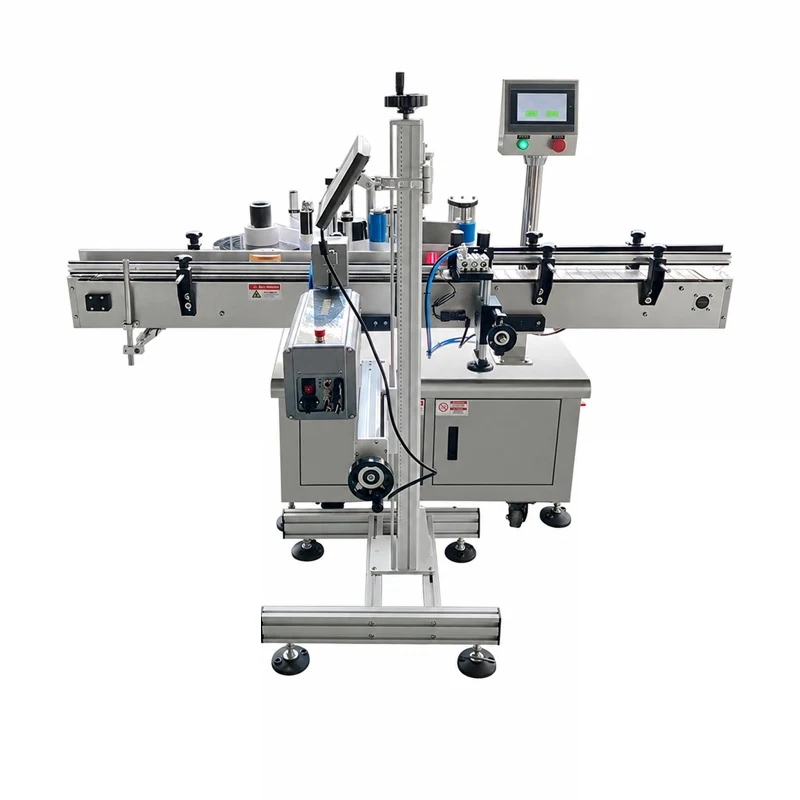
Line integration sequence: capper $\rightarrow$ labeler $\rightarrow$ neck bander
When integrating a tamper-evident neck band applicator into an automated packaging line, sequence the machines correctly to avoid wet-bottle or overhang interference:
- Dry-fill lines (spices, honey, sauces, nutraceuticals): Run Filler $\rightarrow$ Capper $\rightarrow$ Checkweigher/Cap Inspection $\rightarrow$ Body Labeler $\rightarrow$ Neck Band Applicator $\rightarrow$ Neck Heat Zone. Applying the primary body label before the neck band allows the body labeler’s overhead hold-down belt (if used on square/flat jars) to press directly against the bare rigid cap without crushing a newly shrunk neck band.
- Overlap neck-to-label designs: If the bottom of the tamper-evident neck band is designed to overlap the top 3 mm of the primary body label (or neck label), the body labeler must be positioned upstream of the neck bander so the shrink band seals over the paper/BOPP label edge.
Failure modes, root causes, and corrective actions
| Failure Mode / Symptom | Root Cause | Corrective Engineering Action |
|---|---|---|
| Band slips off cap intact without tearing perforation | Top overhang is too short ($< 1.5\text{ mm}$), or container lacks a radial undercut ($\ge 1.2\text{ mm}$) below the cap skirt. | Increase cut length by 2–3 mm to establish a 2.0–4.0 mm top crown fold, and focus lower hot-air nozzle under the neck transfer bead. |
| Top edge “tuliping” (ruffled standing collar on cap top) | Excessive top overhang ($> 5.0\text{ mm}$) or insufficient downward heat on top of closure crown. | Reduce cut length or lower sleeve stop position so overhang is $\le 3.5\text{ mm}$, and angle top louver downward onto the cap perimeter. |
| Premature perforation splitting inside heat tunnel | Perforation tie bridges are too weak for the film’s transverse shrink stress, or tunnel temperature is excessive ($> 200^\circ\text{C}$). | Change perf wheel from 2.5 mm cut / 0.5 mm tie to 1.5 mm cut / 1.0 mm tie, and reduce tunnel temperature by 15–20°C. |
| Band cocks sideways or blows off cap at tunnel entry | Excess layflat clearance ($\Delta D > 4.5\text{ mm}$) combined with upward blower velocity in Zone 1. | Reduce layflat width so diametral clearance is 1.5–2.5 mm, add a top silicone hold-down strip at tunnel entry, and lower Zone 1 fan speed. |
| Mandrel film jam on thin 35 µm bands | Static charge build-up on dry PVC/PETG web, or dull rotary cutter blades leaving uncut fiber threads. | Install an ionizing static-eliminator bar above the unwind dancer, use ≥ 40–45 µm film above 100 BPM, and re-lap rotary cutter knives. |
Specification checklist for neck-band RFQ
Gather these five measurements with our labeling machine RFQ checklist before messaging LINEVO engineers on WhatsApp:
- Closure and neck dimensional drawing: Cap outer diameter ($D_{\text{cap_max}}$), cap skirt height ($H_{\text{cap}}$), neck bead diameter, and radial undercut step depth below the cap.
- Band cut length and layflat width: Target cut length ($15\text{ to }80\text{ mm}$), film polymer (PETG, PVC, PLA), and film gauge ($\mu\text{m}$).
- Perforation style: Specify single vertical, dual vertical, horizontal + vertical T-perforation, or pre-applied vertical tear-tape.
- Resting vs suspended band: State whether the bottom edge of the unshrunk band rests naturally on the bottle shoulder or requires a mechanical/pneumatic neck-stop finger to hold it at cap height before pre-tacking.
- Available conveyor gap: Measure the open straight conveyor length between the capper discharge and the body labeler (minimum $1,800\text{ to }2,400\text{ mm}$ for applicator + compact neck heater).
Common questions
What is the ideal cap overhang for a tamper-evident shrink neck band?
Specify a pre-shrink top overhang of 2.0 mm to 4.0 mm above the top edge of the closure. When heated, a 2.5 to 3.5 mm overhang folds cleanly at 90 degrees onto the flat outer rim of the cap crown, creating a positive upper lock. Overhangs under 1.5 mm tend to pull back down onto the vertical cap wall during axial shrinkage, while overhangs above 5.0 mm pucker into a ruffled collar.
Should I choose PVC or PETG film for tamper-evident neck bands?
PVC film (40 to 50 µm) shrinks at a lower temperature (100–130°C), costs slightly less per roll, and tears very easily by hand along standard vertical perforations, making it common on budget condiment and hot-sauce lines. However, PETG film (40 to 60 µm) offers higher clarity, superior scuff resistance, halogen-free environmental compliance, and higher transverse shrink force (up to 75–78%) for deep cap-to-neck step transitions—provided you pair PETG with a finer perforation tooth pattern or an integrated tear-tape so consumers can open it easily.
Can one shrink sleeve machine apply both full-body sleeves and short tamper-evident neck bands?
Yes, if you specify a full-body shrink sleeve applicator rated for a minimum cut length down to 15–20 mm, along with interchangeable forming mandrels (one sized for the full body diameter and a smaller mandrel sized for the cap diameter). However, if your packaging line runs a pressure-sensitive body label AND a shrink neck band simultaneously on the same bottle, you will need a dedicated neck-band applicator mounted in series with the pressure-sensitive labeler.
Does a neck band applicator require its own conveyor?
No. Most cantilevered automatic neck band applicators and compact hot-air neck heaters are built on C-frame stainless steel stands that straddle your existing 82.5 mm (3.25 in) or 114.3 mm (4.5 in) tabletop chain conveyor. Only a short timing-screw or starwheel indexing unit (400 to 600 mm long) bolts to the existing conveyor side rails to space containers under the mandrel.
Related Guides & Specifications
Pressure Sensitive vs Shrink Sleeve: How to Choose for Your Container and Line
Compare pressure sensitive vs shrink sleeve labeling across container curves, label cost, steam or electric tunnel kW draw, footprint, and moisture resistance.
Learn moreSteam Shrink Tunnel vs Electric Hot-Air and Infrared Tunnels
Compare low-pressure saturated steam shrink tunnels (180–200°F) against electric forced hot-air and radiant infrared shrink sleeve tunnels (176–500°F).
Learn moreRelated Equipment & Guides
Automatic Labeling Machines: How to Choose by Container, Label and Speed
Choose an automatic labeling machine by container shape, label type and speed. Compare labeler types, accuracy tiers and the checks to run on your samples.
Learn moreShrink Sleeve Labeling Machines: How to Match Applicator, Film and Shrink Tunnel
Specify a shrink sleeve labeling machine by sleeve format, layflat width, film shrink ratio and steam or electric tunnel. Compare speeds and sample test steps.
Learn moreBottle Labeling Machines: How to Choose by Container Material, Shape, and Line Speed
Select a bottle labeling machine by container material (glass, PET, HDPE), shape (round, flat, oval, square, tapered), surface condensation, and line speed.
Learn morePressure Sensitive vs Shrink Sleeve: How to Choose for Your Container and Line
Compare pressure sensitive vs shrink sleeve labeling across container curves, label cost, steam or electric tunnel kW draw, footprint, and moisture resistance.
Learn moreSteam Shrink Tunnel vs Electric Hot-Air and Infrared Tunnels
Compare low-pressure saturated steam shrink tunnels (180–200°F) against electric forced hot-air and radiant infrared shrink sleeve tunnels (176–500°F).
Learn moreJar Labeling Machines: Wrap-Around, Front-and-Back, and Tamper-Evident Configurations
Select a jar labeling machine for wide-mouth glass and plastic jars: wrap-around vs front-back, taper draft angles, L-clip tamper strips, and neck bands.
Learn moreWine and Beer Bottle Labeling Machines: Taper, 3-Roller & Wet-Glass Guide
Select wine and beer bottle labeling machines for Bordeaux and Burgundy glass, 3-roller front/back/neck registration, cold brite-tank condensation, and capsules.
Learn more