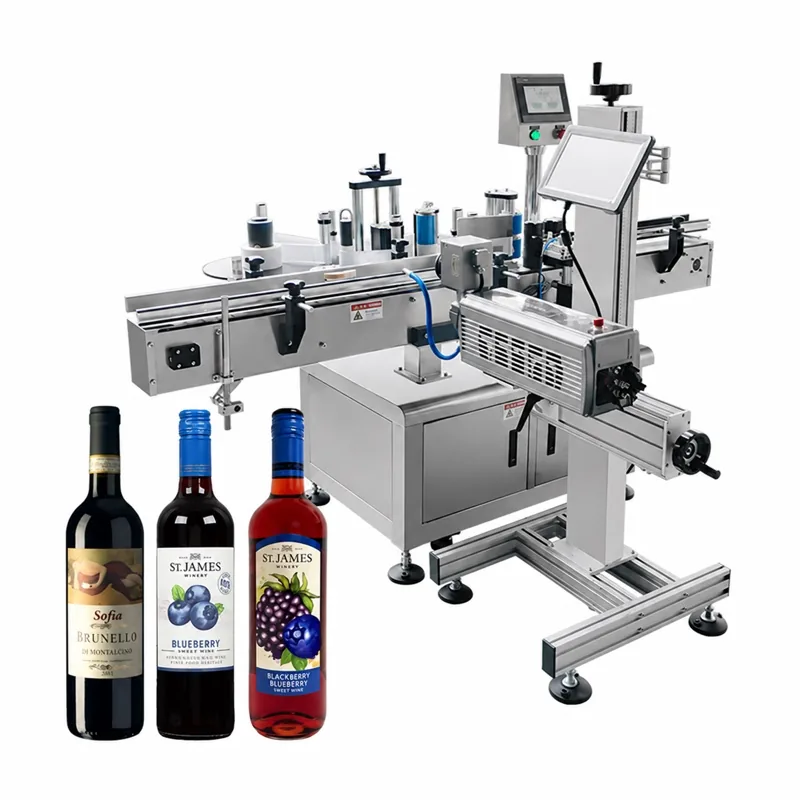
Industrial labeling machine price depends on four engineering variables: automation level, applicator drive precision, container handling tooling, and inspection or washdown compliance. Budgeting from a base machine sticker price alone causes capital overruns, unquoted change-part delays, and high rework and downtime costs during the first year of operation.
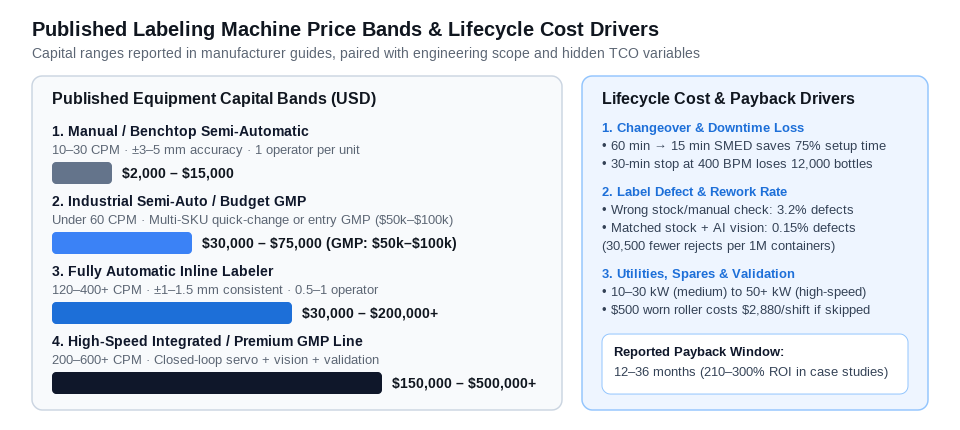
Across industrial labeling machine configurations, equipment capital ranges from $2,000 to $15,000 for benchtop manual and semi-automatic units up to $150,000 to $500,000+ for high-speed rotary, shrink sleeve, or validated GMP lines. When evaluating industrial labeling machines, plant engineers and procurement teams must separate the upfront capital purchase from 5-year Total Cost of Ownership (TCO): changeover downtime, label defect scrap, preventive wear parts, and utility consumption.
Published labeling machine price bands by automation level
Because every container geometry and line layout requires different mechanical handling, reputable manufacturers quote exact project pricing only after reviewing container drawings, label roll specifications, and target speed. However, published industry cost guides establish clear market price bands across five equipment tiers.
| Equipment Tier | Published Capital Price Band | Typical Speed Class & Accuracy | Typical Labour & Engineering Scope |
|---|---|---|---|
| 1. Manual & Benchtop Semi-Automatic | $2,000 – $15,000 | 10–30 CPM; ±3–5 mm accuracy (operator-dependent) | 1 full-time operator hand-loading each container; basic stepper feed; suitable for pilot batches and <500 units/day |
| 2. Industrial Semi-Auto & Multi-SKU Quick-Change | $30,000 – $75,000 | Under 60 CPM; ±1.5–2 mm repeatability | Assisted feed or compact frame with tool-free SMED changeover brackets for frequent small-lot SKU runs |
| 3. Budget / Entry GMP Automatic Inline | $50,000 – $100,000 | 60–150 CPM; ±1–1.5 mm placement accuracy | SUS 304 stainless steel frame, integrated conveyor, single or twin pressure-sensitive heads, standard PLC/HMI |
| 4. Fully Automatic Inline Bottle / Carton System | $30,000 – $200,000+ | 120–400+ CPM; ±1–1.5 mm consistent accuracy | 0.5–1 operator overseeing line; closed-loop servo applicators, top hold-down belts, separator wheel or timing screw, optional lot coding |
| 5. High-Speed Rotary, Shrink Sleeve & Premium GMP Line | $150,000 – $500,000+ | 200–600+ CPM; ±0.5–1 mm ultra-precision | Multi-head cam/servo turret or high-speed sleeve cast + steam/electric shrink tunnel, SUS 316L pharma finish, 100–1,000+ fps vision, 21 CFR Part 11 |
(Note: Regional direct-manufacturer guides in India also report project bands from ₹50,000 to ₹50 lakh+ depending on whether the scope covers a standalone applicator or a multi-head integrated line.)
Eight engineering specifications that drive equipment price
Why does one automatic bottle labeler price out at $38,000 while another seemingly similar inline machine quotes at $145,000? Eight engineering hardware choices account for the price spread within any speed class.
1. Closed-loop servo drives vs open-loop stepper heads
Entry-level automatic labelers use open-loop stepper motors on the dispensing peel head. Steppers hold ±0.1 to 0.3 mm internal precision with a 5 to 10 ms response time, which is adequate for steady-speed round bottles under 100 CPM. Upgrading to a brushless closed-loop servo applicator (holding ±0.01 mm precision with <1 ms response and 0.1 ms encoder feedback) increases head hardware cost but allows the labeler to track conveyor velocity ramps without step loss, run web speeds up to 220 m/min, and store digital SKU recipes in the HMI.
2. Number of dispensing stations and non-stop redundancy
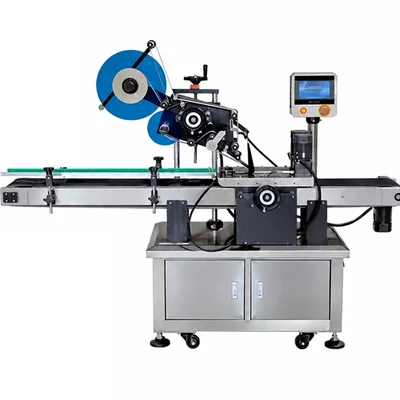
A single-head wrap-around labeler applies one full-wrap or partial-wrap label to cylindrical containers. Moving to a front and back labeling machine adds a second synchronized applicator head, a dual-side flat-bottle orienting chain, and an overhead top hold-down belt. Adding a third head for a neck band, tamper-evident seal, or top lid label, or specifying dual-roll redundant heads with automatic zero-downtime splicing, adds mechanical unwinds, servo axes, and frame length.
3. Container handling architecture: inline linear vs rotary turret
As detailed in our rotary vs inline labeling machine comparison, linear conveyor labelers guide containers between adjustable rails and belts at speeds from 60 to 200+ CPM. When beverage, food, or personal care lines require 250 to 600+ CPM, or when wet and condensation-covered glass bottles must be locked onto individual cam-driven bottle plates during application and brushing, a rotary turret is required. Rotary machines carry higher base capital costs and require custom starwheels, feed worms, and centering bells for each bottle footprint.
4. Pressure-sensitive vs shrink sleeve + thermal tunnel scope
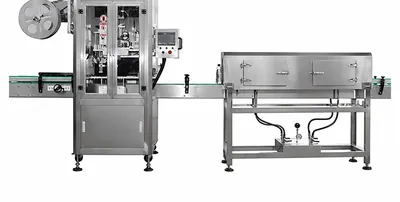
Evaluating pressure-sensitive vs shrink sleeve equipment requires comparing complete system scope. A pressure-sensitive machine is self-contained on a single frame. By contrast, a shrink sleeve labeling machine requires four coordinated subsystems: the roll unwind and mandrel sleeve cutter/applicator, a static-tacking or positioning brush unit, a steam shrink tunnel or electric infrared/hot-air tunnel, and (for steam tunnels) a steam generator, condensate return, and exhaust hood.
5. Optical vs capacitive sensors, date coding, and vision verification
Standard optical fork sensors handle opaque paper labels at moderate speeds. Running transparent film labels (“no-label look”) or high web speeds requires capacitive or ultrasonic gap sensors. Adding an inline Thermal Transfer Overprinter (TTO), Continuous Inkjet (CIJ), or UV/CO2 laser coder for lot and expiration printing, paired with a 100 to 1,000+ fps vision camera, barcode verifier (ISO/IEC 15417:2007 Code 128 grading at ≥99.5% read rate), and a positive lock-out reject pusher, typically adds 15% to 35% to the base machine price while eliminating manual inspection labor.
6. Frame metallurgy, washdown rating, and GMP validation
Standard dry-packaging frames use SUS 304 stainless steel and anodized aluminum brackets. Corrosive chemical, dairy, or sterile pharmaceutical environments require SUS 316L stainless steel contact zones, Ra ≤0.4 to 0.8 µm surface finish, ≥3° self-draining sloped surfaces, and IP65 washdown enclosures. Regulated pharmaceutical buyers also budget for formal DQ, FAT, SAT, IQ, OQ, and PQ validation binders and 21 CFR Part 11 electronic audit trails, which explain why budget GMP labelers start at $50,000 to $100,000 and high-speed validated lines reach $150,000 to $500,000+.
7. Multi-SKU change parts and SMED quick-release tooling
If a line runs a single cylindrical jar all year, standard bolt-on guide rails suffice. Multi-SKU contract packagers running 5 to 15 bottle sizes need color-coded tool-free starwheels, quick-release timing screws, digital handwheel position indicators, and HMI servo presets that cut changeover time from 60 minutes down to 15 minutes.
8. Upstream and downstream line integration hardware
Integrating a labeler into an existing packaging line often requires an accumulation buffer (such as a 0 to 8 RPM rotary accumulation turntable rated up to 300 lb), extended 4.5-inch or 6-inch stainless conveyors, dead-plate transfers, and EtherNet/IP or PROFINET IRT PLC handshakes. See our custom labeling line integration guide for full line scoping.
Hidden costs and Total Cost of Ownership (TCO) breakdown
Focusing strictly on purchase price hides the four operational expense buckets that dominate 5-year lifecycle cost. Published manufacturer studies highlight several stark operational benchmarks:
- Unplanned downtime cost: On a 400 BPM beverage or personal care line, a single 30-minute unplanned stop costs 12,000 unshipped containers.
- Deferred maintenance penalty: Delaying replacement of a $500 worn drive or nip roller (allowing roller TIR to exceed 0.005 in) can trigger web snapping and skew that costs $2,880 in single-shift downtime.
- Label defect and rework rate: Running mismatched label stock with manual visual checks produces a 3.2% defect rate, whereas pairing matched film/adhesive stock with automated vision inspection reduces defects to 0.15% (saving 30,500 rejected containers per 1,000,000 units produced).
- Changeover downtime drag: Reducing a 60-minute manual changeover to a 15-minute SMED changeover cuts setup downtime by 75%. Across 200 changeovers per year, that single upgrade recovers 150 hours of productive line time annually.
| Cost Category | Typical Budget Allowance / Benchmark | Root Cause of Cost Overruns | Prevention Strategy |
|---|---|---|---|
| Consumable Label Roll & Liner Compatibility | Ongoing unit cost per 1,000 labels | Die-cut tolerances looser than ±0.1 mm at 600+ CPM, wrong core ID (not 75–76 mm), or wrong unwind (#1–#8) causing web breaks | Lock converter roll specs in your labeling machine RFQ checklist before ordering label stock |
| Changeover & Setup Labor | 15 min (SMED) vs 60 min (manual) per SKU swap | Bolt-on rails and manual photoeye repositioning across multi-SKU shifts | Specify digital position indicators, HMI servo recipes, and tool-free guides |
| Preventive Wear Parts & Spares | 2%–5% of machine capital per year | Waiting 5–7 working days for emergency air-shipped belts, pads, or rollers after a failure | Include a 2-year critical wear-parts kit (belts, silicone rollers, peel strips, sensors) in the initial PO |
| Electrical & Thermal Utilities | 0.3–2.5 kW (standalone labeler); 10–30 kW (medium line); 50+ kW (high-speed line) | Unbudgeted steam boiler load or 3-phase transformer upgrades for shrink tunnels and high-speed lines | Audit plant 220V/380V/480V power and peak dry compressed air CFM during Gate 7 of selection |
| Freight, Crating, Rigging & SAT | 5%–12% of equipment value (2–6 weeks transit) | Unquoted seaworthy vacuum crating, local rigger/forklift rental, or on-site SAT technician per-diem | Specify Incoterms (EXW, FOB, CIF, or DDP) and itemized SAT commissioning days upfront |
How to calculate labeling machine ROI and payback period
Production line upgrades show that upgrading from manual or bottlenecked semi-automatic labeling to an automatic inline system typically achieves full capital payback in 12 to 36 months, with documented three-year returns on investment between 210% and 300% (for example, one manufacturer case study documented a 210% three-year ROI after automating a manual labeling cell, while a pharmaceutical integration benchmark cited 300% ROI over three years by raising throughput 35% and cutting labor 50%).
Use the engineering payback formula below to model your specific line justification:
Annual_Savings = S_labor + S_scrap + S_changeover
S_labor = (Operators_removed × Hours_per_year × Loaded_hourly_wage)
S_scrap = Annual_units × (Defect_rate_old - Defect_rate_new) × Cost_per_rejected_unit
S_changeover = Changeovers_per_year × ((t_old_min - t_new_min) / 60) × Line_margin_per_hour
Payback_Months = (Total_Installed_Capital / Annual_Savings) × 12
Worked payback example
Consider a nutraceutical and specialty food packager running 3,000,000 bottles per year across two shifts (4,000 operating hours/year) using benchtop semi-automatic labelers, evaluating an $85,000 installed automatic inline wrap-around and front/back labeling system (including conveyor handoffs, closed-loop servo heads, SMED digital guides, and vision reject):
- Direct labor savings (S_labor): Replacing three manual/semi-automatic stations (3 operators) with 1 line tender overseeing the automatic machine saves 2.0 FTEs. At a conservative loaded wage of $22/hour over 2,000 hours/year per shift (4,000 operator-hours/year saved if running 1 shift with 2 operators removed, or 2 operators × 2,000 hr = 4,000 hr):
- S_labor = 4,000 hours × $22/hr = $88,000 / year (even if only 1.0 FTE is redeployed across a single 2,000-hour shift, S_labor = $44,000 / year). Let us use the conservative single-shift 1.0 FTE saving of $44,000 / year.
- Scrap and rework reduction (S_scrap): Switching from manual placement and unverified stock (3.2% defect rate) to servo application with vision verification (0.15% defect rate) reduces rejects by 3.05% across 3,000,000 bottles/year (91,500 bottles saved). At $0.25 in wasted label, container, and rework labor per reject:
- S_scrap = 91,500 × $0.25 = $22,875 / year.
- Changeover uptime recovery (S_changeover): Cutting 120 annual SKU changeovers from 60 minutes to 15 minutes recovers 90 hours/year of line uptime. At $180/hour in recovered line contribution:
- S_changeover = 90 × $180 = $16,200 / year.
- Total annual savings and payback:
- Annual_Savings = $44,000 + $22,875 + $16,200 = $83,075 / year.
- Payback_Months = ($85,000 / $83,075) × 12 = 12.3 months (just over 1 year, well inside the standard 12-to-36-month industrial payback window).
How to request an accurate, itemized labeling equipment quote
Because LINEVO configures each labeling system around your specific container dimensions, label web material, and line speed (confirming parameters on physical buyer samples during quotation and Factory Acceptance Testing), we never publish artificial one-size-fits-all sticker prices that omit change parts, optical or capacitive sensors, or conveyor handoffs. Instead, every quotation separates base frame capital from per-SKU change parts, date coding, vision verification, and export crating so engineering and procurement teams can compare total installed investment line by line.
To get an accurate, transparent quotation with zero hidden add-ons:
- Walk through our 7-gate guide on how to choose an industrial labeling machine and our semi-automatic and tabletop labelers hub for sub-50 BPM cells to lock your machine architecture across wrap-around, front-and-back, shrink sleeve, vial, or print-and-apply configurations.
- Review our industrial labeling machine manufacturer qualification guide, ultrasonic vs. optical clear-label sensor guide, and label wrinkling, bubbling, and flagging troubleshooting guide to decide which FAT endurance trials, sensor packages, and 2-year wear-parts deliverables belong in your purchase order.
- Complete the labeling machine RFQ checklist and send your container drawings and target CPM to LINEVO engineers on WhatsApp.
Common questions
How much does an automatic bottle labeling machine cost?
Standard automatic inline bottle labeling machines range between $30,000 and $200,000+, depending on whether the system is a single-head round-bottle wrap labeler (at the lower end of the band), a budget GMP stainless configuration ($50,000 to $100,000), or a multi-head closed-loop servo system with vision inspection and timing-screw handling. High-speed rotary and validated pharmaceutical lines range from $150,000 to $500,000+.
Why do semi-automatic labeling machine prices vary from $2,000 to $75,000?
Benchtop manual and basic semi-automatic labelers priced between $2,000 and $15,000 use simple stepper motors and manual bottle cradles designed for 10 to 30 CPM in startup operations. Industrial semi-automatic systems priced between $30,000 and $75,000 are built on heavy stainless frames with industrial servo heads, PLC recipes, and precision quick-change fixtures for multi-SKU contract packaging under 60 CPM.
What is the typical payback period when upgrading from manual to automatic labeling?
Industrial automation upgrades typically achieve a payback window of 12 to 36 months, with three-year ROI figures between 210% and 300%. Payback is driven by three measurable savings: redeploying manual labeling operators, cutting label misalignment defects from 3.2% down to 0.15%, and reducing multi-SKU changeover downtime by up to 75% (from 60 minutes to 15 minutes).
What hidden costs should I budget for beyond the base labeling machine price?
Always budget for five lifecycle items alongside the base machine price: custom container change parts (starwheels, timing screws, or peel plates for additional SKUs), thermal transfer or laser date coders, vision or barcode verification sensors, a two-year critical wear-parts kit (belts, nip rollers, and vacuum pads), and seaworthy crating plus on-site SAT commissioning.
Related Guides & Specifications
How to Choose an Industrial Labeling Machine: 7-Gate Selection Guide
Step-by-step labeling machine buying guide: 7 engineering gates from container geometry, surface energy, and unwind #1-#8 to speed headroom and line utilities.
Learn moreClear Label Sensor Selection: Capacitive vs Ultrasonic vs Optical
Engineering guide to clear label sensors on BOPP and PET films: why optical slot sensors drop to 68% and ultrasonic to 12% vs 100% capacitive accuracy at 220 m/min.
Learn moreHow to Fix Label Wrinkling, Bubbling, Flagging, and Axial Skew
Engineering troubleshooting guide to fix pressure-sensitive label wrinkling, air bubbling, edge flagging, and axial skew across bottle and carton labelers.
Learn moreLabeling Machine RFQ Checklist and User Requirement Specification (URS)
Engineering labeling machine RFQ checklist and User Requirement Specification (URS) template covering container drawings, roll unwind #1-#8, CPM, and FAT rules.
Learn moreRelated Equipment & Guides
Automatic Labeling Machines: How to Choose by Container, Label and Speed
Choose an automatic labeling machine by container shape, label type and speed. Compare labeler types, accuracy tiers and the checks to run on your samples.
Learn moreLabel Applicators & Print-and-Apply Systems: Actuation, Speed & Retrofit Guide
Compare pre-printed label applicators and print-and-apply systems across wipe-on, tamp-blow, air-blow, and corner-wrap actuation, web speed, and retrofits.
Learn moreWrap-Around and Pressure-Sensitive Labeling Machines: Web Kinematics & Line Selection
Engineering guide to wrap-around and pressure-sensitive labeling machines: web tension, peel plate geometry, wrap belt vs 3-roller kinematics, and line selection.
Learn moreShrink Sleeve Labeling Machines: How to Match Applicator, Film and Shrink Tunnel
Specify a shrink sleeve labeling machine by sleeve format, layflat width, film shrink ratio and steam or electric tunnel. Compare speeds and sample test steps.
Learn morePrint and Apply Labeling Systems: Thermal Engines, DPI, and PLC Integration
Select print and apply labeling machines across Zebra, Sato, and Datamax engines, 203 to 600 DPI printheads, EtherNet/IP handshakes, and ISO/IEC 15416 grading.
Learn moreBottle Labeling Machines: How to Choose by Container Material, Shape, and Line Speed
Select a bottle labeling machine by container material (glass, PET, HDPE), shape (round, flat, oval, square, tapered), surface condensation, and line speed.
Learn moreSemi-Automatic & Tabletop Labelers: Benchtop Selection & ROI Crossover
Compare semi automatic labeling machines and tabletop bottle labelers (10-40 BPM) against automatic inline payback, cradle vs. tamp fixtures, and TCO math.
Learn moreLabel Automation and Custom Packaging Line Labeling Integration
Engineering guide to label automation and inline labeling system integration across fillers, cappers, accumulation tables, PLC sync, and vision reject gates.
Learn moreHow to Qualify an Industrial Labeling Machine Manufacturer
How to evaluate an industrial labeling machine manufacturer: OEM vs integrator comparison, mechanical build audit, servo vs stepper drives, and FAT checklist.
Learn moreRotary vs. Inline Labeling Machines: Turret Kinematics, Speed & Changeover
Compare rotary carousel turret vs inline linear labeling machines across speed ratings (50-150 vs 150-600+ BPM), bottle plates, starwheel changeover, and layout.
Learn morePressure Sensitive vs Shrink Sleeve: How to Choose for Your Container and Line
Compare pressure sensitive vs shrink sleeve labeling across container curves, label cost, steam or electric tunnel kW draw, footprint, and moisture resistance.
Learn moreHow to Choose an Industrial Labeling Machine: 7-Gate Selection Guide
Step-by-step labeling machine buying guide: 7 engineering gates from container geometry, surface energy, and unwind #1-#8 to speed headroom and line utilities.
Learn moreClear Label Sensor Selection: Capacitive vs Ultrasonic vs Optical
Engineering guide to clear label sensors on BOPP and PET films: why optical slot sensors drop to 68% and ultrasonic to 12% vs 100% capacitive accuracy at 220 m/min.
Learn moreHow to Fix Label Wrinkling, Bubbling, Flagging, and Axial Skew
Engineering troubleshooting guide to fix pressure-sensitive label wrinkling, air bubbling, edge flagging, and axial skew across bottle and carton labelers.
Learn moreLabeling Machine RFQ Checklist and User Requirement Specification (URS)
Engineering labeling machine RFQ checklist and User Requirement Specification (URS) template covering container drawings, roll unwind #1-#8, CPM, and FAT rules.
Learn more