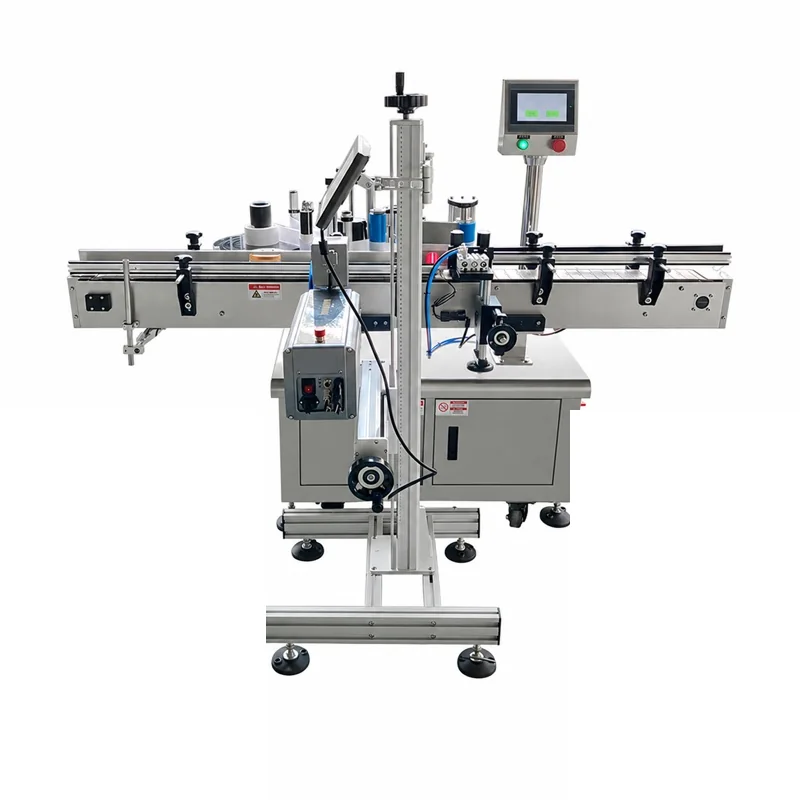
Architectural Divide: Linear (Inline) vs. Rotary Carousel Labeling
When specifying an industrial labeling machine within the wrap-around and pressure-sensitive labelers family, choosing between an inline labeling machine and a rotary labeling machine prevents high-speed bottle jams, registration rejects, and excessive changeover downtime.
Both machine classes use the same fundamental pressure-sensitive dispensing head physics, delaminating self-adhesive labels from a siliconized release liner over an acute 150- to 170-degree peel plate via closed-loop servo or stepper traction drives. The difference lies entirely in how the container is spaced, stabilized, and rotated during the 200 to 500 milliseconds of label transfer and wiping:
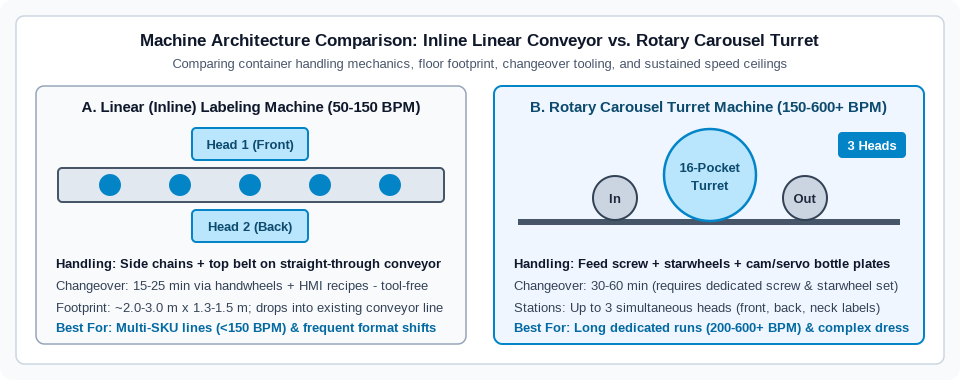
- An inline labeling machine relies on friction belts, roller spacers, synchronous side chains, and an overhead hold-down belt mounted directly over a straight-through slat conveyor, operating at 50 to 150 bottles per minute (BPM) on standard frames (and up to 200 to 250 BPM on heavy-duty wrap or double-side frames).
- A rotary labeling machine captures each container positively inside a pocketed starwheel and clamps it between a bottom turret table (bottle plate) and an overhead pneumatic or cam-actuated centering bell, operating at 150 to 600+ BPM across 12, 16, 24, or 36 carousel stations.
Evaluating a rotary vs inline labeler requires weighing five operational axes: sustained line speed, container dress complexity (number of labels per bottle and mould-seam orientation), SKU changeover frequency, floor footprint, and 5-year total cost of ownership.
Head-to-Head Specification Matrix: Linear vs. Rotary Labeling Machines
Table 1 contrasts verified manufacturer parameters across standard automatic linear labelers, heavy-duty inline double-side frames, and high-speed rotary sticker turrets.
| Engineering Parameter | Automatic Inline (Linear) Labeler | Heavy-Duty Inline Two-Side Frame (LINEVO LV-620 / LV-BSL 2S) |
High-Speed Rotary Turret Labeler (16-Station / 3-Head Class) |
|---|---|---|---|
| Published Speed Rating | 50-150 BPM (standard linear); 100-400 BPM (inline wrap-around) | 80-150 BPM (standard); 120-250 BPM (2.5 kW heavy-duty; max 300 LPM) | 150-600+ BPM (e.g., 240 BPM on a 16-station, 3-head rotary unit) |
| Sustained Operating Band (80-90%) | 40-135 BPM | 100-220 BPM | 190-540+ BPM |
| Container Handling Mechanism | Roller spacing wheel or dual timing belts + side wrap belt or 3-roller station | Differential dividing wheel (+/-5 mm) + rigid centering chains + top holding belt | CNC feed worm (timing screw) + infeed/outfeed starwheels + 16 turret bottle plates |
| Simultaneous Labeling Heads | 1 head (round wrap or single side) | 2 heads (front & back) + optional wrap-around belt module | Up to 3 heads operating simultaneously (front, back, and neck label) |
| Placement Accuracy | +/-0.5 mm (3-roller) to +/-1.0 mm (wrap belt) | +/-0.8 mm to +/-1.0 mm | +/-0.5 mm to +/-1.0 mm (continuous positive pocket lock) |
| Label Dimensions Supported | Height: 8-150 mm; Min length: 12 mm | Height: 8-180 mm; Length: 10-300 mm | Height: 50-100 mm; Length: 160-295 mm (custom heads available) |
| Reel Core ID & Max OD | 75-76 mm ID / 300-400 mm OD | 75-76 mm ID / 300-350 mm OD | 76 mm ID / 300-400 mm OD |
| Format Change Parts Required | Zero starwheels or feed worms for standard 15-85 mm diameters | Zero change parts for standard flat/oval/square bottles (feed worm optional) | Dedicated feed screw, infeed/outfeed starwheels, center guide, & bottle pads per SKU |
| Typical Changeover Duration | 15-20 minutes (handwheels + HMI recipe) | 20-25 minutes (15 min with SMED & servo memory) | 30-60 minutes (mechanical swap of screw, starwheels, and turret bells) |
| Electrical Power & Supply | 0.3-1.25 kW, 220V/110V single-phase | 0.75-2.5 kW, 220V single-phase | 6.5 kW, 440V 3-phase, 50/60 Hz |
| Machine Footprint & Weight | ~1750-2000 x 870-1280 x 1100-1400 mm; 160-190 kg | ~2280-3000 x 1400-1500 x 1400-1750 mm; 280-320 kg | ~2400-3200 x 1800-2200 x 1800 mm; 350-1,200+ kg (SS 304 & aluminum frame) |
Inside the Rotary Labeling Machine: Turret Kinematics and Cam/Servo Control
To understand why a rotary labeling machine dominates beverage brewing, wine and spirits bottling, high-volume sauces, and parenteral pharmaceutical lines running above 200 BPM, examine how a 16-station rotary sticker labeler controls container motion from entry to exit:
1. Pitch Separation via Synchronized Feed Screw and Infeed Starwheel
At 240 to 600 BPM, bottles move at 4 to 10 containers per second. If a bottle queue were released directly into a spinning turret, containers would collide with the pocket dividers and shatter or jam. Instead, incoming bottles enter the helical flute of a CNC-machined polymer feed screw (timing worm). The helix pitch progressively increases from the solid bottle-to-bottle queue diameter at the entry to the exact circular arc pitch of the infeed starwheel at the exit.
Synchronized variable-frequency drives (VFDs) or electronic cam servos lock the phase angle of the feed screw, infeed starwheel, main carousel turret, and outfeed starwheel. An overload clutch and jam/toppled-bottle sensor sit at the screw infeed and starwheel transfer throats; if a deformed bottle binds in a pocket, the machine halts instantaneously before glass breakage or starwheel damage occurs.
2. Clamped Turret Bottle Plates and Overhead Centering Bells
As each bottle transfers from the infeed starwheel onto the main carousel circumference, it steps onto an individual rotating platform called a bottle plate (or turret pad). Simultaneously, an overhead cam-track or pneumatic piston lowers a centering bell (tulip) onto the bottle neck or cap, clamping the container under vertical axial preload:
- Once clamped between the bottom bottle plate and top centering bell, the container is completely isolated from conveyor slat friction, guide-rail drag, or neighbor-to-neighbor impacts.
- Because the bottle is held at both top and bottom centers, even wet, condensation-covered glass beer bottles, lightweight contoured PET bottles, or unstable tapered flasks cannot tip, rock, or slip laterally at 300 to 600 BPM.
3. Cam-Profile vs. Closed-Loop Servo Bottle Plate Rotation
While the main turret carries the clamped bottles around a circular path past up to three stationary pressure-sensitive dispensing heads (typically Head 1 for the front body label, Head 2 for the back body label, and Head 3 for the wrap-around neck band or shoulder medallion), each bottle plate rotates around its own vertical axis according to a programmed angular velocity profile:
- Mechanical Cam-Track Turrets: A follower roller beneath each bottle plate rides inside a hardened steel stationary cam track under the turret table. As the bottle approaches Head 1, the cam turns the bottle plate so the front panel presents at the exact tangent angle required for peel contact, then rocks or spins the bottle past stationary brush/sponge wiping pads before indexing 180 degrees to present the back panel to Head 2.
- Servo-Driven Electronic Turrets: Each of the 16 to 36 bottle plates is driven by an independent brushless servo motor linked to a central motion controller. Operators can program completely different rotation curves for round wrap-around bottles, three-panel square spirit bottles, or asymmetrically tapered flasks via the HMI touchscreen without changing an under-table mechanical cam. Furthermore, pairing each servo plate with an optical spot/lug sensor allows high-speed mould-seam or embossed-crest registration at 240 to 500+ BPM.
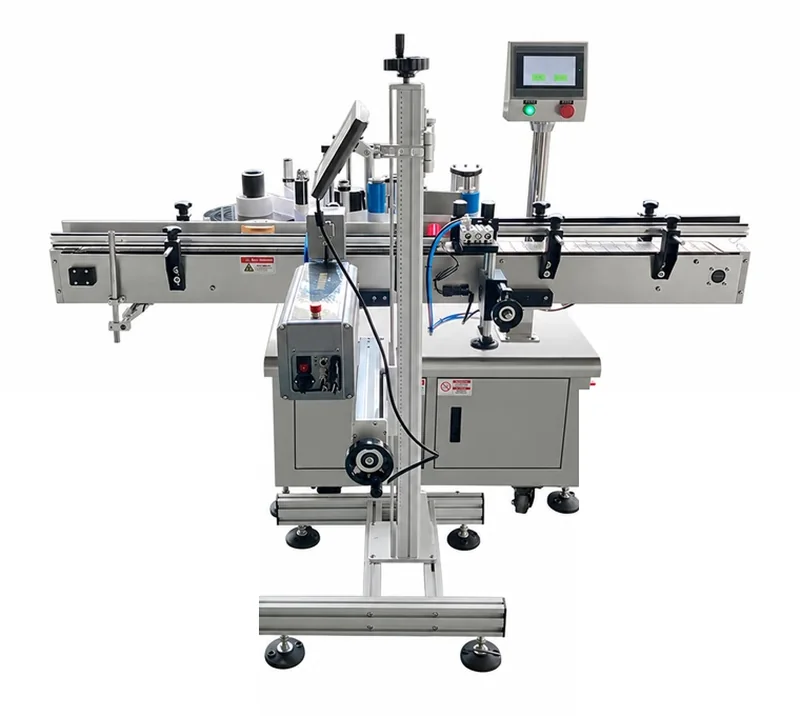
Inside the Inline Labeling Machine: Friction Belts and Zero-Tooling Flexibility
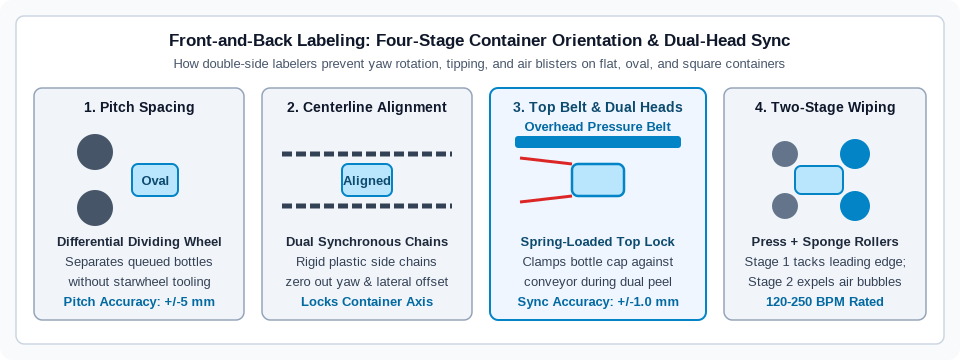
By contrast, an inline labeling machine keeps containers on a straight conveyor path from entry to exit. Depending on container geometry, inline systems use either the roller-and-wrap-belt arrangement detailed in our round bottle labeling machine guide or the four-stage orientation train (dividing wheel, synchronous centering chains, and spring-loaded overhead belt) detailed in our front and back labeling machine guide.
Why Inline Linear Machines Cap Out Around 150-250 BPM
Three physical limits govern the upper speed ceiling of a straight-line belt labeler:
- Unclamped Transfer Between Stages: On an inline double-side machine, a flat or oval bottle transitions from the differential dividing wheel into the centering chains and then under the overhead top belt. Above 200 to 250 BPM (conveyor speeds exceeding 45 to 55 m/min), aerodynamic drag, slat vibration, and micro-slip at the belt entry nose introduce yaw jitter that degrades placement accuracy from +/-1.0 mm toward +/-2.0 mm.
- Centrifugal Spin and Slip on Wrap Belts: On a continuous inline wrap-around labeler, spinning a 70 mm bottle through 360 degrees within a 400 mm backplate at 300 BPM requires high radial belt pressure. On lightweight empty PET or low-friction HDPE containers, high wrap-belt speed causes the bottle base to skid laterally across the conveyor slats rather than rolling cleanly.
- Sequential vs. Simultaneous Wiping Dwell: Because an inline machine wipes labels using inline brush/sponge pairs along the conveyor rail, raising conveyor velocity reduces wipe dwell time proportionally. On a rotary turret, wiping sponges and contour brushes occupy extended angular sectors between stations while the bottle is rigidly clamped on its turret plate.
Changeover Economics, SMED, and Multi-SKU Operations
For contract packagers, craft beverage producers, nutraceutical brands, and personal-care plants running 5 to 30+ SKUs across a single line, changeover downtime often outweighs nameplate speed in determining daily net output.
Consider a shift comparison between a 120 BPM inline labeler and a 240 BPM rotary turret across an 8-hour (480-minute) shift that requires three SKU format changes:
- Rotary Turret Changeover (30 to 60 minutes per SKU): Swapping a rotary machine from a 65 mm round glass bottle to a 78 mm oval bottle requires unbolting the feed worm, removing the infeed and outfeed starwheels, changing the center starwheel guide arch, swapping 16 turret bottle pads/centering bells, and re-threading up to three label webs. Even at 45 minutes per changeover, three format shifts consume $3 \times 45 = 135\text{ minutes}$ (28% of the shift).
- Inline Linear Changeover (15 to 25 minutes per SKU): Because an inline labeler uses a universal roller-spacing wheel, self-centering guide rails, and a spring-loaded overhead belt, operators swap zero mechanical change parts across standard container sizes. By applying Single-Minute Exchange of Die (SMED) practices, combining servomotor adjustment axes, digital position indicators, tool-free quick-release brackets, and HMI recipe memory (storing 10 to 50 presets), changeovers drop from 60 minutes to 15 minutes (a 75% reduction). Three format shifts consume only $3 \times 15 = 45\text{ minutes}$, recovering 90 minutes of active production per shift and eliminating $3,000 to $8,000 per SKU in custom starwheel and feed-screw tooling costs.
Factoring Nameplate Speed vs. Sustained Operating Speed
Regardless of whether you select an inline or rotary platform, capacity planning must account for real-world derating:
- Industrial labeling lines achieve 70% to 90% of nameplate rated speed in sustained production, with 80% to 90% representing the optimal continuous operating zone.
- A 150 BPM inline machine operated at its 85% sweet spot delivers 127 BPM sustained; a 240 BPM 16-station rotary machine operated at 85% delivers 204 BPM sustained.
- Deferred mechanical maintenance erodes both architectures: worn polyurethane drive rollers, glazed traction nips, or degraded turret pad bushings can reduce effective line speed by 25% (dropping a 200 BPM line to 150 BPM) due to web slip and spacing faults.
| Operational Scenario & Line Profile | Recommended Architecture | Engineering & Financial Justification |
|---|---|---|
| Multi-SKU Contract Packaging (5-20+ bottle sizes, 60-130 BPM, 2-4 changeovers/day) | Inline Linear Labeler (Wrap-Around or Double-Side with Wrap Module) | Zero starwheel/screw tooling investment; 15-25 min tool-free changeovers maximize net shift output; fits existing straight conveyor lines |
| Dedicated High-Speed Beverage or Sauce Line (1-3 bottle sizes, 200-500+ BPM, multi-day runs) | Rotary Carousel Turret Labeler (16 to 36 Stations) | Clamped turret plates hold +/-0.5-1.0 mm accuracy at high speed; handles wet glass and lightweight PET without belt slip |
| Premium Spirits / Wine Dress (Front + Back + Neck Band + Mould Seam Orientation at 120-240 BPM) | Rotary Carousel Turret Labeler (3-Head Cam or Servo Turret) | Bottle remains locked on one turret plate while rotating past all 3 heads, guaranteeing mutual registration between neck and body panels |
| Small Cylindrical Vials or Tapered Overlapping Jars (<100 BPM, +/-0.5 mm overlap) | Inline 3-Roller Indexing Labeler | Three-point roller clamping eliminates spiral drift at a fraction of rotary turret capital cost and floor footprint |
| Full-Body 360-Degree Complex Contours (50-200 BPM) | Shrink Sleeve Applicator + Heat Tunnel | Neither flat PS inline nor rotary heads can wrap severe hourglass curves without wrinkling; see shrink sleeve and tamper-evident labelers |
Floor Integration, Utilities, and Regulatory Compliance
Integrating a linear vs rotary labeling machine into an existing plant floor involves distinct mechanical, electrical, and accumulation layouts (covered in full in our labeling line integration guide):
- Conveyor Topology and Footprint: An inline labeler occupies a narrow rectangular envelope (roughly 1.75 to 3.0 m long by 0.87 to 1.5 m wide, weighing 160 to 320 kg) and straddles a straight conveyor section at an 800 to 875 mm working height. A rotary turret requires a wider circular safety enclosure (typically 1.8 to 2.2 m wide and 350 to 1,200+ kg) plus upstream and downstream accumulation tables so brief label-reel splices do not force the upstream filler or capper to emergency-stop.
- Power and Compressed Air Utilities: Standard inline labelers operate on single-phase 220V/110V AC power drawing 0.3 kW to 2.5 kW. A 16-station, 3-head rotary machine requires 440V/380V 3-phase industrial power drawing 6.5 kW plus dry regulated compressed air for pneumatic centering bells and single-bottle reject gates.
- Inspection, Barcode Verification, and 21 CFR Part 11: High-speed rotary and inline machines alike support online vision cameras to verify date/lot thermal-transfer codes, check barcode print quality against ISO/IEC 15417 (maintaining the >=99.5% first-read rate required for automated warehouse sorting), and log electronic batch records and operator signatures under FDA 21 CFR Part 11.
To build your project RFQ specification, calculate conveyor pitch and peak web velocity in our labeling speed (BPM) and web pitch calculator, compare rotary adhesive economics in our hot-melt vs. wet-glue vs. pressure-sensitive comparison, and structure your Factory Acceptance Test (FAT) using our bottle labeling machine hub, how to choose a labeling machine, and labeling machine cost and ROI.
Prepare your target BPM, SKU count, and floor layout using our labeling machine RFQ checklist and message LINEVO engineers on WhatsApp to receive a side-by-side inline versus rotary engineering proposal.
Common questions
At what speed should a packaging line switch from an inline labeler to a rotary labeling machine?
The practical crossover sits between 150 and 200 bottles per minute (BPM). Below 150 BPM, an inline linear labeler handles round, flat, oval, and square containers at lower capital cost and with 15- to 25-minute tool-free changeovers. Above 200 BPM, or when applying three labels (front, back, and neck) with tight mutual registration, centrifugal and belt-slip forces on a straight conveyor increase reject rates, making a 16- to 36-station rotary turret the standard engineering choice.
Why does a rotary labeling machine require change parts for every bottle diameter?
A rotary turret must transfer bottles smoothly from a straight conveyor into discrete circular pockets rotating at high tangential speed. That transfer requires a CNC-machined timing screw (feed worm) to establish exact pocket pitch, an infeed starwheel, an outfeed starwheel, curved starwheel guide rails, and matching turret bottle pads. Any change in container body diameter or cross-section requires swapping those format-specific parts.
Can an inline labeling machine match the placement accuracy of a rotary labeler?
On straight cylindrical wraps and two-panel flat or square containers running within their rated 50 to 150 BPM envelope, servo-driven inline labelers achieve +/-0.5 mm to +/-1.0 mm placement accuracy, matching rotary performance. However, when a bottle requires complex multi-angle orientation (such as aligning a neck band, front medallion, and back panel relative to a glass mould seam at 240+ BPM), a rotary turret holds tighter mutual registration because the bottle never leaves its clamped turret plate between stations.
How much changeover time can SMED and servo recipes save on multi-SKU labeling lines?
Implementing Single-Minute Exchange of Die (SMED) principles, combining servomotor-driven adjustment axes, HMI recipe storage, and quick-release modular guide brackets, reduces typical labeling changeover duration from 60 minutes to 15 minutes, a 75% time reduction that significantly increases Overall Equipment Effectiveness (OEE) on high-mix lines.
Related Guides & Specifications
Label Roll Unwind Direction Chart (#1 to #8) and Roll Length Calculator
Interactive #1 to #8 label winding direction chart (wound out vs wound in), eye-mark guide, and roll length, OD, core size, and shift roll calculator.
Learn moreLabeling Speed (BPM), OEE Surge Capacity, and Web Pitch Calculator
Calculate required labeling machine surge BPM, line OEE headroom, label web dispensing velocity in m/min, container pitch, and matched conveyor speed.
Learn moreIndustrial Labeling Machine FAT Checklist, Maintenance, and Troubleshooting Manual
Execute a 30-minute Factory Acceptance Test (FAT), follow a 6-tier preventive maintenance schedule, and resolve 12 common labeling machine defects.
Learn moreRound Bottle Labeling Machines: Continuous Wrap Belt vs. 3-Roller Indexing
Select a round bottle labeling machine by comparing continuous wrap belts vs 3-roller indexing, web speed equations, bottle pitch spacing, and machine parameters.
Learn moreFront and Back Labeling Machines: Dual-Head Sync & Top Hold-Down Mechanics
Engineering guide to front and back double-side labeling machines: centering chains, overhead top holding belts, dual servo heads, and flat or oval bottle specs.
Learn moreSquare and Flat Bottle Labeling Machine: 1-Panel, 2-Panel, and 3-Panel Wrap Selection
Specify square and flat bottle labeling machines by panel geometry, twin centering chains, overhead hold-down belts, corner wipe rollers, and recessed panel rules.
Learn moreRelated Equipment & Guides
Automatic Labeling Machines: How to Choose by Container, Label and Speed
Choose an automatic labeling machine by container shape, label type and speed. Compare labeler types, accuracy tiers and the checks to run on your samples.
Learn moreWrap-Around and Pressure-Sensitive Labeling Machines: Web Kinematics & Line Selection
Engineering guide to wrap-around and pressure-sensitive labeling machines: web tension, peel plate geometry, wrap belt vs 3-roller kinematics, and line selection.
Learn moreBottle Labeling Machines: How to Choose by Container Material, Shape, and Line Speed
Select a bottle labeling machine by container material (glass, PET, HDPE), shape (round, flat, oval, square, tapered), surface condensation, and line speed.
Learn moreLabel Automation and Custom Packaging Line Labeling Integration
Engineering guide to label automation and inline labeling system integration across fillers, cappers, accumulation tables, PLC sync, and vision reject gates.
Learn moreLabeling Speed (BPM), OEE Surge Capacity, and Web Pitch Calculator
Calculate required labeling machine surge BPM, line OEE headroom, label web dispensing velocity in m/min, container pitch, and matched conveyor speed.
Learn moreRound Bottle Labeling Machines: Continuous Wrap Belt vs. 3-Roller Indexing
Select a round bottle labeling machine by comparing continuous wrap belts vs 3-roller indexing, web speed equations, bottle pitch spacing, and machine parameters.
Learn moreFront and Back Labeling Machines: Dual-Head Sync & Top Hold-Down Mechanics
Engineering guide to front and back double-side labeling machines: centering chains, overhead top holding belts, dual servo heads, and flat or oval bottle specs.
Learn moreHot-Melt Glue vs Wet-Glue vs Pressure-Sensitive Labeling Machines
Compare roll-fed hot-melt glue, cut-and-stack wet/cold glue, and pressure-sensitive labeling machines across unit label cost, line speed, changeover, and TCO.
Learn moreIndustrial Labeling Machine Price and Total Cost of Ownership Guide
Transparent industrial labeling machine price breakdown from $2,000 semi-automatics to $500,000+ high-speed lines, plus hidden TCO drivers and payback math.
Learn moreHow to Choose an Industrial Labeling Machine: 7-Gate Selection Guide
Step-by-step labeling machine buying guide: 7 engineering gates from container geometry, surface energy, and unwind #1-#8 to speed headroom and line utilities.
Learn moreLabeling Machine RFQ Checklist and User Requirement Specification (URS)
Engineering labeling machine RFQ checklist and User Requirement Specification (URS) template covering container drawings, roll unwind #1-#8, CPM, and FAT rules.
Learn more