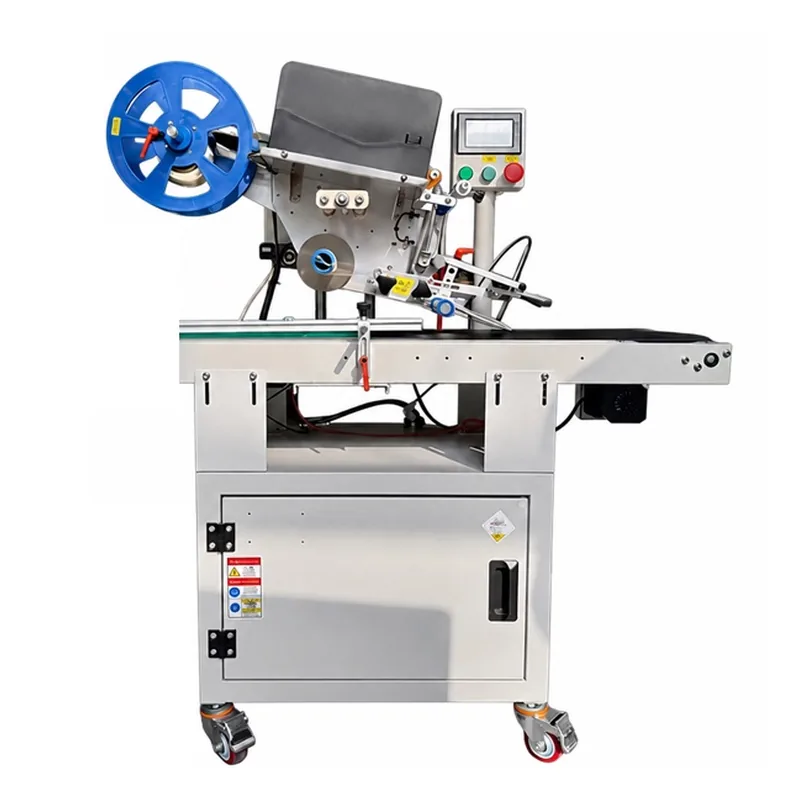
A print and apply labeling machine (also called a label printer applicator, or LPA) combines an industrial thermal print engine with an automated peel-and-transfer mechanism to image and apply variable-data labels onto moving packages in real time, whereas mismatched printhead speeds, slow network handshakes, or unverified dead printhead dots cause unreadable barcodes, sortation rejects, line downtime, and retailer compliance chargebacks. Within the site’s label applicators and print-and-apply authority guide, on-demand print-and-apply systems serve as the core data-serialization layer between warehouse software and physical secondary packaging, branching directly into specialized box and carton labeling machines and end-of-line pallet labelers.
Unlike pre-printed roll applicators that dispense identical static graphics onto every container, a print-and-apply system waits for an upstream product trigger or barcode scan, receives package-specific data from a programmable logic controller (PLC), warehouse management system (WMS), or enterprise resource planning (ERP) database, prints a unique label at up to 16 inches per second (IPS), peels the silicone backing liner, and bonds the label to the passing carton, case, tray, or pallet. This hub guide breaks down OEM print engine integration, thermal transfer versus direct thermal physics, 203 to 600 DPI resolution trade-offs, cycle-time math, industrial Ethernet protocols, and ISO/IEC 15416 / 15415 barcode verification.
Print-and-apply system configurations and throughput benchmarks
Because print-and-apply systems must both image the label and physically transfer it to the package, total system throughput is governed by the combination of thermal printhead velocity and actuator motion. LINEVO modular LPA architectures (such as the LV-250/LV-252 series, LV-9560 series, and LV-850+ platforms) separate the print engine chassis from the application module so plant engineers can pair the same thermal print engine with wipe-on, tamp-blow, or corner-wrap transfer heads across the facility. Compare the actuator mechanisms in detail in our tamp vs wipe-on vs blow-on applicators guide.
| Print-and-Apply Configuration | Published Throughput Range | Placement Accuracy | Primary Application Geometry | Key Mechanical & Consumable Traits |
|---|---|---|---|---|
| Direct-apply (wipe-on merge LPA) | 20 to 60 cases/min standard; up to 150 packs/min on 4 x 6 in GS1 labels | ±1 to 2 mm | Uniform flat top or side panels of cartons and RSC cases passing within 3 to 5 mm of the peel edge | Dispenses label directly onto moving pack at print speed without a tamp stroke or compressed air blast; <60 s ribbon/label reload on clutchless drives |
| Linear tamp-blow LPA | 15 to 50 cases/min (up to 30 to 80 cases/min on short-stroke high-speed tamp) | ±1 to 2 mm (down to ±0.5 to 1 mm on closed-loop servo + vision systems) | Recessed case panels, variable guide-rail clearances, and stopped or indexed trays | Vacuum pad holds label during print feed, extends on pneumatic or servo cylinder, and fires an air pulse across the final gap |
| Adjacent-panel corner-wrap LPA | 15 to 50 cases/min | ±1 mm with corner guides | Leading panel plus adjacent side panel of corrugated shipping cases in a single pass | Pivoting wipe arm or dual-pad tamp wraps a single long GS1-128 label around a 90-degree vertical box corner without rotating the case |
| Swing-arm multi-side pallet LPA | Up to 180 pallets/hour (2 sides, 1 stop) or 120 pallets/hour (3 sides, 2 stops) | GS1 zone compliant (400 to 800 mm height, ≥50 mm from edge) | Front, side, and rear faces of stretch-wrapped pallet loads using A6 (6 x 4 in) or A5 (6 x 8 in) labels | Enclosed floor cabinet (such as 900 x 800 mm) with 700 mm articulated arm and 90-degree wrist pivot tamp pad |
When specifying secondary packaging lines, engineers route erected shipping cartons and trays to a box and carton labeling machine, place dedicated case applicators immediately downstream of the case taper or gluer using our master carton labeling after case sealing architecture, and route unitized stretch-wrapped loads to a heavy-duty pallet labeler. Across both tiers, sustained shift output averages 70% to 90% of nameplate rated speed, making 80% to 90% of catalog speed the standard engineering design window.
Thermal transfer vs. direct thermal print engines and DPI selection
At the center of every print-and-apply labeler is an industrial print engine. Rather than building proprietary thermal mechanisms with locked-in replacement parts, modular industrial LPAs accept field-proven OEM print engines from manufacturers such as Zebra, Sato, and Datamax (covered in our Zebra and Sato print engine integration guide), or use clutchless direct-drive thermal assemblies with electronic supply reels.
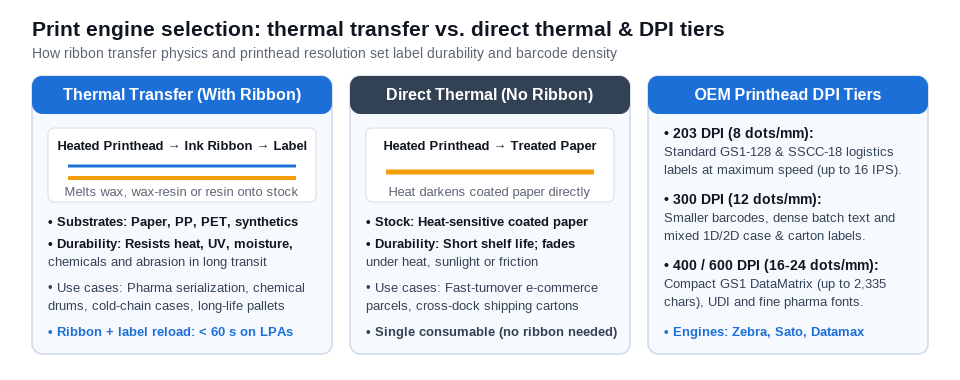
Thermal transfer vs. direct thermal printing physics
Most industrial print engines can operate in either thermal transfer mode or direct thermal mode, and choosing between them changes consumable logistics, printhead wear, and barcode survival in transit.
In thermal transfer mode (with ribbon), the printhead presses a thin ink-coated polyester film ribbon against the label face stock. Microscopic heating elements melt wax, wax-resin, or pure resin ink onto paper, polypropylene (PP), or polyester (PET) labels. Thermal transfer prints resist heat, moisture, abrasion, industrial chemicals, and ultraviolet (UV) light. This mode is required for pharmaceutical serialization, chemical containers, cold-chain cases, and pallets stored outdoors or in long-term distribution. On direct-drive single-path LPAs (such as the LINEVO LV-9560 series), clutchless bidirectional web tension control eliminates manual dancer rollers and allows operators to change both the label roll and thermal transfer ribbon in under 60 seconds.
For ribbon chemistry comparisons across melting points, solvent resistance, and substrate pairing, see our wax vs resin ribbon durability and label stock match guide.
In direct thermal mode (no ribbon), the printhead applies heat directly to chemically treated, heat-sensitive paper stock without a ribbon. Removing the ribbon eliminates one consumable and simplifies web threading, making direct thermal popular for high-turnover e-commerce parcels and cross-dock shipping cartons whose transit life is measured in days. However, direct thermal paper darkens if exposed to warehouse heat or sunlight, scratches under friction, and experiences higher printhead friction because there is no smooth ribbon film lubricating the interface between the ceramic printhead and the paper face stock.
Choosing between 203, 300, 400, and 600 DPI printheads
Modular OEM print engines support interchangeable printheads across four resolution tiers: 203 DPI (8 dots/mm), 300 DPI (12 dots/mm), 400 DPI (15.7 dots/mm), and 600 DPI (23.6 dots/mm). Higher dot density sharpens small fonts and compact 2D symbols, but reduces maximum linear print speed because the controller must fire and cool more rows of heating elements per millimeter of web travel.
| Printhead Resolution | Dot Pitch & Element Size | Maximum Print Speed Ceiling | Target Barcode Symbology & Font Size | Typical Industrial Applications |
|---|---|---|---|---|
| 203 DPI | 8 dots/mm (0.125 mm dot) | Up to 16 IPS (406 mm/s) | Large linear GS1-128 and SSCC-18 barcodes (X-dimension ≥ 0.495 mm / 20 mil); bold human-readable shipping text | Corrugated shipping cases, 4 x 6 in (A6) and 6 x 8 in (A5) logistics labels, high-speed e-commerce fulfillment |
| 300 DPI | 12 dots/mm (0.084 mm dot) | Typically 10 to 14 IPS (254 to 355 mm/s) | Medium-density Code 128, mixed 1D/2D labels, multi-language ingredient tables, 6 pt to 8 pt batch text | Food and beverage secondary cartons, multi-pack trays, automotive parts bins, retail inner packs |
| 400 DPI | 15.7 dots/mm (0.063 mm dot) | Typically 6 to 10 IPS (152 to 254 mm/s) | Compact GS1 DataMatrix and QR codes, dense alphanumeric lot blocks on narrow labels | Medical device cartons, specialty chemical packs, electronics sub-assemblies |
| 600 DPI | 23.6 dots/mm (0.042 mm dot) | Typically 4 to 6 IPS (101 to 152 mm/s) | Micro 2D DataMatrix (encoding up to 2,335 characters), UDI symbols, 4 pt regulatory text, crisp graphics | Pharmaceutical unit cartons, vial/ampoule tray labels, high-density electronics serialization |
As a rule of thumb, if a line applies standard 4 x 6 in (100 x 150 mm) GS1-128 case or pallet labels and requires maximum throughput, specify a 203 DPI printhead so the print engine can run up to its 16 IPS thermal ceiling. Specify 300 DPI when the same machine must alternate between outer case barcodes and smaller inner-carton product labels, and reserve 400 or 600 DPI for compact 2D DataMatrix or pharmaceutical UDI formats where symbol footprint is constrained.
Print-and-apply cycle time math: matching IPS to cases per minute
On a print-and-apply machine, thermal materials are physically limited by printhead heat-transfer physics to a maximum speed of 16 IPS (406.4 mm/s). On a tamp-blow or swing-arm LPA, the machine must first print and peel the full length of the label onto the vacuum pad before the actuator cylinder can extend to the package. Consequently, label length ($L_{\text{label}}$) directly controls maximum case-per-minute capacity.
$$\text{Print Feed Time } t_{\text{print}} \text{ (s)} = \frac{L_{\text{label}} + d_{\text{gap}}}{25.4 \times S_{\text{print}}}$$
$$\text{Total LPA Cycle Time } T_{\text{LPA}} \text{ (s)} = t_{\text{data}} + t_{\text{print}} + t_{\text{extend}} + t_{\text{retract}} + t_{\text{verify}}$$
$$\text{Sustained Net Capacity } Q_{\text{sustained}} \text{ (packs/min)} = \frac{60 \times \eta_{\text{derate}}}{T_{\text{LPA}}}$$
Where:
- $L_{\text{label}}$ is the label length in the feed direction (mm) and $d_{\text{gap}}$ is the inter-label gap (typically $3\text{ mm}$).
- $S_{\text{print}}$ is the print speed in inches per second ($\le 16\text{ IPS}$).
- $t_{\text{data}}$ is the network data lookup and rasterization time (s).
- $t_{\text{extend}}$ and $t_{\text{retract}}$ are the actuator extension and return times (s); on a direct-apply wipe-on LPA, $t_{\text{extend}} + t_{\text{retract}} = 0$ because the label merges directly onto the moving package as it prints.
- $t_{\text{verify}}$ is the inline barcode scanner grading window (s).
- $\eta_{\text{derate}}$ is the sustained operating factor ($0.85$ for the 80% to 90% optimal operating window).
Worked example: Compare a linear tamp-blow LPA against a direct-apply wipe-on LPA applying a $101.6\text{ mm}$ (4 in) feed-length label ($L_{\text{label}} = 101.6\text{ mm}$, $d_{\text{gap}} = 3\text{ mm}$) at $S_{\text{print}} = 12\text{ IPS}$ ($304.8\text{ mm/s}$), with $t_{\text{data}} = 0.02\text{ s}$ (over EtherNet/IP) and $t_{\text{verify}} = 0.05\text{ s}$.
- Print feed time for one label: $t_{\text{print}} = (101.6 + 3) / (25.4 \times 12) = 104.6 / 304.8 = 0.343\text{ s}$.
- Case A (Tamp-blow LPA) with a $150\text{ mm}$ pneumatic stroke ($t_{\text{extend}} = 0.25\text{ s}$, $t_{\text{retract}} = 0.25\text{ s}$): $$T_{\text{LPA, tamp}} = 0.02 + 0.343 + 0.25 + 0.25 + 0.05 = 0.913\text{ s/case}$$ Sustained net capacity at $\eta_{\text{derate}} = 0.85$: $Q_{\text{sustained}} = (60 \times 0.85) / 0.913 = 55.8\text{ cases/min}$ (peak instantaneous rate $65.7\text{ cases/min}$).
- Case B (Direct-apply wipe-on LPA) where $t_{\text{extend}} + t_{\text{retract}} = 0$: $$T_{\text{LPA, direct}} = 0.02 + 0.343 + 0 + 0.05 = 0.413\text{ s/case}$$ Sustained net capacity at $\eta_{\text{derate}} = 0.85$: $Q_{\text{sustained}} = (60 \times 0.85) / 0.413 = 123.5\text{ cases/min}$ (peak instantaneous rate $145.3\text{ cases/min}$, matching published 150 packs/min direct-apply benchmarks).
PLC, WMS, and ERP variable-data handshake architecture
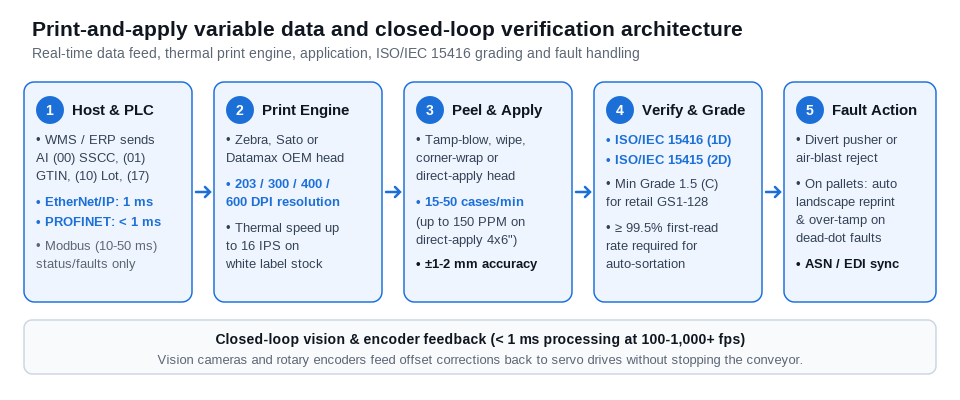
A print-and-apply labeler is an active network node on the packaging line. When cases or pallets carry unique serialized license plates, sending static print files manually from a PC causes operator errors and mislabeled loads. Industrial installations use a five-stage closed-loop data and verification architecture linking the host WMS/ERP, line PLC, print engine, applicator, and barcode verifier.
Industrial communication protocols and cycle-time latency
Choosing the wrong industrial network protocol introduces latency that causes late print triggers or forces the conveyor to slow down. Published line-integration benchmarks divide industrial protocols into real-time motion/trigger networks and slower supervisory/status networks:
| Protocol | Typical Cycle Time & Jitter | Bandwidth / Topology | Recommended Role in Print-and-Apply Integration |
|---|---|---|---|
| EtherNet/IP (with CIP Motion) | Down to 1 ms cycle time | Up to 1,000 Mbps (Star, Linear, Ring) | Real-time print triggering, encoder speed synchronization, and variable-data payload transfer with Allen-Bradley / Rockwell PLCs |
| PROFINET IRT (Isochronous Real-Time) | <1 ms cycle time (<1 µs jitter) | 100 Mbps to 1 Gbps | High-speed deterministic triggering, servo camming, and vision feedback with Siemens PLCs |
| Modbus TCP / RTU | 10 to 50 ms cycle time | Serial or Ethernet | Low-ribbon warnings, roll-low status alerts, fault counters, and recipe selection on slower indexing lines; too slow for high-speed motion triggering |
| DeviceNet | Device-level polling | Up to 500 kbit/s (max 64 nodes) | Legacy sensor/actuator I/O and stack-light signaling only |
To standardize state reporting across multi-vendor packaging lines, modern LPA controllers expose PackML state models (Idle, Execute, Held, Suspended, Aborted) and OPC UA tags so plant SCADA and OEE dashboards track availability, performance, and printhead life automatically.
GS1 Application Identifiers (AIs) and 1D vs. 2D symbol capacity
Variable data sent from the WMS or ERP is formatted into standardized GS1 Application Identifiers (AIs) enclosed in parentheses in the human-readable line and separated by Function 1 Symbol Characters (FNC1) inside the barcode. AI (00) encodes the 18-digit Serial Shipping Container Code (SSCC-18), acting as the unique license plate for a logistics unit or pallet linked to an Electronic Data Interchange (EDI) Advance Ship Notice (ASN). AI (01) encodes the 14-digit Global Trade Item Number (GTIN) identifying the trade item or case configuration, while AI (10) carries the batch or lot number (up to 20 alphanumeric characters), and AIs (11), (15), and (17) encode the production date, best-before date, and expiration date formatted as YYMMDD.
When encoding multiple AIs into a linear barcode under ISO/IEC 15417:2007 (the Code 128 symbology specification underlying GS1-128), engineers must observe the 48-character maximum capacity of a single GS1-128 symbol and the 6.5 in (165 mm) maximum physical width including Quiet Zones. If a pharmaceutical, medical device, or specialty food label requires encoding extended serialization strings, multi-field lot traceability, or regulatory text beyond 48 characters, the print engine must switch to a 2D GS1 DataMatrix symbol, which holds up to 2,335 alphanumeric characters in a compact square footprint.
Inline barcode verification (ISO/IEC 15416 & 15415) and closed-loop fault recovery
Printing and applying a label does not guarantee that a downstream warehouse tunnel scanner or retail receiving dock can read it. A single burned-out thermal printhead dot, a ribbon wrinkle, or adhesive bleed on the peel plate can split a dark bar in a Code 128 symbol and change its decoded value or cause a no-read.
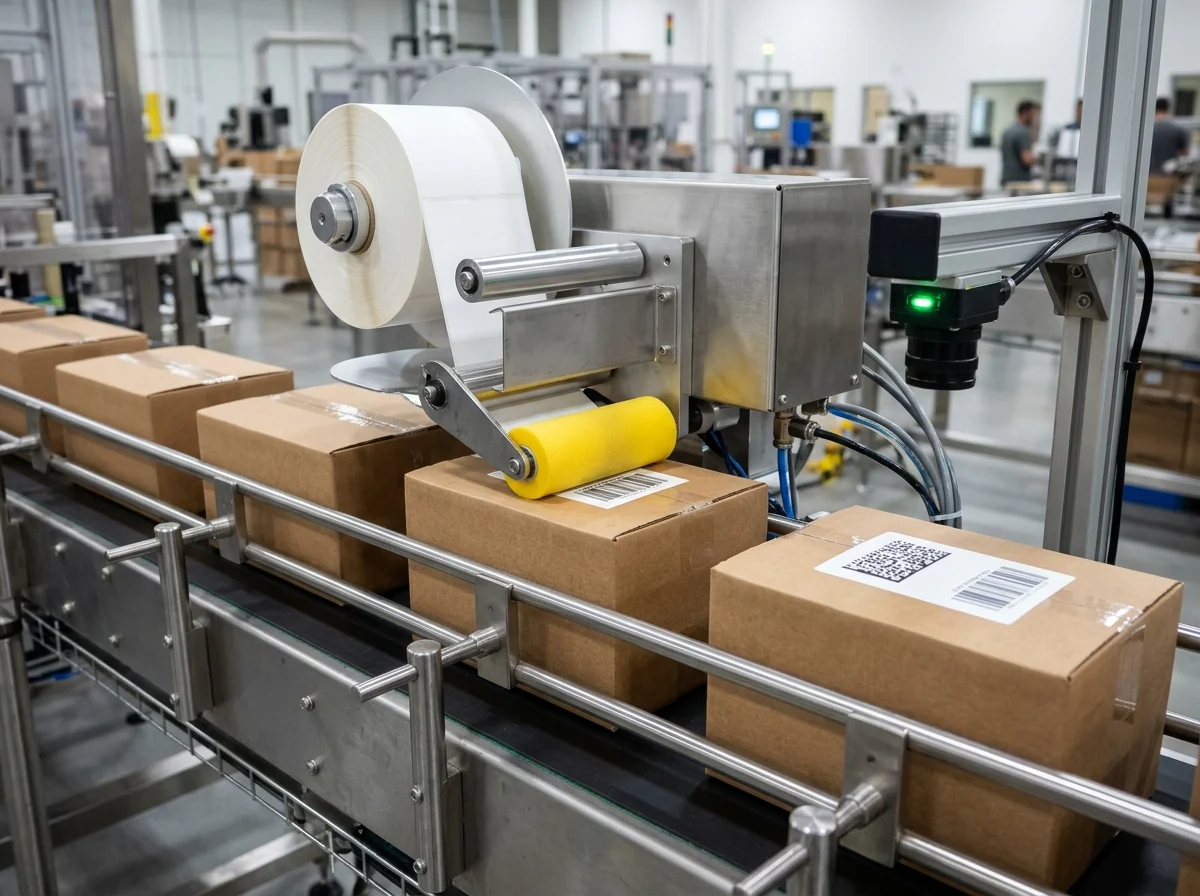
To prevent unreadable cases or pallets from leaving the line (where retailer non-compliance chargebacks cost $50 to $500 per incident), high-reliability print-and-apply systems integrate an inline barcode scanner or an ISO/IEC 15426-1 compliant barcode verifier immediately downstream of the application pad.
Linear 1D barcodes (GS1-128, ITF-14, UPC/EAN) are graded under ISO/IEC 15416, while 2D symbols (GS1 DataMatrix, QR) are graded under ISO/IEC 15415 across parameters including symbol contrast, modulation, decodability, defects, and Quiet Zone clearance. GS1 logistics and retail standards require a minimum overall grade of 1.5 (ANSI Grade C), and automated sortation conveyors require a $\ge 99.5%$ first-read rate. Pairing a servo-driven LPA with a 5 to 20 MP machine-vision camera ($100\text{ to }1,000+\text{ fps}$ with $<1\text{ ms}$ processing) verifies both barcode grade and physical label placement within $\pm 0.5\text{ to }1\text{ mm}$, achieving $>99.9%$ read rates.
On a case or carton conveyor, if a label fails verification, the PLC triggers a pneumatic pusher or air-blast diverter to route the case onto a rework spur before it reaches the palletizer. On an automated end-of-line pallet labeler (such as the LINEVO LV-9560PL), diverting a 1,500 lb pallet is impractical; instead, when the integrated scanner detects an unreadable barcode caused by a dead printhead dot, the system automatically rotates the barcode format 90 degrees into landscape orientation (so the bars run perpendicular to the dead dot), reprints a fresh label, and tamps it directly over the defective label before releasing the pallet.
Dominant print-and-apply failure modes and engineering prevention
| Failure Mode | Root Cause | Preventive Engineering Action |
|---|---|---|
| Voided bars or white streaks through GS1-128 barcodes | Burned-out thermal printhead element, ribbon wrinkle, or adhesive residue baked onto ceramic glaze | Use inline ISO/IEC 15416 verification after the pad; enable automatic landscape reprint on pallet LPAs; clean printhead at every ribbon change |
| Late print trigger or inconsistent leading-edge registration | Variable-data payload sent over high-latency Modbus/serial link (10 to 50 ms) or unbuffered WMS database query | Pre-buffer serialized SSCC/GTIN blocks in the PLC or LPA memory (storing 100+ formats locally) and trigger via EtherNet/IP (1 ms) or PROFINET (<1 ms) |
| Label smear or poor ink anchorage on synthetic PP/PET stock | Wax ribbon paired with glossy synthetic film, or printhead energy/darkness set too low for 12 to 16 IPS speed | Match ribbon chemistry to stock (wax for paper, wax-resin for coated/PP, pure resin for PET/chemical drums) and verify grade at target IPS |
Selecting the right print-and-apply machine for your packaging tier
Use the specialized guides in this cluster to drill down into your specific package format and line integration scope. If you are labeling flat cartons, pouches, trays, or corrugated RSC shipping cases, go to the box and carton labeling machine guide for top-surface belt labelers, side wipe-on case systems, adjacent-panel corner-wrap units, and retail case barcode placement rules ($1.25\text{ in}$ from base, $\ge 0.75\text{ in}$ from vertical edges). If you are labeling unitized stretch-wrapped pallets at the end of the line, read the pallet labeler guide for 1-stop (180 pallets/hour) versus 2-stop (120 pallets/hour) swing-arm systems, GS1 SSCC-18 height zones ($400\text{ to }800\text{ mm}$), and Walmart, Target, Kroger, and Amazon FBA mandates.
When comparing pre-printed applicators against print-and-apply, return to the label applicators and print-and-apply authority guide or verify your roll orientation on the label roll unwind direction chart. When you are ready to scope a complete line or request pricing, review our custom labeling line integration solutions, check budget benchmarks in the industrial labeling machine cost guide, prepare your parameters with the labeling machine RFQ checklist, and send your package dimensions and speed targets to LINEVO engineers on WhatsApp.
Common questions
What is the maximum speed of a print and apply labeling machine?
Thermal printheads are physically limited by heating and cooling response to a maximum print speed of 16 inches per second (406 mm/s). In case and carton packaging, standard tamp-blow and corner-wrap print-and-apply systems run at 15 to 50 cases per minute, while direct-apply (wipe-on) print-and-apply machines that dispense 4 x 6 inch GS1 labels without a tamp stroke reach up to 150 packs per minute.
Should I choose a thermal transfer or direct thermal print-and-apply system?
Choose direct thermal when labeling fast-turnover shipping cases or e-commerce parcels that reach their destination within days and are not exposed to heat, direct sunlight, or abrasion, since direct thermal eliminates the ink ribbon consumable. Choose thermal transfer (using wax, wax-resin, or resin ribbon) whenever labels must survive long-term warehouse storage, cold-chain condensation, outdoor pallet yards, chemical exposure, or pharmaceutical serialization audits.
What printhead resolution (203, 300, or 600 DPI) do GS1-128 logistics labels require?
Standard 4 x 6 inch (A6) and 6 x 8 inch (A5) GS1-128 case and pallet labels use a 203 DPI (8 dots/mm) printhead, which easily achieves the ISO/IEC 15416 Grade 1.5 (ANSI C) print quality threshold while running at maximum 12 to 16 IPS speeds. Upgrade to 300 DPI for smaller carton labels with dense multi-language text, and use 400 or 600 DPI for compact 2D GS1 DataMatrix or UDI symbols on pharmaceutical and medical device packaging.
How does a print-and-apply labeler communicate with a PLC or WMS?
For high-speed lines, the line PLC communicates with the print-and-apply controller over deterministic industrial Ethernet protocols such as EtherNet/IP (1 ms cycle time) or PROFINET IRT (under 1 ms cycle time) to synchronize conveyor encoders and fire print triggers, while the WMS or ERP pushes variable GS1 Application Identifier strings (SSCC-18, GTIN, lot, expiration). Slower protocols like Modbus (10 to 50 ms cycle time) should be restricted to status monitoring and fault alarms rather than real-time product triggering.
How do print-and-apply systems prevent unreadable barcodes from reaching customers?
Industrial print-and-apply machines mount a fixed barcode scanner or ISO/IEC 15426-1 verifier immediately after the application pad to check every label for a minimum Grade 1.5 (C) and maintain a 99.5% or higher first-read rate. If a dead printhead dot or wrinkle causes a failed read, case conveyors divert the box to a reject lane, while automated pallet labelers can automatically rotate the barcode 90 degrees into landscape mode, reprint the label, and apply it directly over the bad label before the pallet advances.
In This Section
Box and Carton Labeling Machines: Top-Surface, Side Wipe-On & Corner-Wrap Guide
Select box and carton labeling machines across split-belt top labelers, side wipe-on case applicators, corner-wrap systems, and GS1 barcode clearance rules.
Learn moreAutomatic Pallet Labelers: GS1 SSCC-18 Placement, Swing-Arm Reach & Throughput
Specify automatic pallet labelers for 1-side, 2-side, and 3-side GS1 SSCC-18 labeling, 400 to 800 mm placement zones, retailer mandates, and pallets/hour math.
Learn moreTamp vs Wipe-On vs Blow-On Applicators and Print-and-Apply Systems
Engineering comparison of wipe-on, tamp-blow, and air-blow label applicators versus print-and-apply systems across speed, stroke distance, accuracy, and air use.
Learn moreIndustrial Label Printer and OEM Print Engine Integration Guide
How industrial label printer OEM engines from Zebra, Sato, and Datamax integrate into print-and-apply systems across DPI, Left/Right web paths, and PLC I/O.
Learn moreMaster Carton Labeling After Case Sealing: Line Layout & GS1-128
Engineering guide to master carton labeling downstream of tape and hot-melt case sealers: pitch spacing, tape-tab avoidance, GS1-128 zones, and scan reject.
Learn moreDirect Thermal vs Thermal Transfer: Durability, Costs, and Line Fit
Direct thermal prints ribbonless on heat-sensitive paper for short-term shipping, while thermal transfer melts ribbon ink for durable industrial barcodes.
Learn moreWax vs Resin Ribbon: Durability, Melting Points, and Label Stock Match
Wax ribbons print fast on paper at low energy, wax-resin bridges coated stock and matte film, and full resin resists heat and solvents on synthetics.
Learn moreRelated Guides & Specifications
Related Equipment & Guides
Label Applicators & Print-and-Apply Systems: Actuation, Speed & Retrofit Guide
Compare pre-printed label applicators and print-and-apply systems across wipe-on, tamp-blow, air-blow, and corner-wrap actuation, web speed, and retrofits.
Learn moreLabel Automation and Custom Packaging Line Labeling Integration
Engineering guide to label automation and inline labeling system integration across fillers, cappers, accumulation tables, PLC sync, and vision reject gates.
Learn moreLabel Roll Unwind Direction Chart (#1 to #8) and Roll Length Calculator
Interactive #1 to #8 label winding direction chart (wound out vs wound in), eye-mark guide, and roll length, OD, core size, and shift roll calculator.
Learn moreBox and Carton Labeling Machines: Top-Surface, Side Wipe-On & Corner-Wrap Guide
Select box and carton labeling machines across split-belt top labelers, side wipe-on case applicators, corner-wrap systems, and GS1 barcode clearance rules.
Learn moreAutomatic Pallet Labelers: GS1 SSCC-18 Placement, Swing-Arm Reach & Throughput
Specify automatic pallet labelers for 1-side, 2-side, and 3-side GS1 SSCC-18 labeling, 400 to 800 mm placement zones, retailer mandates, and pallets/hour math.
Learn moreTamp vs Wipe-On vs Blow-On Applicators and Print-and-Apply Systems
Engineering comparison of wipe-on, tamp-blow, and air-blow label applicators versus print-and-apply systems across speed, stroke distance, accuracy, and air use.
Learn moreIndustrial Label Printer and OEM Print Engine Integration Guide
How industrial label printer OEM engines from Zebra, Sato, and Datamax integrate into print-and-apply systems across DPI, Left/Right web paths, and PLC I/O.
Learn moreIndustrial Labeling Machine Price and Total Cost of Ownership Guide
Transparent industrial labeling machine price breakdown from $2,000 semi-automatics to $500,000+ high-speed lines, plus hidden TCO drivers and payback math.
Learn moreLabeling Machine RFQ Checklist and User Requirement Specification (URS)
Engineering labeling machine RFQ checklist and User Requirement Specification (URS) template covering container drawings, roll unwind #1-#8, CPM, and FAT rules.
Learn moreMaster Carton Labeling After Case Sealing: Line Layout & GS1-128
Engineering guide to master carton labeling downstream of tape and hot-melt case sealers: pitch spacing, tape-tab avoidance, GS1-128 zones, and scan reject.
Learn more