Why Container Geometry Dictates Label Cut Dimensions and Applicator Architecture
Ordering label rotary dies before verifying container circumference, wall taper, and sleeve shrink ratios causes edge flagging, diagonal wrinkling, and costly roll scrap during line commissioning. Across high-speed industrial labeling machines, label-related geometry and material defects account for 15% to 20% of beverage packaging line stoppages, with baseline defect rates on uninspected lines averaging 1.9% on flat or square bottles, 2.8% to 3.2% on cylindrical round bottles, 5.6% on oval or irregular profiles, and 6.1% on transparent films.
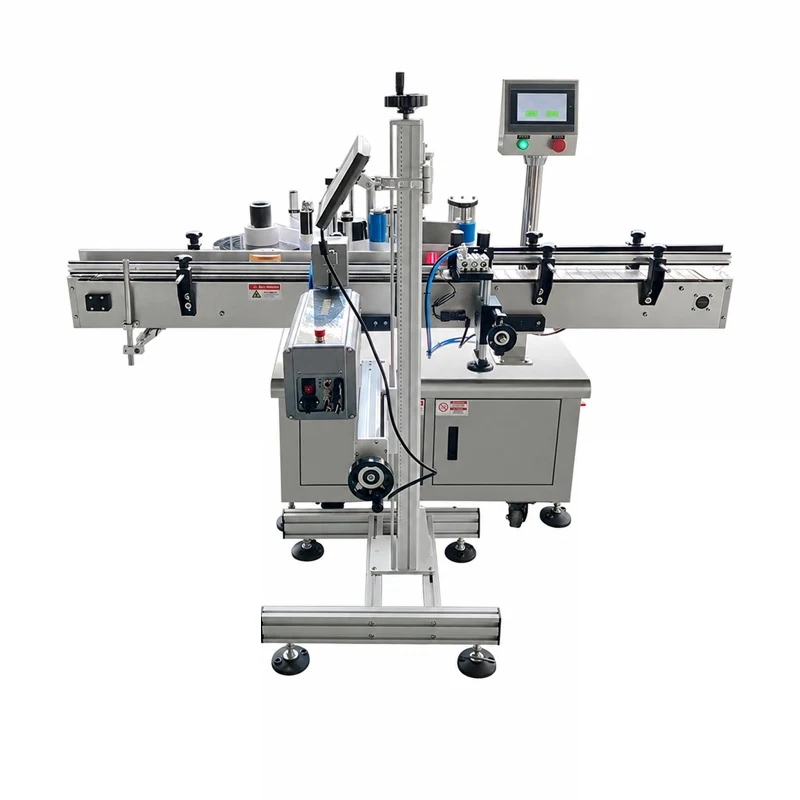
Every bottle labeling machine and jar labeling line operates within strict mechanical envelopes governing peel-plate height, wrap-belt contact arc, mandrel cutter diameter, and film shrink recovery. Before releasing print cylinders or rotary cutting dies, engineering teams must verify four geometric relationships: cylindrical circumference (C = pi x D), seam overlap versus gap allowance, shrink sleeve layflat fold width (LF = (pi x D / 2) + seam), and tapered wall chord differential (Delta_C = pi x (D_top - D_bottom)).
| Packaging Format & Application Method | Typical Coverage (% of C) | Label Dimension & Seam Rule | Representative Machine Envelope | Placement Accuracy & Speed |
|---|---|---|---|---|
| Full Wrap-Around Pressure-Sensitive (Overlap) | 101% to 103% of C |
L = (pi x D) + 3 to 6 mm overlap; H = 8–70 mm (up to 180 mm tall head) |
Bottle OD 20–80 mm, height 50–200 mm, 76 mm core, 300 mm roll OD |
±1.0 mm at 50–150 BPM inline (160–295 mm length at 240 BPM rotary) |
| Nearly Full Wrap Pressure-Sensitive (Seam Gap) | 95% to 98% of C |
L = (pi x D) - 2 to 5 mm gap; avoids mold seam or clear-film lap line |
Round glass wine, spirit, and pharma vials (15–85 mm OD, ≥3 mm die gap) |
±0.8 to ±1.0 mm at 60–200 BPM (15–20 min changeover) |
| Partial Wrap / Front-and-Back Panels | 60% to 70% of C total |
Single partial band 0.65 x C or dual panels (30–35% C each) |
Dual-head inline (15–200 mm OD, 8–180 mm web height, 2.5 kW) |
±0.8 mm at 85–120 BPM (20–25 min setup; up to 300 BPM high-speed) |
| Roll-Fed Hot-Melt Glue Wrap (Water Bottle) | 101% to 103% of C |
L = (pi x D) + 4 to 6 mm glue lap (120–160 °C hot-melt at leading/trailing ends) |
Round label max 140 x 430 mm (square 180 x 750 mm), 152 mm core, 600 mm OD |
±1.0 mm at 250 BPM (12-station rotary, 100 m/min web speed) |
Full-Body Shrink Sleeve (40–70 micron film) |
360° contoured tube | LF = (pi x D_sleeve / 2), transverse shrink ((D_sleeve - D_min) / D_sleeve) x 100 |
Bottle OD 28–120 mm, cutter plane 30–130 mm, cut length 30–250 mm |
±0.5 mm layflat, ±1.0 mm cut length at 150–300 BPM (450–600 rotary) |
Interactive Container Label Size, Wrap Coverage & Shrink Sleeve Calculator
Use the engineering calculator below to compute cylindrical circumference, cut label length with overlap or gap allowances, artwork print bleed dimensions, FDA 21 CFR § 101.2 Principal Display Panel (PDP) width, shrink sleeve layflat width, required transverse film shrink percentage, and tapered wall chord distortion. Select a container preset or enter your exact bottle drawing dimensions to generate a copyable RFQ specification sheet.
Container Circumference, Wrap Length, Layflat & Taper Distortion Calculator
Select a standard container preset or input custom millimeter measurements from your bottle drawing.
1. Container & Label Band Inputs
2. Computed Label & Sleeve Engineering Outputs
RFQ Container & Label Specification Summary
Loading calculation...
Cylindrical Circumference, Overlap Seams, and Water Bottle Labeling Standards
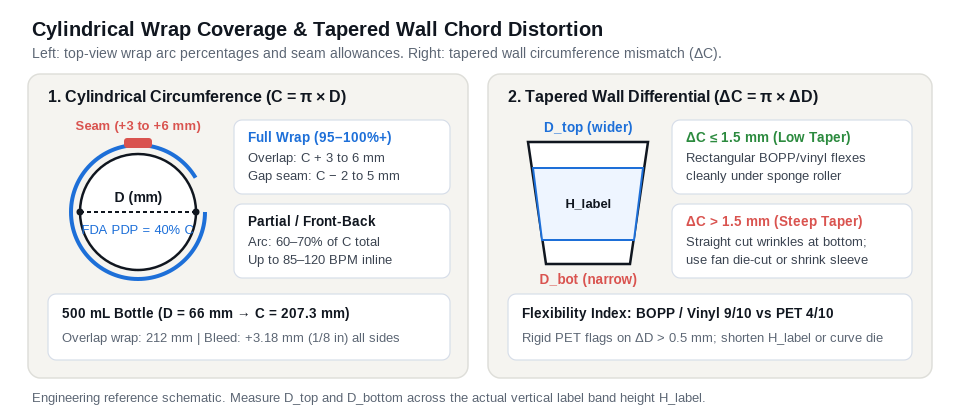
On a straight-walled cylindrical bottle or jar, outer circumference is governed by C = pi x D, where D is the external diameter measured across the actual label recess panel rather than the bumper rings above and below the panel. Blow-molded PET water bottles (500 mL / 16.9 oz) and HDPE nutraceutical canisters exhibit mold shrinkage tolerances of ±0.5 mm to ±1.2 mm in diameter, which translates into ±1.57 mm to ±3.77 mm of circumference variation (pi x Delta_D). Because container circumference fluctuates from cavity to cavity, full-wrap labels cannot be cut to exact 100.0% circumference without either buckling on undersized bottles or leaving an exposed vertical slit on oversized bottles.
Engineers resolve cavity diameter variance by selecting one of three wrap coverage strategies on wrap-around and pressure-sensitive labelers:
- Full Wrap With Leading-to-Trailing Overlap (
+3 mmto+6 mm): Standard for500 mL(16.9 oz) and1.0 Lwater bottle labeling, carbonated soft drinks, and roll-fed BOPP or paper wrap labels. For a66 mmdiameter PET water bottle (C = 207.35 mm), adding a+4.5 mmoverlap yields a211.8 mmcut label length (50 mmto55 mmheight). On roll-fed hot-melt rotary labelers running250 BPM(100 m/minweb speed,25–30 m/minconveyor speed), a heated glue roller applies120–160 °Chot-melt adhesive strictly to the leading and trailing overlap strips so the label bonds tightly to itself without smearing glue across the entire bottle body. - Nearly Full Wrap With Seam Gap (
95%to98%ofC, orC - 2to5 mm): Used on thick coated paper wine bottles (75 mmOD,C = 235.6 mm), craft glass jars, pharmaceutical vials (15–30 mmOD), and transparent BOPP “no-label look” films. Leaving a3 mmto5 mmgap prevents a double-thickness ridge over vertical glass mold seams and eliminates the visible optical line caused when clear film overlaps itself. Inline wrap-around stations achieve±1.0 mmvertical alignment across95–100%coverage at up to100–150 BPM(15–20 minutechangeover). - Partial Wrap and Front-and-Back Coverage (
60%to70%ofC): When a container requires distinct front branding and rear nutritional panels (or when a mild wall taper prevents a 360-degree wrap), a single partial-wrap band or dual-head front-and-back system covers60%to70%of the circumference. Dual-head inline systems run85–120 BPM(up to 300 BPMon high-speed servo configurations) with±0.8 mmregistration accuracy and20–25 minutemechanical setup.
Under FDA food labeling regulations (21 CFR § 101.2), the Principal Display Panel (PDP) on a cylindrical food or beverage container is defined as 40% of the product of container height times circumference (0.40 x C in horizontal arc width). The Information Panel (nutrition facts, ingredient list, and manufacturer address) must sit immediately contiguous and to the right of the PDP with a minimum type height of 1/16 inch (1.59 mm). Pre-press artwork files must also include a minimum 1/8 inch (3.175 mm) print bleed on all four sides (+6.35 mm total length and height) to prevent white unprinted borders during rotary die cutting (±0.1 mm die-cut accuracy required for 600+ CPM dispensing).
Shrink Sleeve Layflat Math and Transverse Film Shrink Ratio Limits
When a container transitions across multiple diameters (such as a contoured sports drink bottle with a 68 mm body tapering down to a 26 mm neck cap ring), pressure-sensitive facestocks cannot compress laterally without pleating. Full-body shrink sleeve labeling machines solve multi-contour geometry by extruding or seaming flat film (40–70 microns typical gauge; 30 microns on ultra-thin PET and 40 microns on OPS) into a continuous folded tube called the layflat.
To calculate layflat width (LF) and transverse shrink percentage:
- Target Sleeve Internal Diameter (
D_sleeve): Add2 mmto4 mmof radial clearance to the widest container diameter (D_max) so the cut sleeve drops freely from the mandrel cutter head over the moving bottle without hanging up on shoulder ribs:D_sleeve = D_max + Clearance. - Folded Layflat Width (
LF): MultiplyD_sleevebypi / 2(1.5708), or computeLF = (pi x D_max / 2) + seam_allowance. For a70 mmbottle with3 mmclearance,LFequals113 mmto114.7 mm. High-speed rotary cutter heads maintain layflat width within±0.5 mmand vertical cut length within±1.0 mm. - Required Transverse Shrink Ratio (
S_req): Compute the percentage diameter reduction required at the narrowest neck or waist zone (D_min):S_req = ((D_sleeve - D_min) / D_sleeve) x 100. Always add a5%to8%safety margin below the film manufacturer’s maximum published shrink curve so the film does not stall or tear inside the steam tunnel.
| Shrink Film Family | Published Max Shrink Ratio | Tunnel Temperature Window | Typical Gauge (Microns) | Primary Container & Recycling Fit |
|---|---|---|---|---|
| PVC (Polyvinyl Chloride) | Up to 64% | 60–80 °C operating (122–140 °F initiation; up to 100–113 °C tunnel) |
40–70 µm |
Low-cost straight cylinders, jar neck tamper bands; restricted by many retail recyclers |
| PLA (Polylactic Acid) | 70% to 72% | 80–100 °C operating window |
40–60 µm |
Bio-based compostable film for natural beverages and moderate neck contours |
| OPS (Oriented Polystyrene) | Up to 75% | 90–120 °C controlled curve |
40–50 µm |
Low shrink force (prevents crushing thin-walled empty PET bottles); wide shrink curve |
| PETG (Glycol-Modified PET) | Up to 78% | 140–180 °C (284–356 °F; 158–176 °F initiation) |
30–70 µm |
Steep neck contours, high gloss, pasteurization/chilled water resistance |
| Floatable Polyolefin (TD PO) | >60% (<1.0 g/cm³ density) |
85–115 °C steam tunnel |
42–50 µm |
Floats separates cleanly from sinking PET flakes during caustic wash recycling |
Standard automatic mandrel shrink sleeve applicators accept container diameters from 28 mm to 120 mm, cutter head planes from 30 mm to 130 mm, and sleeve cut lengths from 30 mm to 250 mm at 150 BPM (using 5 inch to 10 inch roll cores), while compact C-frame applicators cover 16 mm to 150 mm layflat widths and 16 mm to 200 mm cut lengths.
Tapered Container Chord Differential and Substrate Flexibility Limits
Glass preserve jars, yogurt cups, candle tumblers, and conical cosmetic bottles rarely have vertical sidewalls. When a container tapers from a wider upper diameter (D_top) to a narrower lower diameter (D_bottom) over the vertical label height (H_label), the upper circumference exceeds the lower circumference by Delta_C = pi x (D_top - D_bottom).
If a straight rectangular label is wrapped around a tapered wall, the upper edge travels a longer path than the lower edge. Once Delta_C exceeds 1.5 mm on flexible film (or 0.8 mm to 1.0 mm on stiff paper or polyester), the excess circumference at the narrower edge has nowhere to compress and pops outward as a triangular tunnel or diagonal wrinkle.
Material selection directly governs how much taper a straight die-cut can absorb before requiring a curved fan die:
- BOPP (Biaxially Oriented Polypropylene) & Cast Vinyl (
9/10Flexibility): High conformability and8/10moisture resistance allow BOPP and vinyl to stretch slightly under a contoured dual-durometer sponge press roller, absorbing mild taper differentials up toDelta_C = 1.2–1.5 mm. - Uncoated Paper (
6/10Flexibility) & Coated Paper (5/10Flexibility): Paper fibers cannot stretch elastically across compound curves. WhenDelta_Cexceeds1.0 mm, paper labels must either be shortened vertically (reducingH_labelsoDelta_Dacross the band shrinks) or die-cut into an arched fan shape. - Polyester / PET (
4/10Flexibility): Rigid50 micronPET facestocks provide superior chemical and abrasion resistance (9/10) but strongly resist multi-axis bending. On tapered walls or small-diameter vials (<25 mmOD), rigid PET will lift at the leading and trailing edges (“flagging”) unless paired with a high-tack rubber or modified acrylic adhesive (especially on low-surface-energy HDPE/PP containers below38 dynes/cm).
Matching Label Dimensions to Roll Specs and Applicator Envelopes
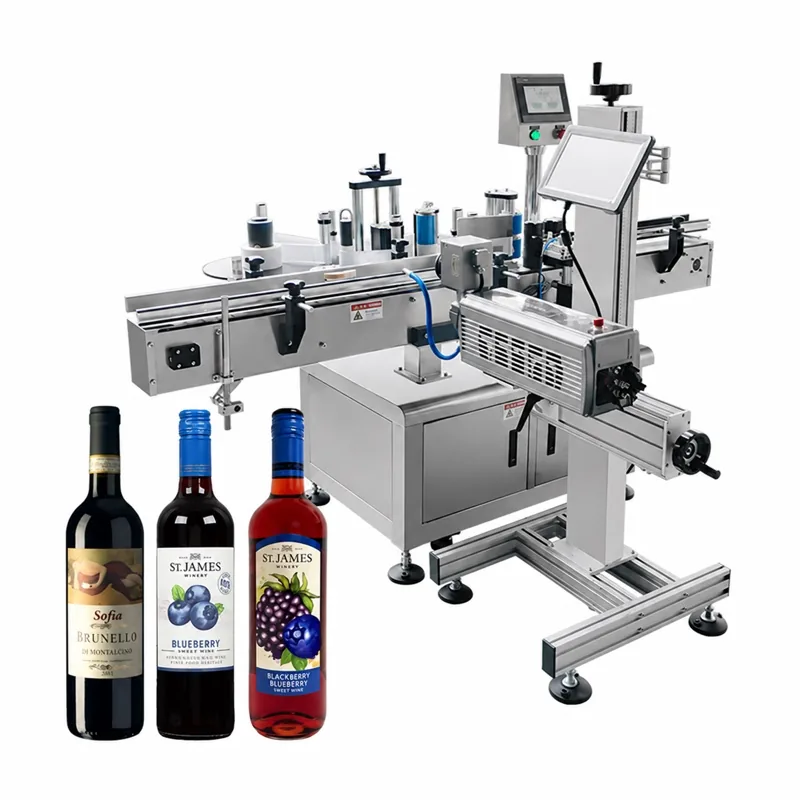
Once cut length (L), vertical height (H), and coverage geometry are finalized, verify that the roll wind and machine head envelope match before issuing purchase orders:
- Verify Unwind Direction (#1 to #8): A wrap-around label that dispenses right-edge-leading (#3) vs left-edge-leading (#4) will print upside down if the applicator head sits on the opposite side of the conveyor. Confirm roll wind using the label roll unwind direction chart.
- Confirm Web Speed and Conveyor Pitch: Long wrap-around labels (
212 mmon a500 mLwater bottle) require a much higher dispensing web velocity (m/min) than short front labels at the sameBPM. Run your calculated label length through the labeling speed and pitch calculator to verify servo drive and gap sensor limits. - Lock In Factory Acceptance Test (FAT) Tolerances: Use the labeling machine RFQ checklist to attach your container drawing and 200–500 sample containers + 2–3 label rolls, and validate placement accuracy during commissioning with the industrial labeling machine FAT and troubleshooting manual. To receive a formal machine configuration and die-line verification for your containers, send your calculated parameters to LINEVO engineers on WhatsApp.
Related Guides & Specifications
Water Bottle Labeling Machines: PET Wrap-Around, Roll-Fed BOPP, and Shrink Sleeve
Compare pressure-sensitive wrap, roll-fed BOPP hot-melt, and shrink sleeve water bottle labelers for thin-wall PET, sparkling water, and glass lines.
Learn moreJar Labeling Machines: Wrap-Around, Front-and-Back, and Tamper-Evident Configurations
Select a jar labeling machine for wide-mouth glass and plastic jars: wrap-around vs front-back, taper draft angles, L-clip tamper strips, and neck bands.
Learn moreWine and Beer Bottle Labeling Machines: Taper, 3-Roller & Wet-Glass Guide
Select wine and beer bottle labeling machines for Bordeaux and Burgundy glass, 3-roller front/back/neck registration, cold brite-tank condensation, and capsules.
Learn moreCan and Tin Labeling Machines: Chime Clearance, Wall Dent Prevention & Format Selection
Select can and tin labeling machines for 12/16 oz aluminum beverage cans, steel food tins, and aerosols across wrap PS, shrink sleeve, and hot-melt.
Learn moreRelated Equipment & Guides
Automatic Labeling Machines: How to Choose by Container, Label and Speed
Choose an automatic labeling machine by container shape, label type and speed. Compare labeler types, accuracy tiers and the checks to run on your samples.
Learn moreWrap-Around and Pressure-Sensitive Labeling Machines: Web Kinematics & Line Selection
Engineering guide to wrap-around and pressure-sensitive labeling machines: web tension, peel plate geometry, wrap belt vs 3-roller kinematics, and line selection.
Learn moreShrink Sleeve Labeling Machines: How to Match Applicator, Film and Shrink Tunnel
Specify a shrink sleeve labeling machine by sleeve format, layflat width, film shrink ratio and steam or electric tunnel. Compare speeds and sample test steps.
Learn moreBottle Labeling Machines: How to Choose by Container Material, Shape, and Line Speed
Select a bottle labeling machine by container material (glass, PET, HDPE), shape (round, flat, oval, square, tapered), surface condensation, and line speed.
Learn moreLabel Roll Unwind Direction Chart (#1 to #8) and Roll Length Calculator
Interactive #1 to #8 label winding direction chart (wound out vs wound in), eye-mark guide, and roll length, OD, core size, and shift roll calculator.
Learn moreLabeling Speed (BPM), OEE Surge Capacity, and Web Pitch Calculator
Calculate required labeling machine surge BPM, line OEE headroom, label web dispensing velocity in m/min, container pitch, and matched conveyor speed.
Learn moreIndustrial Labeling Machine FAT Checklist, Maintenance, and Troubleshooting Manual
Execute a 30-minute Factory Acceptance Test (FAT), follow a 6-tier preventive maintenance schedule, and resolve 12 common labeling machine defects.
Learn moreWater Bottle Labeling Machines: PET Wrap-Around, Roll-Fed BOPP, and Shrink Sleeve
Compare pressure-sensitive wrap, roll-fed BOPP hot-melt, and shrink sleeve water bottle labelers for thin-wall PET, sparkling water, and glass lines.
Learn moreJar Labeling Machines: Wrap-Around, Front-and-Back, and Tamper-Evident Configurations
Select a jar labeling machine for wide-mouth glass and plastic jars: wrap-around vs front-back, taper draft angles, L-clip tamper strips, and neck bands.
Learn moreLabeling Machine RFQ Checklist and User Requirement Specification (URS)
Engineering labeling machine RFQ checklist and User Requirement Specification (URS) template covering container drawings, roll unwind #1-#8, CPM, and FAT rules.
Learn more