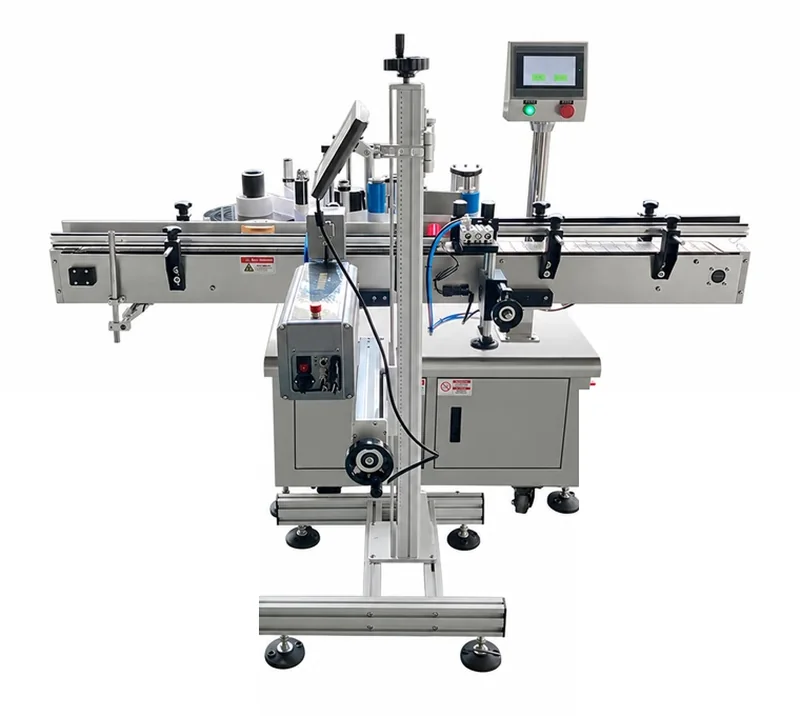
Choosing the wrong adhesive architecture between a hot melt glue labeling machine, a cut-and-stack wet-glue labeler, and a pressure-sensitive system either locks your packaging line into excessive unit consumable costs or buries operators under daily glue-pot cleanup downtime. While capital equipment price dominates initial procurement debates, the five-year total cost of ownership (TCO) is governed by release-liner waste, annual container volume, SKU changeover frequency, and whether bottles enter the labeler wet or dry.
Within the wrap-around and pressure-sensitive labeler category and the site-wide industrial labeling machine architecture, these three technologies represent fundamentally different ways of carrying and activating adhesive on a container. The engineering matrix below compares their operating envelopes head-to-head.
| Engineering Parameter | Pressure-Sensitive (Self-Adhesive) | Roll-Fed Hot-Melt Glue (BOPP) | Cut-and-Stack Cold / Wet Glue |
|---|---|---|---|
| Label Stock Format | Die-cut paper or film on siliconized release liner | Continuous linerless roll of BOPP/OPP film (30–50 µm) | Pre-cut paper stack in magazine (55–90 gsm) |
| Adhesive Chemistry & Temp | Pre-coated acrylic or rubber PSA (ambient application) | EVA or PSA hot-melt applied at 120–160°C | Starch, dextrin, casein, or PVA resin at 20–30°C |
| Adhesive Coverage | 100% full-surface pre-coated backing | Two vertical strips only (leading pickup + trailing lap) | Full-surface or horizontal stripe pallet transfer |
| Typical Speed Range | 20–180 BPM (inline) / 150–500+ BPM (rotary) | 100–250 BPM (inline) / 200–600+ BPM (rotary) | 60–150 BPM (inline) / 150–800+ BPM (rotary) |
| Relative Consumable Cost | Highest ($12–$35 per 1,000 labels; liner waste = 35–45% of web cost) | Lowest film cost ($3.50–$8.00 per 1,000 labels + $0.30 glue) | Lowest paper cost ($2.50–$6.50 per 1,000 labels + $0.25 glue) |
| SKU Changeover Time | 5–15 min (swap reel, thread peel plate, recall HMI recipe) | 20–40 min (change vacuum drum pads/guides; heated pot standby) | 30–60 min (swap magazine stack,glue pallets, and wash rollers) |
| End-of-Shift Cleanup | Zero (no open liquid or melted glue system) | 10–15 min (enclosed heated tank; scraper blade check) | 30–45 min (mandatory warm-water washdown of glue pot and pallets) |
| Condensation Tolerance | Moderate (requires air knife + wet-tack emulsion acrylic) | High on overlap seam (thermal bond sets in < 0.2 s) | Highest with casein glue (bonds directly to cold sweating beer glass) |
| Die-Cut Shape Flexibility | Any contour, clear “no-label look”, partial panels | Rectangular 360° full wrap only (straight cut on vacuum drum) | Pre-cut rectangular, oval, neck V-label, or custom paper die-cuts |
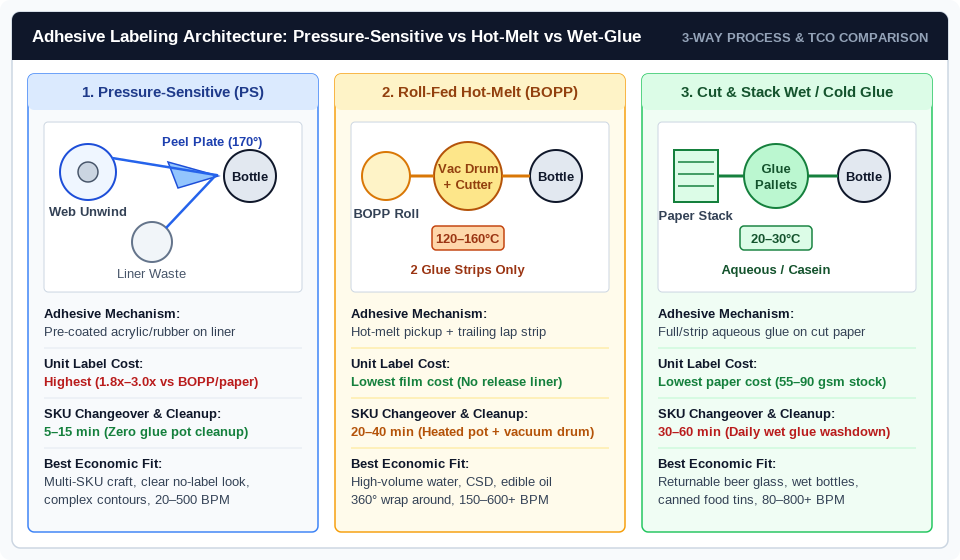
How each adhesive delivery mechanism works
Understanding why unit costs, speed limits, and maintenance hours diverge so sharply requires looking inside the dispensing station of each machine type.
1. Pressure-sensitive (self-adhesive) peel-plate dispensing
In a pressure-sensitive labeler, the adhesive manufacturing step happens at the label converter rather than on your packaging line. Die-cut labels arrive laminated onto a siliconized glassine or clear PET release liner. A servo-driven feed roll pulls the web around a sharp 160- to 170-degree peel plate edge; the stiff label facestock projects straight forward onto the passing container while the flexible release liner bends sharply backward onto a motorized rewind spindle.
Because there is no glue tank, heater manifold, or liquid pump on the machine:
- Operators never adjust adhesive viscosity, film thickness, or pot temperature.
- Full-surface adhesive contact allows crystal-clear BOPP films to achieve a transparent “no-label look” on glass and PET bottles.
- However, every square meter of applied label generates a matching square meter of siliconized liner waste that you pay to buy, ship, rewind, and dispose of as industrial solid waste.
2. Roll-fed hot-melt glue (linerless BOPP) labeling
A roll-fed hot melt glue labeling machine eliminates the release liner completely. The machine unwinds a continuous mono-web of thin 30 to 50 µm white, metallized, or clear BOPP film through tension dancer rollers into a rotary vacuum cutting unit:
- Rotary cutting drum: A servo-synchronized rotary knife cuts individual label lengths from the continuous film web at registration marks read by a high-speed contrast eye.
- Vacuum transfer & heated glue roller (
120–160°C): The vacuum drum holds the cut film sheet and sweeps it past a precision knurled glue roller heated to 120–160°C (248–320°F). Instead of coating the entire back of the label, the roller applies only two narrow vertical adhesive strips: a leading-edge “pick-up” strip (which tacks the leading edge to the container wall) and a trailing-edge “lap-seal” strip (which bonds the 6 to 10 mm label overlap seam film-to-film). - Container wrap: As the bottle rotates past the vacuum drum (either on a rotary turret or an inline wrap-around belt), the leading glue strip grabs the container, pulls the film around the 360-degree circumference, and seals the trailing lap seam instantaneously as the hot-melt cools.
Because hot-melt glue covers only 4% to 8% of the label surface area, clear BOPP film on a roll-fed hot-melt machine remains unglued across the center viewing panel (producing a glossy wrap rather than an optically bonded “no-label” look). Additionally, cut-and-stack hot-melt machines exist specifically for heavy paper wraps on steel food cans, using heated pickup glue Dots (120–150°C) from a melt pot plus a cold or hot lap-paste belt.
3. Cut-and-stack cold / wet-glue labeling
A wet-glue (cold-glue) labeling machine uses the lowest-cost packaging substrate available: pre-cut stacks of uncoated or coated litho paper (55 to 90 gsm) loaded into a reciprocating or stationary label magazine.
- Glue film metering: An stainless steel glue roller rotates through a trough of liquid aqueous adhesive (starch, dextrin, casein, or synthetic PVA emulsion held at 20–30°C), while a doctor blade meters a uniform 15 to 35 µm wet film thickness.
- Oscillating glue pallets: Cam-driven or servo-articulated rubber/metal glue pallets rock against the glue roller to pick up a thin adhesive film, then rock against the face of the label magazine. The tacky pallet pulls the bottom sheet out of the magazine stack.
- Gripper cylinder transfer: Mechanical sponge grippers take the glued paper sheet from the pallet, press it onto the bottle on the main turret, and pass the container through multistage cam-actuated brush wiping stations.
While cut-and-stack paper labels cost a fraction of pressure-sensitive labels, the exposed liquid glue trough skins over when the line stops for more than 10 to 15 minutes, and every shift ends with a 30- to 45-minute warm-water washdown of the glue roller, doctor blade, pallets, and gripper fingers.
Total Cost of Ownership (TCO) and volume crossover calculation
Equipment buyers frequently overpay over a 3- to 5-year horizon because they evaluate capex in isolation from consumable spend. You can calculate the exact annual container volume where a roll-fed hot-melt or wet-glue machine pays back its higher capital and changeover cost using the TCO crossover formula:
$$\text{Annual Cost}{\text{total}} = \frac{\text{Capex}}{N{\text{years}}} + \left( V_{\text{annual}} \times C_{\text{unit_label}} \right) + \left( N_{\text{changeovers}} \times t_{\text{downtime}} \times C_{\text{line_hour}} \right)$$
Worked 3-way TCO example: 500 mL beverage bottle at 15 million vs 2 million bottles/year
Consider a cylindrical 500 mL bottle (see our water bottle labeling machine guide) running a full-wrap 210 × 65 mm label, amortized over $N_{\text{years}} = 5\text{ years}$, with a fully burdened packaging line downtime cost of $C_{\text{line_hour}} = $300/\text{hr}$:
-
Consumable unit cost ($C_{\text{unit_label}}$):
- Pressure-sensitive BOPP on liner: $$16.50\text{ per 1,000 labels}$ ($$0.0165/\text{bottle}$)
- Roll-fed linerless BOPP + hot-melt glue: $$5.20\text{ film} + $0.30\text{ glue} = $5.50\text{ per 1,000 labels}$ ($$0.0055/\text{bottle}$)
- Cut-and-stack 70 gsm paper + cold glue: $$4.10\text{ paper} + $0.25\text{ glue} = $4.35\text{ per 1,000 labels}$ ($$0.00435/\text{bottle}$)
- Consumable savings vs pressure-sensitive: Roll-fed hot-melt saves $$11.00\text{ per 1,000 bottles}$; wet-glue paper saves $$12.15\text{ per 1,000 bottles}$.
-
Scenario A — High-volume dedicated line ($V_{\text{annual}} = 15,000,000\text{ bottles/yr}$, 50 changeovers/yr):
- Pressure-Sensitive: $$247,500/\text{yr}$ consumables + $$3,750/\text{yr}$ changeover downtime (12.5 hrs) = $$251,250/\text{yr}$ operating spend.
- Roll-Fed Hot-Melt: $$82,500/\text{yr}$ consumables + $$7,500/\text{yr}$ changeover/maintenance (25 hrs) = $$90,000/\text{yr}$ operating spend.
- Net annual savings with Roll-Fed Hot-Melt: $$161,250/\text{year}$, paying back a $$60,000\text{ to }$90,000$ capex premium in 4.5 to 7 months.
-
Scenario B — Multi-SKU contract or craft packer ($V_{\text{annual}} = 2,000,000\text{ bottles/yr}$, 400 SKU changeovers/yr + 250 shift washdowns):
- Pressure-Sensitive: $$33,000/\text{yr}$ consumables + 67 hrs changeover ($$20,100$) = $$53,100/\text{yr}$.
- Cut-and-Stack Wet Glue: $$8,700/\text{yr}$ consumables + 260 hrs changeover ($$78,000$) + 156 hrs washdown labor ($$46,800$) = $$133,500/\text{yr}$.
- In Scenario B, wet-glue changeover and daily washdown downtime wipe out its paper cost advantage more than five times over.
Engineering crossover rules of thumb
- Below 5 million containers/year or > 2 SKU changeovers per shift: Specify pressure-sensitive. The 5- to 15-minute glue-free changeover and lower machine capex dominate total economics.
- Above 12 to 15 million cylindrical containers/year with 360° film wrap: Specify roll-fed hot-melt BOPP. Eliminating release liner waste cuts consumable spend by 60% to 70% while running at 200 to 600+ BPM.
- High-speed returnable glass beer bottles or corrugated steel food cans (> 15 million/year): Specify cut-and-stack wet glue (for caustic wash-off returnable glass) or pickup hot-melt + lap cold glue (for steel food tins).
Container surface moisture, returnable glass, and structural reinforcement
Beyond unit economics, physical container behavior frequently forces the adhesive decision:
1. Cold-fill condensation and ice-bucket immersion
When glass beer or white wine bottles exit a cold filler at 2–6°C into a warm packaging hall, atmospheric moisture condenses continuously on the glass exterior.
- Casein wet glue is uniquely hydrophilic: formulated from milk protein dissolved in alkaline water, casein adhesive absorbs up to 20–30% surface water on contact with a sweating glass bottle while cross-linking into an ice-water-resistant bond that survives 24-hour ice-bucket immersion.
- Pressure-sensitive labels hydroplane on a continuous water film unless the bottle first passes through a dual centrifugal air-knife drying tunnel and uses a specialized wet-tack emulsion acrylic adhesive.
- Roll-fed hot-melt BOPP seals its trailing overlap seam film-to-film with 120–160°C hot-melt, making the lap seam virtually immune to surface moisture, provided the leading pick-up strip tacks cleanly to an air-wiped container band.
2. Returnable glass caustic wash-off (bottle washer compatibility)
In returnable beer and mineral water bottling systems, returned glass bottles pass through a 65–80°C caustic soda ($1.5%–2.5%\text{ NaOH}$) bottle washer before refilling. Cut-and-stack wet-glue paper labels bonded with casein or starch adhesive dissolve and release cleanly within 3 to 5 minutes in the caustic bath without clogging filter screens with plastic film fragments. Standard pressure-sensitive BOPP and roll-fed hot-melt labels do not pulp in caustic washers unless engineered with specialized washable alkaline-release adhesives.
3. Ultra-thin PET wall support (why water bottles use roll-fed BOPP)
Lightweight 500 mL still water bottles (9.5 to 12 g PET preforms) have sidewalls so thin (0.12 to 0.18 mm) that pressing a pressure-sensitive label across the side wall with a wipe roller collapses the bottle unless it is nitrogen-dosed. Roll-fed hot-melt labelers tension a continuous 35–40 µm BOPP band tightly around the full 360-degree circumference; once the overlap seam sets, the tensioned BOPP hoop acts as a structural girdle that increases the bottle’s top-load and grip stiffness. (For full-body contoured reinforcement, compare our pressure-sensitive vs shrink sleeve guide.)
Common failure modes across the three adhesive systems
| Technology | Primary Failure Mode | Root Cause | Corrective Action |
|---|---|---|---|
| Roll-Fed Hot-Melt | ** glue stringing (“angel hair”) & nozzle/roller char** | Glue pot held above 165°C during extended line stops oxidizes EVA resin; low roller temperature (< 115°C) increases viscosity and pulls strings. | Enable automatic HMI standby setback (drops pot to 100°C during stops > 10 min) and maintain operating window strictly at 120–160°C. |
| Roll-Fed Hot-Melt | Overlap seam flagging or telescopic shifting | Vacuum drum tension drops during cut transfer, or trailing glue strip misses the 6–10 mm overlap zone due to registration eye drift. | Clean fiber-optic eye lens every shift, verify vacuum pump manifold pressure (-0.6 bar), and align trailing glue bar within 1.5 mm of cut edge. |
| Cut & Stack Wet Glue | Label curling, blistering, or magazine double-feed | Paper grain direction runs perpendicular to bottle axis (fighting curvature), or glue film thickness exceeds 35 µm and saturates 60 gsm paper. | Specify horizontal grain-short paper for round bottles, close doctor blade gap to 18–25 µm wet film, and store paper stacks at 45–55% RH. |
| Pressure-Sensitive | Web snap (liner break) or edge flagging | Die-cut anvil scored > 20% into the 58 gsm glassine liner; or label facestock stiffness exceeds adhesive peel tack on small diameters (< 35 mm). | Audit incoming rolls for liner die-strike, switch to 23–30 µm PET liner for > 300 BPM rotary lines, and increase wrap-belt dwell length. |
How to select the right system for your line
Use this three-step engineering filter before issuing an RFQ across our round bottle labeling machine or bottle labeling machine configurations:
- Audit your container geometry and aesthetics: If your package requires a die-cut contour, a clear no-label look on glass/PET, or separate front and back panels on non-round containers, eliminate roll-fed hot-melt (which only applies 360-degree straight-cut rectangular wraps) and compare pressure-sensitive vs rotary wet-glue.
- Calculate your annual single-SKU volume and changeover burden: If your line runs fewer than 8 to 10 million bottles per year or changes label dimensions more than twice per day, pressure-sensitive delivers the lowest total cost per shipped case. If a dedicated line runs 15 to 100+ million cylindrical PET bottles per year, roll-fed hot-melt BOPP cuts annual label spend by more than 60%.
- Check environmental and end-of-life constraints: For cold sweating glass bottles entering a caustic returnable wash loop, casein wet-glue paper remains the global brewery standard.
Ready to model consumable payback and line layout for your container mix? Organize your bottle drawings, annual volume, and target BPM with our labeling machine RFQ checklist and message LINEVO engineers on WhatsApp.
Common questions
At what annual bottle volume does a roll-fed hot-melt labeler beat pressure-sensitive on TCO?
For standard 330 mL to 1.5 L cylindrical PET beverage and edible oil bottles, the TCO breakeven between an inline pressure-sensitive wrap-around labeler and a rotary roll-fed hot-melt BOPP labeler typically falls between 8 million and 12 million bottles per year on a single-shift or two-shift operation. Above 15 million bottles per year, saving $10 to $14 per thousand labels on linerless BOPP film pays back the higher capital cost of the roll-fed machine in under 9 months.
What temperature do hot-melt glue labeling machines operate at?
Standard roll-fed BOPP and cut-and-stack can hot-melt labeling machines run ethylene-vinyl acetate (EVA), polyolefin, or pressure-sensitive hot-melt adhesives at a melt tank and glue-roller temperature of 120°C to 160°C (248°F to 320°F). Low-melt formulations (105–125°C) are used for heat-sensitive thin gauge films to prevent film shrinkage on the vacuum drum.
Why do breweries still use wet-glue paper labelers instead of self-adhesive labels?
High-volume breweries running 300 to 800+ BPM rotary glass bottling lines rely on cut-and-stack wet-glue labelers for three reasons: 65–75 gsm wet-glue paper costs 60–75% less per bottle than pressure-sensitive stock; aqueous casein adhesive bonds directly through cold brite-tank condensation without expensive air-knife drying tunnels; and wet-glue paper washes off cleanly in 75°C caustic bottle washers on returnable glass lines.
Can a roll-fed hot-melt labeler apply partial front-and-back labels?
No. Standard rotary roll-fed hot-melt labelers use the tension of the continuous 360-degree film wrap and the film-to-film trailing overlap seam to hold the label tight against the container body. Because hot-melt adhesive is applied only in two narrow vertical strips (pickup and overlap), partial front-and-back labels require either a pressure-sensitive applicator, a cold/wet-glue pallet turret, or a specialized pre-glued cut-and-stack system.
Related Guides & Specifications
Label Roll Unwind Direction Chart (#1 to #8) and Roll Length Calculator
Interactive #1 to #8 label winding direction chart (wound out vs wound in), eye-mark guide, and roll length, OD, core size, and shift roll calculator.
Learn moreLabeling Speed (BPM), OEE Surge Capacity, and Web Pitch Calculator
Calculate required labeling machine surge BPM, line OEE headroom, label web dispensing velocity in m/min, container pitch, and matched conveyor speed.
Learn moreIndustrial Labeling Machine FAT Checklist, Maintenance, and Troubleshooting Manual
Execute a 30-minute Factory Acceptance Test (FAT), follow a 6-tier preventive maintenance schedule, and resolve 12 common labeling machine defects.
Learn moreRound Bottle Labeling Machines: Continuous Wrap Belt vs. 3-Roller Indexing
Select a round bottle labeling machine by comparing continuous wrap belts vs 3-roller indexing, web speed equations, bottle pitch spacing, and machine parameters.
Learn moreFront and Back Labeling Machines: Dual-Head Sync & Top Hold-Down Mechanics
Engineering guide to front and back double-side labeling machines: centering chains, overhead top holding belts, dual servo heads, and flat or oval bottle specs.
Learn moreSquare and Flat Bottle Labeling Machine: 1-Panel, 2-Panel, and 3-Panel Wrap Selection
Specify square and flat bottle labeling machines by panel geometry, twin centering chains, overhead hold-down belts, corner wipe rollers, and recessed panel rules.
Learn moreRelated Equipment & Guides
Automatic Labeling Machines: How to Choose by Container, Label and Speed
Choose an automatic labeling machine by container shape, label type and speed. Compare labeler types, accuracy tiers and the checks to run on your samples.
Learn moreWrap-Around and Pressure-Sensitive Labeling Machines: Web Kinematics & Line Selection
Engineering guide to wrap-around and pressure-sensitive labeling machines: web tension, peel plate geometry, wrap belt vs 3-roller kinematics, and line selection.
Learn moreBottle Labeling Machines: How to Choose by Container Material, Shape, and Line Speed
Select a bottle labeling machine by container material (glass, PET, HDPE), shape (round, flat, oval, square, tapered), surface condensation, and line speed.
Learn moreRound Bottle Labeling Machines: Continuous Wrap Belt vs. 3-Roller Indexing
Select a round bottle labeling machine by comparing continuous wrap belts vs 3-roller indexing, web speed equations, bottle pitch spacing, and machine parameters.
Learn moreSquare and Flat Bottle Labeling Machine: 1-Panel, 2-Panel, and 3-Panel Wrap Selection
Specify square and flat bottle labeling machines by panel geometry, twin centering chains, overhead hold-down belts, corner wipe rollers, and recessed panel rules.
Learn moreRotary vs. Inline Labeling Machines: Turret Kinematics, Speed & Changeover
Compare rotary carousel turret vs inline linear labeling machines across speed ratings (50-150 vs 150-600+ BPM), bottle plates, starwheel changeover, and layout.
Learn morePressure Sensitive vs Shrink Sleeve: How to Choose for Your Container and Line
Compare pressure sensitive vs shrink sleeve labeling across container curves, label cost, steam or electric tunnel kW draw, footprint, and moisture resistance.
Learn moreWater Bottle Labeling Machines: PET Wrap-Around, Roll-Fed BOPP, and Shrink Sleeve
Compare pressure-sensitive wrap, roll-fed BOPP hot-melt, and shrink sleeve water bottle labelers for thin-wall PET, sparkling water, and glass lines.
Learn more