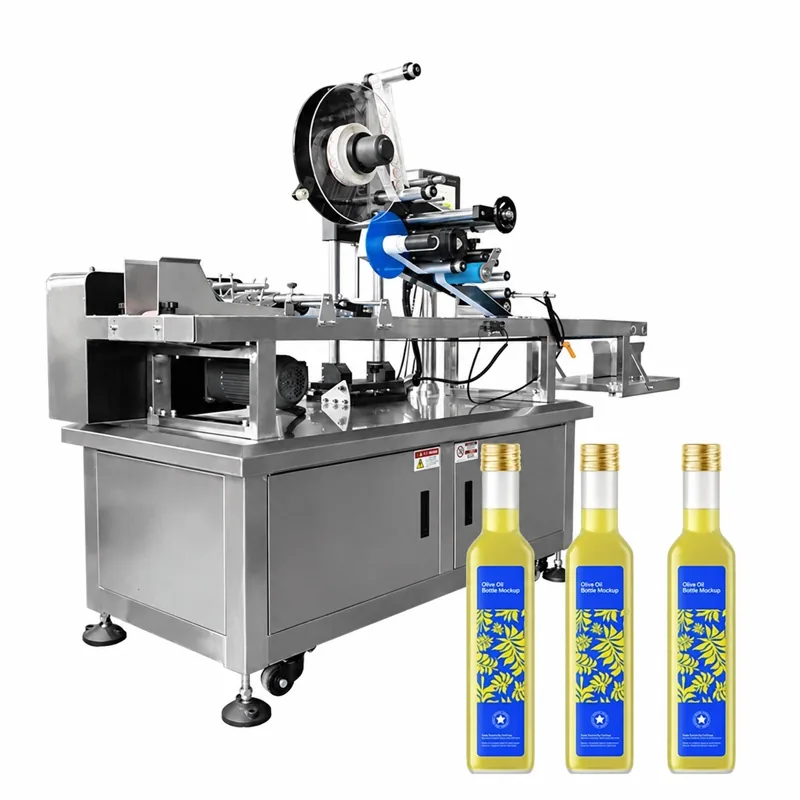
Why Nameplate Speed Ratings Fail Without OEE Derating and Web Pitch Math
Specifying a labeling machine by dividing shift volume by shift minutes without derating for line OEE and web pitch causes chronic upstream filler starvation, registration drift, and costly overtime rework. Across industrial labeling machines, real-world production throughput averages 70% to 90% of nameplate rated speed, while unlogged micro-stops under 60 seconds (roll splices, sensor faults, and fallen bottles) silently consume up to 15% of revenue capacity.
A rigorous labeling speed calculation links two physical velocities that are frequently confused during procurement: container throughput (BPM or CPM) and linear web dispensing velocity (m/min). On wrap-around and pressure-sensitive labelers, a machine rated for 150 BPM on a short 45 mm front vial label (7.2 m/min web velocity) cannot dispense a 215 mm full-wrap water bottle label at 150 BPM unless its servo applicator drive, peel plate, and gap sensor are rated for 32.8 m/min continuous web velocity.
| Machine Architecture Class | Rated Container Speed | Typical Web Velocity (v_web) |
Placement Accuracy | Drive, Sensor & Staffing Baseline |
|---|---|---|---|---|
| Manual / Benchtop Dispenser | Up to 16 BPM (1,000 BPH) |
1–4 m/min |
±3.0 to ±5.0 mm |
Manual hand-lever or foot-switch roller (1.5–5 in bottle OD, 1 operator) |
| Semi-Automatic Applicator | 10–30 BPM (2,000–3,000 BPH) |
2–8 m/min |
±1.5 to ±3.0 mm |
Stepper drive (5–10 ms response), optical fork gap eye (1 operator) |
| Automatic Inline Linear (Wrap / F&B) | 50–150 BPM (up to 200 BPM) |
10–35 m/min |
±0.8 to ±1.0 mm |
Closed-loop servo (<1 ms), encoder speed sync (≤2% delta, 0.5–1 operator) |
| High-Speed Wrap-Around Linear | 100–400 BPM |
25–65 m/min |
±1.0 mm |
Servo head + timing screw infeed, high-speed contrast/capacitive sensor |
| Rotary Turret (Sticker / Hot-Melt) | 150–600+ BPM (240–250 BPM 12–16T) |
40–100+ m/min (up to 220 m/min) |
±0.5 to ±1.0 mm |
Cam/servo bottle plates, capacitive gap sensor (100% at 220 m/min), dual unwind |
| Shrink Sleeve Applicator (Inline / Rotary) | 50–200 BPM (300–600 BPM rotary) |
15–90 m/min cut feed |
±0.5 mm LF / ±1.0 mm cut |
Servo mandrel + rotary cutter (28–120 mm OD), multi-zone steam tunnel |
| Print-and-Apply / Case Applicator | 15–50 CPM LPA (20–100 CPM wipe/air) |
Up to 24.4 m/min (16 IPS print) |
±1.0 to ±2.0 mm |
Thermal transfer print engine (203–600 DPI) + tamp-blow (30–80 CPM) or wipe-on |
Interactive Labeling Speed (BPM), OEE Surge & Web Pitch Calculator
Use the interactive calculator below to convert your shift production target into net BPM, OEE-compensated running BPM, and required machine surge BPM. The tool simultaneously computes linear label web dispensing velocity (m/min, m/s, and IPS), container center-to-center pitch, matched conveyor speed, accumulation buffer capacity, and recommended machine architecture.
Shift Output to Surge BPM, Web Velocity (m/min) & Conveyor Pitch Calculator
Load a packaging line preset or input your shift target, OEE baseline, label length, and container spacing.
1. Shift Demand, OEE & Pitch Inputs
2. Computed Speed, Pitch & Architecture Outputs
RFQ Line Speed & Web Pitch Specification Summary
Loading calculation...
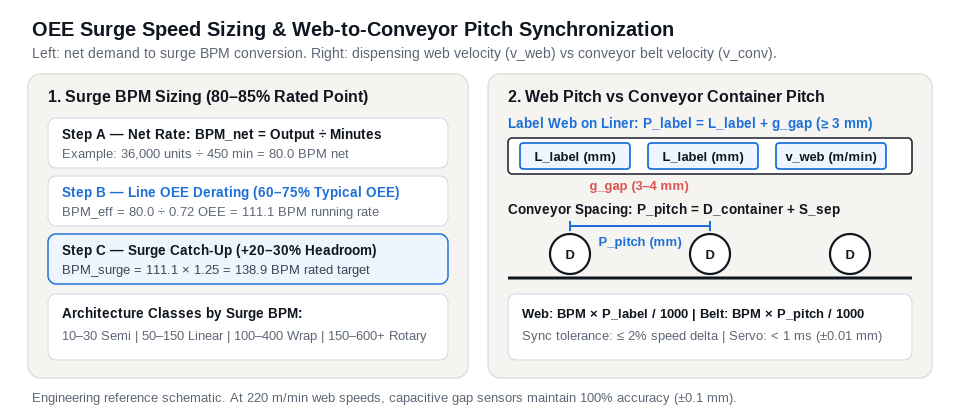
Step 1: Converting Shift Output Into OEE-Adjusted Surge BPM
Nameplate speed ratings on bottle labeling machines represent mechanical capability under continuous, uninterrupted feed with uniform test containers. On an operating packaging line, real-world throughput averages 70% to 90% of rated speed (70% to 85% on multi-SKU bottle lines), and running any mechanical system at 100% of its maximum rating accelerates wear on bearings, timing belts, and sponge rollers.
Engineering a reliable line capacity requires three sequential equations:
- Net Baseline Rate (
BPM_net): Divide total required shift output by planned shift minutes:BPM_net = Shift_Target / Shift_Minutes. For36,000bottles across a450-minutenet shift (7.5 hoursafter breaks),BPM_net = 80.0 BPM(4,800 BPH). - OEE-Derated Running Rate (
BPM_eff): Overall Equipment Effectiveness (OEE = Availability x Performance x Quality) averages60%to75%across typical food, beverage, and personal care lines, while world-class packaging lines achieve≥85%OEE (Availability ≥90%,Performance ≥95%,Quality ≥99%). Dividing80.0 BPMby a realistic72%OEE (0.72) raises the required steady running speed toBPM_eff = 111.1 BPM. - Surge Catch-Up Rating (
BPM_surge): Whenever the labeler pauses45to90 secondsto splice a depleted label roll (or clear a fallen container), bottles accumulate on upstream rotary tables or mass-flow conveyors. To drain the accumulation buffer without throttling back the upstream filler, the labeler must accelerate20%to30%above steady running speed:BPM_surge = BPM_eff x (1 + Surge_Factor). Multiplying111.1 BPMby1.25(+25%surge) yields138.9 BPM.
Sizing for 138.9 BPM ensures that during normal 111.1 BPM production, a 140 BPM machine runs at 79.4% of nameplate capacity, squarely inside the optimal 80% to 85% operating window that maximizes component life and placement repeatability. When a brand forecasts 15% to 40% year-over-year volume growth, procurement teams often size initial equipment with 50% to 100% multi-year capacity headroom (running initial demand at 60% to 70% of rated speed).
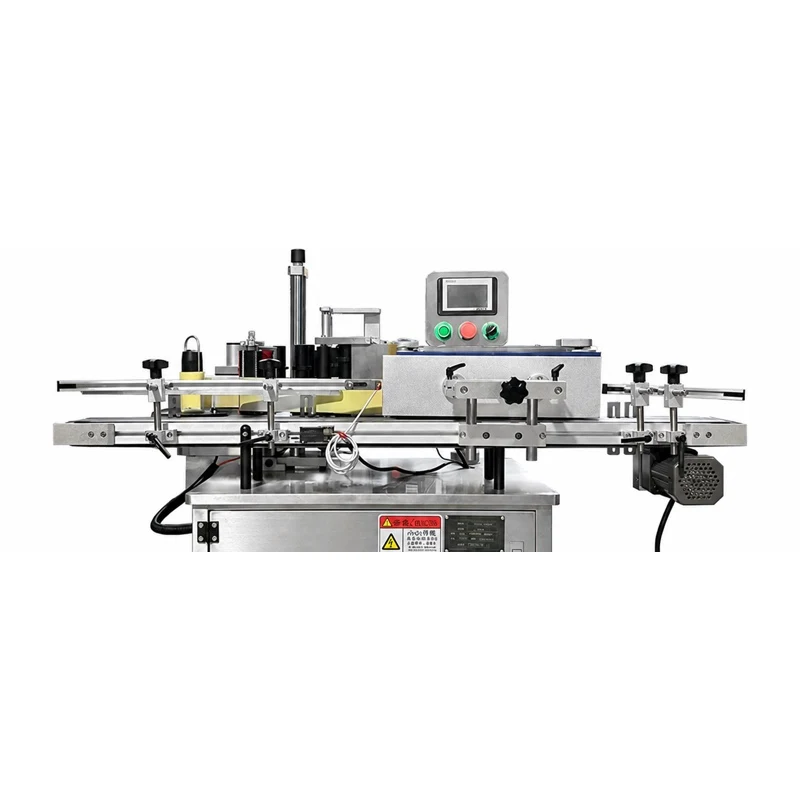
Step 2: Label Pitch to Dispensing Web Velocity (m/min) and Conveyor Pitch
Once BPM_surge is established, the applicator head must advance one full label pitch (P_label) every time a container triggers the product detection sensor. On pressure-sensitive roll stock, label pitch equals the cut label length (L_label, calculated in the container label size and coverage calculator) plus the die-cut matrix gap (g_gap, minimum 3.0 mm to 4.0 mm):
P_label (mm) = L_label + g_gapv_web (m/min) = BPM_surge x P_label / 1000
Consider how label length transforms the required web drive speed at the exact same 138.9 BPM container rate:
- 10 mL Pharmaceutical Vial (
L_label = 72 mm,g_gap = 3 mm,P_label = 75 mm):v_web = 138.9 x 75 / 1000 = 10.42 m/min(0.17 m/s). - 500 mL Water Bottle Full Wrap (
L_label = 212 mm,g_gap = 3.5 mm,P_label = 215.5 mm):v_web = 138.9 x 215.5 / 1000 = 29.93 m/min(0.50 m/sor19.6 IPS).
Simultaneously, the conveyor belt must separate incoming containers by a consistent container center-to-center pitch (P_pitch), equal to the container diameter (D_container) plus the edge-to-edge separation gap (S_sep) enforced by an infeed spacing wheel, pneumatic indexing gate, or feed timing screw:
P_pitch (mm) = D_container + S_sepv_conv (m/min) = BPM_surge x P_pitch / 1000
At the moment the peel-plate tip (positioned 3–5 mm from the container wall) transfers the leading edge of the label onto the bottle, the dispensing web velocity (v_web) and the tangential surface velocity of the container must match within ≤2%. If velocity synchronization drifts beyond 2%, shear forces at the nip point cause vertical wrinkles, air bubbles, or diagonal skew. On wrap-around stations, the motorized side wrap belt must also match the tangential rotation speed of the bottle so the label wipes across 95–100%+ of the circumference without slipping.
Infeed Spacing Mechanics: Rubber Starwheels vs Timing Screws vs Dual-Belt Indexing
Generating a repeatable container pitch (P_pitch = D_container + S_sep) requires dedicated infeed singulation hardware matched to the target BPM_surge and bottle stability:
- Variable-Speed Rubber Spacing Wheels (
50–120 BPM): Dual polyurethane or sponge rubber wheels grip the incoming bottle queue and release individual containers at a timed gap (S_sep = 60–120 mm). Best suited for rigid cylindrical glass jars and stable round HDPE bottles on inline wrap-around stations. - Twin-Belt Infeed Indexing & Top Hold-Down Belts (
80–200 BPM): Flat, oval, and rectangular bottles require side orienting chains paired with a synchronized top hold-down belt so the container cannot twist or rock as it enters the dual dispensing heads. - CNC-Machined Delrin / UHMW Timing Screws (
150–600+ BPM): Mandatory on high-speed wrap-around lines, rotary sticker turrets (240 BPM), and roll-fed hot-melt rotaries (250 BPM). The helical screw pocket positively captures each bottle and accelerates it smoothly to match the exact turret pitch or wrap-belt pitch with zero container-to-container impact.
Step 3: Servo vs Stepper Drives and High-Speed Sensor Accuracy at 220 m/min
As linear web velocity (v_web) climbs from 10 m/min toward 60–220 m/min, actuator latency and sensor response time become the primary determinants of placement accuracy (±0.5 mm to ±1.5 mm):
| Subsystem Parameter | Entry / Stepper Baseline | High-Speed Servo & Capacitive Standard | Operational Consequence on Line |
|---|---|---|---|
| Web Drive Motor & Control | Open-loop stepper (±0.1–0.3 mm positioning, 5–10 ms response) |
Closed-loop servo (±0.01 mm positioning, <1 ms response, ±0.005 mm repeatability) |
Steppers lose steps under high roll inertia; servos use S-curve jerk limitation to prevent liner snap |
Label Gap Detection at 220 m/min |
Ultrasonic (12% accuracy) or standard optical (68% accuracy) |
High-frequency capacitive gap sensor (100% accuracy within ±0.1 mm) |
Optical/ultrasonic lag causes missing labels or double-dispensing above 60–100 m/min |
| Clear / Metallic Registration Mark | Standard photo-eye (fails on clear BOPP 6.1% defect / metallic 7.4%) |
High-speed contrast sensor (5%+ contrast difference at >3 m/s / 180+ m/min) |
Eliminates registration walk on transparent no-label-look films and foil-stamped webs |
| Thermal Print-and-Apply Engine | Standard 8–12 IPS (12.2–18.3 m/min) thermal printhead |
Industrial 16 IPS (406 mm/s = 24.4 m/min) at 203/300/600 DPI |
Caps real-time print-and-apply carton/case speeds at 15–50 CPM (up to 175 PPM short labels) |
For secondary carton, case, and pallet lines, pneumatic and mechanical stroke time replaces web speed as the governing bottleneck: wipe-on applicators run 20–60 CPM (±2–3 mm accuracy), tamp-blow applicators run 30–80 CPM (±1.5–2 mm accuracy), and non-contact air-blow applicators reach 40–100+ CPM (±2–3 mm accuracy).
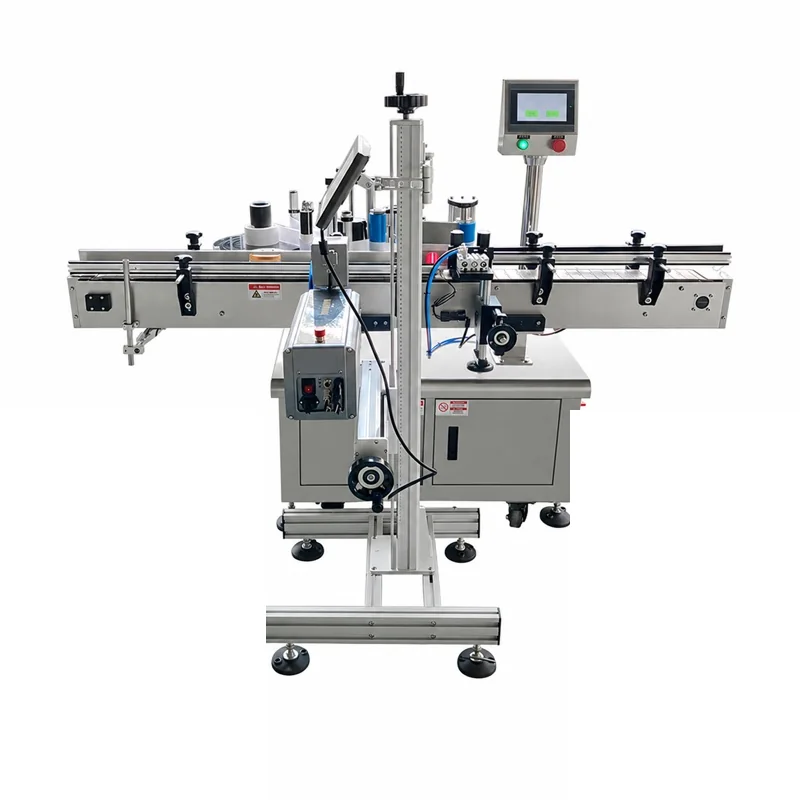
Step 4: Sizing Roll Change Intervals and Accumulation Buffer Tables
A standard 300 mm (12 inch) outer diameter pressure-sensitive roll wound on a 76 mm (3 inch) core holds approximately 220 to 260 meters of release liner (depending on facestock and liner caliper). At a label pitch of 215.5 mm and a steady running rate of 111.1 BPM (23.9 m/min average web consumption), one 240-meter roll holds 1,113 labels and depletes every 10.0 minutes.
Without accumulation buffering, stopping the line for 60 to 90 seconds every 10 minutes to thread a new roll destroys line OEE (losing 10% to 15% of shift availability). High-throughput lines prevent roll-change starvation through two engineering controls:
- Upstream and Downstream Accumulation Buffers (
2 to 5 MinutesCapacity): Installing bidirectional conveyor accumulation tables or rotary accumulation tables (0–8 RPMvariable speed,300 lbload capacity) ahead of the labeler stores220to550bottles during a60-secondroll change, which the labeler then clears using its+25%surge speed headroom. - Dual-Unwind Non-Stop Auto-Splicing or Large Roll Formats: High-speed rotary sticker turrets (
240 BPM) and shrink sleeve labeling machines (150–600 BPM) deploy dual-mandrel unwind stands with automatic zero-downtime splicing, while roll-fed hot-melt rotary labelers (250 BPM) use600 mmOD rolls on152 mm(6 inch) cores to extend run intervals fourfold. - SMED Quick-Changeover Hardware (
5 to 15 Minutes): On multi-SKU lines running 3 to 6 batch changes per shift, legacy manual rail and head adjustments (45 to 60 minutesper changeover) depress shift OEE below55%. Specifying digital handwheel position indicators, color-coded change parts, and PLC recipe recall cuts changeover downtime by75%(down to 5–15 minutes), directly recovering60 to 120 minutesof productive labeling time per shift without raising peak machine speed.
Before finalizing your line speed specification, verify your roll winding orientation on the label roll unwind direction chart, include your surge BPM and encoder handshake requirements in the labeling machine RFQ checklist, and review the 30-minute run trial protocol in the industrial labeling machine FAT and troubleshooting manual. To receive a formal speed simulation and line layout proposal, message our LINEVO engineering team on WhatsApp.
Related Guides & Specifications
Label Roll Unwind Direction Chart (#1 to #8) and Roll Length Calculator
Interactive #1 to #8 label winding direction chart (wound out vs wound in), eye-mark guide, and roll length, OD, core size, and shift roll calculator.
Learn moreIndustrial Labeling Machine FAT Checklist, Maintenance, and Troubleshooting Manual
Execute a 30-minute Factory Acceptance Test (FAT), follow a 6-tier preventive maintenance schedule, and resolve 12 common labeling machine defects.
Learn moreRound Bottle Labeling Machines: Continuous Wrap Belt vs. 3-Roller Indexing
Select a round bottle labeling machine by comparing continuous wrap belts vs 3-roller indexing, web speed equations, bottle pitch spacing, and machine parameters.
Learn moreFront and Back Labeling Machines: Dual-Head Sync & Top Hold-Down Mechanics
Engineering guide to front and back double-side labeling machines: centering chains, overhead top holding belts, dual servo heads, and flat or oval bottle specs.
Learn moreSquare and Flat Bottle Labeling Machine: 1-Panel, 2-Panel, and 3-Panel Wrap Selection
Specify square and flat bottle labeling machines by panel geometry, twin centering chains, overhead hold-down belts, corner wipe rollers, and recessed panel rules.
Learn moreRotary vs. Inline Labeling Machines: Turret Kinematics, Speed & Changeover
Compare rotary carousel turret vs inline linear labeling machines across speed ratings (50-150 vs 150-600+ BPM), bottle plates, starwheel changeover, and layout.
Learn moreRelated Equipment & Guides
Automatic Labeling Machines: How to Choose by Container, Label and Speed
Choose an automatic labeling machine by container shape, label type and speed. Compare labeler types, accuracy tiers and the checks to run on your samples.
Learn moreWrap-Around and Pressure-Sensitive Labeling Machines: Web Kinematics & Line Selection
Engineering guide to wrap-around and pressure-sensitive labeling machines: web tension, peel plate geometry, wrap belt vs 3-roller kinematics, and line selection.
Learn moreShrink Sleeve Labeling Machines: How to Match Applicator, Film and Shrink Tunnel
Specify a shrink sleeve labeling machine by sleeve format, layflat width, film shrink ratio and steam or electric tunnel. Compare speeds and sample test steps.
Learn moreBottle Labeling Machines: How to Choose by Container Material, Shape, and Line Speed
Select a bottle labeling machine by container material (glass, PET, HDPE), shape (round, flat, oval, square, tapered), surface condensation, and line speed.
Learn moreLabel Roll Unwind Direction Chart (#1 to #8) and Roll Length Calculator
Interactive #1 to #8 label winding direction chart (wound out vs wound in), eye-mark guide, and roll length, OD, core size, and shift roll calculator.
Learn moreContainer Label Size, Wrap Coverage, and Shrink Sleeve Layflat Calculator
Calculate bottle label circumference, partial wrap arc, shrink sleeve layflat width, film shrink percentage, and tapered jar chord distortion for RFQs.
Learn moreIndustrial Labeling Machine FAT Checklist, Maintenance, and Troubleshooting Manual
Execute a 30-minute Factory Acceptance Test (FAT), follow a 6-tier preventive maintenance schedule, and resolve 12 common labeling machine defects.
Learn moreRotary vs. Inline Labeling Machines: Turret Kinematics, Speed & Changeover
Compare rotary carousel turret vs inline linear labeling machines across speed ratings (50-150 vs 150-600+ BPM), bottle plates, starwheel changeover, and layout.
Learn moreLabeling Machine RFQ Checklist and User Requirement Specification (URS)
Engineering labeling machine RFQ checklist and User Requirement Specification (URS) template covering container drawings, roll unwind #1-#8, CPM, and FAT rules.
Learn more