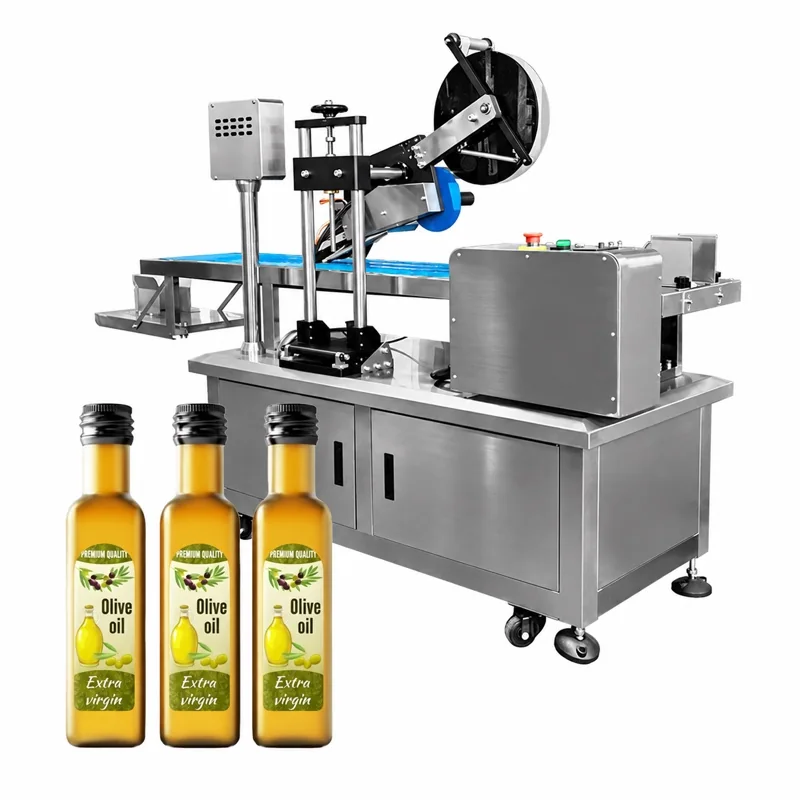
Mechanical Role of the Front and Back Labeling Machine
Within our industrial labeling machines engineering catalog and the wrap-around and pressure-sensitive labelers architecture, a front and back labeling machine (also termed a double side labeling machine or two side bottle labeler) prevents panel skew rejects, air-blister rework, and changeover downtime on flat, oval, rectangular, and square and flat bottles. Unlike a round bottle labeling machine that uses one dispensing head and rotates the cylinder against a backplate, a double-side system holds the container strictly non-rotating along the conveyor centerline while two opposing pressure-sensitive heads dispense front and back panels simultaneously.
Designing a high-speed flat oval bottle labeler requires solving three mechanical challenges that do not exist on simple cylindrical lines:
- Angular (Yaw) Orientation: Oval and rectangular containers exiting an upstream capper or accumulation table arrive skewed at random yaw angles between +/-5 and +/-25 degrees. If the container is not squared parallel to the peel plates before locking, the front label lands high on one corner and the back label lands off-center.
- Symmetric Dual-Head Synchronization: Because two separate servo or stepper applicators fire onto opposite walls of the same moving bottle, any velocity mismatch between the left head, right head, and main conveyor imparts a net rotational torque that twists the container mid-peel.
- Compound Panel Curvature and Flexible Wall Deflection: Oval HDPE shampoo bottles and thin-walled PET beverage containers flex under lateral roller pressure, creating center blisters or edge flagging unless wiping pressure is staged across compliant rollers.
| Machine Sub-Class | Rated Speed Band | Container Envelope | Orientation & Wiping Train | Power & Footprint |
|---|---|---|---|---|
Standard Dual-Side Inline (LV-BSL 2S / LV-DSL2) |
80-150 BPM (up to 300 LPM on small stable bottles) | 15-120 mm width; 30-300 mm height | Synchronized top holding belt + dual servo heads (+/-0.8-1.0 mm) | 0.75 kW; 2280 x 1500 x 1500 mm |
Heavy-Duty Two-Side Servo (LV-620) |
120-250 BPM | 25-120 mm width; 40-400 mm height | Dividing wheel (+/-5 mm) + rigid side chains + spring top belt + 2-stage sponge wipe | 2.5 kW; 2800 x 1400 x 1400 mm (280 kg) |
| Multi-Format Double-Side + Wrap Module | 80-150 BPM | 15-200 mm width (flat, oval, square, round, pouches) | Dual side heads + bolt-on cylindrical wrap belt station | 2.5 kW; 3000 x 1400 x 1750 mm (320 kg) |
Four-Stage Container Orientation and Dual-Head Kinematics
To hold +/-0.8 mm to +/-1.0 mm placement accuracy at 80 to 250 bottles per minute (BPM), industrial double-side machines process every container through four mechanically synchronized zones mounted along a 2.2- to 3.0-meter stainless-steel conveyor frame.
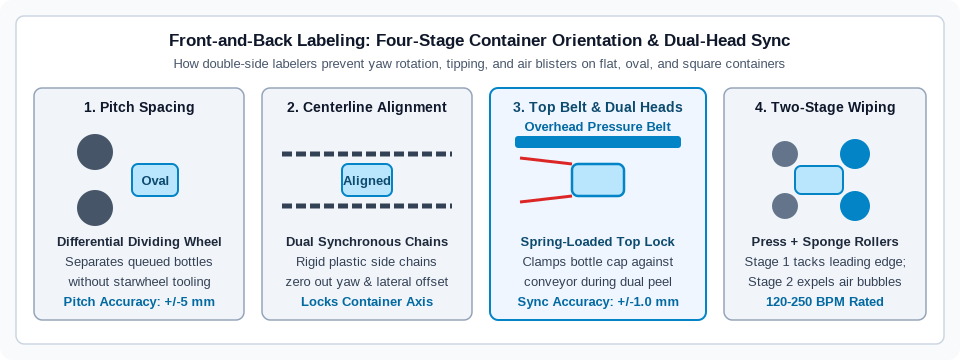
Stage 1: Differential Bottle-Dividing Wheel or Feed Screw Spacing
Queued containers arriving from an upstream capper press against one another with zero inter-bottle gap. Before the centering chains can grip each container individually, a differential bottle-dividing wheel (composed of dual high-friction rubber star-rollers driven by variable-frequency inverters) accelerates each leading bottle away from the queue.
- On standard flat, oval, and square containers, a differential dividing wheel establishes a repeatable center-to-center pitch within +/-5 mm accuracy without requiring format-specific change parts.
- When running unstable, top-heavy, or sharply contoured bottles at speeds above 150 BPM, engineers substitute a CNC-machined Delrin feed worm (timing screw) or pocket system that positively captures the container body pitch before handoff.
Stage 2: Double-Sided Rigid Synchronous Centering Chains
Immediately downstream of the spacing wheel, the bottle enters the orientation throat between two opposing endless loops of rigid engineered-plastic guide chain. Both left and right chain loops are mechanically coupled through a synchronous gearbox and matched to the exact linear velocity of the main slat conveyor:
- Because the left and right chains close symmetrically toward the conveyor centerline via a single self-centering handwheel, an oval or rectangular bottle entering at a diagonal yaw angle is nudged squarely onto the machine axis without scuffing the container side walls.
- Crucially, the centering chains do not release the bottle until after the overhead top hold-down belt has engaged the container cap, preventing any unguided free-travel zone where conveyor vibration could re-introduce skew.
Stage 3: Spring-Loaded Overhead Top Holding Belt and Dual Peel Plates
Once the centering chains align the bottle, a servo- or VFD-synchronized overhead top pressure belt lowers onto the container closure. The overhead belt assembly rides on vertical linear guides preloaded with mechanical compression springs (or pneumatic cylinders) so it automatically absorbs +/-1.0 mm to +/-2.0 mm of vertical bottle height variation while pinning the container base flat against the main conveyor slats.
With the container locked between the bottom slat conveyor and the top holding belt, it passes between the left (front) and right (back) dispensing stations:
- Dual fiber-optic product sensors gate the left and right peel heads independently, allowing the PLC to fire two labels of different lengths or different horizontal offsets onto the front and back panels within the same pass.
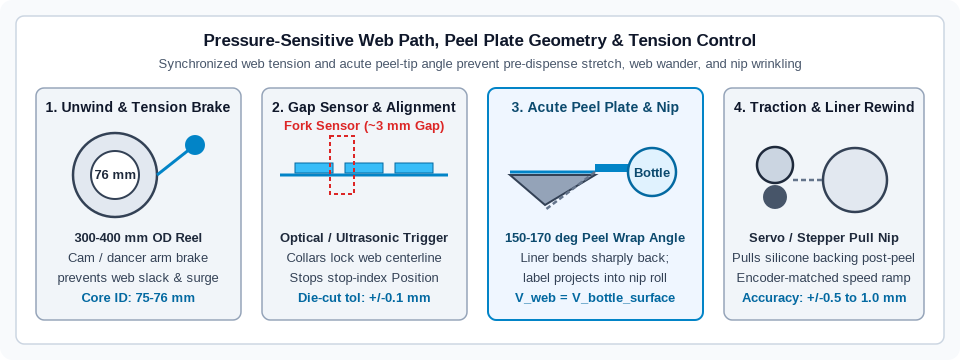
- Each head pulls a label web (10 mm to 180 mm tall on a 75 mm or 76 mm ID core, up to 300 mm to 350 mm roll OD) through a cam-type tension brake and band-bypass web-offset correction guide, delaminating the leading edge across an acute peel plate directly into the primary nip rollers.
- Integrated “No Container - No Labeling” logic inhibits both servo drives if a gap occurs in the bottle stream, preventing adhesive labels from firing onto the opposite pressure rollers.
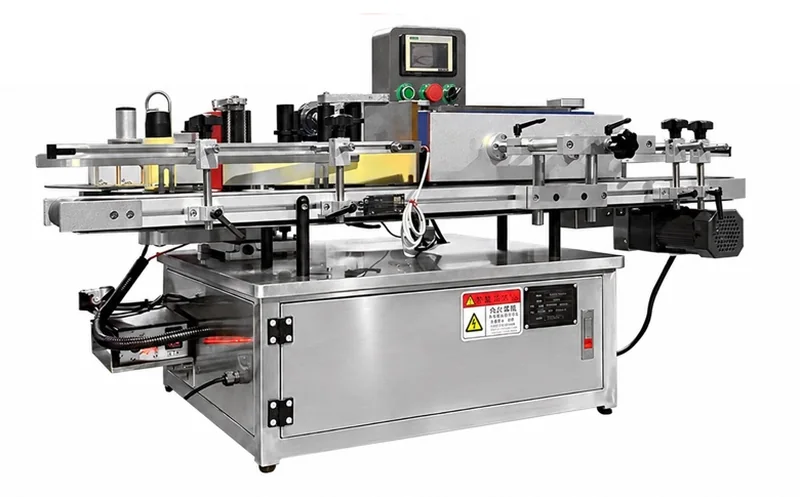
Stage 4: Two-Stage Press and Sponge Wiping Rollers
Applying a wide label across a crowned oval or recessed rectangular panel in a single high-pressure nip traps air pockets near the center and leaves the leading and trailing edges weakly bonded. Industrial double-side machines split post-peel compression into two sequential stages:
- First-Stage Tack Roller: Immediately behind each peel tip, a compliant polyurethane nip roller tacks the leading edge of the label and rolls the web progressively across the panel face.
- Second-Stage Extrusion Sponge and Brush Assembly: Downstream of the primary nip, a pair of spring-loaded contoured sponge rollers, twin squeegee blades, or nylon bristle brushes compress the label from center to edge, expelling trapped air bubbles at the head and tail and seating the adhesive into recessed panel borders.
Published Technical Specifications: Double-Side Labeler Classes
Table 1 compares engineering specifications across standard dual-head sticker labelers (LINEVO LV-DSL2 / LV-BSL 2S), high-speed heavy-duty two-side machines (LINEVO LV-620), and multi-format double-side bottle frames.
| Specification Parameter | Standard Front & Back Labeler (LV-BSL 2S / LV-DSL2) |
Heavy-Duty Two-Side Labeler (LV-620) |
Wide-Envelope Multi-Format Double-Side Machine |
|---|---|---|---|
| Rated Throughput | 80-120 LPM standard; up to 120-150 BPM (max 300 LPM on small stable bottles) | 120-250 bottles/min (product & label size dependent) | 80-100 bottles/min (large format containers & pouches) |
| Sustained Operating Band (80-90%) | 70-135 BPM | 100-220 BPM | 65-90 BPM |
| Placement Accuracy | +/-0.8 mm to +/-1.0 mm | +/-1.0 mm (dividing wheel spacing: +/-5.0 mm) | +/-1.0 mm |
| Container Width / Diameter | 15-120 mm (flat, oval, square, round) | 25-120 mm (customizable for wider jugs) | 15-200 mm (rectangular, square, flat, cylindrical, pouches) |
| Container Height Range | 30-300 mm | 40-400 mm | 30-300 mm |
| Label Height (Web Width) | 8-70 / 90 / 120 / 150 / 180 mm (head model dependent) | 10-150 mm | 10-180 mm |
| Label Length Range | 12 mm minimum (~3 mm gap between labels) | 10-300 mm | 15-300 mm |
| Roll Core ID & Max OD | 75-76 mm ID / 300 mm OD | 76 mm ID / 350 mm OD | 76 mm ID / 350 mm OD |
| Electrical Power & Supply | 0.75 kW (1 HP), 220V AC single-phase, 50/60 Hz | 2.5 kW (2500 W), 220V AC 50/60 Hz | 2.5 kW, AC 220V 50 Hz |
| Conveyor Height | 830-875 mm adjustable | 800-900 mm adjustable | 750-850 mm adjustable |
| Overall Dimensions (L x W x H) & Weight | 2280 x 1500 x 1500 mm | 2800 x 1400 x 1400 mm; 280 kg | 3000 x 1400 x 1750 mm; 320 kg |
Preventing Skew and Blisters on Flexible HDPE and PET Containers
Production defect studies across packaging lines show a sharp contrast between rigid flat panels and flexible compound curves: while square and flat rigid bottles average a 1.9% defect rate, oval and irregular containers average a 5.6% defect rate, nearly three times higher. Furthermore, adding transparent clear-on-clear film labels (6.1% defect rate) or stiff metallic stock (7.4% defect rate) compounds the challenge on personal-care and cosmetic lines.
Four engineering adjustments eliminate skew, smiling/frowning curvature, and center blistering on flexible plastic containers:
- Controlling Internal Bottle Pressure and Pre-Press Squeeze: Empty or thin-walled HDPE and PET bottles compress inward as they enter the primary press rollers, reducing panel width during transfer and causing the label to buckle when the bottle expands at the exit. Where product characteristics allow, labeling after filling and capping utilizes hydraulic liquid head and capped headspace pressure to stiffen the container walls. When empty flexible bottles must be labeled prior to filling, high-precision lines use either low-durometer cellular foam nip rollers or a calibrated pre-squeeze pressure setting on the overhead belt and side wipers so wall deflection remains constant from peel contact through final wipe.
- Matching Label Conformability to Compound Panel Crown: Most “flat” or “oval” plastic bottles do not have truly flat sidewalls; blown HDPE and PET molds incorporate a subtle two-axis crown (compound curvature) to resist vacuum paneling after hot-fill or ambient cooling. Stiff polyester labels (rated 4/10 on flexibility) bridge across compound curves and lift at the corners. Specifying 50-micron BOPP film (rated 9/10 on flexibility) or squeezable PE/polyolefin face stock allows the label to stretch slightly over the panel crown without edge lift.
- Adhesive Selection for Low-Energy Polyolefins (<38 Dynes/cm): Untreated HDPE and PP shampoo, detergent, and motor-oil bottles have surface energies below 38 dynes/cm. Standard general-purpose acrylic adhesives fail to wet out rapidly during the brief 50-millisecond roller dwell, leading to trailing-edge flagging. Specify high-tack rubber-based hot-melt adhesives or modified low-energy acrylics formulated specifically for polyolefin substrates.
- 8-Axis Handwheel Calibration & Band-Bypass Web Correction: Both dispensing heads on an industrial double-side frame mount on multi-axis slides allowing independent adjustment of vertical height, lateral in-out stroke, longitudinal pitch, and peel-plate tilt angle (pitch and roll). On tapered oval bottles (where the shoulder is wider or narrower than the base), tilting the dispensing heads by 1 to 3 degrees to match the sidewall draft angle prevents the label from curving upward (“smiling”) or downward (“frowning”) across the panel.
| Field Symptom on Flat / Oval Bottles | Mechanical or Material Root Cause | Corrective Engineering Adjustment |
|---|---|---|
| Front Label High on Left, Back Label High on Right | Centering chains release bottle before overhead top holding belt clamps the cap | Extend centering chain exit guide or lower overhead top belt entry nose so clamping overlaps by >=50 mm |
| “Smiling” or “Frowning” Curved Label Baseline | Bottle sidewall has a vertical mold taper (draft angle) while peel plate is set strictly vertical | Tilt dispensing head pitch/roll adjustment by 1-3 deg to match container sidewall draft angle |
| Center Air Blisters or Longitudinal Crease | Flexible HDPE/PET bottle wall compresses under rigid primary press roller and rebounds | Replace solid rubber press roller with dual-stage soft sponge roller + contoured nylon brush; label after filling/capping where feasible |
| Asymmetric Front-to-Back Panel Offset | Velocity mismatch between left/right servo heads and top holding belt, or Bottle dividing wheel slip | Synchronize encoder master-slave ratio across conveyor, top belt, and both heads; verify +/-5 mm dividing wheel spacing |
| Corner Flagging on Oval Panels | Stiff PET/paper stock (4/10 flexibility) or low-energy HDPE surface (<38 dynes/cm) | Switch to conformable BOPP/PE film (9/10 flexibility) with high-tack rubber adhesive; increase secondary sponge wipe dwell |
Multi-Format Versatility: Running Round, Flat, and Pouch SKUs on One Line
Contract packagers and multi-brand plants rarely dedicate a line to a single container cross-section. A major economic advantage of the double side labeling machine is its ability to serve as a three-in-one universal inline labeler:
- Mode 1 , Dual-Panel Front & Back (Oval, Flat, Square, Rectangular): Both left and right heads active, centering chains engaged, overhead top holding belt active.
- Mode 2 , Single-Panel Application (Flat, Square, or Stand-Up Pouches): One dispensing head switched off on the HMI recipe screen; runs single-sided labels on flat bottles or pre-made pouches at 50 to 200 units per minute.
- Mode 3 , Cylindrical Wrap-Around (Round Bottles, Jars, Tins): By bolting an auxiliary motorized side wrap-around belt assembly onto the conveyor frame downstream of Head 1, operators retract Head 2, raise the overhead belt (or keep it engaged for cap-stabilized vials), and run 360-degree or partial wrap-around round bottles at 80 to 150 BPM.
With servomotor-driven axes, mechanical digital position indicators on all handwheels, and HMI recipe memory (storing 10 to 50+ SKU parameter sets), operators can execute a full multi-SKU format changeover in 15 to 25 minutes, a 75% reduction compared with legacy 60-minute manual wrench setups.
When to Step Up From an Inline Double-Side Machine
While an inline front-and-back labeler handles 90% of flat and oval applications up to 150 to 250 BPM, three project conditions point to an alternative architecture:
- Line Speed Above 200-250 BPM or 3+ Simultaneous Labels (Front + Back + Neck): When a beverage, spirit, or personal-care filler runs at 200 to 600+ BPM, or requires front, back, and wrap-around neck labels registered simultaneously to within +/-0.5 mm, positive container control inside a cam- or servo-driven rotary turret outperforms straight-line belts. Compare both options in our rotary vs inline labeling machine guide.
- Full-Body 360-Degree Contoured Decoration on Squeezable Bottles: If artwork must cover 100% of a complex hourglass or trigger-sprayer bottle from base to neck closure, pressure-sensitive panels will wrinkle across severe compound curves; evaluate shrink sleeve and tamper-evident labelers instead.
- Standalone Single-Side Retrofit: If you only need to apply a single promotional, barcode, or nutrition sticker to one flat side of an already-stabilized container or carton, review our automatic label applicator guide.
For a complete capital budgeting model, factory acceptance test (FAT) checklist, and compliance review (including FDA 21 CFR Part 11 electronic records for pharmaceutical lines), proceed to how to choose a labeling machine and labeling machine cost and ROI.
Compile your flat, oval, or square bottle drawings and label specs using the labeling machine RFQ checklist and send them on WhatsApp so LINEVO engineers can configure your dual-head orientation train and confirm line speed.
Common questions
How does a front and back labeling machine keep oval or flat bottles from twisting during label application?
Before the bottle reaches the dispensing heads, a pair of double-sided rigid plastic synchronous guide chains closes symmetrically onto the left and right flanks of the container. These moving chains square the container centerline parallel to the conveyor direction. While the bottle is still guided by the centering chains, a spring-loaded overhead top holding belt engages the bottle cap and clamps the container base firmly against the conveyor slats through both peel and wiping zones.
Why do flexible HDPE or thin-wall PET bottles wrinkle on a double-side labeler?
Flexible plastic walls deflect inward when squeezed by excessive top-belt preload or rigid press rollers, altering the panel curvature during label transfer and trapping air pockets as the wall rebounds. Operators prevent wall deflection by calibrating the spring-top pressure belt to absorb vertical bottle height tolerances without crushing the shoulder, using high-flexibility BOPP film (rated 9/10 for conformability), and employing two-stage contoured sponge and brush wipers.
Can a two side bottle labeler apply only a single front label or run round wrap-around bottles?
Yes. Either the left or right dispensing head can be switched off via the PLC touchscreen to run single-panel applications on flat or square containers. When equipped with an optional wrap-around belt unit downstream of one dispensing head, the same machine can also roll full or partial circumferential labels onto round bottles, eliminating the need for a dedicated cylindrical labeler on multi-SKU lines.
What is the typical setup time and payback period for an automatic front-and-back labeling machine?
In comparative production benchmarks, an automatic front-and-back labeling machine requires 20 to 25 minutes for a full SKU changeover (compared with 15 to 20 minutes on a single-head wrap-around unit) because operators thread two webs and align two peel plates. With typical initial capital costs of $35,000 to $45,000, hourly operating costs of $14 to $17/hr, and monthly maintenance of $400 to $500, multi-shift operations achieve payback in 15 to 20 months.
Related Guides & Specifications
Label Roll Unwind Direction Chart (#1 to #8) and Roll Length Calculator
Interactive #1 to #8 label winding direction chart (wound out vs wound in), eye-mark guide, and roll length, OD, core size, and shift roll calculator.
Learn moreLabeling Speed (BPM), OEE Surge Capacity, and Web Pitch Calculator
Calculate required labeling machine surge BPM, line OEE headroom, label web dispensing velocity in m/min, container pitch, and matched conveyor speed.
Learn moreIndustrial Labeling Machine FAT Checklist, Maintenance, and Troubleshooting Manual
Execute a 30-minute Factory Acceptance Test (FAT), follow a 6-tier preventive maintenance schedule, and resolve 12 common labeling machine defects.
Learn moreRound Bottle Labeling Machines: Continuous Wrap Belt vs. 3-Roller Indexing
Select a round bottle labeling machine by comparing continuous wrap belts vs 3-roller indexing, web speed equations, bottle pitch spacing, and machine parameters.
Learn moreSquare and Flat Bottle Labeling Machine: 1-Panel, 2-Panel, and 3-Panel Wrap Selection
Specify square and flat bottle labeling machines by panel geometry, twin centering chains, overhead hold-down belts, corner wipe rollers, and recessed panel rules.
Learn moreRotary vs. Inline Labeling Machines: Turret Kinematics, Speed & Changeover
Compare rotary carousel turret vs inline linear labeling machines across speed ratings (50-150 vs 150-600+ BPM), bottle plates, starwheel changeover, and layout.
Learn moreRelated Equipment & Guides
Automatic Labeling Machines: How to Choose by Container, Label and Speed
Choose an automatic labeling machine by container shape, label type and speed. Compare labeler types, accuracy tiers and the checks to run on your samples.
Learn moreWrap-Around and Pressure-Sensitive Labeling Machines: Web Kinematics & Line Selection
Engineering guide to wrap-around and pressure-sensitive labeling machines: web tension, peel plate geometry, wrap belt vs 3-roller kinematics, and line selection.
Learn moreShrink Sleeve Labeling Machines: How to Match Applicator, Film and Shrink Tunnel
Specify a shrink sleeve labeling machine by sleeve format, layflat width, film shrink ratio and steam or electric tunnel. Compare speeds and sample test steps.
Learn moreBottle Labeling Machines: How to Choose by Container Material, Shape, and Line Speed
Select a bottle labeling machine by container material (glass, PET, HDPE), shape (round, flat, oval, square, tapered), surface condensation, and line speed.
Learn moreRound Bottle Labeling Machines: Continuous Wrap Belt vs. 3-Roller Indexing
Select a round bottle labeling machine by comparing continuous wrap belts vs 3-roller indexing, web speed equations, bottle pitch spacing, and machine parameters.
Learn moreSquare and Flat Bottle Labeling Machine: 1-Panel, 2-Panel, and 3-Panel Wrap Selection
Specify square and flat bottle labeling machines by panel geometry, twin centering chains, overhead hold-down belts, corner wipe rollers, and recessed panel rules.
Learn moreRotary vs. Inline Labeling Machines: Turret Kinematics, Speed & Changeover
Compare rotary carousel turret vs inline linear labeling machines across speed ratings (50-150 vs 150-600+ BPM), bottle plates, starwheel changeover, and layout.
Learn moreJar Labeling Machines: Wrap-Around, Front-and-Back, and Tamper-Evident Configurations
Select a jar labeling machine for wide-mouth glass and plastic jars: wrap-around vs front-back, taper draft angles, L-clip tamper strips, and neck bands.
Learn moreIndustrial Labeling Machine Price and Total Cost of Ownership Guide
Transparent industrial labeling machine price breakdown from $2,000 semi-automatics to $500,000+ high-speed lines, plus hidden TCO drivers and payback math.
Learn moreHow to Choose an Industrial Labeling Machine: 7-Gate Selection Guide
Step-by-step labeling machine buying guide: 7 engineering gates from container geometry, surface energy, and unwind #1-#8 to speed headroom and line utilities.
Learn more