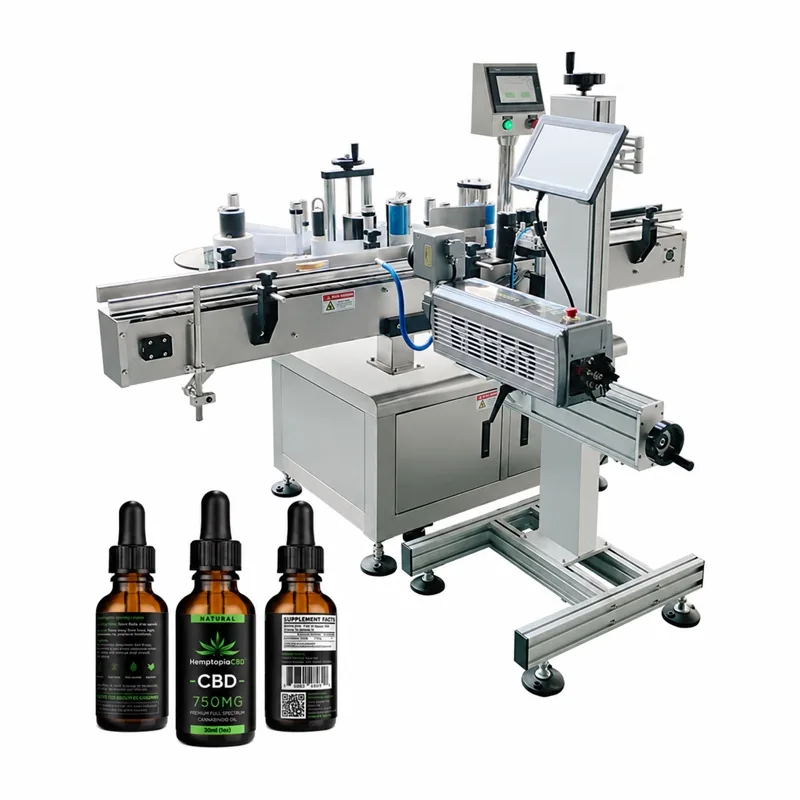
Five engineering gates separate pressure-sensitive and shrink sleeve labeling
Pressure-sensitive labeling peels a pre-coated self-adhesive face stock off a release liner and wipes it directly onto a rigid container wall, whereas shrink sleeve labeling drops a loose tubular plastic film over the container and shrinks it tight inside a steam, hot-air, or infrared tunnel. Selecting the wrong method for your container geometry or line utilities causes edge lifting and darting wrinkles on contoured bottles, or saddles a simple cylindrical SKU with unnecessary shrink-tunnel energy costs, floor space, and thermal stop rejects.
Across the four core families of industrial labeling machines, pressure-sensitive (sticker) systems and shrink sleeve labeling machines compete directly on beverage, personal care, food, pharmaceutical, and nutraceutical packaging lines. Both technologies run from 50 bottles per minute on entry inline conveyors up to 450 to 600+ containers per minute on continuous-motion rotary or dual-mandrel architectures, and both hold ±1 mm placement accuracy on round and molded containers. The right engineering choice comes down to five measurable project constraints:
- Container contour ratio and graphic surface area (straight panels versus compound curves and 360-degree base-to-cap decoration).
- Tamper-evident closure integration (single-piece perforated sleeve or add-on neck bander versus dedicated tamper-seal dispensing).
- Unit consumable cost versus SKU changeover speed across multi-product runs.
- Connected electrical and steam load (single-station servo drive versus applicator plus thermal shrink tunnel).
- Filling environment, condensation, abrasion exposure, and bottle-to-bottle recycling sorting rules.
| Comparison dimension | Pressure-sensitive (self-adhesive) labeling | Shrink sleeve (heat-shrink tubular film) labeling |
|---|---|---|
| Container geometry limit | Flat, oval, square, and straight-walled cylinders; steep tapers or compound curves cause adhesive wrinkling and edge lift | Complex compound curves, deep waist indentations, asymmetric trigger bottles, and steep neck tapers (up to 78% shrink with PETG) |
| Graphic coverage area | 60–70% on front-and-back setups; 95–100% around straight cylindrical walls only | True 360-degree coverage from base to cap, including multi-pack bundling of twin or promo containers |
| Tamper-evident seal | Must be engineered into the initial labeler specification (over-the-cap L-tab or secondary neck head) | Built into a single full-body sleeve via horizontal tear perforation, or added later with a compact C-frame neck bander |
| Unit label consumable cost | Lower per-label material cost using paper, BOPP, PE, or PET face stock on release liner | Higher per-unit film and converting cost (40–70 μm seamed PETG, OPS, PLA, PVC, or floatable polyolefin tube) |
| Equipment stages and footprint | Single dispensing station mounted beside or over the conveyor (e.g., 2000 × 800 × 1400 mm round bottle unit) | Two-stage system: sleeve applicator (e.g., 2100 × 850 × 2000 mm) plus downstream thermal shrink tunnel and accumulation buffer |
| Connected utility and power draw | 0.3 kW (round bottle) to 1.25–2.5 kW (flat/double-sided); zero heat tunnel or steam boiler required | 1.5–3.0 kW applicator plus electric tunnel blowers/heaters (176–392 °F) or 9–18 kW steam generator (24 kg/h steam at 0.4 MPa) |
| Ink scuff and moisture resistance | Surface-printed ink sits on the outside face (requires over-varnish or film laminate); cold or damp walls weaken adhesive tack | Ink is reverse-printed inside the transparent 40–70 μm film, sealing graphics from moisture, condensation, and powder abrasion |
| Typical speed envelope | 20–100 BPM (round), 40–150 BPM (flat), 40–200 BPM (double-sided), up to 500+ BPM (rotary continuous) | 50–200 BPM (inline mandrel; 150 BPM standard benchmark), up to 450 BPM (full-body) and 600 BPM (tamper bands) |
Container geometry, graphic coverage, and tamper-evident integration
The physical profile of your bottle or jar is the first technical filter. Pressure-sensitive face stocks are two-dimensional sheets with minimal transverse elasticity; shrink sleeves are biaxially or transversely oriented polymer tubes engineered to contract under heat.
Straight walls and mild tapers favor pressure-sensitive application
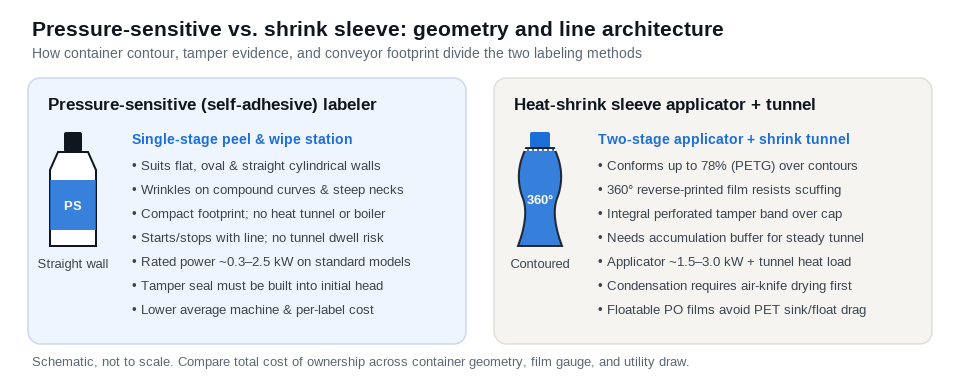
When a bottle, vial, canister, or jar has a straight vertical side wall or a single-axis panel curvature, a pressure-sensitive labeling machine applies the label in a single mechanical pass. A servo-driven traction roller pulls the backing liner around a sharp peel plate, separating the adhesive label and presenting its leading edge to the container as a wrap belt, sponge roller, or dual wipe brush presses it flat.
On cylindrical containers, round bottle wrap-around labeling machines achieve 95% to 100% circumferential coverage along the straight body section. On oval, rectangular, or flask-shaped bottles, front-and-back labeling machines apply two separate panels covering 60% to 70% of the container perimeter while leaving the moulded side ribs exposed. If the container wall curves in two directions simultaneously (a sphere, a pinched waist, or a steep shoulder dome), a flat self-adhesive label cannot compress along its top or bottom edge and will form radial darts, air channels, or flagging corners within hours of application.
Contoured profiles and 360-degree branding require shrink sleeves
Shrink sleeve film starts as a loose cylinder sized slightly larger than the widest container diameter (plus radial mandrel clearance) and shrinks transversely in the tunnel to grip smaller diameters. Published film data shows how much diameter reduction each polymer can bridge:
- PETG (polyethylene terephthalate glycol) shrinks up to 78%, handling aggressive waist pinches, asymmetric trigger-spray bottles, and steep shoulder-to-neck transitions.
- OPS (oriented polystyrene) shrinks up to 75% with lower contraction force than PETG, preventing thin-walled plastic containers from squeezing or paneling in the heat zone.
- PLA (polylactic acid) shrinks up to 70% to 72% in an 80–100 °C tunnel window for bio-based packaging specifications.
- PVC (polyvinyl chloride) shrinks up to 64% at low initiation temperatures (122–140 °F / 50–60 °C).
- Floatable low-density polyolefin films (such as CCL EcoFloat at over 60% shrink) handle moderate contours on recyclable PET bottles.
Because the film wraps the entire height and circumference of the vessel, shrink sleeves turn the shoulder, waist, and cap junction into continuous graphic real estate. On small cosmetic or over-the-counter packages with under 12 square inches of surface area, manufacturer sleeve guides note that full-body sleeves provide the uninterrupted straight-panel height needed to fit mandatory regulatory declarations and scannable barcodes without obscuring the container shape. Sleeves can also bundle two or more containers together into a promotional twin-pack without secondary cartons or shrink wrap.
Tamper-evident closure architecture
Packaging engineers frequently overlook how each technology handles tamper evidence until late in machine procurement. According to one manufacturer’s comparison of the two systems, tamper-evident capability on a pressure-sensitive labeler must be planned into the initial machine purchase (for example, specifying a top-down L-strip or C-strip tamper seal applicator head or a specialized neck-wrap wipe assembly). Retrofitting tamper-evident dispensing onto a standard side-panel pressure-sensitive labeler later is difficult and expensive.
On a shrink sleeve line, tamper evidence is achieved in two ways. First, a full-body sleeve can be cut 20 mm to 30 mm taller so its top hem extends over the bottle cap; a horizontal perforation wheel in the converter press or applicator head creates a tear-away neck band that breaks visibly on first opening. Second, if a line already runs pressure-sensitive body labels on food jars, sauce bottles, or pharmaceutical vials, a compact C-frame tamper-evident neck band applicator (such as the LINEVO LV-AS150, covering 16–150 mm layflat and 16–200 mm cut lengths) can be rolled directly over the existing conveyor downstream of the capper and paired with a focused electric heat tunnel.
Capital equipment, unit consumable cost, and changeover economics
Total cost of ownership (TCO) moves in opposite directions depending on whether you measure upfront equipment and per-label material cost or multi-SKU tooling flexibility.
Per-label consumable and pre-press costs
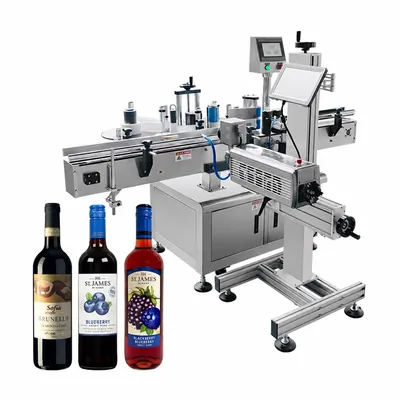
Pressure-sensitive labels generally carry a lower unit consumable price on small and medium production volumes. Converters die-cut paper, BOPP, PE, or PET face stock coated with acrylic or rubber pressure-sensitive adhesive on a siliconized glassine or PET release liner. Digital and flexographic presses produce short multi-flavor runs without cylinder engraving charges or longitudinal tube-seaming operations.
Shrink sleeves require 30 to 130 micron (typically 40 to 70 micron) biaxially or transversely oriented film, pre-distorted artwork mapping to compensate for 50% to 78% horizontal compression, reverse-printed ink layers, and a precision solvent-welded or glued longitudinal seam held within a ±0.5 mm layflat tolerance. While unit film cost drops significantly at high beverage and dairy volumes, short runs incur higher setup and converting overhead than die-cut adhesive labels.
Equipment stages and SKU changeover time
A pressure-sensitive bottle labeler is a single-unit machine. Switching between two cylindrical bottle diameters or label heights on a pressure-sensitive station requires adjusting the conveyor guide rails, setting the separation wheel pitch, cranking the dispensing head height, and recalling the servo peel recipe on the touchscreen PLC.
A shrink sleeve line requires both the sleeve applicator and the thermal tunnel, plus size-specific forming parts. When container diameter changes beyond the clearance window of the existing mandrel bullet, operators must swap the stainless steel mandrel and size ring, thread the new layflat web, verify rotary cutter timing, and re-aim the steam nozzles or hot-air louvers inside the shrink tunnel. On 150 BPM inline sleeve applicators (such as the LINEVO LV-PM150 and LV-150B), a unified rotary cutter head plane across Ø30–130 mm eliminates blade re-debugging during diameter steps, and quick-release mandrel designs keep full mechanical changeovers under 30 minutes, but a pressure-sensitive head still changes over faster when container diameters shift frequently across a single shift.
For lines transitioning from manual application or semi-automatic bench units, packaging line automation data shows that full inline labeling automation typically achieves capital payback within 18 to 24 months through labor reduction, lower scrap rates, and higher overall equipment effectiveness (OEE).
Energy draw, utility infrastructure, and floor footprint
Facility utilities and conveyor layout often decide the comparison before marketing preferences do. Pressure-sensitive labeling is a cold mechanical process; shrink sleeving is a thermal process.
Connected electrical and steam power comparison
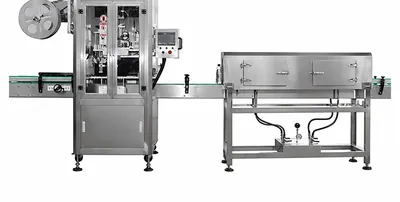
Published specification sheets from pharmaceutical and packaging machinery manufacturers illustrate the utility gap between the two architectures:
| Machine configuration | Representative published speed | Connected electrical / thermal load | Machine envelope (L × W × H) and weight | Additional plant utilities required |
|---|---|---|---|---|
| Automatic round bottle PS labeler | 20–100 BPM (±1 mm accuracy) | 0.3 kW (220 V, 50/60 Hz) | 2000 × 800 × 1400 mm; 200 kg | Standard single-phase power; clean dry compressed air only if pneumatic wiper/coder fitted |
| Automatic flat bottle PS labeler | 40–150 BPM (±1 mm accuracy) | 1.25 kW (220 V, 50 Hz) | 2000 × 1250 × 1500 mm; 200 kg | Standard electrical drop |
| Automatic double-sided PS labeler | 40–200 BPM (±1 mm accuracy) | 2.5 kW (220 V, 50/60 Hz) | 3000 × 1450 × 1600 mm; 550 kg | Standard electrical drop |
150 BPM inline shrink sleeve applicator (LINEVO LV-150B / LV-PM150) |
150 BPM (±1 mm cut accuracy; Ø28–120 mm) | 1.5 kW to 3.0 kW applicator host (220/380 VAC, 3-phase) | 2100 × 850 × 2000 mm; 300 kg (applicator only) | Must pair with downstream steam or electric heat shrink tunnel |
Steam shrink tunnel + generator (LINEVO LV-DZBS-1135 + LV-LDR18-0.4-Z) |
0–10 m/min tunnel conveyor (steam tunnels up to 70 ft/min) | 150 W tunnel + 120 W conveyor + 9 kW / 18 kW electric steam generator (380 V, 3-phase) | 1500 × 500 × 1500 mm tunnel (150 kg) + 620 × 450 × 1060 mm boiler (85 kg) | 24 kg/h saturated steam at 0.4 MPa, water supply, condensate drain, vapour exhaust hood, and air-knife dryer |
Line footprint and micro-stop accumulation math
A pressure-sensitive dispensing head is an intermittent-friendly device: because the servo peel drive is slaved to a conveyor encoder, if a downstream case packer pauses and the conveyor stops, the label head halts mid-pitch without damaging the container sitting at the peel plate.
A shrink sleeve tunnel cannot stop with containers inside the heated chamber. Whether the tunnel runs saturated steam at 180–200 °F (82–93 °C), forced electric hot air at 176–392 °F (80–200 °C), or infrared radiant emitters at 350–500 °F (177–260 °C), any bottle stalled inside the tunnel for more than a few seconds suffers scorched film, melted seams, or warped PET walls.
We can calculate the minimum clearance buffer required between the sleeve applicator and downstream stop points from the tunnel length and conveyor speed:
Tunnel dwell time (seconds) = (Tunnel chamber length (m) ÷ Conveyor speed (m/min)) × 60
Containers in flight inside tunnel = (Containers per minute ÷ 60) × Tunnel dwell time (seconds)
Example calculation (assuming a 2.0 m multi-zone shrink tunnel running on a 15 m/min conveyor at 150 bottles per minute): The tunnel dwell time is (2.0 ÷ 15) × 60 = 8.0 seconds. At 150 BPM (2.5 bottles per second), 2.5 × 8.0 = 20 bottles sit inside the heated chamber at any instant, plus another 5 to 8 unshrunk bottles travelling between the applicator mandrel and the tunnel entrance. Your conveyor layout must provide at least 25 to 30 containers of downstream accumulation capacity (and automatic tunnel louvers or steam shutoff valves) so the sleeving section can clear every bottle out of the tunnel whenever a downstream machine stops.
Moisture, condensation, abrasion, and PET recycling rules
Operating environment and end-of-life package recyclability provide the final engineering tie-breakers.
Cold-fill condensation, washdown, and powder dusting
Both technologies are sensitive to surface moisture at the moment of application, but for different physical reasons:
- Pressure-sensitive moisture limits: Cold container walls lower the initial tack of standard acrylic and rubber adhesives, while high plant humidity causes paper release liners to absorb moisture and curl or snap under web tension. However, once a synthetic BOPP or PET pressure-sensitive label with a cold-temp or wet-surface adhesive is wiped onto a dry container and given time to wet out, it withstands ice-bath immersion and refrigerated transport.
- Shrink sleeve moisture and abrasion advantages: A shrink sleeve uses zero adhesive on the container wall; mechanical hoop tension holds the shrunk film in place. Cold-filled beverage cans and bottles still require an upstream air-knife dryer before the sleeve applicator so surface water droplets do not create friction drag as the loose sleeve drops off the mandrel, and steam tunnels require a downstream air knife to blow condensate off the shrunk package before case packing. Once shrunk, because the ink is reverse-printed on the inside of a 40–70 micron PETG, OPS, or polyolefin layer, the graphics cannot be scratched off by conveyor guide rails, chemical splashes, or abrasive powder dust on nutraceutical filling lines.
Liner waste versus PET bottle-to-bottle recycling
Environmental and retailer packaging mandates weigh differently on each system:
- Liner waste on pressure-sensitive lines: Every roll of pressure-sensitive labels leaves an equal area of siliconized glassine or PET release liner skeleton that must be rewound and disposed of or routed to specialized liner-recycling programs. Shrink sleeves are linerless rolls of continuous tubular film, generating zero backing waste on the plant floor.
- Sink/float separation in PET bottle recycling: Standard PETG and PVC shrink sleeves have a specific gravity higher than water, meaning shredded sleeve flakes sink alongside PET bottle flakes in caustic wash tanks and discolor recycled PET resin. On clear PET bottles, pressure-sensitive polypropylene (BOPP) or polyethylene (PE) labels with wash-off adhesives float and separate cleanly. If your brand requires full-body shrink sleeves on recyclable PET bottles, specify either a low-density floatable polyolefin sleeve film (such as CCL EcoFloat with >60% shrink or Taghleef SHAPE360 TDS and white TDSW in 42, 45, and 50 micron gauges) that floats in the wash tank, or an APR-recognized magnetizable ink coating (such as Magmark SS on PETG) that lets magnetic separators pull sleeve flakes out of the PET stream.
Run this four-step decision sequence for your SKU list
Use these four engineering rules of thumb to lock in the right architecture before requesting quotes:
- Check the diameter shrink demand: If your container is a straight cylinder, flat flask, or mild taper (<3% to 5% diameter change across the label panel) and does not require 360-degree top-to-bottom graphics, select a pressure-sensitive labeler for lower capital cost, lower unit label cost, and sub-2.5 kW electrical draw.
- Check compound curves and required shrink percentage: If the label zone spans a concave waist, spherical body, or shoulder-to-neck transition where required transverse shrink exceeds 10% up to 78%, specify a shrink sleeve applicator and match the polymer (PETG, OPS, PLA, or floatable polyolefin) to the contour ratio.
- Audit tamper-evidence across your SKU roadmap: If you only need a tamper-evident cap seal on a bottle that already accepts a flat front-and-back or wrap-around sticker, pair a pressure-sensitive body labeler with a compact C-frame neck bander rather than running full-body sleeves across every SKU.
- Measure plant utilities and line stop frequency: Before ordering a steam shrink sleeve line, confirm that your facility has 380 V three-phase power for a 9–18 kW steam generator (or plant boiler steam at 0.4 MPa), vapour exhaust ducting, and enough conveyor length to buffer 25+ bottles during downstream micro-stops.
For high-speed beverage bottles comparing self-adhesive, sleeve, and hot-melt roll-fed options, see our water bottle labeling machine application guide. For wide-mouth food, cosmetic, and supplement containers, review jar labeling machines. To plan budget and line layout across your entire project, consult industrial labeling machine cost and our step-by-step selection framework in how to choose an industrial labeling machine.
Common questions
Is shrink sleeve labeling more expensive than pressure-sensitive labeling?
Yes, at low to medium volumes, shrink sleeve labeling carries a higher capital equipment cost (because it requires an applicator, mandrel tooling, a thermal shrink tunnel, and often a steam generator or air-knife dryer) and a higher per-label converting cost for seamed tubular film. At high beverage and consumer goods volumes, unit sleeve film prices narrow the gap, and a single perforated full-body sleeve can replace a separate front label, back label, and tamper-evident neck seal.
Can pressure-sensitive labels be applied to contoured or tapered bottles?
Pressure-sensitive film labels (especially conformable PE or thin BOPP stocks) can handle flat panels, oval curves, and very slight single-axis tapers when applied with contoured wipe rollers or tamp pads. However, if a container has compound curves, a pinched waist, or a steep shoulder taper requiring more than a few percent of material compression, flat self-adhesive labels will wrinkle or flag at the edges, and a shrink sleeve system is required.
Which labeling method is better for wet or cold-filled beverage containers?
Both systems require surface moisture control at the exact point of application: pressure-sensitive adhesives lose initial tack on wet condensation, while loose shrink sleeves can snag on water droplets as they shoot off the mandrel. With an upstream air-knife dryer installed, shrink sleeves offer superior long-term moisture and scuff durability because the ink is reverse-printed inside a 40–70 micron polymer tube with zero adhesive bond to weaken in ice buckets or humid coolers.
Can I combine a pressure-sensitive labeler and a shrink sleeve neck bander on the same conveyor?
Yes. Combining a wrap-around or front-and-back pressure-sensitive labeler for the primary body label with a compact C-frame shrink sleeve applicator and short electric heat tunnel for the over-the-cap tamper band is one of the most common line configurations in food, sauce, condiment, and nutraceutical packaging.
Compare both configurations with LINEVO’s engineering team
LINEVO’s labeling catalog includes automatic round, flat, and double-sided pressure-sensitive labeling machines alongside automatic beverage bottle shrink sleeve applicators, shrink tunnels, and integrated high-speed sleeving lines. Because machine speed, mandrel or wipe-station geometry, and tunnel utilities depend on your container profile and label material, all performance parameters are verified against your samples and set out in the formal quotation. Prepare your bottle dimensions, label or layflat specs, and target speed using the labeling machine RFQ checklist, then send your project details directly to LINEVO engineers on WhatsApp for a side-by-side quotation.
Related Guides & Specifications
Steam Shrink Tunnel vs Electric Hot-Air and Infrared Tunnels
Compare low-pressure saturated steam shrink tunnels (180–200°F) against electric forced hot-air and radiant infrared shrink sleeve tunnels (176–500°F).
Learn moreTamper-Evident Neck Band Applicator: Overhang Geometry, Perforation & Line Integration
Specify automatic tamper-evident shrink neck band applicators for jars and bottles: cap overhang rules, vertical/T-perforation blades, and 21 CFR 211.132 compliance.
Learn moreRelated Equipment & Guides
Automatic Labeling Machines: How to Choose by Container, Label and Speed
Choose an automatic labeling machine by container shape, label type and speed. Compare labeler types, accuracy tiers and the checks to run on your samples.
Learn moreWrap-Around and Pressure-Sensitive Labeling Machines: Web Kinematics & Line Selection
Engineering guide to wrap-around and pressure-sensitive labeling machines: web tension, peel plate geometry, wrap belt vs 3-roller kinematics, and line selection.
Learn moreShrink Sleeve Labeling Machines: How to Match Applicator, Film and Shrink Tunnel
Specify a shrink sleeve labeling machine by sleeve format, layflat width, film shrink ratio and steam or electric tunnel. Compare speeds and sample test steps.
Learn moreBottle Labeling Machines: How to Choose by Container Material, Shape, and Line Speed
Select a bottle labeling machine by container material (glass, PET, HDPE), shape (round, flat, oval, square, tapered), surface condensation, and line speed.
Learn moreLabel Automation and Custom Packaging Line Labeling Integration
Engineering guide to label automation and inline labeling system integration across fillers, cappers, accumulation tables, PLC sync, and vision reject gates.
Learn moreRound Bottle Labeling Machines: Continuous Wrap Belt vs. 3-Roller Indexing
Select a round bottle labeling machine by comparing continuous wrap belts vs 3-roller indexing, web speed equations, bottle pitch spacing, and machine parameters.
Learn moreFront and Back Labeling Machines: Dual-Head Sync & Top Hold-Down Mechanics
Engineering guide to front and back double-side labeling machines: centering chains, overhead top holding belts, dual servo heads, and flat or oval bottle specs.
Learn moreSteam Shrink Tunnel vs Electric Hot-Air and Infrared Tunnels
Compare low-pressure saturated steam shrink tunnels (180–200°F) against electric forced hot-air and radiant infrared shrink sleeve tunnels (176–500°F).
Learn moreTamper-Evident Neck Band Applicator: Overhang Geometry, Perforation & Line Integration
Specify automatic tamper-evident shrink neck band applicators for jars and bottles: cap overhang rules, vertical/T-perforation blades, and 21 CFR 211.132 compliance.
Learn moreWater Bottle Labeling Machines: PET Wrap-Around, Roll-Fed BOPP, and Shrink Sleeve
Compare pressure-sensitive wrap, roll-fed BOPP hot-melt, and shrink sleeve water bottle labelers for thin-wall PET, sparkling water, and glass lines.
Learn moreJar Labeling Machines: Wrap-Around, Front-and-Back, and Tamper-Evident Configurations
Select a jar labeling machine for wide-mouth glass and plastic jars: wrap-around vs front-back, taper draft angles, L-clip tamper strips, and neck bands.
Learn moreIndustrial Labeling Machine Price and Total Cost of Ownership Guide
Transparent industrial labeling machine price breakdown from $2,000 semi-automatics to $500,000+ high-speed lines, plus hidden TCO drivers and payback math.
Learn moreHow to Choose an Industrial Labeling Machine: 7-Gate Selection Guide
Step-by-step labeling machine buying guide: 7 engineering gates from container geometry, surface energy, and unwind #1-#8 to speed headroom and line utilities.
Learn moreLabeling Machine RFQ Checklist and User Requirement Specification (URS)
Engineering labeling machine RFQ checklist and User Requirement Specification (URS) template covering container drawings, roll unwind #1-#8, CPM, and FAT rules.
Learn more