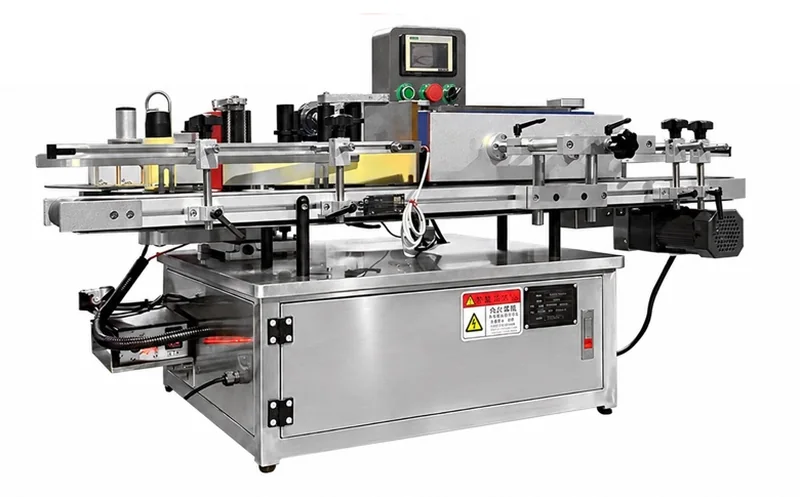
Specifying a square bottle labeling machine around a standard round-bottle rolling belt causes immediate container skew, corner air bridging, and high reject rates. Unlike cylindrical containers that self-center while spinning against a wrap belt, square, rectangular, and flat oval bottles require positive flat-face orientation through twin centering chains and a synchronized overhead hold-down belt before the label web touches the sidewall.
Across edible oil jugs, laundry detergent bottles, personal care flasks, agrochemical jerrycans, and square spirits decanters, the machine architecture depends on how many container faces the label crosses. Within the wrap-around and pressure-sensitive labeler family and the broader industrial labeling machine architecture, square and flat container systems divide into four mechanical configurations based on panel coverage, corner radius wiping, and sidewall rigidity.
| Configuration | Panel Coverage | Orientation & Wipe Mechanism | Typical Throughput | Placement Accuracy | Primary Container Fit |
|---|---|---|---|---|---|
| Single-Head Flat Side | 1 flat panel (front only) | Guide rails + top hold-down belt + flat sponge roller | 60–150 BPM | ±1.0 mm | Single-face detergent, motor oil, flat flasks |
| Dual-Head Front & Back | 2 opposing flat/oval panels | Twin centering chain + top hold-down belt + dual heads | 40–180 BPM | ±0.5 to ±1.0 mm | Shampoo, dish soap, spirits, rectangular jars |
| 3-Panel U-Wrap (Corner Wipe) | Front face + 2 adjacent side panels | Centering chain + top belt + articulated swing-arm rollers | 30–80 BPM | ±1.0 mm | 1 L to 5 L edible oil, agrochemical, sanitizer jugs |
| 4-Panel Full Wrap | All 4 faces + trailing lap seam | Orbital corner-wipe station or rotary cam-oriented turret | 30–100 BPM | ±1.0 mm | Tamper-sealed square canisters, bulk chemical jugs |
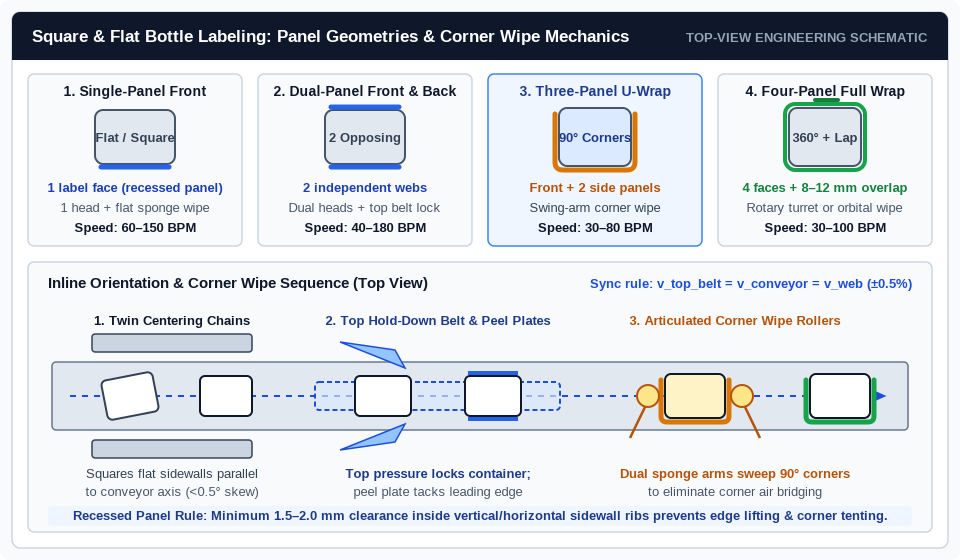
How panel count dictates machine mechanics
Square and flat containers introduce two mechanical constraints that do not exist on a round bottle labeling machine: yaw rotation on the conveyor bed and sharp 90-degree corner transitions between adjacent faces. Each additional panel crossed by a single label web changes the wiping kinematics and limits maximum line speed.
1. Single-panel and opposing two-panel (front and back) systems
When a container carries a standalone front label or separate front and back labels on opposing faces, the label web never crosses a 90-degree corner radius. The engineering task is purely planar alignment. As detailed in our front and back labeling machine guide, the bottle enters a counter-rotating twin centering chain (or pneumatic alignment gate) that squares the flat sidewalls parallel to the conveyor centerline while the container is still in motion.
Before the container exits the centering chains, a synchronized overhead hold-down belt engages the cap crown or bottle shoulder, clamping the base firmly against the flat-top conveyor chain. Left and right servo dispensing heads then peel and tack the leading label edges simultaneously onto the opposing panels, followed by fixed dual-durometer sponge rollers and nylon brushes that wipe out entrapped air. Because no reciprocating swing arms are required, opposing two-panel inline machines run continuously at 40 to 180 BPM with ±0.5 to ±1.0 mm vertical and horizontal registration.
2. Three-panel U-wrap square bottle labelers
Edible oil packers (1 L, 2 L, and 5 L PET or HDPE square bottles), agrochemical producers, and industrial chemical blenders frequently specify a single long label that covers the center front panel and wraps 90 degrees around both left and right corners onto the two adjacent side panels. This three-panel U-wrap provides a wide billboard for regulatory tables and nutrition facts while using a single dispensing head instead of two or three separate webs.
Applying a three-panel label inline requires a two-stage wipe sequence:
- Leading side + front panel application: A single wide servo applicator (typically 120 to 250 mm web width) tacks the leading wing onto the first side panel and dispenses across the front face as the bottle advances under the overhead hold-down belt. Alternatively, a front-tacking cross-wipe head applies the center of the label to the front face while the container is indexed or moving at synchronized pitch.
- Articulated corner-wipe swing arms: Passive flat brushes cannot push a stiff BOPP or paper label around a trailing 90-degree corner without leaving an unbonded air pocket (“corner tenting”) at the bend. Three-panel square bottle labelers use cam-driven or pneumatic swing-arm sponge rollers that follow the trailing corner radius, sweeping the label tightly around the 90-degree edge and pressing the trailing wing flat onto the rear-facing side panel.
Because the articulated corner-wipe arms must cycle in and out of the inter-bottle gap between every container, mechanical cycle time caps single-lane three-panel U-wrap machines at 30 to 80 BPM.
3. Four-panel full-wrap square labeling
Wrapping a single label around all four faces of a square container with an 8 to 12 mm overlap seam on the fourth panel is the most demanding square-bottle operation. Rolling a square bottle between a flat wrap belt and a stationary backing pad causes the container velocity to surge and decelerate every time a 90-degree corner pivots against the pad, stretching the label web and misaligning the overlap seam by 2 to 5 mm.
To execute a four-panel wrap without seam walk:
- Low-to-medium speed lines (30–60 BPM) use an inline indexing cradle or orbital dual-wiper station where the bottle is held stationary or advanced through synchronized planetary wipe rollers that fold the web sequentially across all four faces.
- High-speed lines (80–250+ BPM) step up to a cam-indexed rotary carousel (see our rotary vs inline labeling machine comparison), where individual bottle plates driven by servo motors or a master cam profile rotate the square container at a programmed angular velocity profile that keeps linear surface speed constant as each flat face and corner passes the dispensing peel plate.
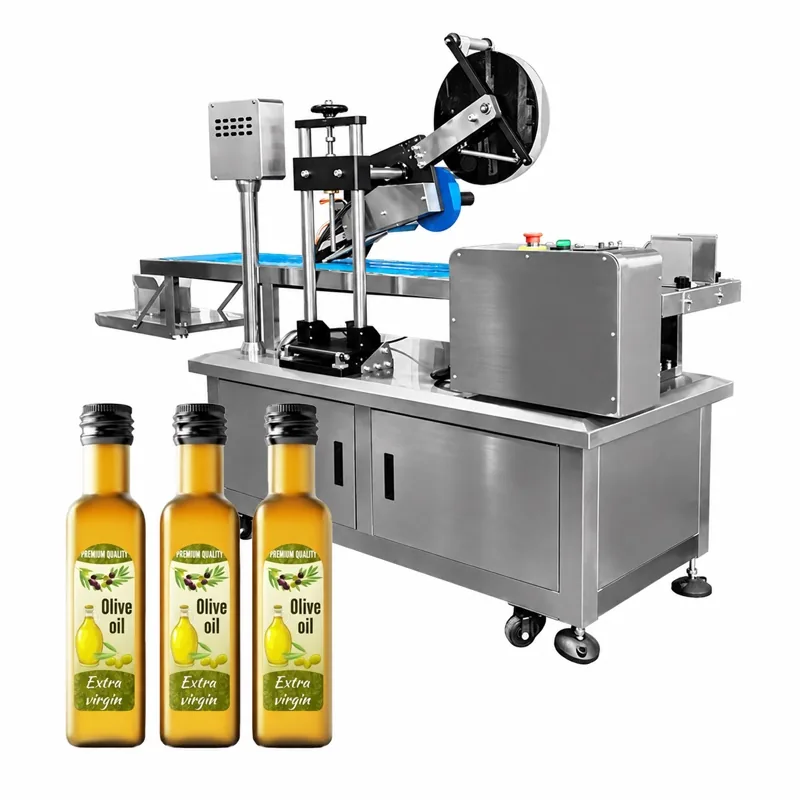
Chain-aligner and overhead hold-down belt mechanics
The most common mechanical failure on a flat or square bottle labeler is yaw drift between the centering chain release point and the peel plate tip. If a flat HDPE detergent bottle twists by just 1.5 degrees before the leading edge of a 140 mm tall label contacts the sidewall, the trailing edge of that label will walk vertically by:
$$\Delta y_{\text{walk}} = L_{\text{label}} \times \sin(\theta_{\text{yaw}})$$
For a label length $L_{\text{label}} = 120\text{ mm}$ and a yaw angle $\theta_{\text{yaw}} = 1.5^\circ$:
$$\Delta y_{\text{walk}} = 120 \times \sin(1.5^\circ) = 120 \times 0.0262 = 3.14\text{ mm}$$
A 3.14 mm vertical walk immediately pushes the label out of a 2.0 mm recessed panel border, causing the top edge to ride up onto the bottle shoulder ridge and blister.
To eliminate yaw drift, verify three mechanical design rules during factory acceptance testing (FAT):
- Physical handoff overlap ($L_{\text{overlap}} \ge 1.5 \times W_{\text{bottle}}$): The overhead hold-down belt must compress the container cap or shoulder while the container body is still fully captured between the twin centering chains. Never allow a free-travel gap where the bottle is released by the centering chain before the top belt locks it down.
- Closed-loop encoder synchronization ($\Delta v \le 0.5%$): The main conveyor drive, twin centering chains, overhead hold-down belt, and label dispensing stepper/servo motor must follow a single master encoder mounted on the conveyor shaft. If the overhead belt runs even 1.5% faster than the bottom conveyor chain, tall flat bottles tip forward on their base heel, introducing a consistent nose-down label tilt.
- Dual-jack lead-screw top belt frame: On 1 L to 5 L edible oil and detergent lines, the overhead belt applies 40 to 120 N of downward hold-down force. Specify a dual-column synchronized twin-screw jack lift rather than a single-post cantilevered arm, which deflects upward under load and loses grip on the outboard edge of wide rectangular jugs.
Working with recessed panels, sidewall ribs, and thin-wall HDPE
Blow-molded square PET edible oil bottles and flat HDPE household chemical containers almost always incorporate recessed label panels bounded by horizontal strengthening ribs or corner bumper ridges. These ribs prevent the flat sidewalls from paneling (sucking inward under vacuum or stacking load) and protect the label from scuffing during case packing.
However, recessed panels create a strict dimensional window for label die-cutting and wipe roller specification:
The 1.5 to 2.0 mm recessed-border clearance rule
Blow-molded PET and HDPE bottles exhibit mold-to-mold shrinkage variation of ±0.8 to ±1.5 mm on overall height and panel location, while inline labeling placement accuracy holds ±0.5 to ±1.0 mm. When you combine container molding tolerance with machine registration tolerance using root-sum-square (RSS) stack-up:
$$\text{Clearance}{\text{min}} = \sqrt{\sigma{\text{bottle}}^2 + \sigma_{\text{machine}}^2} \approx \sqrt{1.2^2 + 0.8^2} = 1.44\text{ mm}$$
Rule of thumb: Always size the die-cut label height and width at least 3.0 to 4.0 mm smaller than the flat bottom of the recessed panel (providing 1.5 to 2.0 mm clearance on all four sides inside the chamfered panel transition). If the label edge extends within 0.5 mm of the recessed step, minor bottle shrinkage will push the label onto the angled rib wall, creating an unbonded edge channel that collects dust and peels during shipping.
Preventing thin-wall sidewall deflection (in-line vs air-inflation)
Empty or lightweight unpressurized square PET and thin-wall HDPE bottles (wall thickness 0.35 to 0.55 mm) flex inward when compressed by stiff rubber wipe rollers. When the sidewall dishes inward by 2 mm at the peel plate, the center of the label fails to wet out, trapping a vertical air tunnel down the middle of the panel.
- If labeling filled, capped containers: Liquid hydrostatic head and sealed headspace air provide internal back-pressure. Use dual-durometer segmented foam rollers (soft Shore 15A–25A closed-cell sponge core with a compliant skin) that conform into recessed panels without crushing corners.
- If labeling empty thin-wall HDPE/PET containers: Specify a low-pressure air-inflation nozzle mounted in the overhead hold-down belt assembly (or positive internal air chuck) that pressurizes the open bottle neck to 0.15–0.35 bar during the 0.4-second wipe window, keeping the flat sidewall rigid against the wipe brush.
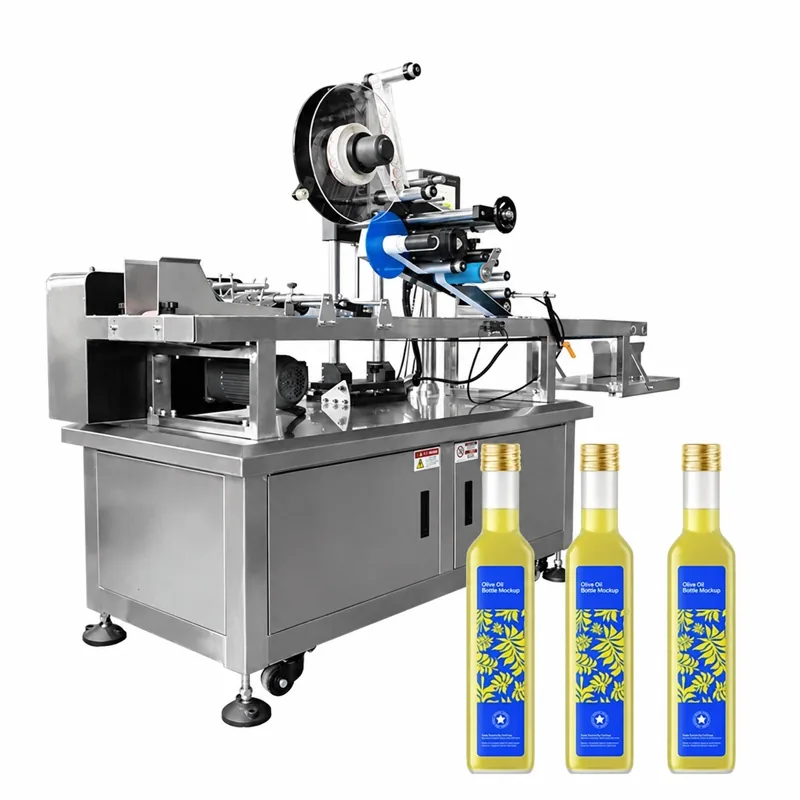
Throughput sizing and pitch calculation for square bottles
To verify whether a quoted inline square bottle labeler can meet your production target without exceeding safe web speeds, calculate the required conveyor speed and dispensing velocity from container pitch:
$$v_{\text{conveyor}}\text{ (m/min)} = \frac{\text{BPM} \times P_{\text{pitch}}\text{ (mm)}}{1,000}$$
Where container pitch $P_{\text{pitch}} = W_{\text{bottle_travel}} + G_{\text{gap}}$.
Worked example: 2 L rectangular edible oil bottle (3-panel U-wrap vs 2-panel front/back)
Suppose a packaging line runs a 2 L rectangular PET edible oil bottle measuring $110\text{ mm}$ along the conveyor travel axis and $90\text{ mm}$ wide:
- Case A (Opposing 2-panel front and back labels):
- Inter-bottle gap required for centering chain and optical sensor reset: $G_{\text{gap}} = 90\text{ mm}$
- Pitch $P_{\text{pitch}} = 110 + 90 = 200\text{ mm}$
- At $100\text{ BPM}$, required conveyor speed is: $$v_{\text{conveyor}} = \frac{100 \times 200}{1,000} = 20.0\text{ m/min}$$
- A standard 30 to 40 m/min servo dispensing head handles $20.0\text{ m/min}$ at 50% duty cycle with zero mechanical swing-arm delay.
- Case B (3-panel U-wrap across front + 2 sides):
- Total label length across the $90\text{ mm}$ front panel plus two $65\text{ mm}$ side wings is $L_{\text{label}} = 220\text{ mm}$.
- Articulated swing-arm corner wipe rollers require a minimum inter-bottle clearance of $G_{\text{gap}} = 160\text{ mm}$ so the trailing wipe arm can sweep the rear face and retract before the next bottle arrives.
- Pitch $P_{\text{pitch}} = 110 + 160 = 270\text{ mm}$, plus a 0.35-second corner-wipe dwell per bottle, capping practical single-lane throughput at 45 to 65 BPM. If your line requires 120 BPM on a 3-panel U-wrap, specify either a twin-lane inline system or a rotary cam-oriented labeler.
Failure modes, root causes, and corrective actions
| Failure Mode / Symptom | Root Cause on Square & Flat Containers | Corrective Engineering Action |
|---|---|---|
| Corner bridging / tenting (unbonded air gap along 90° vertical corners) | 1. Label facestock is too stiff (e.g., > 90 gsm paper or thick 65 µm PET) for a tight corner radius ($R < 3\text{ mm}$). 2. Passive flat brush used instead of articulated corner wipe roller. |
1. Switch to conformable 50 µm BOPP/PE co-extruded film with high-tack permanent acrylic or rubber-based adhesive. 2. Install spring-loaded or pneumatic swing-arm sponge rollers that wrap 90° around the corner radius. |
| Diagonal label skew / upward walk on flat panel | 1. Bottle yaws between centering chain exit and overhead hold-down belt entry. 2. Speed mismatch ($\Delta v > 1%$) between top hold-down belt and bottom conveyor. |
1. Extend centering chain guides so top hold-down belt clamps the bottle before chain release. 2. Couple top belt drive to main conveyor encoder and verify zero slip under load. |
| Edge lifting / flagging along recessed panel perimeter | 1. Die-cut label is oversized and rides up the chamfered rib wall. 2. Mold release agent or oil mist on container surface. |
1. Reduce die-cut label dimensions to maintain ≥ 1.5–2.0 mm clearance inside all recessed panel borders. 2. Verify surface energy ($\ge 38\text{ dynes/cm}$ on HDPE via flame treatment if needed). |
| Center panel air bubbling / tunneling | Thin-wall container flexes inward under peel-plate pressure, preventing center adhesive wet-out. | Reduce peel-plate contact pressure, switch to segmented soft Shore 20A foam wipe rollers, or add low-pressure neck air inflation on empty bottles. |
| Leading wing wrinkling on 3-panel U-wrap | Dispensing web velocity does not match bottle linear speed during initial side-wing tack. | Calibrate servo web speed ratio within ±0.5% of conveyor velocity and set peel plate tip 2–3 mm from the passing sidewall. |
Specification checklist for RFQ intake
Before requesting a formal engineering quote or comparing machines in our bottle labeling machine hub or jar labeling machine guide, gather these six container parameters:
- Container drawings and physical samples: Provide exact cross-sectional dimensions (width × depth × height), corner radii ($R_{\text{corner}}$ in mm), and recessed panel step depth (typically 0.5 to 1.2 mm).
- Panel coverage map: Specify whether each SKU uses 1-panel front, 2-panel front/back, 3-panel U-wrap, 4-panel full wrap, or an L-shaped tamper-evident top-over-cap strap.
- Filling state at labeler infeed: State whether bottles arrive filled and capped (rigid) or empty and uncapped (requiring internal air inflation or low-force wiping).
- Label material and roll winding: Specify facestock (white/clear BOPP, squeeze PE, or paper), liner type (glassine vs PET), roll core ID (76 mm / 3 in standard), and unwind direction (charts #1 through #8).
- Line speed and SKU changeover frequency: Define both nominal and surge speeds in BPM, plus the number of bottle sizes to determine whether tool-less handwheel digital position indicators and HMI recipe memory are required.
When your container drawings and throughput targets are ready, organize your package parameters with our labeling machine RFQ checklist and message LINEVO engineers on WhatsApp for a layout and cycle-time review.
Common questions
Can one labeling machine run both square and round bottles?
Yes, provided the inline machine is ordered with a modular wrap-around belt attachment mounted downstream of the dual front-and-back dispensing heads. When running square or flat bottles, the wrap belt is backed out on its slide rails and the twin centering chains, overhead hold-down belt, and dual opposing heads operate. When converting to cylindrical containers, the back head is switched off, the front head dispenses the full wrap label, and the side wrap-around belt spins the bottle against a sponge backing pad.
Why do three-panel square bottle labels bubble at the corners after 24 hours?
Delayed corner bubbling (“memory lift”) occurs when a rigid label facestock with high flexural modulus recovers elastically against an adhesive with insufficient shear tack on a tight corner radius ($R < 3\text{ mm}$). Even if the articulated wipe rollers press the label flat during application, internal bending stress slowly pulls the film away from the corner over 12 to 24 hours. Switching to a conformable 50 µm polyolefin or BOPP film paired with an aggressive rubber-based or high-tack acrylic adhesive eliminates memory lift.
What is the minimum corner radius for wrapping a pressure-sensitive label around a square bottle?
A corner radius of at least $R \ge 2.5\text{ to }3.0\text{ mm}$ is recommended for standard 50 to 60 µm BOPP films and 70 to 80 gsm paper labels. Knife-edge square bottles with corner radii under $1.5\text{ mm}$ concentrate bending stress along a razor line, requiring either a pre-creased paper label, a conformable thin PE film, or separate front and side panels rather than a continuous wrap.
Do HDPE detergent and agrochemical jugs require flame treatment before pressure-sensitive labeling?
Standard pressure-sensitive acrylic and hot-melt rubber adhesives bond reliably to untreated HDPE (surface energy ~31 dynes/cm) without flame treatment, unlike UV screen printing which requires 42+ dynes/cm. However, if fluorinated HDPE containers or heavy silicone mold-release agents are used for solvent-based agrochemicals, specify a high-coat-weight rubber-resin adhesive tested directly on production-lot jugs.
Related Guides & Specifications
Label Roll Unwind Direction Chart (#1 to #8) and Roll Length Calculator
Interactive #1 to #8 label winding direction chart (wound out vs wound in), eye-mark guide, and roll length, OD, core size, and shift roll calculator.
Learn moreLabeling Speed (BPM), OEE Surge Capacity, and Web Pitch Calculator
Calculate required labeling machine surge BPM, line OEE headroom, label web dispensing velocity in m/min, container pitch, and matched conveyor speed.
Learn moreIndustrial Labeling Machine FAT Checklist, Maintenance, and Troubleshooting Manual
Execute a 30-minute Factory Acceptance Test (FAT), follow a 6-tier preventive maintenance schedule, and resolve 12 common labeling machine defects.
Learn moreRound Bottle Labeling Machines: Continuous Wrap Belt vs. 3-Roller Indexing
Select a round bottle labeling machine by comparing continuous wrap belts vs 3-roller indexing, web speed equations, bottle pitch spacing, and machine parameters.
Learn moreFront and Back Labeling Machines: Dual-Head Sync & Top Hold-Down Mechanics
Engineering guide to front and back double-side labeling machines: centering chains, overhead top holding belts, dual servo heads, and flat or oval bottle specs.
Learn moreRotary vs. Inline Labeling Machines: Turret Kinematics, Speed & Changeover
Compare rotary carousel turret vs inline linear labeling machines across speed ratings (50-150 vs 150-600+ BPM), bottle plates, starwheel changeover, and layout.
Learn moreRelated Equipment & Guides
Automatic Labeling Machines: How to Choose by Container, Label and Speed
Choose an automatic labeling machine by container shape, label type and speed. Compare labeler types, accuracy tiers and the checks to run on your samples.
Learn moreWrap-Around and Pressure-Sensitive Labeling Machines: Web Kinematics & Line Selection
Engineering guide to wrap-around and pressure-sensitive labeling machines: web tension, peel plate geometry, wrap belt vs 3-roller kinematics, and line selection.
Learn moreBottle Labeling Machines: How to Choose by Container Material, Shape, and Line Speed
Select a bottle labeling machine by container material (glass, PET, HDPE), shape (round, flat, oval, square, tapered), surface condensation, and line speed.
Learn moreRound Bottle Labeling Machines: Continuous Wrap Belt vs. 3-Roller Indexing
Select a round bottle labeling machine by comparing continuous wrap belts vs 3-roller indexing, web speed equations, bottle pitch spacing, and machine parameters.
Learn moreFront and Back Labeling Machines: Dual-Head Sync & Top Hold-Down Mechanics
Engineering guide to front and back double-side labeling machines: centering chains, overhead top holding belts, dual servo heads, and flat or oval bottle specs.
Learn moreRotary vs. Inline Labeling Machines: Turret Kinematics, Speed & Changeover
Compare rotary carousel turret vs inline linear labeling machines across speed ratings (50-150 vs 150-600+ BPM), bottle plates, starwheel changeover, and layout.
Learn moreHot-Melt Glue vs Wet-Glue vs Pressure-Sensitive Labeling Machines
Compare roll-fed hot-melt glue, cut-and-stack wet/cold glue, and pressure-sensitive labeling machines across unit label cost, line speed, changeover, and TCO.
Learn moreJar Labeling Machines: Wrap-Around, Front-and-Back, and Tamper-Evident Configurations
Select a jar labeling machine for wide-mouth glass and plastic jars: wrap-around vs front-back, taper draft angles, L-clip tamper strips, and neck bands.
Learn more