Industrial label adhesive types divide into six functional classes: permanent, removable, high-tack (ultra-aggressive), freezer-grade, cryogenic, and tamper-evident, built mostly from acrylic or rubber pressure-sensitive polymers. Matching an adhesive to a packaging line requires aligning container surface energy, surface roughness, minimum application temperature, post-dwell service temperature, and dwell time rather than defaulting to general-purpose permanent stock.
Applying standard permanent stock onto cold, condensation-covered bottles or rough corrugated boxes is one of the fastest causes of corner flagging and unreadable barcodes on automated wrap-around and pressure-sensitive labeling machines. Understanding how adhesive chemistry interacts with container substrates lets packaging engineers prevent line rejects before ordering production label rolls.
What do self-adhesive labels mean and how does pressure-sensitive bonding work?
Self-adhesive (pressure-sensitive) labels are paper or plastic labels pre-coated on the back with viscoelastic adhesive so they bond immediately when pressed against a container surface without heat, UV curing, or chemical reactions. A protective plastic-coated release liner shields the adhesive from premature contact and is stripped away just before dispensing.
Unlike structural glues that cure through evaporation or cross-linking, pressure-sensitive adhesives (PSAs) are loosely cross-linked viscoelastic polymers formulated from acrylates, natural rubber, styrenic block copolymers, or silicones. Peer-reviewed polymer mechanics research published in Polymers (PubMed Central NIH) and PNAS (PubMed Central NIH) explains that PSA performance depends on three core physical parameters:
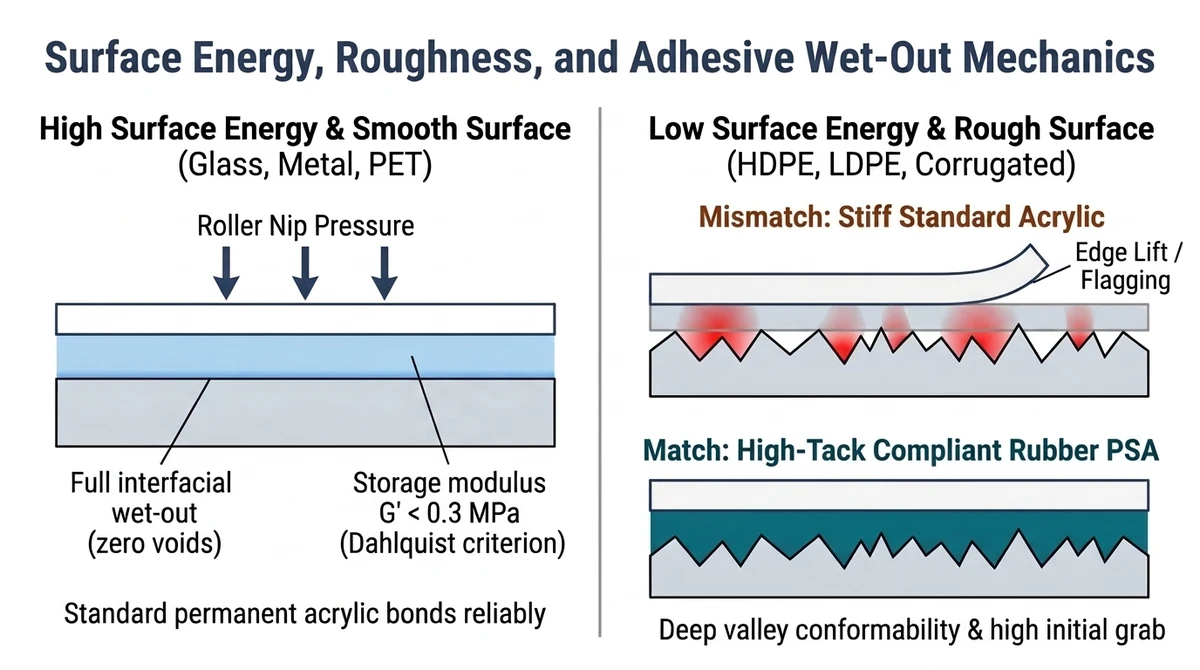
- Storage modulus and the Dahlquist criterion: The elastic storage modulus must remain low enough during application for the adhesive to deform and wet out microscopic surface peaks under light roller pressure. Under the Dahlquist criterion, a PSA requires a storage shear modulus below 0.3 MPa at room temperature (measured below 3 × 10⁵ Pa at 1 Hz) to establish rapid tack.
- Loss modulus and energy dissipation: Once bonded, a high viscous loss modulus dissipates mechanical energy during peeling through cavity nucleation and fibril stretching, raising peel resistance.
- Glass-transition temperature and dwell time: The polymer glass-transition temperature governs the cold limit below which an adhesive turns stiff and loses tack, with industrial acrylic PSAs commonly measuring near -40.23 °C. Even after initial nip contact, many commercial PSAs require 48 to 72 hours of dwell time to reach complete ultimate bonding strength.
What are the main types of self-adhesive label adhesives?
The six primary self-adhesive label classes are permanent, removable, high-tack (ultra-aggressive), freezer-grade, cryogenic, and tamper-evident, supplemented by water-soluble wash-off formulations for reusable or recyclable containers. Each class trades initial loop tack, sustained 90-degree peel force, minimum application temperature, and clean removability against a specific packaging environment.
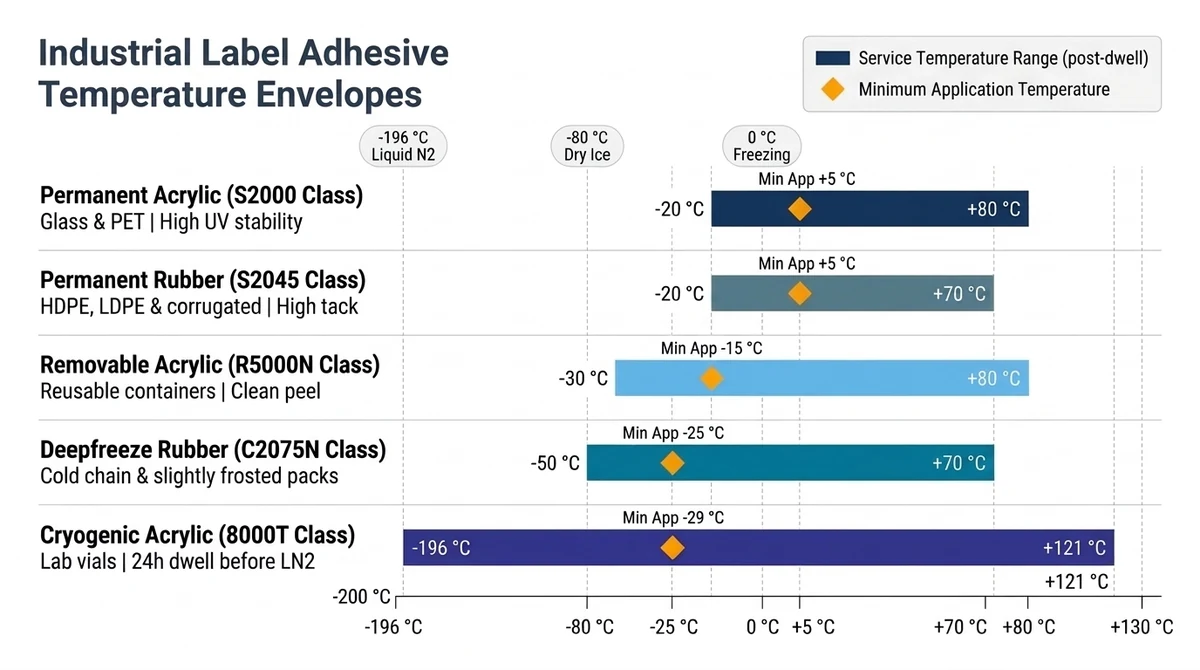
| Adhesive Class (Representative Industrial Grade) | Base Polymer Chemistry | Initial Loop Tack (FTM 9 Glass) | 90-Degree Peel (FTM 2 Steel) | Minimum Application Temp | Post-Dwell Service Temp Range | Primary Container & Environment Fit |
|---|---|---|---|---|---|---|
| Permanent acrylic emulsion (S2000 class) | Emulsion acrylic | Above 400 N/m | Above 280 N/m | +5 °C | -20 °C to +80 °C | Smooth glass, metal, and PET; strong UV and aging stability |
| Permanent rubber / high-tack (S2045 class) | Rubber-based PSA | 480 N/m | 360 N/m | +5 °C | -20 °C to +70 °C | Apolar plastics (HDPE, LDPE), rough corrugated, slightly curved packs; indoor use |
| Removable acrylic (R5000N class) | Removable acrylic | 4 N/25mm | 2 N/25mm | -15 °C | -30 °C to 80 °C | Reusable glass, metal, PET, PP, and ABS requiring clean peel |
| Deepfreeze rubber (C2075N class) | Cold-temp rubber PSA | 14 N/25mm | 7.5 N/25mm | -25 °C | -50 °C to 70 °C | Cold-chain cartons, apolar films, curved and slightly frosted surfaces |
| Cryogenic acrylic (8000T CryoCool class) | Permanent acrylic (20-micron coat) | Specialty high-hold | Permanent cryo bond | -29 °C | -196 °C to 121 °C (after 24 h dwell) | Liquid nitrogen (-196 °C), dry ice (-80 °C), autoclaves, and lab vials |
| Tamper-evident & water-soluble wash-off | Engineered security or water-soluble PSA | Application-tuned | Destructive or wash-off | Formulation-dependent | Ambient to wash-tank | Pharma/warranty seals (visible void pattern) or recyclable wash-off jars |
Permanent vs. high-tack permanent adhesives
Standard permanent adhesives are built to stay bonded for the entire lifecycle of the package and serve as the default choice on smooth, high-surface-energy glass jars, beverage bottles, and metal cans. Attempting to peel a fully set permanent label generally tears the facestock or leaves adhesive residue behind.
High-tack (ultra-aggressive) label adhesives are formulated specifically to build rapid initial contact grab on textured packaging, recycled corrugated cartons, and apolar plastics where conventional acrylics slip or lift at the corners. Because high initial tack and long-term permanence are distinct properties, high initial tack alone does not guarantee stronger ultimate bond strength, outdoor UV durability, or sub-zero performance across every plastic resin; engineers must confirm both initial grab and end-use environmental compatibility on actual container samples.
Removable and water-soluble wash-off adhesives
Removable adhesives hold securely through warehouse handling and retail display yet release cleanly without tearing or leaving sticky residue when the label is no longer needed. Representative removable acrylic formulations such as R5000N run at much lower 90-degree peel force (2 N/25mm on stainless steel and 4 N/25mm loop tack on glass) than permanent grades, retain good UV resistance, and peel cleanly from PET, polypropylene (PP), ABS, aluminum, stainless steel, glass, and fiberboard.
Two boundaries matter on production lines using removable stock. First, recycled cardboard and loosely bonded paper fibers can still tear upon peel, making pre-production container testing essential. Second, when glass or rigid plastic packaging enters automated container-washing or recycling loops, water-soluble pressure-sensitive adhesives allow entire labels to strip cleanly during washing without manual peeling.
Freezer-grade, cryogenic, and tamper-evident specialties
Standard room-temperature adhesives turn glassy and lose wet-out flexibility in cold storage, causing labels to pop off cartons or bottles. Separating cold-chain requirements into two distinct temperature tiers prevents costly field failures:
- Refrigerated and deepfreeze logistics (-50 °C to +70 °C): Most general freezer labels should be applied above freezing prior to cold storage unless explicitly rated for frozen application. When operators need to label already-chilled or slightly frosted packages, dedicated deepfreeze rubber formulations such as C2075N drop the minimum application temperature to -25 °C while delivering 14 N/25mm initial tack on glass and 7.5 N/25mm 90-degree peel on steel across apolar, curved, and irregular surfaces.
- Ultra-low and cryogenic laboratory storage (-196 °C): Freezer adhesives and cryogenic adhesives are not interchangeable. Cryogenic constructions such as 8000T CryoCool pair a 58-micron gloss white topcoated polypropylene facestock with a 20-micron permanent acrylic adhesive (136 microns +/-10% total caliper with its 58-micron kraft liner), applying down to -29 °C and withstanding -196 °C liquid nitrogen, -80 °C dry ice, steam autoclaving, and gamma radiation up to 121 °C after a typical 24-hour dwell time.
- Tamper-evident security seals: Where regulatory or warranty compliance demands visible opening evidence on pharmaceutical cartons or electronics, tamper-evident adhesives are engineered to fracture or leave a distinct pattern if anyone attempts removal.
How do acrylic and rubber-based label adhesives behave on different container surfaces?
Acrylic pressure-sensitive adhesives deliver superior transparency, heat resistance (up to 80 °C on standard emulsion grades and 121 °C on cryogenic acrylics), UV stability, and aging resistance on high-surface-energy glass and metal, whereas rubber-based adhesives deliver higher initial grab on low-surface-energy plastics and rough corrugated cartons but are generally limited to indoor service.
Polymer chemistry, surface energy, and outdoor aging
Industrial acrylic PSAs typically blend 50 to 90% low-Tg monomer, 10 to 40% high-Tg monomer, and 2 to 20% functional monomer so chemists can dial in exact tack, clarity, and thermal stability. Because acrylic polymers resist oxidation and UV yellowing, they anchor long-term outdoor labels and clear-on-clear beverage packaging. However, unmodified acrylics exhibit poor natural wetting on low-surface-energy (apolar) plastics such as untreated HDPE, LDPE, and polypropylene, where standard adhesives tend to lift around label edges during handling or thermal cycling.
Rubber-based PSAs (such as general-purpose permanent S2045 at 480 N/m loop tack and 360 N/m 90-degree peel) wet apolar plastics, rough cardboard, and tight curves far more aggressively right off the peel plate. Their trade-off is lower upper service temperature (+70 °C vs. +80 °C for permanent acrylic S2000) and reduced UV and aging resistance, which is why rubber-based permanent S2045 is designated for indoor applications. Peer-reviewed analysis in PNAS (PubMed Central NIH) further notes that uncross-linked tackifiers and plasticizers used to soften adhesive networks can phase-separate, migrate, or leach during long-term aging, shifting bond properties over time.
When a packaging line pairs an acrylic adhesive with a low-surface-energy plastic bottle, surface pretreatment such as corona discharge, plasma treatment, or chemical priming raises surface wettability—for example, plasma treatment increased polymethyl methacrylate (PMMA) surface energy from 38.37 mJ/m² to 54.12 mJ/m² in Polymers (PubMed Central NIH) measurements.
Surface roughness, adhesive coat thickness, and mechanical line checks
Real packaging surfaces contain micron-scale peaks and valleys that prevent stiff adhesives from reaching full contact area. Laboratory fracture testing on acrylic PSA in Polymers (PubMed Central NIH) quantified two critical mechanical sensitivities that explain why thin, low-tack labels fail on textured bottles and cartons:
- Roughness penalty: Abrading a smooth polymer substrate to intermediate (P150) and high (P60) roughness cut joint failure load by 17% (to 42.52 N +/- 2.66) and 16% (to 43.05 N +/- 8.38 with much wider scatter), while cutting crack-initiation fracture energy by 25% (to 0.6 N/mm).
- Adhesive coat thickness penalty: Reducing the acrylic adhesive thickness from 0.26 mm to 0.13 mm dropped failure load by 56% (to 22.69 N +/- 1.13) because thinner adhesive layers trap air pockets more easily and lose bulk energy dissipation.
| Container Substrate & Surface Condition | Surface Behavior & Failure Risk | Recommended Adhesive Selection | Practical Verification Check |
|---|---|---|---|
| Clean glass jars, wine bottles, and metal tins | High surface energy; easy wetting and strong bond | Standard permanent acrylic emulsion (S2000 class) | Verify ambient +5 °C surface temperature; switch to cold-temp grade if chilled |
| Rigid PET beverage and personal-care bottles | Moderate-to-high surface energy; generally bonds cleanly | Permanent acrylic (or high-tack permanent for curved or squeezable panels) | Confirm flexible facestock pairing on bottle labeling machines |
| Untreated HDPE, LDPE, and PP squeeze bottles | Low surface energy (apolar); standard acrylics lift at edges | High-tack permanent rubber PSA (S2045 class) or modified LSE acrylic | Sample-test after 48 to 72 hours dwell under squeeze and humidity cycles |
| Corrugated cartons and recycled cardboard | Rough, fibrous surface traps air under thin, stiff coats | Ultra-aggressive / high-tack rubber PSA with heavier coat weight | Validate shear hold on target fiberboard; avoid untested removable grades |
| Chilled, frozen, or slightly frosted cold-chain packs | Standard adhesives turn brittle and lose tack below +5 °C | Deepfreeze rubber PSA (C2075N class, -25 °C min app, -50 °C to 70 °C) | Confirm whether application occurs before freezing or directly in cold room |
| Cryogenic laboratory vials and tubes | Extreme thermal shock down to -196 °C liquid nitrogen | Cryogenic acrylic construction (8000T class, -29 °C min app) | Enforce 24-hour dwell before immersion and pair with full resin ribbon |
| Reusable bins, returnable totes, and promotional packs | Permanent adhesive tears or leaves heavy residue on removal | Removable acrylic (R5000N class) or water-soluble wash-off PSA | Verify clean peel after full expected dwell period and UV exposure |
If labels still wrinkle, bubble, or flag after matching the adhesive chemistry to the container material and temperature window, the fault usually lies in unwind tension, peel-plate angle, or wrap-belt pressure rather than glue chemistry; diagnose those machine adjustments in our guide to fixing label wrinkling, bubbling, and flagging.
What testing standards and food-contact regulations apply to label adhesives?
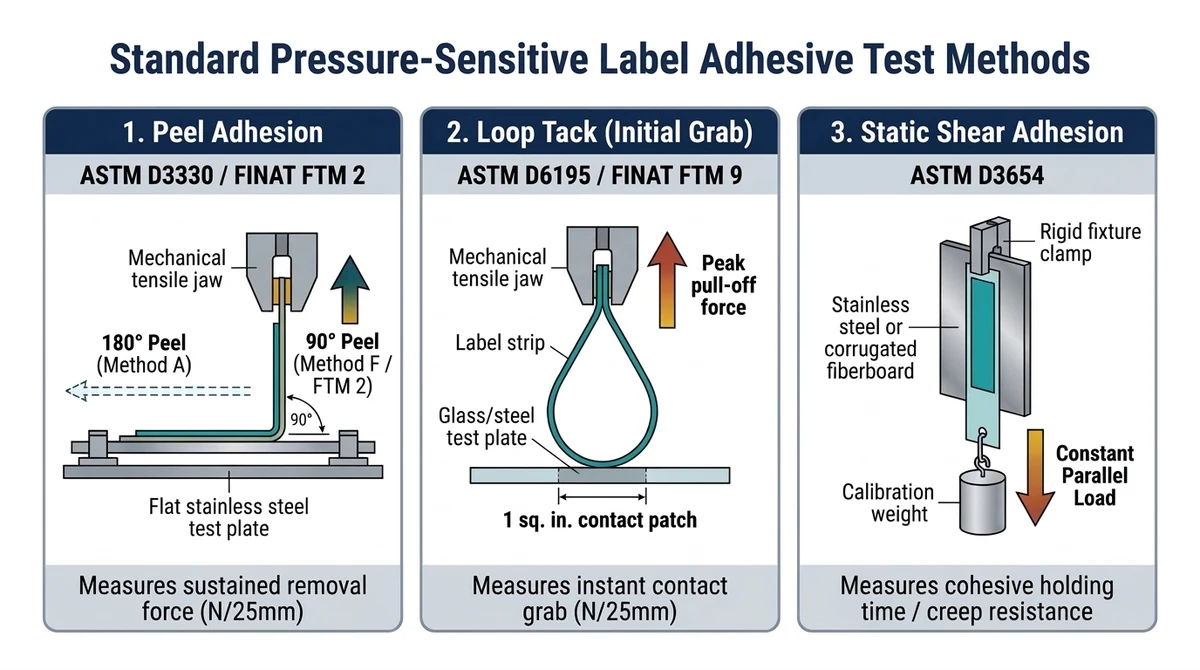
Industrial buyers qualify label adhesives using three core ASTM mechanical test standards—ASTM D3330/D3330M for peel adhesion, ASTM D6195-22 (aligned with FINAT FTM 9 and TLMI L-IB2) for loop tack, and ASTM D3654/D3654M for static shear—alongside U.S. FDA Section 175.105 for indirect food-contact packaging.
| Standard / Regulation | Property Measured or Governed | Key Test Geometry & Conditions | Engineering Interpretation & Boundary |
|---|---|---|---|
| ASTM D3330/D3330M | Peel adhesion and release liner peel | Method A (180-degree peel), Method F (90-degree peel), Method D (liner release peel) on standard stainless steel or target substrate | Tracks lot uniformity and relative substrate adhesion; cannot directly compare two different manufacturers’ products because backing stiffness and rheology alter the stressed area |
| ASTM D6195-22 (matches FINAT FTM 9 & TLMI L-IB2) | Loop tack (instant quick-stick grab) | Method A uses a 7 in. (175 mm) strip on a tensile tester; Method B uses a 5 in. (125 mm) strip; 1 in.2 contact under self-weight; 2 mil (0.05 mm) clear PET backing for uncoated adhesives | Quantifies immediate grab on high-speed applicators; stiffer facestocks generally raise reported loop tack values |
| ASTM D3654/D3654M (replaces AFERA 4012, CEN 1943, PSTC) | Static shear adhesion (cohesive holding power) | Constant parallel load on vertical steel (Procedure A), NIST SRM 1810A or CEN or buyer-agreed fiberboard (Procedures B, C, D), or elevated temperature after 10-min dwell (Procedure H) | Measures resistance to edge creep, label slide, and adhesive ooze under load or warm storage; fiberboard surfaces vary across mills and batches |
| U.S. FDA Section 175.105 | Indirect food-contact packaging adhesives | Requires permitted formulation substances plus either a functional barrier, GMP limits for dry foods, or trace seam/edge contact only for fatty and aqueous foods with intact seams | Finished bulk adhesive containers must bear the statement “food-packaging adhesive”; request supplier food-contact statements for each specific laminate construction |
Why datasheet numbers cannot replace container sample trials
A critical warning written directly into ASTM D3330/D3330M Section 5.3 states that peel test methods cannot be used to compare two pressure-sensitive products from different manufacturers for real-world holding ability, because measured peel force is not normalized for a fixed stress zone—both facestock stiffness and adhesive firmness change the area under load. Likewise, ASTM D6195-22 notes that stiffer backings yield higher loop tack readings for the exact same adhesive mass.
For reliable qualification before scaling production, apply candidate label constructions onto your actual production containers (filled at true packaging temperature), allow full 24-hour to 72-hour dwell before freezing or transport stress, and log every substrate and environmental variable inside our labeling machine RFQ checklist.
Pre-use label roll storage conditions
Even a correctly matched adhesive degrades before reaching the applicator if rolls sit in hot, humid warehouses. Standard FINAT storage conditions specify 20 to 25 °C and 40 to 50% relative humidity, giving typical roll shelf life of one year for deepfreeze rubber (C2075N) and two years for removable acrylic (R5000N). Permanent S2045 laminates similarly specify a 1-year shelf life at 22 °C and 50% relative humidity, while cryogenic acrylic 8000T CryoCool rolls specify a 1-year pre-use storage window at 0 °C to 21 °C and 35% to 50% relative humidity.
How does pressure-sensitive label adhesive differ from wet glue?
Pressure-sensitive label adhesives arrive pre-coated on a siliconized release liner for dry, instant dispensing with zero glue-pot cleanup, whereas wet-glue labeling meters liquid aqueous starch, dextrin, casein, or synthetic PVA emulsion at 20 to 30 °C in a 15 to 35 µm wet film onto cut paper stacks right on the packaging line.
Choosing between pre-coated pressure-sensitive rolls and wet-glue systems hinges on changeover discipline versus extreme bottle condensation:
- Line stops and shift washdown: Exposed liquid wet-glue troughs skin over when a packaging line stops for more than 10 to 15 minutes and require a 30- to 45-minute warm-water washdown of glue rollers, doctor blades, pallets, and grippers at the end of every shift. Pressure-sensitive applicators eliminate liquid glue troughs and shift washdown completely.
- Cold sweating glass bottles: Hydrophilic casein wet glue absorbs 20 to 30% surface water on contact with cold, sweating glass bottles and cross-links into a bond that survives 24-hour ice-bucket immersion, whereas standard pressure-sensitive adhesives require effective air-knife drying or specialized wet-tack formulations to avoid hydroplaning.
For full equipment-level economics, speed bands, and five-year total cost of ownership across self-adhesive, roll-fed hot-melt, and cut-and-stack wet-glue labelers, see our hot-melt vs. wet-glue vs. pressure-sensitive labeling comparison.
Technical references
- U.S. FDA / eCFR — Section 175.105 Adhesives (Indirect Food Additives) — Federal safety conditions, functional barrier and GMP limits for dry versus fatty and aqueous foods, and finished container labeling rules for food-packaging adhesives.
- ASTM International — ASTM D3330/D3330M Standard Test Method for Peel Adhesion of Pressure-Sensitive Tape — Standardized 180-degree (Method A), 90-degree (Method F), and release liner (Method D) peel adhesion test procedures and cross-manufacturer comparison limits.
- ASTM International — ASTM D6195-22 Standard Test Methods for Loop Tack — Quantitative loop tack procedures (Method A 175 mm strip aligned with FINAT FTM 9 and TLMI L-IB2; Method B 125 mm strip) over a 1 in.2 contact area.
- ASTM International — ASTM D3654/D3654M Standard Test Methods for Shear Adhesion of Pressure-Sensitive Tapes — Constant parallel load shear procedures on stainless steel, NIST SRM 1810A and CEN fiberboard, and elevated temperature after 10-minute dwell.
- Rheological and Mechanical Properties of an Acrylic PSA (Polymers / PubMed Central NIH) — Peer-reviewed measurement of acrylic PSA viscoelasticity, Dahlquist criterion (3 × 10⁵ Pa at 1 Hz), glass-transition temperature (-40.23 °C), plasma surface-energy treatment, roughness load loss, and adhesive coat thickness effects.
- Soft Elasticity Enabled Adhesion Enhancement on Rough Surfaces (PNAS / PubMed Central NIH) — Peer-reviewed analysis of pressure-sensitive polymer networks, the 0.3 MPa Dahlquist modulus limit, surface asperity wetting paradox, 48- to 72-hour commercial dwell times, and additive migration risks.
Frequently asked questions
What is the difference between minimum application temperature and service temperature?
Minimum application temperature is the coldest container and ambient temperature at which the adhesive remains soft enough to wet out the surface when dispensed, such as +5 °C for standard permanent S2000 acrylic or -25 °C for deepfreeze C2075N rubber. Service temperature is the wider range the bonded label withstands after application and dwell time—such as -20 °C to +80 °C for S2000 or -196 °C to 121 °C after 24 hours of dwell for cryogenic 8000T CryoCool.
Why do standard permanent labels peel off HDPE and LDPE plastic bottles?
Untreated polyethylene (HDPE and LDPE) and polypropylene containers are low-surface-energy apolar plastics that resist wetting by unmodified acrylic adhesives, leading to weak initial contact and corner lifting. Switching to a rubber-based permanent adhesive (such as S2045) or a specially formulated high-tack adhesive designed for apolar plastics—or applying corona or plasma surface treatment—resolves wetting failures.
Can I apply a regular freezer label to a box or bottle that is already frozen?
Only if the adhesive datasheet explicitly specifies a sub-zero minimum application temperature. Most standard freezer labels should be applied above freezing before packages enter cold storage; labeling already-frozen or slightly frosted surfaces calls for a dedicated low-temperature adhesive rated down to -25 °C (such as C2075N) or -29 °C for cryogenic acrylic constructions.
Are freezer-grade and cryogenic label adhesives interchangeable?
No. Deepfreeze rubber adhesives such as C2075N are built for cold-chain food and logistics storage down to about -50 °C, whereas cryogenic laboratory environments expose vials to -80 °C dry ice and -196 °C liquid nitrogen. Ultra-low lab applications require dedicated cryogenic acrylic constructions engineered to remain bonded down to -196 °C after proper dwell time.
How long should labeled containers dwell before entering a freezer or distribution stress?
While pressure-sensitive labels establish immediate handling tack at the wipe roller, full ultimate bond strength develops gradually as the viscoelastic polymer flows into microscopic surface valleys. Cryogenic 8000T CryoCool specifies a typical 24-hour dwell before exposure to its -196 °C to 121 °C service range, and many commercial pressure-sensitive adhesives require 48 to 72 hours to reach complete bonding strength.
Related Guides & Specifications
Label Roll Unwind Direction Chart (#1 to #8) and Roll Length Calculator
Interactive #1 to #8 label winding direction chart (wound out vs wound in), eye-mark guide, and roll length, OD, core size, and shift roll calculator.
Learn moreLabeling Speed (BPM), OEE Surge Capacity, and Web Pitch Calculator
Calculate required labeling machine surge BPM, line OEE headroom, label web dispensing velocity in m/min, container pitch, and matched conveyor speed.
Learn moreIndustrial Labeling Machine FAT Checklist, Maintenance, and Troubleshooting Manual
Execute a 30-minute Factory Acceptance Test (FAT), follow a 6-tier preventive maintenance schedule, and resolve 12 common labeling machine defects.
Learn moreRound Bottle Labeling Machines: Continuous Wrap Belt vs. 3-Roller Indexing
Select a round bottle labeling machine by comparing continuous wrap belts vs 3-roller indexing, web speed equations, bottle pitch spacing, and machine parameters.
Learn moreFront and Back Labeling Machines: Dual-Head Sync & Top Hold-Down Mechanics
Engineering guide to front and back double-side labeling machines: centering chains, overhead top holding belts, dual servo heads, and flat or oval bottle specs.
Learn moreSquare and Flat Bottle Labeling Machine: 1-Panel, 2-Panel, and 3-Panel Wrap Selection
Specify square and flat bottle labeling machines by panel geometry, twin centering chains, overhead hold-down belts, corner wipe rollers, and recessed panel rules.
Learn moreRelated Equipment & Guides
Wrap-Around and Pressure-Sensitive Labeling Machines: Web Kinematics & Line Selection
Engineering guide to wrap-around and pressure-sensitive labeling machines: web tension, peel plate geometry, wrap belt vs 3-roller kinematics, and line selection.
Learn moreBottle Labeling Machines: How to Choose by Container Material, Shape, and Line Speed
Select a bottle labeling machine by container material (glass, PET, HDPE), shape (round, flat, oval, square, tapered), surface condensation, and line speed.
Learn moreRound Bottle Labeling Machines: Continuous Wrap Belt vs. 3-Roller Indexing
Select a round bottle labeling machine by comparing continuous wrap belts vs 3-roller indexing, web speed equations, bottle pitch spacing, and machine parameters.
Learn moreHot-Melt Glue vs Wet-Glue vs Pressure-Sensitive Labeling Machines
Compare roll-fed hot-melt glue, cut-and-stack wet/cold glue, and pressure-sensitive labeling machines across unit label cost, line speed, changeover, and TCO.
Learn moreHow to Fix Label Wrinkling, Bubbling, Flagging, and Axial Skew
Engineering troubleshooting guide to fix pressure-sensitive label wrinkling, air bubbling, edge flagging, and axial skew across bottle and carton labelers.
Learn moreLabeling Machine RFQ Checklist and User Requirement Specification (URS)
Engineering labeling machine RFQ checklist and User Requirement Specification (URS) template covering container drawings, roll unwind #1-#8, CPM, and FAT rules.
Learn more