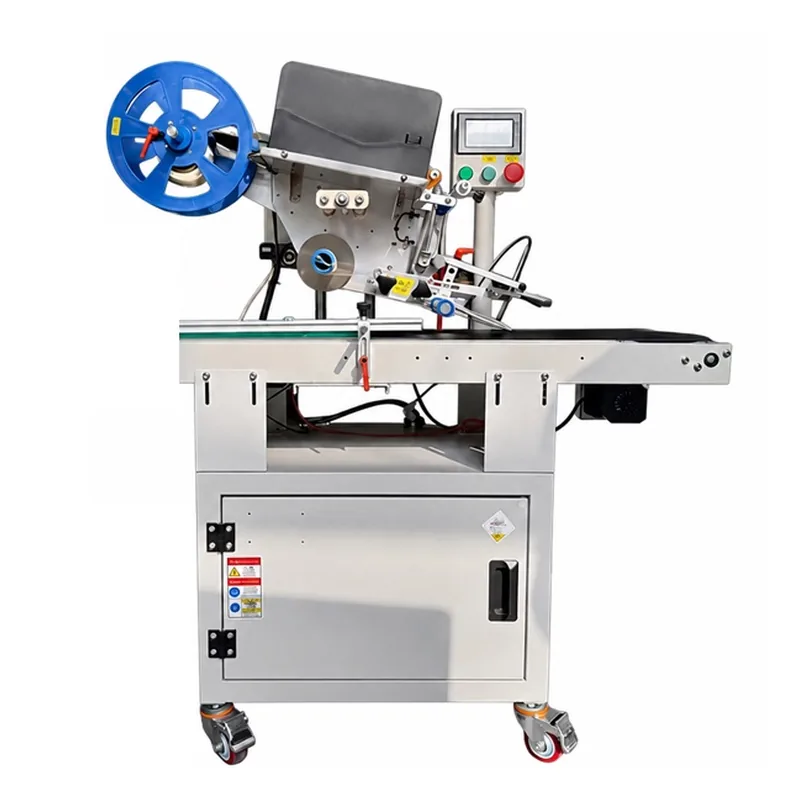
Packaging engineers specifying a label applicator or print-and-apply system face two sequential architecture decisions. First, they must decide whether each container receives a static pre-printed roll label or a variable thermal-printed barcode generated one cycle before application. Second, they must select the physical transfer mechanism that moves the peeled label from the backing liner onto the moving package: direct wipe-on (merge), linear tamp-blow, or non-contact air-blow.
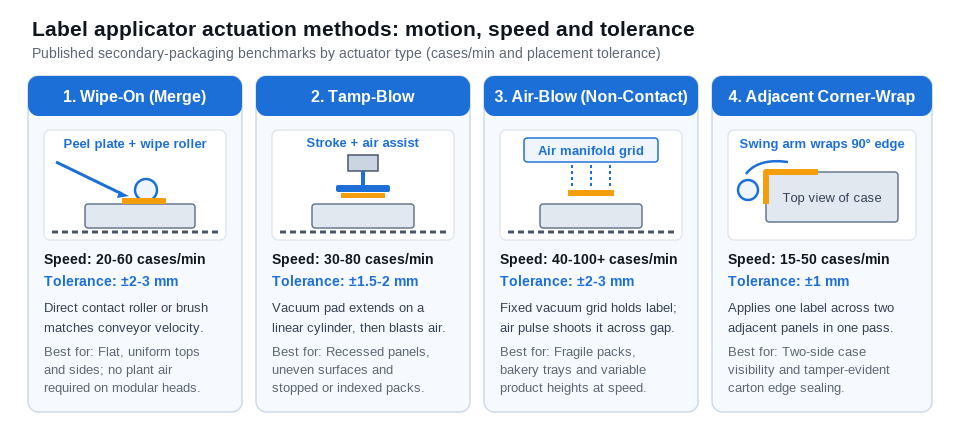
Those two choices govern line throughput, placement repeatability, plant compressed-air demand, and mechanical maintenance intervals. On secondary shipping cases, standard wipe-on heads run 20 to 60 cases per minute at ±2 to 3 mm placement accuracy without consuming plant compressed air, tamp-blow heads run 30 to 80 cases per minute at ±1.5 to 2 mm accuracy across variable standoff gaps, and non-contact air-blow heads reach 40 to 100+ cases per minute at ±2 to 3 mm accuracy on fragile or uneven trays. When an inline thermal print engine is added to create a print-and-apply labeling system, standard secondary case throughput shifts to 15 to 50 cases per minute at ±1 to 2 mm accuracy, while direct-apply servo print-and-apply architectures reach up to 150 packs per minute on 100 × 150 mm (4 × 6 in) GS1 labels.
Step 1: Pre-Printed Label Applicator vs Print-and-Apply System
Before comparing wipe, tamp, and blow actuators, clarify the print-and-apply vs label applicator boundary. Both machine classes share the same unwind reel, tension dancer arm, peel plate, liner rewind mandrel, and application head. The structural difference lies in whether the web passes through an inline thermal printhead immediately upstream of the peel edge.
A dedicated pre-printed label applicator dispenses pressure-sensitive labels that were flexographic- or digitally printed offline in bulk rolls. Because the machine never pauses or regulates web velocity for thermal dot-row heating, its speed ceiling is limited only by servo drive torque, liner tensile strength, and product handling stability. LINEVO pre-printed applicators (such as the LV-9310 series) use clutchless direct drives to dispense labels from 10 to 110 mm wide and 10 to 500 mm long in top, bottom, or side orientations, while high-speed primary product applicators run from 60 to 500 bottles per minute on inline conveyors.
A print-and-apply labeler (LPA) integrates an industrial OEM thermal transfer or direct thermal print engine (such as a Zebra, Sato, Datamax, or ALX924 module) or a direct-apply print chassis directly behind the peel bar. Every label is imaged on demand from PLC, WMS, or ERP data streams immediately prior to dispensing. That architecture eliminates pre-printed label inventory waste when running variable GS1-128 batch codes, serialized SSCC-18 pallet licenses, dynamic catch-weight pricing, or country-specific regulatory panels.
| Engineering Parameter | Pre-Printed Label Applicator | Print-and-Apply Labeling System (LPA) |
|---|---|---|
| Primary Function | Dispenses and applies pre-printed prime or promotional labels | Prints variable text, dates, and barcodes on demand, then applies |
| Secondary Case Throughput | 20 to 100+ cases/min depending on wipe, tamp, or blow head | 15 to 50 cases/min standard; up to 150 PPM on direct-apply servo LPAs |
| Primary Container Throughput | 60 to 500+ containers/min on inline servo dispensing heads | 40 to 175 PPM across format sizes; thermal print speed capped at 16 IPS |
| Typical Placement Tolerance | ±1.5 to 3 mm on cases; ±0.5 to 1 mm on encoder-synced prime products | ±1 to 2 mm on standard cases; ±0.25 mm (±0.01 in) on precision servo tamp |
| Media Width & Length Range | 10 to 110 mm width × 10 to 500 mm length (up to 250 mm wide on wide-web heads) | 4-inch (104 mm) or 6-inch (168 mm) print engine width; 100 × 150 mm standard |
| Consumable Reloads | Self-adhesive label roll only | Label roll plus thermal transfer ribbon (wax, wax-resin, or resin) |
| Best-Fit Line Mission | High-speed prime branding, promotional stickers, static security seals | Serialized GS1-128 shipping cases, lot/expiry traceability, pallet SSCC |
In thermal print-and-apply systems, physical throughput is bounded by the thermal printhead speed limit of 16 inches per second (406 mm/s) for clean barcode edge definition and by the label feed distance per cycle. On a 150 mm (6 in) shipping label printed at 12 to 16 IPS, print-and-dispense time alone consumes 375 to 500 milliseconds before actuator stroke and return time are added. When a line exceeds 50 to 60 cases per minute with long labels, engineers either specify a direct-apply LPA that removes the reciprocating tamp stroke or split the task between a pre-printed prime applicator and a compact inline thermal transfer overprinter (TTO).
Step 2: How the Three Core Transfer Mechanisms Work
Once the dispensing chassis is chosen, the transfer mechanism determines how the peeled label crosses the air gap between the sharp peel-plate tip and the target container wall.
1. Wipe-On (Direct-Merge) Application
In a wipe-on applicator, the peel plate is positioned 3 to 5 mm from the passing product surface. As a photoelectric or ultrasonic product sensor detects the leading edge of the carton or bottle, the servo or stepper drive accelerates the label web so that dispense velocity matches conveyor belt speed within ±2%. The label peels off the siliconized backing liner over a sharp radius and contacts the moving package directly, where a conformable wipe roller, sponge roller, or tamp brush presses the adhesive down from leading edge to trailing edge.
Modular wipe-on heads (such as the LINEVO LV-250 and LV-252 wipe-on modules) eliminate pneumatic cylinders and vacuum manifolds entirely. Because the label transfers directly from the peel edge onto the package without a vacuum pad hold cycle, wipe-on heads decouple print engine speed from intermittent cylinder strokes and require zero plant compressed air. In direct-apply servo print-and-apply designs such as the LINEVO LV-9560, direct on-pack wipe application reaches up to 150 packs per minute on 4 × 6 in GS1 labels while removing more than 80 wear parts associated with external pneumatic tamping arms.
2. Tamp-Blow and Linear Tamp Application
In a linear tamp or tamp-blow applicator, the label is peeled from the liner onto a perforated aluminum or silicone vacuum pad while the actuator rod is retracted. A vacuum venturi or blower holds the non-adhesive face of the label flat against the pad. When the target package reaches the registration point, a pneumatic cylinder or linear servo actuator extends the pad toward the container.
Pure contact tamp heads press the label directly onto the surface with a foam or compliant rubber pad. Tamp-blow heads combine linear stroke extension with a timed compressed-air pulse: the pad stops a few millimeters short of the package surface (or touches lightly), vacuum shuts off, and a positive air blast through the pad perforations projects the label onto the recessed or uneven panel. Combining linear reach with non-contact air transfer prevents pad impact damage on thin-walled cartons and reaches into recessed tray lips, clam-shell cavities, or variable-depth cases where a fixed peel plate cannot fit.
3. Air-Blow (Non-Contact) Application
An air-blow applicator eliminates the moving linear stroke altogether. The peeled label feeds onto a stationary vacuum grid mounted a fixed distance (typically 10 to 50 mm) above or beside the conveyor path. When the product sensor triggers, a high-velocity solenoid valve fires a short pulse of compressed air through the manifold grid, shooting the label across the air gap onto the passing product without any mechanical part entering the conveyor envelope.
Because there is zero reciprocating mass, air-blow heads cycle faster than long-stroke pneumatic tamp cylinders, reaching 40 to 100+ cases per minute in secondary packaging and higher rates on small primary coupons or produce labels. Non-contact transfer also protects delicate bakery goods, thermoformed blister packs, and fresh produce from crushing forces.
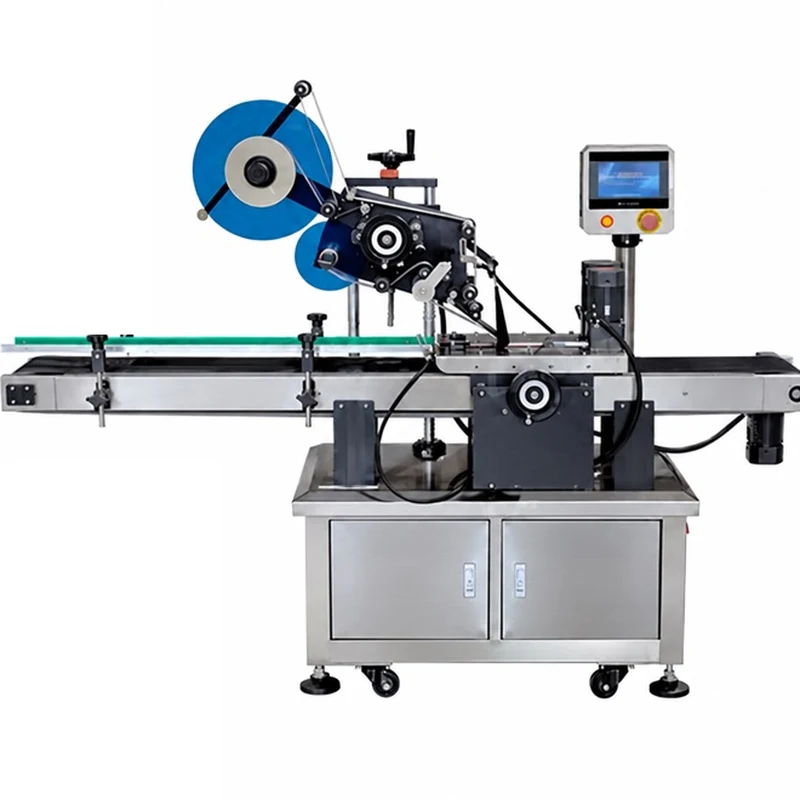
Head-to-Head Engineering Comparison: Wipe-On vs Tamp-Blow vs Air-Blow
Selecting the wrong actuator mode creates immediate commissioning failures. If a wipe-on head is specified for a carton stream whose width or height varies by ±25 mm from case to case without automatic stand adjustment, the peel plate will either crash into oversized boxes or miss undersized boxes completely. Conversely, if a long-stroke pneumatic tamp head is specified on a 90-pack-per-minute continuous conveyor without product stopping or servo speed following, the extended tamp pad will shear across the moving box face and tear the label web.
| Criterion | Wipe-On (Direct Merge) | Linear Tamp / Tamp-Blow | Air-Blow (Non-Contact) | | :— | :— | :— | | Secondary Case Speed | 20 to 60 cases/min (up to 150 PPM on direct-apply servo LPA) | 30 to 80 cases/min | 40 to 100+ cases/min | | High-Precision Servo Speed | Up to 400 products/min on continuous primary webs | Up to 250 parts/min on high-speed servo tamp | Up to 200 to 300+ small labels/min | | Secondary Placement Accuracy | ±2 to 3 mm (±1 to 2 mm on servo direct-apply) | ±1.5 to 2 mm (±1 mm on corner-wrap swing arm) | ±2 to 3 mm | | Precision Primary Accuracy | Down to ±0.05 mm to ±0.5 mm with encoder sync | Down to ±0.01 in (±0.25 mm) on servo tamp | ±1.0 to 2.0 mm within close standoff | | Peel-to-Product Standoff | 3 to 5 mm fixed peel-tip distance | Variable stroke reach into recesses and across gaps | Fixed 10 to 50 mm non-contact air jump | | Compressed Air Consumption | Zero air required on all-electric wipe modules | 0.4 to 0.6 MPa (4 to 6 kg/cm²) at 30 L/min up to 5 CFM at 80 PSI | High instantaneous air pulse; requires regulated accumulator volume | | Container Motion During Apply | Continuous motion required; web speed matched within ±2% | Indexed/stopped or continuous motion with short tamp dwell | Continuous motion or indexed; zero physical contact dwell | | Recessed Panel Capability | Cannot reach inside recessed lips or deep tray cavities | Excellent; linear cylinder extends pad directly into cavity | Limited; air turbulence over deep cavity rims degrades accuracy | | Fragile Product Safety | Moderate; requires spring-loaded wipe roller pressure | High in tamp-blow mode (pad stops short of product wall) | Maximum; zero mechanical contact with package |
Mechanical Physics: Stroke Time, Web Synchronization, and Compressed Air Utilities
Three quantitative engineering constraints separate successful factory acceptance tests from chronic line bottlenecks: web-to-conveyor velocity synchronization on wipe-on heads, reciprocating stroke time budgets on tamp heads, and compressed-air supply sizing on pneumatic and blow-on heads.
1. Velocity Synchronization and Peel Geometry on Wipe-On Heads
A wipe-on applicator relies on the moving package to pull and lay down the label as it exits the peel bar. According to published line-integration benchmarks, the peel plate tip must sit 3 to 5 mm from the container surface, application roller runout must remain below 0.005 in (0.127 mm) total indicator reading (TIR), and label web velocity must match conveyor belt speed within ±2%.
When conveyor speed fluctuates during upstream accumulation recovery without closed-loop encoder feedback, a web moving more than 2% slower than the carton stretches the label or pulls it prematurely off the liner, while a web moving more than 2% faster creates a slack loop that buckles under the wipe roller and causes axial skew exceeding the 2° industrial quality threshold. Adding a quadrature shaft encoder to track belt speed in real time tightens placement repeatability from ±1.0 mm down to ±0.5 mm and increases usable line throughput by more than 25%.
2. Stroke Distance vs Cycle Time on Linear Tamp Heads
Unlike wipe-on heads that dispense continuously while the label attaches, a tamp-blow cycle is sequential:
- The print engine or dispenser feeds the label onto the vacuum pad (for example, 300 to 500 ms for a 150 mm label).
- The linear cylinder extends across the standoff distance (typically 80 to 250 ms depending on stroke length and air pressure).
- The blow solenoid fires for 30 to 60 ms to transfer the label.
- The cylinder retracts to home position (80 to 200 ms) before the next label can feed onto the pad.
Because feed and stroke cannot overlap on a standard single-pad tamp head, long cylinder strokes directly reduce maximum cases per minute. When mixed-size cartons travel down the same conveyor, guiding all cases against a common reference rail on the applicator side minimizes required tamp stroke length and preserves the 30 to 80 cases-per-minute operating window. For two-panel compliance labeling (front and side or side and back), replacing a single linear tamp with an adjacent-panel swing-arm tamp or dual-tamp module applies labels at 15 to 50 cases per minute with ±1 mm accuracy in a single pass.
3. Compressed Air Consumption and Utility Sizing
Plant utility engineers frequently underestimate the pneumatic demand of tamp-blow and air-blow applicators. Pneumatic consumption specifications show that a compact flat/tamping applicator such as the LINEVO LV-DGT220 requires a 4 to 6 kg/cm² (0.4 to 0.6 MPa / 58 to 87 PSI) clean, dry compressed-air supply consuming 30 L/min, while heavy-duty inline thermal transfer printer-applicators such as the LV-AL600 specify 5 CFM (approximately 141 L/min) at 80 PSI (0.55 MPa).
Air-blow and tamp-blow manifold valves draw high instantaneous flow rates during the 30 to 60 ms blow pulse. If multiple applicators share an undersized branch drop or share supply lines with case erectors and pneumatic reject diverters, line pressure drops during simultaneous firing. A pressure drop of 15 PSI mid-pulse causes incomplete label release from the vacuum grid or skewed flight across the air gap. Where plant compressed air is expensive, wet, or unavailable at the end of the line, specifying an all-electric modular wipe-on head or servo-electric linear actuator eliminates pneumatic air consumption completely.
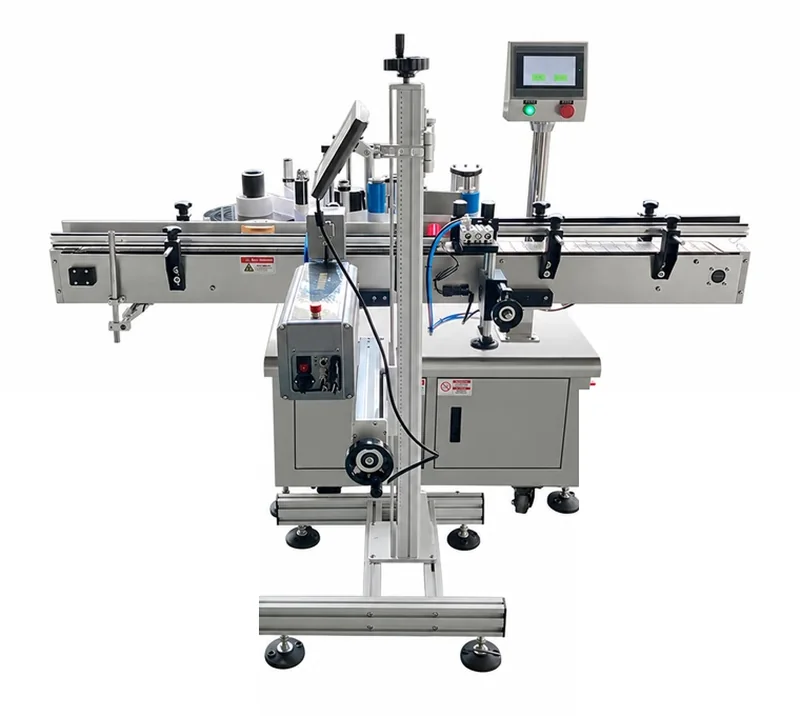
Application Selection Matrix by Container and Line Scenario
Use the following engineering rules to match your container geometry and line speed to the correct actuator architecture:
- Uniform corrugated shipping cases at 20 to 60 cases/min (single side or top): Specify a wipe-on (direct-merge) applicator or direct-apply LPA. Guide the cases against a fixed side rail so the target panel passes within 3 to 5 mm of the peel plate. You eliminate plant air cost and reciprocating cylinder wear.
- Mixed-width cartons, recessed plastic totes, or stopped indexing packs at 30 to 80 cases/min: Specify a tamp-blow applicator. The linear stroke bridges variable standoff distances and reaches inside recessed tote panels while the air-assist pulse seats the label without crushing thin corrugated walls.
- Fragile bakery trays, shrink-wrapped multipacks, thermoformed clamshells, or high-speed variable-height products at 40 to 100+ cases/min: Specify a non-contact air-blow applicator positioned within its calibrated standoff window so the air pulse transfers the label with zero mechanical impact.
- Two adjacent panels (front + side GS1-128 case compliance) at 15 to 50 cases/min: Specify an adjacent-panel corner-wrap wipe/tamp or pivoted swing-arm tamp applicator rather than turning the heavy carton 90° on the conveyor.
- High-speed primary containers or medical/automotive components requiring sub-millimeter registration: Specify a closed-loop servo wipe-on system (capable of ±0.05 to ±0.5 mm placement up to 400 products/min) or a precision servo tamp-blow head (capable of ±0.01 in / ±0.25 mm accuracy up to 250 parts/min).
How LINEVO Configures Applicator and Print-and-Apply Heads
LINEVO builds modular wipe-on, pneumatic and servo tamp-blow, air-blow, and adjacent corner-wrap applicator heads across both pre-printed dispensing frames and OEM print-and-apply systems. Because centerline-modular actuator sub-assemblies bolt to a common mounting interface, plants can swap a wipe-on module for a tamp-blow or corner-wrap arm if packaging formats change in the future. Machine speed, stroke length, power, and physical dimensions are confirmed on buyer container and label samples and set out in the formal engineering quotation.
To evaluate adjacent secondary packaging equipment, compare our box and carton labeling machines, pallet labeling machines for GS1 SSCC compliance, Zebra and Sato OEM print engine integration, and master carton labeling after case sealing. When you are ready to size an actuator for your line, review the labeling machine RFQ checklist and message LINEVO engineers on WhatsApp with your container drawings and target cases per minute.
Related Guides & Specifications
Box and Carton Labeling Machines: Top-Surface, Side Wipe-On & Corner-Wrap Guide
Select box and carton labeling machines across split-belt top labelers, side wipe-on case applicators, corner-wrap systems, and GS1 barcode clearance rules.
Learn moreAutomatic Pallet Labelers: GS1 SSCC-18 Placement, Swing-Arm Reach & Throughput
Specify automatic pallet labelers for 1-side, 2-side, and 3-side GS1 SSCC-18 labeling, 400 to 800 mm placement zones, retailer mandates, and pallets/hour math.
Learn moreIndustrial Label Printer and OEM Print Engine Integration Guide
How industrial label printer OEM engines from Zebra, Sato, and Datamax integrate into print-and-apply systems across DPI, Left/Right web paths, and PLC I/O.
Learn moreMaster Carton Labeling After Case Sealing: Line Layout & GS1-128
Engineering guide to master carton labeling downstream of tape and hot-melt case sealers: pitch spacing, tape-tab avoidance, GS1-128 zones, and scan reject.
Learn moreDirect Thermal vs Thermal Transfer: Durability, Costs, and Line Fit
Direct thermal prints ribbonless on heat-sensitive paper for short-term shipping, while thermal transfer melts ribbon ink for durable industrial barcodes.
Learn moreWax vs Resin Ribbon: Durability, Melting Points, and Label Stock Match
Wax ribbons print fast on paper at low energy, wax-resin bridges coated stock and matte film, and full resin resists heat and solvents on synthetics.
Learn moreRelated Equipment & Guides
Label Applicators & Print-and-Apply Systems: Actuation, Speed & Retrofit Guide
Compare pre-printed label applicators and print-and-apply systems across wipe-on, tamp-blow, air-blow, and corner-wrap actuation, web speed, and retrofits.
Learn morePrint and Apply Labeling Systems: Thermal Engines, DPI, and PLC Integration
Select print and apply labeling machines across Zebra, Sato, and Datamax engines, 203 to 600 DPI printheads, EtherNet/IP handshakes, and ISO/IEC 15416 grading.
Learn moreBox and Carton Labeling Machines: Top-Surface, Side Wipe-On & Corner-Wrap Guide
Select box and carton labeling machines across split-belt top labelers, side wipe-on case applicators, corner-wrap systems, and GS1 barcode clearance rules.
Learn moreAutomatic Pallet Labelers: GS1 SSCC-18 Placement, Swing-Arm Reach & Throughput
Specify automatic pallet labelers for 1-side, 2-side, and 3-side GS1 SSCC-18 labeling, 400 to 800 mm placement zones, retailer mandates, and pallets/hour math.
Learn moreIndustrial Label Printer and OEM Print Engine Integration Guide
How industrial label printer OEM engines from Zebra, Sato, and Datamax integrate into print-and-apply systems across DPI, Left/Right web paths, and PLC I/O.
Learn moreAbout IndustrialLabelingMachine.com: LINEVO's Labeling Equipment Platform
How IndustrialLabelingMachine.com, a specialized LINEVO vertical platform, helps packaging engineers specify, test and quote automatic labeling systems.
Learn more