Standard wax ink melts at 65 °C (149 °F) for paper printing up to 16 ips (400 mm/s). Standard wax-resin melts at 75 °C (167 °F) with 100 °C (212 °F) heat resistance across paper and synthetics. Standard resin ink melts at 80 °C (176 °F) for 180 °C (356 °F) heat resistance on PE and PET labels.
Mismatched consumables are one of the fastest ways to trigger barcode scan failures on an automated print-and-apply labeling system. Running a wax ribbon on a smooth synthetic label or chemical drum leaves an unreadable barcode within days, while loading a full resin ribbon onto plain indoor shipping cartons slows print velocity and adds avoidable consumable expense.
What is the difference between wax and resin ribbons?
Wax ribbons transfer soft, low-melting wax ink into porous paper fibers at minimal printhead energy, whereas resin ribbons transfer hard, high-melting synthetic polymer ink that bonds onto smooth plastic films to resist heat, scraping, moisture, and chemicals. Choosing between them trades printhead heat and maximum line speed against environmental durability.
Across standard flathead thermal transfer constructions, all ribbon tiers share the same 4.5-micron polyethylene terephthalate (PET) carrier film and a low-friction protective backcoat with a friction coefficient below 0.2. What separates wax, wax-resin, and full resin is the ink formulation coated onto the image side, its total caliper, its melting threshold, and the resulting resistance of the finished barcode.
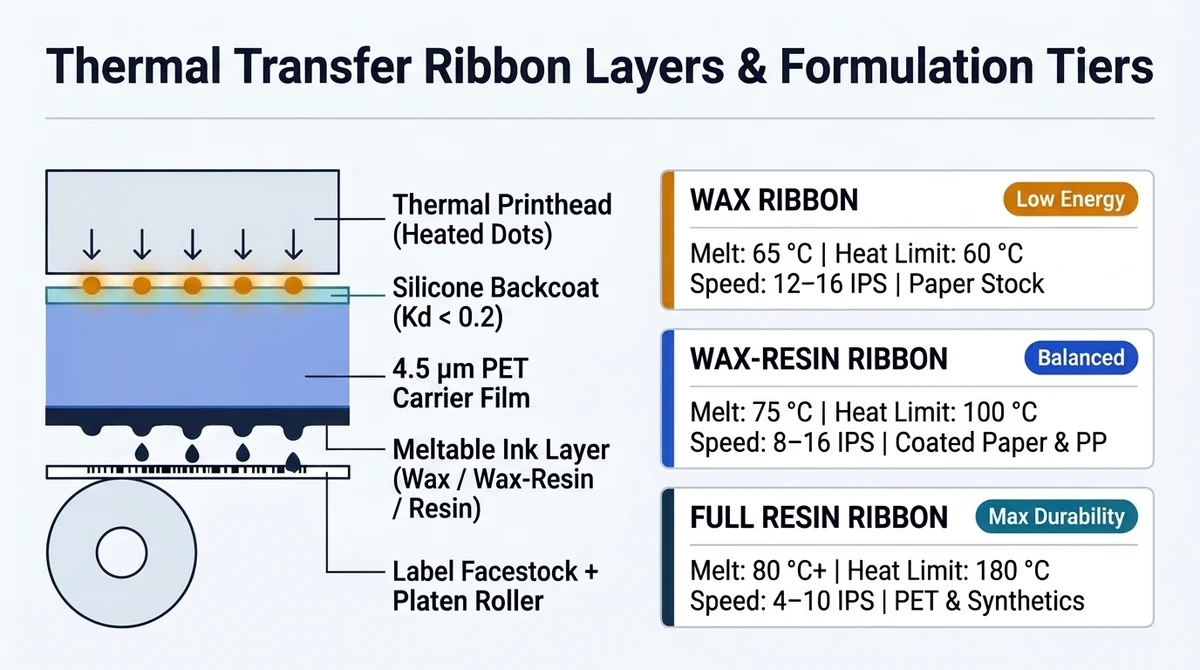
| Engineering Parameter | Wax Ribbon | Wax-Resin Ribbon | Full Resin Ribbon |
|---|---|---|---|
| Federal wax-content boundary | At least 20% total wax across image-side layers and at least 10% wax in colorant layer | Blended wax and resin within the same 20% total / 10% colorant wax scope | Pure resin polymer formulation outside the wax and wax-resin scope |
| Total caliper (on 4.5 µm PET film) | 8 microns (standard industrial 2300 wax) | 9 microns (premium 3200 wax-resin) | 6.5 microns +/- 10% (high-performance 5095 resin) |
| Ink melting or softening point | 65 °C (149 °F) standard flathead melt | 75 °C (167 °F) standard flathead melt | 80 °C (176 °F) standard flathead melt; styrene-acrylate resin softens at 100 to 150 °C |
| Printed heat resistance limit | Up to 60 °C (140 °F) | Up to 100 °C (212 °F) | Up to 180 °C (356 °F) |
| Maximum flathead print speed | Up to 12 to 16 ips (304 to 400 mm/s) | Up to 8 to 16 ips (203 to 400 mm/s); 254 mm/s (10 ips) on 3200 | Up to 6 to 10 ips (152 to 250 mm/s); 101 mm/s (4 ips) on specialist resin |
| Compatible label facestocks | Uncoated and coated paper labels | Uncoated paper, coated paper, and matte synthetic films | Matte and gloss synthetics (PE, PET, polyamide) and select coated papers |
| Key durability certifications | FDA 21 CFR Part 175.300, EU 1935/2004/EC, RoHS, REACH | Adds UL 969 recognition plus RoHS, REACH, and FDA/EU food contact | Adds GHS/BS 5609 marine drum durability alongside UL 969, RoHS, REACH, and FDA/EU food contact |
Chemical composition and federal classification boundary
Under the U.S. Department of Commerce thermal transfer ribbon trade scope determination, wax and wax-resin ribbons are quantitatively defined by having a total natural or synthetic wax content of equal to or greater than 20 percent by weight across all transferring image-side layers and equal to or greater than 10 percent by weight in the colorant layer. Full resin ribbons sit outside that wax-content class because their binder matrix consists predominantly of synthetic polymers rather than waxes.
For barcode readability across optical and infrared verifiers, the same federal determination records the industry CIELAB black color boundary for black and near-black barcode ribbons: lightness L* below 35, red-green coordinate a* between -20 and 35, and yellow-blue coordinate b* between -40 and 31. Industrial wax, wax-resin, and resin ribbons are formulated to scan cleanly under both infrared (IR) and visible-light barcode readers.
Ribbon layer anatomy and printhead energy balance
The essential structure of both an unslit jumbo roll and a printer-ready slit thermal transfer ribbon is a strip of PET film coated with meltable ink on the print side and a smooth backcoat on the printhead side. Keeping the backcoating friction coefficient below 0.2 lets the ribbon glide beneath stationary ceramic heating elements without snagging or accelerating glaze abrasion.
Because wax ink melts at 65 °C (149 °F), it transfers cleanly at low printhead energy settings, which directly helps protect thermal printheads over long production shifts. Stepping up to wax-resin (75 °C / 167 °F melt) and full resin (80 °C / 176 °F standard melt, with higher-heat styrene-acrylate resins softening between 100 and 150 °C) raises the melting threshold and pairs with lower rated print speeds—from 16 ips (400 mm/s) on standard wax down to 10 ips (250 mm/s) on standard resin and 4 ips (101 mm/s) on specialist solvent resin.
What are the three types of thermal transfer ribbons?
The three main thermal transfer ribbon types are wax, wax-resin, and full resin, each balancing transfer temperature, substrate bonding, durability, and cost. Under the U.S. EPA ENERGY STAR Imaging Equipment specification, thermal transfer (TT) deposits small drops of solid colorant in a melted state onto print media in a matrix pattern.
Before choosing among the three ribbon chemistries, confirm that your line actually requires ribbon-based imaging rather than ribbonless heat-sensitive paper by reviewing our direct thermal vs thermal transfer comparison. Once thermal transfer is selected, converters slit coated jumbo rolls into finished end-use dimensions, insert one or two winding cores to match the printer chassis, and attach leaders, bridges, and trailers—converting steps that U.S. producers reported account for an average of 34 percent of finished barcode ribbon cost.
- Wax ribbons: Formulated with a high share of low-melting wax for economical, high-speed printing on porous paper shipping labels, retail tags, and indoor warehouse inventory tracking.
- Wax-resin ribbons: A hybrid blend combining much of the print speed and economy of wax with substantially better resistance to smudging, scratching, moisture, and light handling across coated paper and matte synthetic labels.
- Full resin ribbons: Pure synthetic polymer formulations designed for non-paper synthetic films such as polyester (PET), polyethylene (PE), and polyamide exposed to abrasion, high or ultra-low temperatures, outdoor weathering, and industrial chemicals.
Flathead vs. near-edge ribbons and colored variants
Printhead geometry adds an important hardware check alongside ink chemistry. Standard industrial label engines use flathead printheads positioned horizontally against the label web, whereas near-edge printheads meet the label at an angle and require dedicated near-edge ribbons engineered to release ink almost immediately after transfer.
Because of that instant ink release, general-purpose near-edge wax-resin ribbons run at recommended limits up to 10 inches per second (ips) in near-edge barcode printers and up to 20 ips in thermal transfer overprinting (TTO), while high-speed packaging TTO wax-resin formulations reach 70 m/min (46 inches/s) on biaxially oriented polypropylene (BOPP) and biaxially oriented polyethylene terephthalate (BOPET) films. Colored ribbons—used for color-coded inventory, branding, or hazard accents—do not form a separate durability class because they are produced in wax or wax-resin formulations whose smudge and chemical limits follow the underlying binder chemistry.
Wax vs. wax-resin ribbon: when should you step up?
Step up from wax to wax-resin whenever labels move from controlled indoor uncoated paper onto coated paper or matte synthetic films, face heat above 60 °C, endure conveyor friction or moisture, or encounter wipe-downs with alcohol or household cleaners. Standard wax-resin raises printed heat resistance from 60 °C (140 °F) to 100 °C (212 °F) while maintaining high production speeds.
Standard wax ribbons remain the right engineering choice for dry, short-life shipping cartons and indoor warehouse barcodes where porous paper absorbs low-melting wax cleanly at speeds up to 304 mm/sec (12 ips) for normal codes and 152 mm/sec (6 ips) for rotated codes—or up to 16 ips (400 mm/s) on high-speed flathead grades. However, wax images smudge, scratch, and degrade quickly when exposed to damp loading docks, abrasive chute rails, oils, or warm storage above 60 °C.
Stepping up to a wax-resin blend delivers four measurable operational gains without forcing a full-resin speed penalty:
- Higher speed on rotated barcodes and coated stock: Laboratory verification on premium 3200 wax-resin achieves Typical ANSI Grade A for 10 or 12 mil normal barcodes up to 254 mm/sec (10 ips) on coated paper and up to 203.3 mm/sec on synthetics, alongside Typical ANSI Grade B on uncoated paper up to 152.4 mm/sec. For 15 mil rotated barcodes, 3200 wax-resin sustains Typical ANSI Grade B up to 254 mm/sec on coated paper and 203.2 mm/sec on synthetic labels, while general flathead wax-resin grades reach up to 16 ips (400 mm/s).
- Verified cleaner and alcohol resistance: In 10-cycle (20-rub) Crockmeter tests on Z-Xtreme 4000T White synthetic labels, 3200 wax-resin retained ANSI Grade B or above against 90% isopropyl alcohol, ammonia glass cleaner, and Formula 409.
- Component marking certification: Moving from standard wax to standard wax-resin adds UL 969 recognition alongside RoHS (2011/65/EU), REACH/SVHC (1907/2006/EC), halogen-free (IEC 61249-2-21:2003), and FDA food-contact compliance.
- Ribbon SKU consolidation: Because versatile wax-resin bonds reliably to uncoated paper, coated paper, and matte synthetic films, packaging plants running mixed substrates can standardize on one hybrid ribbon instead of stocking separate rolls across adjacent box and carton labeling machines.
Wax-resin vs. full resin ribbon: when is full resin required?
Full resin ribbon is required whenever polyester, polyethylene, or polyamide labels face heat above 100 °C up to 180 °C, contact with motor oil, Gunk degreaser, WD-40, or hexane, liquid nitrogen storage, BS 5609 marine weathering, or regulated chemical and medical traceability. Wax-resin breaks down under these stresses even on synthetic stock.
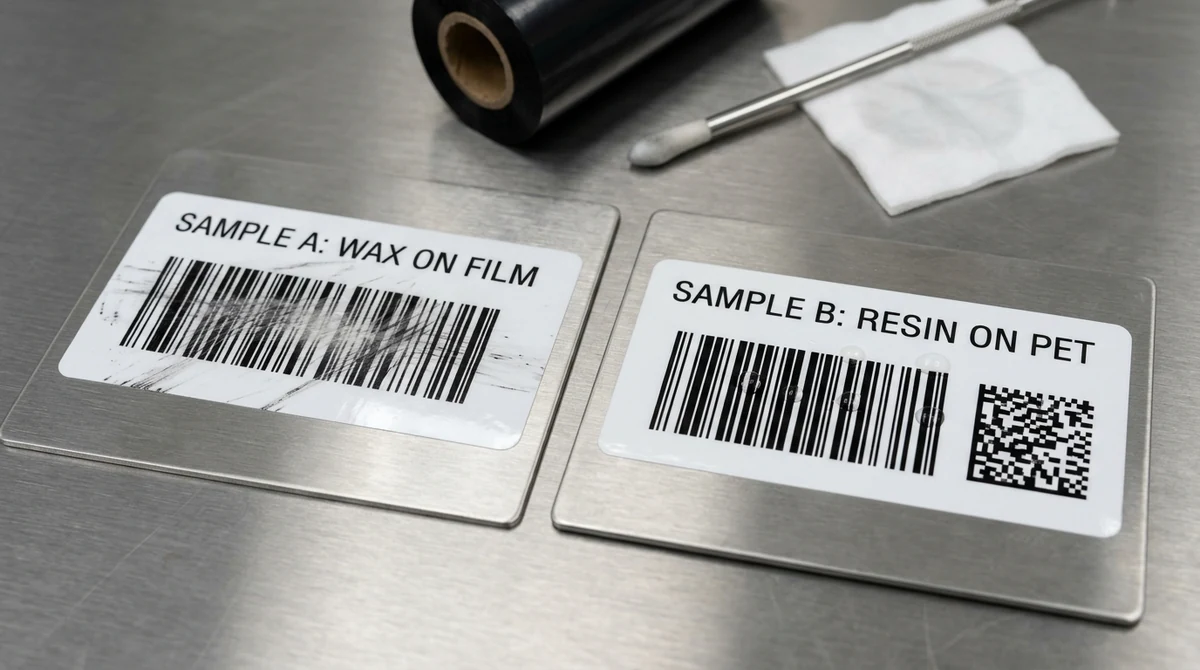
Measured laboratory solvent rubs illustrate exactly where wax-resin stops and full resin takes over—and where even general-purpose full resin hits its own chemical boundary. Both series below were tested on Z-Xtreme 4000T White synthetic facestock using 10 cycles (20 rubs) on a Crockmeter:
| Test Fluid (10 Cycles / 20 Crockmeter Rubs) | Premium Wax-Resin (3200 Series) | High-Performance Full Resin (5095 Series) | Engineering Takeaway |
|---|---|---|---|
| Glass cleaner with ammonia | Pass (ANSI Grade B or above) | Good | Both wax-resin and resin handle routine alkaline glass cleaners |
| Formula 409 cleaner | Pass (ANSI Grade B or above) | Good | Wax-resin suffices for mild industrial surface cleaners |
| 90% Isopropyl alcohol | Pass (ANSI Grade B or above) | Good | Both grades survive alcohol wipe-downs on synthetic stock |
| Motor oil | Fail (barcode does not scan) | Good | Step up to full resin for oily machinery, automotive, and lubricant lines |
| Gunk degreaser | Degraded (ANSI Grade C to F) | Good | Full resin prevents scan-grade collapse under industrial degreasers |
| WD-40 penetrating oil | Degraded (ANSI Grade C to F) | Good | Full resin required wherever lubricating sprays contact labels |
| Hexane | Degraded (ANSI Grade C to F) | Good | Full resin required for hydrocarbon solvent exposure |
| Brake fluid | Degraded (ANSI Grade C to F) | Test in your application | Qualify candidate resin and synthetic topcoat via sample rub trial |
| Gasoline | Degraded (ANSI Grade C to F) | Test in your application | Run live fuel-contact trials before locking ribbon specification |
| Xylene | Pass (ANSI Grade B or above) | Not Recommended | Solvent resistance is chemistry-specific; test each target fluid on sample stock before rollout |
| Acetone | Fail (barcode does not scan) | Not Recommended | Standard resin fails ketones; specify specialist solvent-resistant resin and sample-test |
| Skydrol or Genesolv | Fail on Genesolv (does not scan) | Not Recommended | Aerospace hydraulic fluids and fluorinated solvents demand dedicated specialist resin |
That solvent table underscores a critical engineering rule: specifying full resin is necessary for petroleum oils, degreasers, WD-40, and hexane, yet general-purpose 5095 resin is still rated Not Recommended against acetone, xylene, Skydrol, and Genesolv. Chemical plants handling aggressive ketones or aromatics must qualify specialist solvent-resistant resin grades (such as 4 ips / 101 mm/s Image Lock formulations matched to dedicated synthetic stock) through pre-production rub trials rather than relying on generic resin labels.
Thermal thresholds, cryogenic plastics, and regulatory mandates
Beyond hydrocarbon solvents, four thermal and regulatory triggers decisively require full resin over wax-resin:
- High-temperature stability above 100 °C: Standard flathead resin extends printed heat resistance from 100 °C (212 °F) on wax-resin up to 180 °C (356 °F). Peer-reviewed label-printer research published in PubMed Central (NIH) on microfluidic device patterning similarly confirms that styrene-acrylate resin ribbon toner softens at 100 to 150 °C—above 100 °C—delivering markedly higher thermal stability than wax-based transfer.
- Cryogenic storage and laboratory plastics: In a peer-reviewed PLOS Computational Biology guide to laboratory information management, researchers note that containers exposed to liquid nitrogen, harsh chemicals, or extreme high and low temperatures require specialized labels and conclude that thermal transfer prints the most durable labels on plastic items—especially when paired with resin ribbon instead of wax—using a 300 dpi or higher printhead for compact scannable barcodes.
- Hazardous chemical container and maritime drum mandates: Under the U.S. OSHA Hazard Communication Standard, hazardous chemical labels must display the required pictogram, hazard statement, signal word, and precautionary statement, and employers must ensure labels on incoming containers of hazardous chemicals are not removed or defaced. Full resin ribbons certified to GHS/BS 5609 and UL 969 on synthetic PE or PET film provide the immersion, outdoor weather, and abrasion permanence required for chemical drums.
- Medical device UDI and indirect food-contact rules: Under U.S. FDA Unique Device Identifier rules, every medical device UDI must meet section 830.20 technical standards and appear in both easily readable plain-text and machine-readable Automatic Identification and Data Capture (AIDC) format. For food packaging lines, industrial wax, wax-resin, and resin ribbons are available with FDA 21 CFR Part 175.300 indirect food-contact approval for resinous and polymeric coatings alongside European Food Directive 1935/2004/EC compliance.
What are the main applications for wax-resin ribbons?
Wax-resin ribbons are mainly used for box, pallet, and shipping labels facing handling friction, outdoor product tags on wire, cable, and fabricated parts, indoor and outdoor shelf-edge labels, moderate-abrasion distribution packs, and pharmacy or pharmaceutical cartons. Matching any ribbon starts with the label facestock’s surface porosity and topcoat chemistry before tuning printhead darkness.
Matching wax, wax-resin, and full resin ribbons to label stock
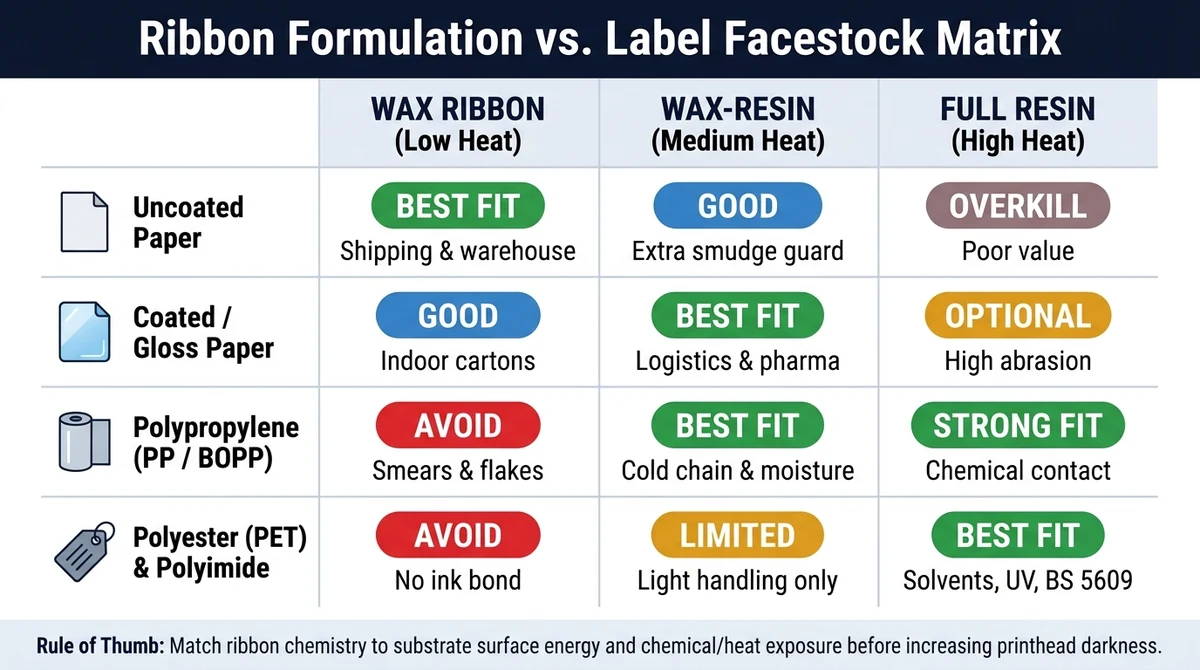
| Label Facestock | Best-Fit Ribbon | Rated Flathead Speed Window | Primary Industrial Applications | Key Mismatch Risk to Avoid |
|---|---|---|---|---|
| Uncoated paper | Wax (or wax-resin for extra smudge guard) | Up to 12 to 16 ips (304 to 400 mm/s) for wax; 152.4 mm/s Grade B for 3200 wax-resin | Indoor shipping cartons, warehouse rack and pallet labels, retail price tags | Overspecifying full resin adds unnecessary cost without making paper waterproof |
| Coated paper | Wax-resin (or wax for dry indoor cartons) | Up to 10 to 16 ips (254 to 400 mm/s); ANSI Grade A at 254 mm/s on 3200 | Logistics cases, pharmacy and pharmaceutical cartons, food information and retail labels | Standard wax scuffs during high-friction conveyor handling or damp staging |
| Matte synthetics (PP / BOPP / PE) | Wax-resin (or full resin for oil/solvent contact) | Up to 8 to 10 ips (203 to 254 mm/s); ANSI Grade A at 203.3 mm/s on 3200 | Cold-chain moisture labels, outdoor wire/cable/parts tags, moderate-abrasion bins | Pure wax smears and flakes off non-porous film surfaces |
| Gloss synthetics (PET, polyamide, polyimide, specialty films) | Full resin (or specialist resin for ketones/aromatics) | Up to 6 to 10 ips (152 to 250 mm/s) standard resin; 4 ips (101 mm/s) specialist resin | Chemical drums (GHS/BS 5609), medical UDI, cryogenic lab plastics, automotive plates | Wax fails within days; wax-resin fails motor oil, degreasers, and heat above 100 °C |
Throughput trade-offs and ribbon storage rules on print-and-apply lines
Ribbon formulation directly caps linear printhead velocity on automated pallet labelers and high-speed carton applicators. Across a single industrial ribbon portfolio, rated flathead speed steps down systematically as durability climbs:
- Standard wax (2300 series): Up to 304 mm/sec (12 ips) on uncoated and coated paper (152 mm/sec or 6 ips for rotated barcodes), reaching 400 mm/s (16 ips) on high-speed flathead wax formulations.
- Wax-resin (3400 and 3200 series): Up to 203 mm/sec (8 ips) on 3400 wax-resin and up to 254 mm/sec (10 ips) on 3200 wax-resin across paper and matte synthetics (up to 400 mm/s or 16 ips on high-speed flathead wax-resin).
- Standard and high-performance resin (4800, 5095, and 5100 series): Up to 152 mm/sec (6 ips) on 4800 and 5100 resin, up to 203 mm/sec (8 ips) on 5095 resin (with 10 or 12 mil normal codes achieving Typical ANSI Grade A up to 203.2 mm/sec and 15 mil rotated codes achieving Typical ANSI Grade B up to 152.4 mm/sec on synthetics), and up to 250 mm/s (10 ips) on general-purpose flathead resin.
- Specialist chemical-resistant resin (Image Lock on Z-Xtreme 5000T): Up to 101 mm/sec (4 ips) for extreme solvent permanence.
When switching an existing print engine from wax to full resin, verify that the lower print speed still meets your target cases or pallets per minute, confirm left- or right-hand web alignment and printhead energy settings via our Zebra and Sato print engine integration guide, and document your facestock and solvent list inside our labeling machine RFQ checklist prior to Factory Acceptance Testing.
Finally, protect unmounted ribbon inventory from premature ink blocking or backcoat degradation. Store standard wax and wax-resin ribbons away from direct light for use within 12 months of production at 5 to 35 °C (40 to 95 °F) and 20 to 80% relative humidity; high-performance resin ribbons such as the 5095 series carry a 1-year recommended pre-use storage window from -5 to 40 °C (23 to 104 °F) at 20 to 85% relative humidity.
Technical references
- U.S. Department of Commerce — Notice of Final Determination: Wax and Wax/Resin Thermal Transfer Ribbons (Federal Register) — Federal chemical weight thresholds separating wax and wax-resin ribbons from pure resin, CIELAB black barcode values, PET carrier structure, and slitting cost structure.
- U.S. EPA — ENERGY STAR Imaging Equipment Final Specification (PDF) — Federal technical definition of thermal transfer (TT) marking technology.
- U.S. OSHA — Hazard Communication Standard (eCFR) — Mandatory chemical container label elements and employer non-defacement duties.
- U.S. FDA — Form of a Unique Device Identifier (eCFR) — Mandatory plain-text and AIDC machine-readable labeling requirements for medical device UDI compliance.
- Ten simple rules for managing laboratory information (PLOS Computational Biology / PubMed Central NIH) — Peer-reviewed guidance recommending thermal transfer with resin ribbon over wax and 300 dpi or higher resolution for plastic labware under liquid nitrogen and chemical exposure.
- Paper-Based Microfluidic Analytical Device Patterned by Label Printer (PubMed Central NIH) — Peer-reviewed thermal analysis documenting styrene-acrylate resin ribbon softening at 100 to 150 °C and superior thermal stability compared to wax.
Frequently asked questions
What is the main difference between wax, wax-resin, and resin ribbons?
Wax ribbons melt at around 65 °C for economical, high-speed printing on paper stock in dry indoor environments, with printed heat resistance up to 60 °C. Wax-resin ribbons blend wax and polymer resins (75 °C melt, 100 °C heat resistance) for smudge and moisture resistance on coated paper and matte synthetics. Full resin ribbons melt at 80 °C and above (printed heat resistance up to 180 °C) to bond permanently onto polyester, polyethylene, and polyamide films exposed to abrasion, oils, chemicals, and outdoor weather.
Can I use a wax ribbon on polypropylene or polyester synthetic labels?
No. Pure wax ribbons are formulated for porous paper surfaces and do not anchor reliably onto smooth, non-porous synthetic films, causing barcodes to smear, scratch, or become unreadable within days. Use a wax-resin ribbon for moderate-duty matte polypropylene labels or step up to a full resin ribbon for gloss synthetics, polyester labels, and chemical contact.
Does switching from wax to full resin ribbon shorten thermal printhead life or slow the line?
Full resin ribbons carry higher melting points and lower rated linear speeds of 6 to 10 ips (152 to 250 mm/s), or 4 ips (101 mm/s) for specialist solvent resin, compared to 12 to 16 ips (304 to 400 mm/s) for standard wax. Although all three grades use a low-friction backcoat (Kd below 0.2) to protect the printhead, running only the lowest burn energy needed for a crisp ANSI Grade A or B scan maximizes printhead longevity.
Do all full resin ribbons resist acetone, xylene, and every industrial solvent?
No. In 10-cycle Crockmeter rub testing on synthetic polyester stock, high-performance 5095 resin rates Good against motor oil, Gunk degreaser, WD-40, hexane, and 90% isopropyl alcohol, yet is still rated Not Recommended for acetone, xylene, Skydrol, and Genesolv. Lines exposed to aggressive ketones, aromatics, or fuels should qualify a specialist solvent-resistant resin formulation through pre-production sample testing.
Can flathead thermal transfer ribbons run in a near-edge printer?
No. Flathead printheads press horizontally against the label web, whereas near-edge printheads contact the label at an angle and separate the ribbon almost immediately after ink transfer. Near-edge printers and TTO coders require dedicated near-edge ribbon formulations designed for rapid ink release.
Related Guides & Specifications
Box and Carton Labeling Machines: Top-Surface, Side Wipe-On & Corner-Wrap Guide
Select box and carton labeling machines across split-belt top labelers, side wipe-on case applicators, corner-wrap systems, and GS1 barcode clearance rules.
Learn moreAutomatic Pallet Labelers: GS1 SSCC-18 Placement, Swing-Arm Reach & Throughput
Specify automatic pallet labelers for 1-side, 2-side, and 3-side GS1 SSCC-18 labeling, 400 to 800 mm placement zones, retailer mandates, and pallets/hour math.
Learn moreTamp vs Wipe-On vs Blow-On Applicators and Print-and-Apply Systems
Engineering comparison of wipe-on, tamp-blow, and air-blow label applicators versus print-and-apply systems across speed, stroke distance, accuracy, and air use.
Learn moreIndustrial Label Printer and OEM Print Engine Integration Guide
How industrial label printer OEM engines from Zebra, Sato, and Datamax integrate into print-and-apply systems across DPI, Left/Right web paths, and PLC I/O.
Learn moreMaster Carton Labeling After Case Sealing: Line Layout & GS1-128
Engineering guide to master carton labeling downstream of tape and hot-melt case sealers: pitch spacing, tape-tab avoidance, GS1-128 zones, and scan reject.
Learn moreDirect Thermal vs Thermal Transfer: Durability, Costs, and Line Fit
Direct thermal prints ribbonless on heat-sensitive paper for short-term shipping, while thermal transfer melts ribbon ink for durable industrial barcodes.
Learn moreRelated Equipment & Guides
Print and Apply Labeling Systems: Thermal Engines, DPI, and PLC Integration
Select print and apply labeling machines across Zebra, Sato, and Datamax engines, 203 to 600 DPI printheads, EtherNet/IP handshakes, and ISO/IEC 15416 grading.
Learn moreBox and Carton Labeling Machines: Top-Surface, Side Wipe-On & Corner-Wrap Guide
Select box and carton labeling machines across split-belt top labelers, side wipe-on case applicators, corner-wrap systems, and GS1 barcode clearance rules.
Learn moreAutomatic Pallet Labelers: GS1 SSCC-18 Placement, Swing-Arm Reach & Throughput
Specify automatic pallet labelers for 1-side, 2-side, and 3-side GS1 SSCC-18 labeling, 400 to 800 mm placement zones, retailer mandates, and pallets/hour math.
Learn moreIndustrial Label Printer and OEM Print Engine Integration Guide
How industrial label printer OEM engines from Zebra, Sato, and Datamax integrate into print-and-apply systems across DPI, Left/Right web paths, and PLC I/O.
Learn moreLabeling Machine RFQ Checklist and User Requirement Specification (URS)
Engineering labeling machine RFQ checklist and User Requirement Specification (URS) template covering container drawings, roll unwind #1-#8, CPM, and FAT rules.
Learn moreDirect Thermal vs Thermal Transfer: Durability, Costs, and Line Fit
Direct thermal prints ribbonless on heat-sensitive paper for short-term shipping, while thermal transfer melts ribbon ink for durable industrial barcodes.
Learn more