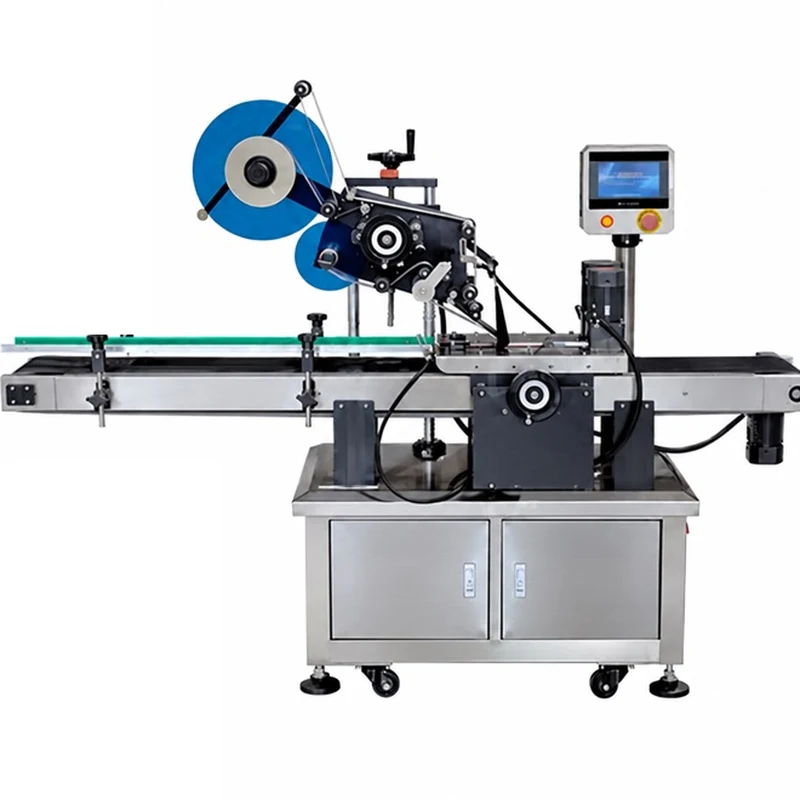
A box labeling machine (also called a carton labeler or case labeler) transports flat folding cartons, thermoformed food trays, flexible pouches, or erected corrugated shipping cases past a synchronized dispensing head to apply decorative, tamper-evident, or GS1 barcode labels, whereas selecting the wrong conveyor presentation or violating retail edge clearances causes bubbling over box flaps, skewed barcodes, scanner rejects, and costly warehouse rework. As a core secondary-packaging configuration within our label applicators and print-and-apply authority guide and our print and apply labeling systems hub, box and carton labelers bridge the gap between primary container filling and end-of-line palletizing.
While buyer inquiries often group folding cartons, ready-meal boxes, and heavy corrugated shipping cases under the single term “box labeler,” the underlying conveyor mechanics divide sharply by package rigidity and target panel orientation. Flat knocked-down cartons, snack boxes, lids, and stand-up pouches require a guided split-belt or flat-belt top-surface labeler with conformable sponge pressure rollers. Erected regular slotted containers (RSCs) and shrink-wrapped case trays require side-panel wipe-on, tamp-blow, or adjacent-panel corner-wrap systems engineered around fixed conveyor scanner heights. This guide compares all four box and carton labeling architectures, details split-belt and corner-wrap mechanics, provides conveyor pitch and speed-matching equations, and defines the exact GS1 barcode placement clearances required on retail shipping cases.
Comparing box, carton, and case labeling architectures
Choosing the right machine starts with three physical inputs: whether the package arrives flat or erected, which panel or edge must carry the label, and whether the label is pre-printed or imaged on demand by a thermal print engine.
| Machine Configuration | Target Package Formats | Application Orientation | Published Throughput Range | Typical Placement Accuracy | Primary Mechanical Elements |
|---|---|---|---|---|---|
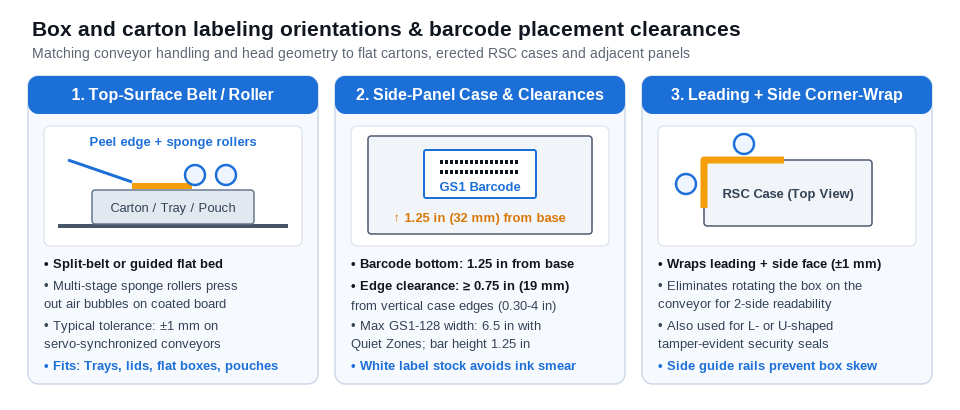
| Top-surface split-belt carton & pouch labeler | Flat folding cartons, snack boxes, ready-meal trays, plastic lids, flat pouches | Top panel (center or offset) | 20 to 60+ packs/min (up to 150 PPM on servo direct-apply heads) | ±1 mm on servo-synchronized belt frames | Stainless-steel frame, single-motor synchronized inlet/outlet belts, long peel plate, multi-stage sponge press rollers |
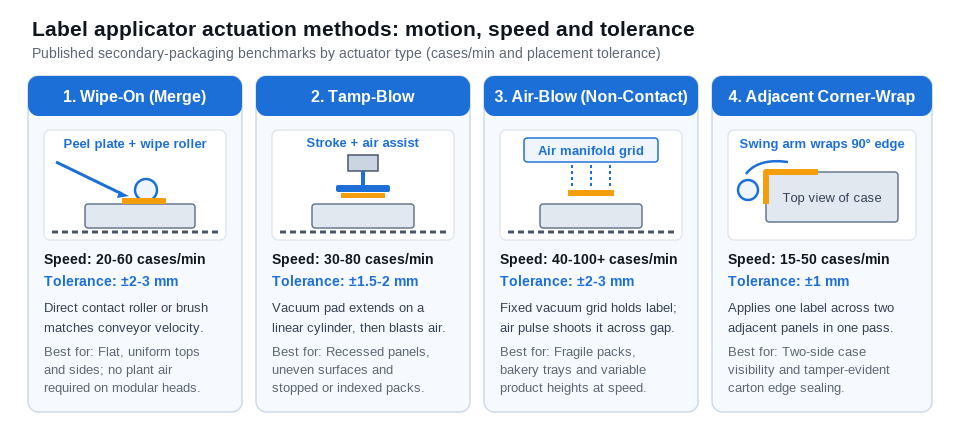
| Side-panel wipe-on or tamp-blow case labeler | Erected corrugated RSC boxes, taped shipping cases, shrink-wrapped trays | Single side panel or top-and-side dual panel | 20 to 60 cases/min (wipe-on); 30 to 80 cases/min (tamp-blow); 40 to 100+ cases/min (air-blow) | ±2 to 3 mm (wipe/blow); ±1.5 to 2 mm (tamp-blow) | Side guide rails, rotary shaft encoder, peel separating plate (3 to 5 mm gap) or linear vacuum tamp pad |
| Adjacent-panel corner-wrap case labeler | Erected shipping cases requiring 2-side warehouse scan visibility | Leading panel + adjacent side panel around 90° vertical edge | 15 to 50 cases/min | ±1 mm with corner guides and dual-panel wipe | Print-and-apply or pre-printed head, vacuum tamp/wipe pad, pivoting swing arm or dual-roller wrap assembly |
| L-clip or U-clip tamper-evident carton sealer | Retail electronics boxes, pharmaceutical cartons, hinged food clamshells | Top-to-side (L-shape) or top-side-bottom (U-shape) edge wrap | 20 to 60 cartons/min depending on fold length | ±1 mm across carton closure seam | Over-edge peel plate, timed wipe-down fingers or contoured sponge rollers that press label across 90° folds |
In LINEVO’s secondary-packaging catalog, automatic top-surface labeling machines are configured for food boxes, snack cartons, lunch containers, and ready-meal trays, while industrial box labeling conveyor lines handle erected cartons and shipping cases, with final machine specifications confirmed on buyer samples and set out in the project quotation.
Top-surface carton, tray, and pouch labeling mechanics
When labeling flat folding cartons, thermoformed food containers, lids, or flexible bags before or after filling, the package has a low vertical profile and can slide or twist easily if pushed against a side applicator. LINEVO’s top-surface carton labelers (such as the LV-LBLR flat-carton series) solve this by transporting the package flat beneath a synchronized overhead dispensing head. For sealed RSC master cartons leaving a case taper or hot-melt case gluer, see our master carton labeling after case sealing and tamp vs wipe-on vs blow-on applicators guides.
A heavy-duty stainless-steel frame supports a split-belt or flat-belt conveyor fitted with adjustable lateral product guides. Driving both the inlet and outlet conveyor sections from a single synchronized motor ensures that packages do not accelerate or decelerate as they cross beneath the peel plate. A photoelectric product sensor detects the leading edge of each carton or tray, triggering the overhead dispenser to feed the label web over a long separating peel plate positioned 3 to 5 mm above the top face.
Because folding cartons, corrugated mailer lids, and filled food trays often have slight surface crown, embossing, or board warpage, a rigid steel roller would bridge over low spots and leave air bubbles beneath the label. Top carton labelers instead use multi-stage conformable sponge pressure rollers (with roller runout held below 0.005 in TIR) that compress against the package face and wipe out trapped air from the center outward. Operators adjust head height and lateral offset across carton SKU changeovers using calibrated micro-regulation handwheels without tools, while a motorized backing-paper rewinder collects the spent silicone liner.
Coordinating top-surface labelers with flexible pouch lines
Top-surface carton labelers are frequently installed immediately downstream of horizontal form-fill-seal (HFFS) or premade pouch filling lines to apply promotional, nutrition, or batch-code labels onto flat or stand-up pouches. When integrating a top labeler with a pouch sealer, engineers must verify that the upstream pouch seal has cooled and stabilized before the sponge pressure roller compresses the pouch body. Published flexible food pouch quality benchmarks specify a seal peel strength of 3 to 8 lbs (13 to 36 N) with a 2 lbs (9 N) minimum threshold, internal burst pressure resistance of 5 to 20 PSI, and heat-seal bar temperature uniformity within ±5°F (±3°C) across a 0.3 to 2.0 second dwell window. Setting sponge roller down-force within the 5 to 20 PSI burst envelope prevents seal blowout while ensuring full wet-out of the pressure-sensitive adhesive.
Erected RSC case labeling: side wipe-on, tamp-blow, and corner-wrap
Once primary cartons or bottles are packed and sealed inside a corrugated regular slotted container (RSC), the labeling task shifts from retail aesthetics to automated warehouse sortation and GS1 supply-chain traceability.
Side-panel wipe-on vs. tamp-blow on corrugated cases
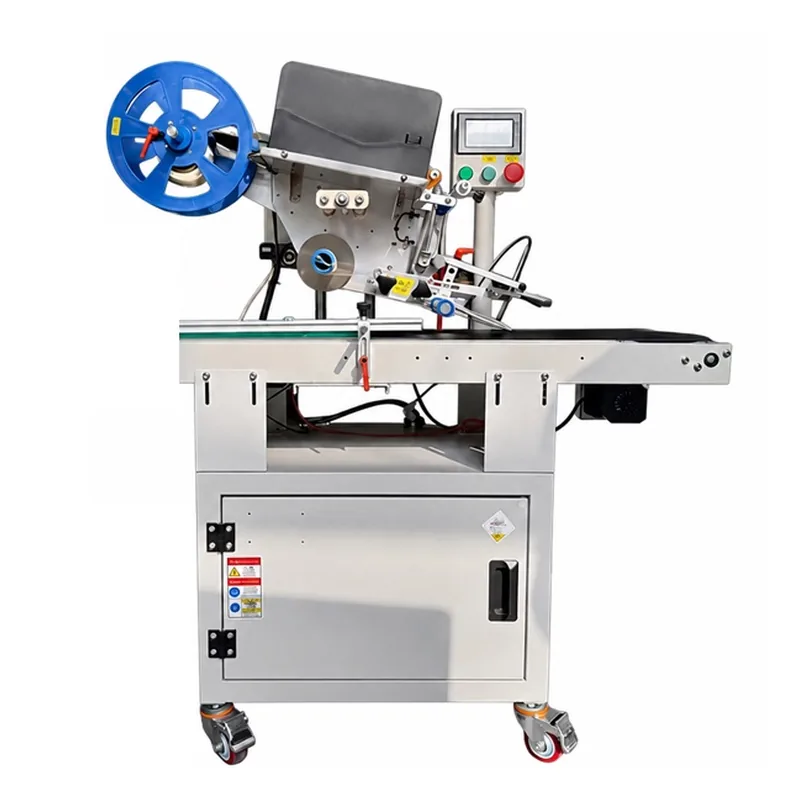
When an erected RSC case exits a case sealer, its side panels are vertical and accessible along the conveyor rails. If the cases are uniform in width and guided tightly against a reference rail so the side panel passes within 3 to 5 mm of the peel edge, a side-mounted wipe-on applicator or direct-apply print and apply labeling machine merges the label onto the box at 20 to 60 cases per minute (and up to 150 packs/min on high-speed servo direct-apply units) without using compressed plant air.
However, when a single packaging line runs mixed case footprints where box width varies from cycle to cycle, or when under-filled corrugated panels bow inward, a fixed wipe-on roller loses contact pressure. In those environments, engineers specify a linear tamp-blow applicator (30 to 80 cases/min at ±1.5 to 2 mm accuracy) or a non-contact air-blow head (40 to 100+ cases/min at ±2 to 3 mm accuracy). On a tamp-blow unit, the pneumatic or servo cylinder strokes outward until it reaches the recessed or offset box face, then fires an air pulse to seat the label firmly onto the corrugated flute tips.
Adjacent-panel corner-wrap mechanics
Distribution centers that scan cases from both the front conveyor axis and cross-belt sortation spurs require barcode visibility on two adjacent vertical panels (typically the leading panel and the right or left side panel). Rather than buying two separate print-and-apply machines or installing a mechanical bump-turn bar that twists boxes 90 degrees on the conveyor, plants deploy an adjacent-panel corner-wrap labeler.
In a corner-wrap cycle (rated at 15 to 50 cases/min), the print engine images a single elongated label containing duplicate GS1-128 barcodes on its left and right halves. As the case approaches, a pivoting swing arm or dual-pad tamp applies the first half of the label to the leading face of the moving box, and a follower wipe roller with rigid corner guides sweeps the trailing half tightly around the 90-degree vertical corner onto the adjacent side panel within ±1 mm placement accuracy.
Conveyor speed synchronization and case throughput math
On any box or carton labeler, matching web dispense velocity to conveyor speed within $\pm 2%$ is mandatory to prevent label wrinkling, flagging, or liner breakage. In addition, engineers must size the conveyor speed and minimum box gap so upstream case sealers and downstream pallet labelers never bottleneck.
$$\text{Case Pitch } P_{\text{case}} \text{ (mm)} = L_{\text{case}} + G_{\text{case}}$$
$$\text{Required Belt Velocity } V_{\text{belt}} \text{ (m/min)} = \frac{Q_{\text{case}} \times P_{\text{case}}}{1000 \times \eta_{\text{derate}}}$$
$$\text{Allowed Speed Window } V_{\text{web}} \text{ (m/min)} = V_{\text{belt}} \times (1 \pm 0.02)$$
$$\text{Corner-Wrap Contact Window } t_{\text{wrap}} \text{ (s)} = \frac{L_{\text{lead}} + L_{\text{side}}}{16.67 \times V_{\text{belt}}}$$
Where:
- $L_{\text{case}}$ is the box length along the conveyor axis (mm) and $G_{\text{case}}$ is the clear spacing between boxes (mm).
- $Q_{\text{case}}$ is the target net production rate (cases/min).
- $\eta_{\text{derate}}$ is the sustained operating factor ($0.85$, reflecting the 80% to 90% optimal operating window within the 70% to 90% real-world production range).
- $L_{\text{lead}}$ and $L_{\text{side}}$ are the wrapped label leg lengths on the leading and side panels (mm).
Worked example: An e-commerce and retail case line runs RSC boxes measuring $L_{\text{case}} = 450\text{ mm}$ long with a minimum photo-eye trigger gap of $G_{\text{case}} = 300\text{ mm}$ at a net target rate of $Q_{\text{case}} = 35\text{ cases/min}$. Each box receives an adjacent-panel corner-wrap label with $L_{\text{lead}} = 75\text{ mm}$ on the front face and $L_{\text{side}} = 100\text{ mm}$ on the side face ($175\text{ mm}$ total label length).
- Case pitch: $P_{\text{case}} = 450 + 300 = 750\text{ mm}$.
- At $\eta_{\text{derate}} = 0.85$, peak design capacity is $35 / 0.85 = 41.18\text{ cases/min}$.
- Required conveyor belt velocity: $V_{\text{belt}} = (41.18 \times 750) / 1000 = 30.88\text{ m/min}$ ($514.7\text{ mm/s}$).
- The servo web drive must track the conveyor encoder within $\pm 2%$, holding dispense velocity between $30.26\text{ m/min}$ and $31.50\text{ m/min}$.
- During the corner-wrap wipe phase, the roller assembly remains in contact with the moving box for $t_{\text{wrap}} = (75 + 100) / (16.67 \times 30.88) = 175 / 514.8 = 0.340\text{ s}$. Adding $0.43\text{ s}$ for 16 IPS thermal printing and $0.25\text{ s}$ for arm reset yields a total cycle of $1.02\text{ s/case}$, which fits cleanly inside the $60 / 41.18 = 1.457\text{ s}$ case pitch budget.
Retail and GS1 case barcode placement rules
Applying a crisp barcode in the wrong position on a corrugated box is just as damaging as a printhead failure: fixed-mount laser and image scanners along distribution center conveyors scan within a strict vertical height band and require unobstructed Quiet Zones around the bars.
Published GS1 and North American retail case labeling standards establish the following mandatory placement and dimensional thresholds for shipping cases and cartons:
| Case Barcode Parameter | Published Standard / Threshold | Operational Reason & Failure Consequence |
|---|---|---|
| Vertical barcode height from container base | Position bottom of barcode at 1.25 in (32 mm) above the bottom edge of the box | Aligns the symbol with fixed-mount conveyor scanner beams and keeps the barcode above bottom flap tape seams |
| Clearance from vertical box edges | At least 0.75 in (19 mm) from any vertical edge (placed within 0.30 to 4 in of the nearest edge) | Prevents corner crush, board creasing, and shadow distortion from clipping the left or right Quiet Zones |
| Maximum GS1-128 barcode width | 6.5 in (165 mm) maximum width including left and right Quiet Zones | Exceeding 6.5 in pushes the symbol beyond the field of view of standard fixed-mount sortation readers |
| Minimum barcode bar height | 1.25 in (32 mm) for automated fixed conveyor scanners; 0.500 in (12.7 mm) for handheld-only scanning | Tall bars allow omnidirectional laser and camera readers to capture a complete scan line even if the box skews slightly (up to 2 degrees) |
| Label substrate vs. direct ink printing | Apply white pressure-sensitive label stock rather than printing dark ink directly onto brown kraft corrugated board | Direct inkjet printing on brown kraft board suffers low optical contrast and ink wicking along paper fibers, dropping ISO/IEC 15416 grades below the 1.5 (ANSI C) minimum |
| First-read rate & print grade | Minimum ISO/IEC 15416 Grade 1.5 (C) and $\ge 99.5%$ first-read rate | Prevents manual rework recirculation loops and avoids $50 to $500 retailer non-compliance chargebacks |
Box and carton labeling failure modes and prevention
| Failure Mode | Root Cause | Preventive Engineering Action |
|---|---|---|
| Label bridges or bubbles over RSC flap seam | Label applied across an unsealed or stepped top/bottom flap joint, or single hard roller fails to conform to board flutes | Place side labels 1.25 in above the box base away from horizontal flap seams, and use multi-stage sponge pressure rollers |
| Skewed label (>2 degrees) on flat folding cartons | Cartons enter the peel zone twisted or slip across a split belt driven by separate unsynchronized motors | Specify a single-motor synchronized split-belt conveyor with full-length lateral guide rails and top hold-down rollers |
| Corner-wrap label tears or buckles at the 90° box edge | Box corner is crushed due to under-filled headspace, or swing-arm wipe speed does not match conveyor encoder velocity | Use internal case dividers/proper board burst strength, couple the applicator to a quadrature shaft encoder ($\pm 2%$ sync), and install rigid entry guide rails |
How to configure and quote your box or carton labeler
To move from architectural selection to a formal engineering layout, connect your secondary case parameters with the rest of the packaging line:
If your line needs variable GS1-128, lot, or weight printing on each box, review the print engine and PLC handshake specifications in the print and apply labeling systems hub. If your boxes are unitized onto stretch-wrapped loads downstream, pair your case labeler with an automated pallet labeler so case GTINs and pallet SSCC-18 license plates remain synchronized in your WMS. You can also compare actuator physics in our label applicators and print-and-apply authority guide and verify roll feed orientation on the label roll unwind direction chart.
When preparing a project specification, consult our custom labeling line integration page, review budget ranges in the industrial labeling machine cost guide, compile your carton dimensions and speeds using the labeling machine RFQ checklist, and send your drawings or sample details directly to LINEVO engineers on WhatsApp.
Common questions
What is the difference between a top carton labeler and a side case labeler?
A top carton labeler uses a synchronized flat-belt or split-belt conveyor and overhead sponge pressure rollers to apply labels to the top face of flat folding cartons, ready-meal trays, lids, and flexible pouches at ±1 mm accuracy. A side case labeler mounts a wipe-on, tamp-blow, or corner-wrap head beside a roller or belt conveyor to apply shipping and GS1 barcode labels onto the vertical side and leading panels of erected corrugated RSC boxes.
Where should a GS1 barcode label be placed on a corrugated shipping box?
Published GS1 and retail case standards specify placing the bottom of the barcode 1.25 inches (32 mm) above the base of the container and at least 0.75 inches (19 mm) inward from any vertical edge (within 0.30 to 4 inches of the nearest edge). The GS1-128 symbol must not exceed 6.5 inches in total width including Quiet Zones, and the bars should be at least 1.25 inches tall when cases are read by fixed-mount conveyor scanners.
When does a box labeling line need a corner-wrap applicator?
A line needs an adjacent-panel corner-wrap applicator when warehouse sortation tunnels or retail compliance rules require barcode visibility on both the leading panel and the adjacent side panel of a shipping case, or when applying an L-shaped tamper-evident security seal across a carton closure edge. Corner-wrap applicators apply one label across both faces in a single pass at 15 to 50 cases per minute with ±1 mm accuracy, eliminating the need to rotate the box on the conveyor.
Why are white pressure-sensitive labels preferred over direct inkjet printing on corrugated boxes?
Brown kraft corrugated board has low optical reflectance and porous paper fibers that absorb liquid ink, which reduces bar-to-space contrast and causes edge feathering that frequently fails the ISO/IEC 15416 Grade 1.5 (ANSI C) minimum threshold. Applying a white pressure-sensitive thermal transfer or direct thermal label provides high contrast and clean bar edges, supporting the 99.5% or higher first-read rate required by automated sortation systems.
Can one box labeling machine handle multiple carton and case sizes?
Yes, provided the conveyor width, guide rails, and applicator stand cover the full minimum-to-maximum dimensional envelope of your box SKUs. Operators adjust lateral guide rails and overhead or side dispenser positions in minutes using calibrated micro-regulation handwheels and digital position indicators, while servo-driven print-and-apply controllers store more than 100 label formats in memory for instant recipe recall.
Related Guides & Specifications
Automatic Pallet Labelers: GS1 SSCC-18 Placement, Swing-Arm Reach & Throughput
Specify automatic pallet labelers for 1-side, 2-side, and 3-side GS1 SSCC-18 labeling, 400 to 800 mm placement zones, retailer mandates, and pallets/hour math.
Learn moreTamp vs Wipe-On vs Blow-On Applicators and Print-and-Apply Systems
Engineering comparison of wipe-on, tamp-blow, and air-blow label applicators versus print-and-apply systems across speed, stroke distance, accuracy, and air use.
Learn moreIndustrial Label Printer and OEM Print Engine Integration Guide
How industrial label printer OEM engines from Zebra, Sato, and Datamax integrate into print-and-apply systems across DPI, Left/Right web paths, and PLC I/O.
Learn moreMaster Carton Labeling After Case Sealing: Line Layout & GS1-128
Engineering guide to master carton labeling downstream of tape and hot-melt case sealers: pitch spacing, tape-tab avoidance, GS1-128 zones, and scan reject.
Learn moreDirect Thermal vs Thermal Transfer: Durability, Costs, and Line Fit
Direct thermal prints ribbonless on heat-sensitive paper for short-term shipping, while thermal transfer melts ribbon ink for durable industrial barcodes.
Learn moreWax vs Resin Ribbon: Durability, Melting Points, and Label Stock Match
Wax ribbons print fast on paper at low energy, wax-resin bridges coated stock and matte film, and full resin resists heat and solvents on synthetics.
Learn moreRelated Equipment & Guides
Label Applicators & Print-and-Apply Systems: Actuation, Speed & Retrofit Guide
Compare pre-printed label applicators and print-and-apply systems across wipe-on, tamp-blow, air-blow, and corner-wrap actuation, web speed, and retrofits.
Learn morePrint and Apply Labeling Systems: Thermal Engines, DPI, and PLC Integration
Select print and apply labeling machines across Zebra, Sato, and Datamax engines, 203 to 600 DPI printheads, EtherNet/IP handshakes, and ISO/IEC 15416 grading.
Learn moreLabel Automation and Custom Packaging Line Labeling Integration
Engineering guide to label automation and inline labeling system integration across fillers, cappers, accumulation tables, PLC sync, and vision reject gates.
Learn moreLabel Roll Unwind Direction Chart (#1 to #8) and Roll Length Calculator
Interactive #1 to #8 label winding direction chart (wound out vs wound in), eye-mark guide, and roll length, OD, core size, and shift roll calculator.
Learn moreAutomatic Pallet Labelers: GS1 SSCC-18 Placement, Swing-Arm Reach & Throughput
Specify automatic pallet labelers for 1-side, 2-side, and 3-side GS1 SSCC-18 labeling, 400 to 800 mm placement zones, retailer mandates, and pallets/hour math.
Learn moreTamp vs Wipe-On vs Blow-On Applicators and Print-and-Apply Systems
Engineering comparison of wipe-on, tamp-blow, and air-blow label applicators versus print-and-apply systems across speed, stroke distance, accuracy, and air use.
Learn moreIndustrial Labeling Machine Price and Total Cost of Ownership Guide
Transparent industrial labeling machine price breakdown from $2,000 semi-automatics to $500,000+ high-speed lines, plus hidden TCO drivers and payback math.
Learn moreLabeling Machine RFQ Checklist and User Requirement Specification (URS)
Engineering labeling machine RFQ checklist and User Requirement Specification (URS) template covering container drawings, roll unwind #1-#8, CPM, and FAT rules.
Learn moreMaster Carton Labeling After Case Sealing: Line Layout & GS1-128
Engineering guide to master carton labeling downstream of tape and hot-melt case sealers: pitch spacing, tape-tab avoidance, GS1-128 zones, and scan reject.
Learn more