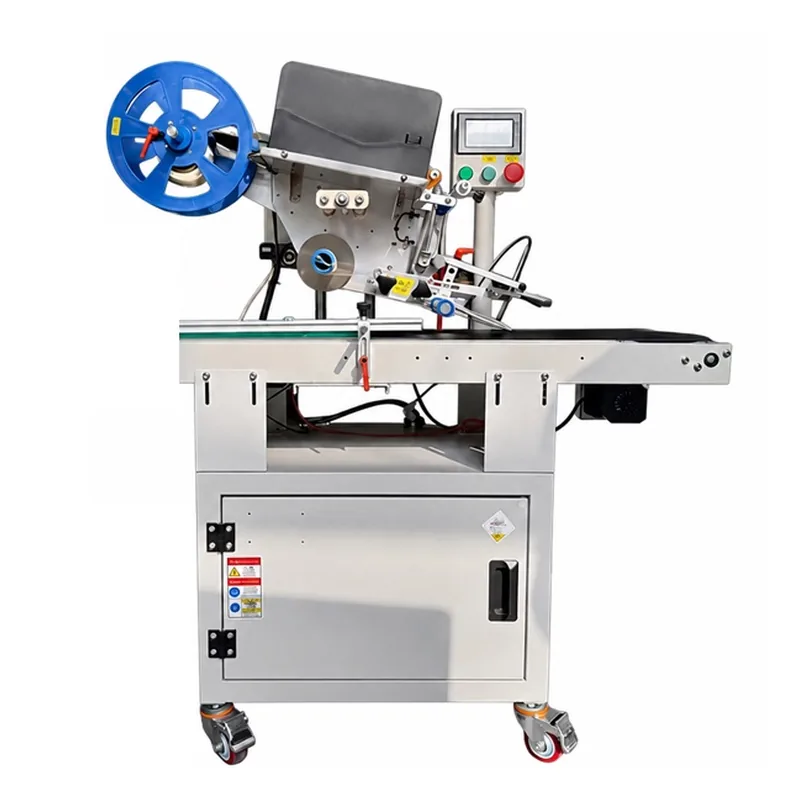
An automatic pallet labeler is an end-of-line print-and-apply system that images and transfers serialized GS1 logistics labels onto one, two, three, or four vertical faces of a unitized pallet load, whereas manual hand-labeling or out-of-spec placement causes unreadable stretch-wrap glare, warehouse dock rejections, and retailer non-compliance chargebacks of $50 to $500 per incident. Positioned as the final serialization station within our label applicators and print-and-apply authority guide and our print and apply labeling systems hub, a pallet labeler links physical palletized loads to the warehouse management system (WMS) and Electronic Data Interchange (EDI) Advance Ship Notices (ASNs) before forklift or automated guided vehicle (AGV) pickup.
Unlike secondary box and carton labeling machines where small packages pass within 3 to 5 mm of a stationary peel plate, palletized loads sit on heavy roller or drag-chain conveyors with wide safety clearances, uneven stretch-wrapped load profiles, and pallet overhang variations. To bridge that gap and apply identical Serial Shipping Container Code (SSCC-18) labels across multiple faces without rotating a 1,500 to 2,000 lb pallet, industrial pallet labelers use long-reach articulated swing arms or multi-axis linear tamp assemblies housed in environmentally sealed floor cabinets. This guide covers multi-side pallet applicator kinematics, GS1 SSCC-18 data and placement rules, major retailer compliance mandates, stretch-wrapper integration, and pallets-per-hour cycle-time math.
Comparing 1-side, 2-side, 3-side, and 4-side pallet labeling configurations
The primary architectural decision when specifying a pallet labeler is how many vertical faces of the pallet must carry a label and how many times the pallet conveyor can stop per cycle.
| Pallet Labeling Configuration | Conveyor Stops per Pallet | Published Throughput Ceiling | Actuator & Arm Mechanism | Target Logistics & Retailer Scope |
|---|---|---|---|---|
| 1-side pass-through or single-stop tamp | 0 stops (wipe/tamp on fly) or 1 stop | 180+ pallets/hour | Long-stroke linear pneumatic or servo tamp pad mounted beside the roller bed | Internal warehouse transfers, single-face storage racks, or Target standard 1-label largest-face shipments |
| 2-adjacent-side (front + side, or side + rear) | 1 conveyor stop | Up to 180 pallets/hour (LINEVO LV-850+ with LV-P3 applicator) |
Articulated swing arm with 90-degree pivoting wrist tamp pad reaching leading face and side face from one stop | Standard GS1 logistics compliance, Walmart 2-adjacent-side mandate, and automated high-bay AS/RS crane entry |
| 3-side (front + side + rear) | 2 conveyor stops | Up to 120 pallets/hour (LINEVO LV-9560PL and LV-P3 3-side mode) |
700 mm swing arm labels leading and side face on Stop 1, then labels trailing rear face on Stop 2 (up to 4 labels/pallet) | Multi-customer contract logistics, Kroger opposite-side requirements, and bidirectional forklift staging lanes |
| 4-side full perimeter | Turntable integration or dual-cabinet 2-stop layout | 60 to 100 pallets/hour depending on turntable index time | Pallet labeler integrated with stretch-wrapper turntable rotation, or dual opposing swing-arm cabinets | Amazon FBA (4 labels across all 4 sides) and Walmart Fulfillment Services (WFS) 4-side mandates |
Because multi-shift palletizing lines cannot tolerate prolonged maintenance stops, LINEVO industrial pallet labelers (such as the LV-850+ LV-P3 series) are engineered with modular applicator heads that maintenance technicians can unbolt and swap in under 1 hour, while storing more than 100 variable-data label jobs in onboard memory.
Swing-arm kinematics, reach, and environmental cabinet protection
End-of-line pallet conveyors operate in harsher conditions than upstream primary packaging rooms. Loading docks expose print engines to forklift dust, cold-storage condensation, drafts, and ambient humidity swings that cause paper liners to curl and thermal printheads to misfire.
Articulated swing-arm and wrist-pivot mechanics
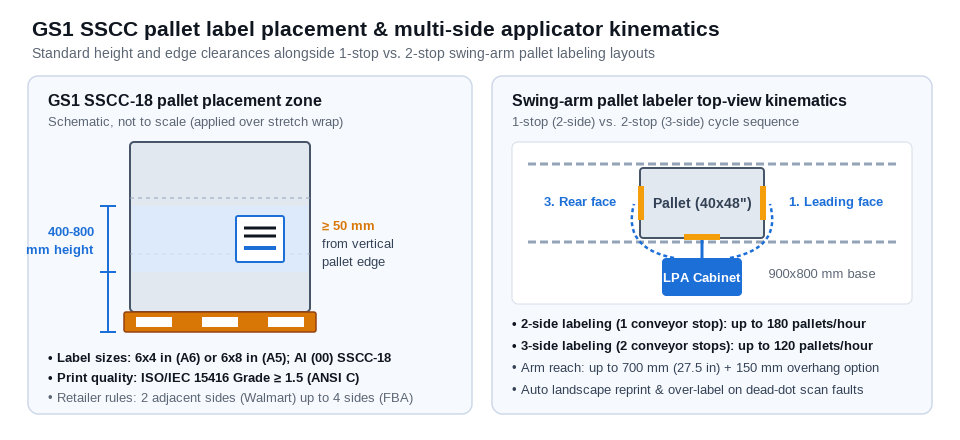
LINEVO industrial pallet labelers (such as the LV-9560PL) house the print engine and unwind/rewind reels inside a fully enclosed floor-standing cabinet measuring 900 x 800 mm (35.4 x 31.5 in). The enclosure shields the label roll, thermal transfer ribbon, and printhead from cold temperatures, humidity, wind drafts, and warehouse dust until the moment the label is peeled onto the vacuum tamp pad.
When a pallet arrives on the roller conveyor, a heavy-duty articulated swing arm extends out of the cabinet with a 700 mm (27.5 in) reach and a 90-degree pivoting wrist joint at the tamp pad. If stacked cases are under-sized relative to the wooden pallet base (or overhang the stringers), an optional overhang configuration extends reach by an additional 150 mm (6 in). The vacuum pad holds either a 6 x 4 in (A6 / 150 x 100 mm) or 6 x 8 in (A5 / 150 x 210 mm) label:
- On Stop 1, the pallet stops with its leading face just past the cabinet. The 700 mm arm swings forward, pivots its wrist 90 degrees so the tamp pad faces the leading front panel, presses the first SSCC-18 label onto the stretch wrap, and retracts to the peel edge to pick up the second freshly printed label.
- While the pallet remains at Stop 1 (or as it begins to index), the arm extends straight out perpendicular to the conveyor to tamp the second identical label onto the side panel. This completes 2-adjacent-side labeling with a single conveyor stop at rates up to 180 pallets per hour.
- If a 3-side application (front, side, and rear) is required, the conveyor advances the pallet to Stop 2 so the trailing rear face clears the cabinet. The swing arm pivots backward toward the trailing face and applies the third label, achieving up to 120 pallets per hour (and up to 4 labels per pallet when dual-label formats are specified).
GS1 SSCC-18 data structure and mandatory placement rules
Every unitized pallet entering retail or third-party distribution requires a globally unique license plate that links the physical load to the electronic Advance Ship Notice (ASN). Under GS1 standards, that license plate is the 18-digit Serial Shipping Container Code (SSCC-18) encoded inside a GS1-128 linear barcode (governed by ISO/IEC 15417:2007 for Code 128 symbology).
Anatomy of the 18-digit SSCC barcode
An SSCC-18 symbol starts with the Function 1 Symbol Character (FNC1) followed immediately by Application Identifier (00) and 18 numeric digits. Those 18 digits consist of five fields in order: Application Identifier (00) signaling an SSCC logistics license plate, a 1-digit Extension Digit (0 through 9) used by the shipper to increase serial numbering capacity, a 7 to 10 digit GS1 Company Prefix assigned by a national GS1 Member Organization, a 6 to 9 digit Serial Reference assigned sequentially by the shipper’s WMS or ERP, and a 1-digit Modulo-10 Check Digit calculated to catch substitution or transcription errors.
When a pallet contains a single homogeneous SKU, shippers often include additional Application Identifiers on the same label (up to the 48-character maximum limit of a single GS1-128 barcode), such as AI (01) for the 14-digit item GTIN, AI (10) for batch/lot number, AI (11) for production date, AI (15) for best-before date, and AI (17) for expiration date (or use a 2D GS1 DataMatrix symbol for payloads up to 2,335 characters). A strict GS1 operational rule applies to every pallet labeler database: never reuse an SSCC on a second pallet while the original record remains active in supply-chain databases (GS1 guidelines prohibit reusing an SSCC for at least one year after shipment).
Mandatory GS1 physical placement clearances on pallets
To ensure forklift operators, handheld scanners, and automated dock portal cameras can read the pallet license plate without dismounting, published GS1 pallet labeling standards enforce four geometric rules.
First, position the pallet label vertically between 400 mm and 800 mm (16 in to 32 in) above the floor (measured from the bottom of the pallet base). Placing a label below 400 mm exposes it to forklift tine impact and floor splash; placing it above 800 mm puts it above standard dock-door scanner fields on low-height loads.
Second, maintain horizontal edge clearance by keeping the entire label at least 50 mm (2 in) inward from any vertical edge of the pallet load so corner wrap tension and corner-board protectors do not crease the Quiet Zones.
Third, apply the label to the outside of the final stretch-wrap film layer. Labels applied underneath opaque, tinted, or multiple overlapping layers of polyethylene stretch film suffer severe optical glare and modulation loss, failing the mandatory ISO/IEC 15416 Grade 1.5 (ANSI C) print quality threshold.
Fourth, apply identical SSCC-18 labels on at least two adjacent sides (typically the short fork-entry face and the adjacent right-hand side face) so the barcode is visible regardless of whether the pallet is stored short-side or long-side out.
Major retailer pallet labeling mandates and chargeback prevention
Major North American retailers and fulfillment networks enforce their own vendor compliance manuals on top of baseline GS1 rules. Shipping a pallet with missing sides, incorrect label dimensions, or unreadable barcodes triggers automated vendor chargebacks ranging from $50 to $500 per incident, plus manual re-labeling labor fees at the receiving distribution center.
| Retailer / Network | Required Label Count & Sides | Label Size & Barcode Format | Pallet Height, Weight & Construction Limits | Critical Compliance Notes |
|---|---|---|---|---|
| Walmart (Standard DC & WFS) | Minimum 2 adjacent sides for standard DCs; all 4 sides required for Walmart Fulfillment Services (WFS) | 4 x 6 in (A6) GS1-128 with SSCC-18 | Max height 96 in (84 in when shipping from DCs); Grade A 40 x 48 in GMA wooden pallets | Place in upper right corner of target zone; zero carton overhang permitted past the 40 x 48 in pallet deck |
| Target | 1 label on the largest outward-facing surface (2 adjacent sides recommended for automated DCs) | GS1-128 with SSCC-18 | Maximum gross pallet weight 2,000 lbs | Place in the upper right quadrant within the GS1 vertical height band |
| Kroger | 2 identical labels on opposite sides (front and back fork-entry faces) | Minimum 8 x 11 in pallet sheet / label format | Cartons exceeding 50 lbs require an additional “Dual lift” safety label | No mixed SKUs permitted on a single standard pallet without explicit mixed-load authorization |
| Amazon FBA | 4 labels across all 4 sides of the pallet | 4 x 6 in FBA pallet ID + GS1 SSCC-18 where ASN-linked | Maximum height 72 in (single pallet); maximum gross weight 1,500 lbs | Place on the top center of all four sides on the outside of the stretch wrap; wooden pallets must meet ISPM-15 heat-treatment standards |
Pallet labeling cycle-time calculation (pallets/hour)
Unlike continuous bottle or carton conveyors, a pallet conveyor moves heavy loads (typically at $10\text{ to }18\text{ m/min}$) and must decelerate and stop for multi-side swing-arm application. Engineers calculate net pallet throughput (pallets/hour) by summing conveyor index time, print-and-apply arm strokes per stop, verification scan time, and the sustained operating factor.
$$\text{Single-Pallet Cycle Time } T_{\text{pallet}} \text{ (s)} = t_{\text{transfer}} + N_{\text{stops}} \times t_{\text{brake}} + \sum_{i=1}^{N_{\text{labels}}} \left( t_{\text{print},i} + t_{\text{arm},i} \right) + t_{\text{verify}}$$
$$\text{Sustained Pallet Throughput } Q_{\text{pallets/hr}} = \frac{3600 \times \eta_{\text{derate}}}{T_{\text{pallet}}}$$
Where:
- $t_{\text{transfer}}$ is the conveyor travel time to move one pallet pitch ($P_{\text{pallet}} = L_{\text{pallet}} + G_{\text{pallet}}$) into and out of the labeling zone (s).
- $N_{\text{stops}}$ is the number of conveyor stops ($1$ for 2-adjacent-side labeling; $2$ for 3-side front/side/rear labeling).
- $t_{\text{brake}}$ is the deceleration and settle time per stop (typically $1.5\text{ s}$ on heavy roller conveyors).
- $N_{\text{labels}}$ is the number of labels applied per pallet ($2$ or $3$).
- $t_{\text{print},i}$ is the thermal print feed time (s), which overlaps with arm motion on subsequent labels after the first label is pre-printed during pallet approach.
- $t_{\text{arm},i}$ is the swing-arm extension, wrist pivot, tamp dwell, and retraction time for label $i$ (s).
- $t_{\text{verify}}$ is the barcode scanner verification window (s), and $\eta_{\text{derate}}$ is the sustained operating factor ($0.85$).
Worked example: Calculate the sustained pallet-per-hour capacity of a 3-side swing-arm pallet labeler ($N_{\text{stops}} = 2$, $N_{\text{labels}} = 3$) applying $150\text{ mm}$ (6 in) A6 labels onto $1,219\text{ mm}$ (48 in) GMA pallets with a $600\text{ mm}$ gap ($P_{\text{pallet}} = 1.819\text{ m}$) on a roller conveyor running at $15\text{ m/min}$ ($0.25\text{ m/s}$):
- Conveyor transfer time: $t_{\text{transfer}} = 1.819 / 0.25 = 7.28\text{ s}$.
- Braking and settle time across 2 stops ($1.5\text{ s}$ each): $2 \times 1.5 = 3.00\text{ s}$.
- Label 1 is pre-printed while the pallet transfers in ($t_{\text{print},1} = 0\text{ s}$ net added time); the front-face swing-arm stroke takes $t_{\text{arm},1} = 4.2\text{ s}$.
- Label 2 prints during retraction and applies to the side face in $t_{\text{arm},2} = 3.5\text{ s}$.
- After advancing to Stop 2, Label 3 applies to the trailing rear face in $t_{\text{arm},3} = 4.2\text{ s}$, plus $t_{\text{verify}} = 0.8\text{ s}$ total scanner check time.
- Total cycle time: $T_{\text{pallet}} = 7.28 + 3.00 + 4.2 + 3.5 + 4.2 + 0.8 = 22.98\text{ s/pallet}$.
- Peak instantaneous capacity is $3600 / 22.98 = 156.7\text{ pallets/hour}$, and sustained net capacity at $\eta_{\text{derate}} = 0.85$ is $Q_{\text{pallets/hr}} = (3600 \times 0.85) / 22.98 = 133.2\text{ pallets/hour}$ (comfortably meeting the 120 pallets/hour 3-side benchmark). Dropping from 3 sides ($2\text{ stops}$) to 2 adjacent sides ($1\text{ stop}$) removes $1.5\text{ s}$ of braking and $4.2\text{ s}$ of rear-arm stroke, cutting $T_{\text{pallet}}$ to $17.28\text{ s}$ and raising peak capacity past 180 pallets/hour.
Stretch-wrapper integration, inline verification, and dead-dot over-labeling
A pallet labeler must be coordinated mechanically and electrically with the upstream rotary-arm or turntable stretch wrapper and the downstream warehouse conveyor.
Coordinating with the stretch wrapper and film tails
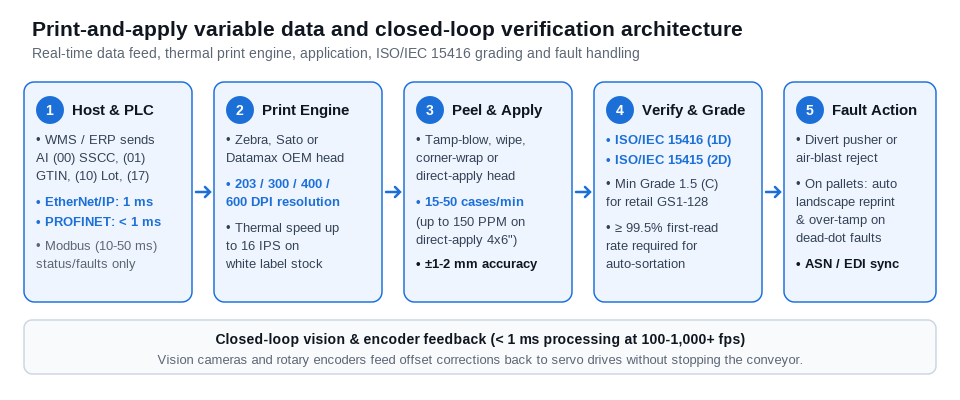
If a stretch wrapper leaves a loose polyethylene film tail fluttering on the side of the pallet, the tamp pad will bond the SSCC label onto the loose tail, which subsequently tears off on the forklift. Always specify a heat-seal or wipe-down film tail treatment on the stretch wrapper, and mount the pallet labeler downstream of the wrapper exit zone (or integrate the labeler with the wrapper turntable pause cycle when applying 4-side Amazon FBA or Walmart WFS labels). Triggering between the wrapper PLC and the pallet labeler should run over deterministic EtherNet/IP (1 ms) or PROFINET IRT (<1 ms) networks rather than high-latency Modbus links.
Automatic landscape reprint and over-labeling on barcode faults
In a high-volume distribution center, rejecting a 2,000 lb stretch-wrapped pallet because a single thermal printhead dot burned out creates a major forklift bottleneck. LINEVO automated pallet labelers (LV-9560PL series) solve this with an integrated barcode scanner and an automated landscape over-label recovery routine:
- Immediately after the tamp pad applies the SSCC-18 label, the integrated scanner reads and checks the barcode before the pallet moves.
- If a dead printhead dot runs parallel to the vertical picket-fence bars of a portrait label and creates a void that causes a no-read, the controller detects the failure instantly.
- Without operator intervention, the print engine rotates the label layout 90 degrees into landscape orientation (so the barcode bars now run perpendicular to the dead printhead dot, preventing the void from splitting a bar), prints a replacement label with the exact same SSCC-18 number, and extends the swing arm to tamp the new label directly over the defective one.
Common pallet labeling failure modes and engineering prevention
| Failure Mode | Primary Root Cause | Preventive Engineering Action |
|---|---|---|
| Barcode fails scan at customer receiving dock | Label applied over a horizontal gap between stacked case layers where stretch wrap bows inward, or applied under opaque stretch film | Program tamp height to target a solid corrugated case face within the 400 to 800 mm GS1 band, and always label over the outer stretch-wrap layer |
| Poor label adhesion on cold or dusty stretch wrap | Cold-storage condensation on polyethylene film, or standard general-purpose acrylic adhesive used below minimum application temperature | Specify an enclosed 900 x 800 mm environmental cabinet to keep label rolls warm/dry, and use freezer-grade or high-tack hot-melt rubber adhesives |
| Swing-arm collision with overhanging pallet load | Cases overhang the 40 x 48 in pallet stringers into the swing path, or pallet stops early on the roller bed | Install photo-eye overhang sensors at the entry gate, specify a 700 mm swing arm with +150 mm overhang compliance and compliant wrist joint, and enforce zero-overhang stacking |
Scoping your end-of-line pallet and case labeling system
To build a complete secondary and end-of-line specification:
Review print engine resolutions, thermal transfer ribbons, and PLC network handshakes in our print and apply labeling systems hub and our Zebra and Sato print engine integration guide, or compare actuator physics across the full plant in the label applicators and print-and-apply authority guide. If you are also automating the upstream case packer or carton line, pair your pallet station with a box and carton labeling machine or a post-sealer master carton labeling system, and verify your roll feed specs on the label roll unwind direction chart.
For turnkey conveyor layouts, PLC/WMS handshakes, and guarding, visit our custom labeling line integration page, review budget tiers in the industrial labeling machine cost guide, complete the labeling machine RFQ checklist, and send your pallet dimensions, sides required, and pallets-per-hour target to LINEVO engineers on WhatsApp.
Common questions
Where does GS1 require SSCC-18 pallet labels to be placed?
GS1 logistics standards require pallet labels to be positioned between 400 mm and 800 mm (16 to 32 inches) above the ground and at least 50 mm (2 inches) inward from any vertical edge of the pallet load. Labels must be applied smoothly to the outside of the final stretch-wrap layer on at least two adjacent sides so forklift and dock scanners have a clear line of sight.
How many pallets per hour can an automatic pallet labeler handle?
Throughput depends on the number of sides labeled and the number of conveyor stops. High-speed swing-arm pallet print-and-apply systems label two adjacent sides (front and side) at up to 180 pallets per hour using a single conveyor stop, and label three sides (front, side, and rear) at up to 120 pallets per hour using two conveyor stops.
What label sizes and barcode standards are used on pallets?
Standard pallet logistics labels measure 6 x 4 inches (A6 / 150 x 100 mm) or 6 x 8 inches (A5 / 150 x 210 mm), although certain grocery retailers such as Kroger require 8 x 11 inch formats. The barcode uses the GS1-128 linear symbology (ISO/IEC 15417) encoding the 18-digit Serial Shipping Container Code under Application Identifier (00), and must verify at ISO/IEC 15416 Grade 1.5 (ANSI C) or higher.
How do Walmart, Target, Kroger, and Amazon FBA pallet label rules differ?
Walmart requires 4 x 6 inch GS1-128 SSCC-18 labels on at least two adjacent sides for standard distribution centers and all four sides for Walmart Fulfillment Services (with zero overhang on 40 x 48 inch pallets). Target requires one label in the upper right of the largest face (up to 2,000 lbs). Kroger requires two identical labels (minimum 8 x 11 inches) on opposite sides with no mixed SKUs. Amazon FBA requires four labels placed top-center across all four sides over the stretch wrap on pallets up to 72 inches tall and 1,500 lbs.
What happens if a thermal printhead dot burns out during unmanned pallet labeling?
When an automatic pallet labeler with an integrated verification scanner detects an unreadable barcode caused by a dead printhead dot, it does not need to halt the conveyor or reject the heavy pallet. Instead, the controller automatically rotates the label format 90 degrees into landscape orientation so the barcode bars run perpendicular to the dead dot, reprints the identical SSCC-18 label, and tamps it directly over the defective label before releasing the pallet.
Related Guides & Specifications
Box and Carton Labeling Machines: Top-Surface, Side Wipe-On & Corner-Wrap Guide
Select box and carton labeling machines across split-belt top labelers, side wipe-on case applicators, corner-wrap systems, and GS1 barcode clearance rules.
Learn moreTamp vs Wipe-On vs Blow-On Applicators and Print-and-Apply Systems
Engineering comparison of wipe-on, tamp-blow, and air-blow label applicators versus print-and-apply systems across speed, stroke distance, accuracy, and air use.
Learn moreIndustrial Label Printer and OEM Print Engine Integration Guide
How industrial label printer OEM engines from Zebra, Sato, and Datamax integrate into print-and-apply systems across DPI, Left/Right web paths, and PLC I/O.
Learn moreMaster Carton Labeling After Case Sealing: Line Layout & GS1-128
Engineering guide to master carton labeling downstream of tape and hot-melt case sealers: pitch spacing, tape-tab avoidance, GS1-128 zones, and scan reject.
Learn moreDirect Thermal vs Thermal Transfer: Durability, Costs, and Line Fit
Direct thermal prints ribbonless on heat-sensitive paper for short-term shipping, while thermal transfer melts ribbon ink for durable industrial barcodes.
Learn moreWax vs Resin Ribbon: Durability, Melting Points, and Label Stock Match
Wax ribbons print fast on paper at low energy, wax-resin bridges coated stock and matte film, and full resin resists heat and solvents on synthetics.
Learn moreRelated Equipment & Guides
Label Applicators & Print-and-Apply Systems: Actuation, Speed & Retrofit Guide
Compare pre-printed label applicators and print-and-apply systems across wipe-on, tamp-blow, air-blow, and corner-wrap actuation, web speed, and retrofits.
Learn morePrint and Apply Labeling Systems: Thermal Engines, DPI, and PLC Integration
Select print and apply labeling machines across Zebra, Sato, and Datamax engines, 203 to 600 DPI printheads, EtherNet/IP handshakes, and ISO/IEC 15416 grading.
Learn moreLabel Automation and Custom Packaging Line Labeling Integration
Engineering guide to label automation and inline labeling system integration across fillers, cappers, accumulation tables, PLC sync, and vision reject gates.
Learn moreLabel Roll Unwind Direction Chart (#1 to #8) and Roll Length Calculator
Interactive #1 to #8 label winding direction chart (wound out vs wound in), eye-mark guide, and roll length, OD, core size, and shift roll calculator.
Learn moreBox and Carton Labeling Machines: Top-Surface, Side Wipe-On & Corner-Wrap Guide
Select box and carton labeling machines across split-belt top labelers, side wipe-on case applicators, corner-wrap systems, and GS1 barcode clearance rules.
Learn moreTamp vs Wipe-On vs Blow-On Applicators and Print-and-Apply Systems
Engineering comparison of wipe-on, tamp-blow, and air-blow label applicators versus print-and-apply systems across speed, stroke distance, accuracy, and air use.
Learn moreIndustrial Label Printer and OEM Print Engine Integration Guide
How industrial label printer OEM engines from Zebra, Sato, and Datamax integrate into print-and-apply systems across DPI, Left/Right web paths, and PLC I/O.
Learn moreIndustrial Labeling Machine Price and Total Cost of Ownership Guide
Transparent industrial labeling machine price breakdown from $2,000 semi-automatics to $500,000+ high-speed lines, plus hidden TCO drivers and payback math.
Learn moreLabeling Machine RFQ Checklist and User Requirement Specification (URS)
Engineering labeling machine RFQ checklist and User Requirement Specification (URS) template covering container drawings, roll unwind #1-#8, CPM, and FAT rules.
Learn moreMaster Carton Labeling After Case Sealing: Line Layout & GS1-128
Engineering guide to master carton labeling downstream of tape and hot-melt case sealers: pitch spacing, tape-tab avoidance, GS1-128 zones, and scan reject.
Learn more