Direct thermal printing burns an image directly onto chemically coated heat-sensitive paper without a ribbon, whereas thermal transfer printing melts solid wax, wax-resin, or resin ink from a ribbon onto plain paper or synthetic film labels. Choose direct thermal for short-term indoor shipping and fast-turnover parcels lasting under six months; choose thermal transfer when barcodes need durability against heat, sunlight, abrasion, moisture, solvents, cold storage, or multi-year warehousing.
Choosing the wrong print mode on an automated print-and-apply labeling system or inline label applicator leads directly to blackened shipping labels inside warm trailers, faded lot barcodes in long-term storage, or needless ribbon changeovers on rapid cross-dock lines. The engineering sections below detail the imaging physics, retention limits, consumable cost drivers, coating compliance rules, and industrial line selection gates separating the two processes.
Do direct thermal and thermal transfer printers need ink?
Neither direct thermal nor thermal transfer printers use liquid ink cartridges or toner. Under the U.S. EPA ENERGY STAR Imaging Equipment Version 3.2 specification, direct thermal is defined as burning dots onto coated print media passed over a heated print head without ribbons, whereas thermal transfer deposits small drops of solid colorant—usually colored waxes—in a melted state onto print media in a matrix pattern.
Because thermal transfer colorant stays solid at room temperature and melts only beneath energized printhead dots, it differs fundamentally from liquid inkjet printing and exits the print engine completely dry for immediate label application. Direct thermal omits even the dry ribbon by embedding colorless dye and acid developer chemistry inside the paper face stock itself.
| Evaluation Criterion | Direct Thermal | Thermal Transfer |
|---|---|---|
| Imaging mechanism | Heated printhead activates chemically coated heat-sensitive paper directly | Heated printhead melts solid wax, wax-resin, or resin ink from a ribbon onto the label |
| Ribbon requirement | Ribbonless single-roll consumable path | Uses a one-trip ink ribbon fed between printhead and label stock |
| Compatible substrates | Chemically treated direct thermal paper (uncoated or top-coated) | Regular paper, polypropylene, polyester, card, and textile label stocks |
| Typical scannable lifespan | Roughly six months indoors (around one year maximum away from harsh elements) | Exceeds one year; suited to prolonged warehousing and permanent identification |
| Heat, UV, and solvent resistance | Darkens under accidental heat or friction; fades from heat, humidity, UV, oils, and plasticizers | Wax-resin and full resin resist heat, moisture, grease, industrial solvents, cold storage, and abrasion |
| Print color capability | Primarily black unless specialized thermochromic stock is supplied | Prints black or other colors by loading different colored transfer ribbons |
| Changeover and reload complexity | Fast single-roll loading without ribbon alignment | Requires aligning and loading both label roll and one-trip ribbon onto take-up spindle |
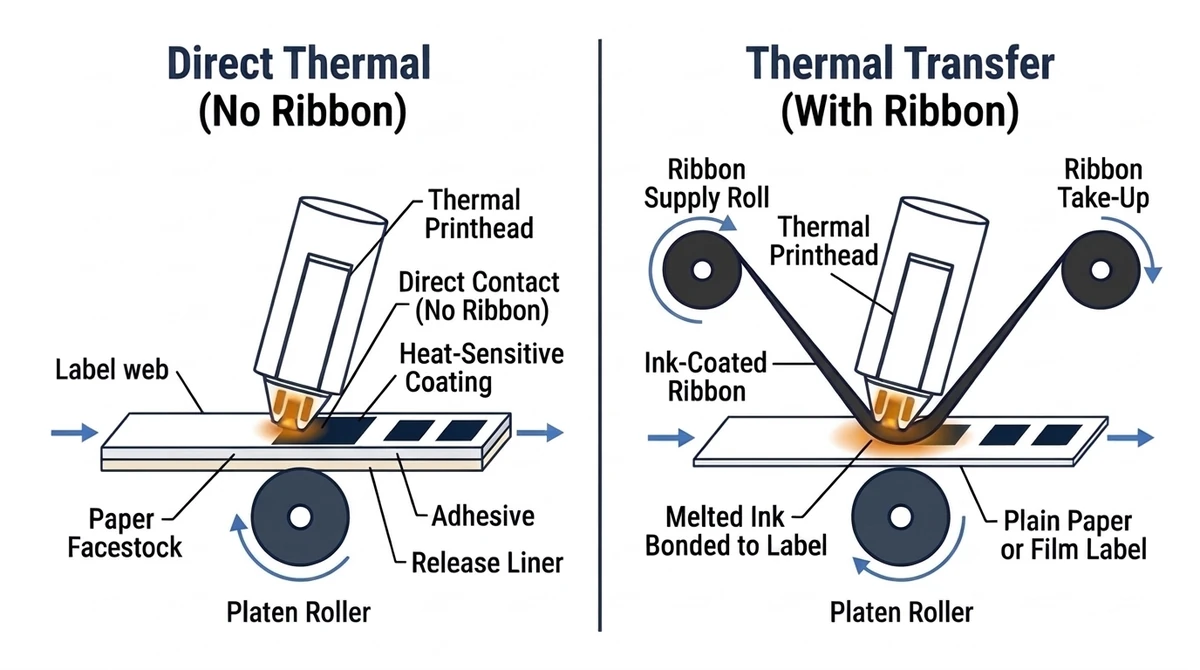
What is thermal transfer printing, and how does imaging differ?
Thermal transfer printing is a digital non-impact method invented by SATO Corporation—which produced the first thermal-transfer label printer, the SATO M-2311, in 1981—that bonds melted ribbon coating onto paper or synthetic substrates. Industrial label engines form a three-layer sandwich with a stationary printhead on top, an ink-coated carbon ribbon in the middle, and the target label stock advancing underneath, as outlined in standard thermal-transfer printing documentation.
How direct thermal paper forms an image without a ribbon
Direct thermal media contains four classes of imaging chemicals in its surface layer: colorless leuco dyes, organic acid developers, sensitizers, and stabilizers, as detailed in thermal paper chemistry references. Common organic acid developers include phenols such as Bisphenol A (BPA) and Bisphenol S (BPS), sulfonyl ureas, and zinc salts of substituted salicylic acids.
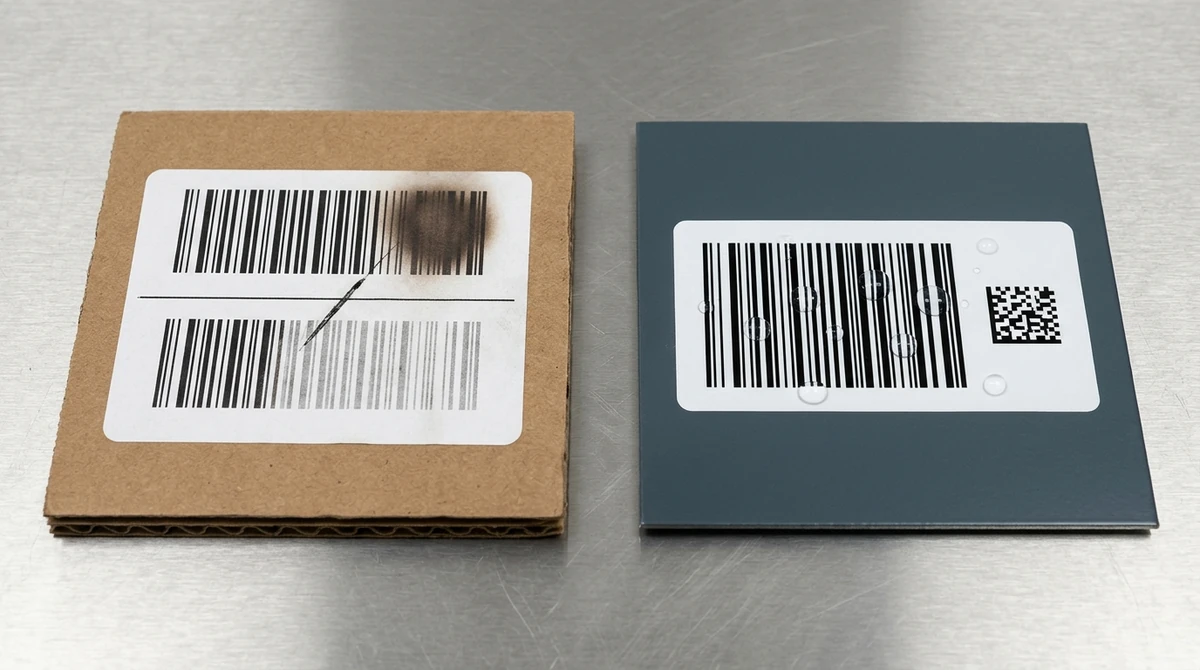
Because leuco dyes and developers mix poorly on their own, manufacturers add low-viscosity ether sensitizers that melt at approximately 100 °C to trigger rapid coloration at a defined threshold with minimal head energy. When heated dots press across the face stock, the melted mixture turns dark to form crisp text and barcodes. However, the resulting glassy dye state remains chemically reactive: ambient heat or humidity can cause dyes to recrystallize back to colorless form, while unintended contact with warm surfaces or friction heat darkens the blank background.
How thermal transfer melts one-trip ribbon ink onto substrates
In thermal transfer printing, stationary printheads available in 203 dpi, 300 dpi, and 600 dpi resolutions energize each microscopic dot independently to a preset temperature. Constant mechanical head pressure transfers melted wax, wax-resin, or resin ink directly from the ribbon face onto the moving substrate; the moment a dot powers off, it cools rapidly so ink transfer stops cleanly and the finished label leaves dry.
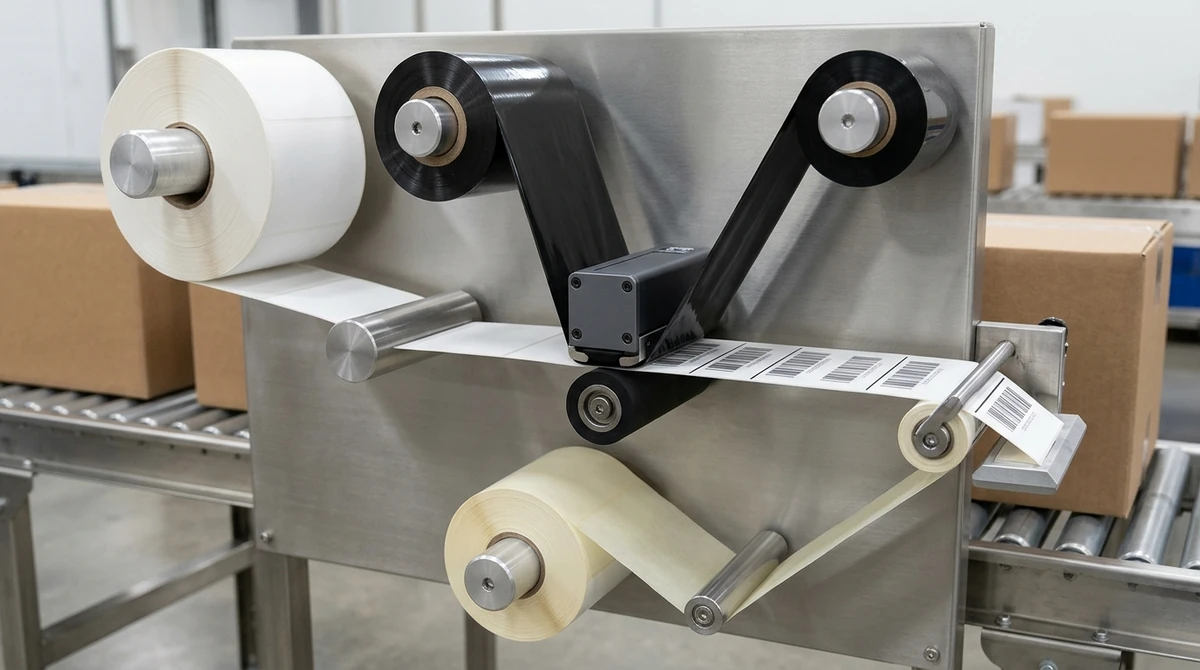
Industrial engines run a one-trip carbon ribbon that unwinds from a supply spindle and winds onto a take-up spindle for disposal after a single pass. Holding a spent strip up to light reveals an exact negative of every printed barcode. Because fresh, unused ink passes under the heating elements on every label, properly tuned thermal transfer engines deliver consistent 100% print density without the gradual image fading characteristic of reusable impact ribbons.
How long do direct thermal labels last compared to thermal transfer?
Direct thermal labels generally remain scannable for around six months—and roughly one year at best—even when stored away from extreme heat or sunlight. Thermal transfer labels routinely exceed one year of readable life and remain the standard choice for long-term warehousing, outdoor staging, cold storage, and high-density asset or barcode identification.
Environmental exposure widens that durability gap quickly. Uncoated direct thermal coatings degrade under UV light, moisture, oils, fats, plasticizers, and mechanical rubbing. Adding a protective top-coating reduces fading from UV light, water, oils, fats, and plasticizers, yet the underlying heat-sensitive chemistry still darkens if exposed to elevated heat or sharp friction.
Thermal transfer durability scales directly with ribbon chemistry and substrate selection:
| Printing Option | Typical Substrate | Resistance Profile | Best Industrial Fit |
|---|---|---|---|
| Direct thermal (uncoated) | Standard heat-sensitive paper | Vulnerable to heat, sunlight, moisture, oils, and scuffing; roughly six-month scan window | E-commerce parcels, short-term shipping cartons, receipts, event tickets, bakery and deli labels |
| Direct thermal (top-coated) | Protective top-coated thermal paper | Improved barrier against UV light, water, oils, fats, and plasticizers; lowers printhead wear | Fast-turnover chilled distribution cartons with moderate moisture or handling friction |
| Thermal transfer (wax ribbon) | Uncoated or matte paper stock | Crisp dry barcodes at low heat; wax ink remains sensitive to heavy scraping or smearing | General warehouse shipping cases and indoor distribution cartons stored beyond six months |
| Thermal transfer (wax-resin ribbon) | Coated paper or polypropylene (PP) film | Higher resistance to smudging, scratching, moisture, and conveyor abrasion | Secondary food and industrial cartons, cold-chain pallets, and moderate-wear logistics |
| Thermal transfer (full resin ribbon) | Polyester (PET) or heavy-duty synthetics | Resists chemicals, grease, solvents, heat, moisture, and outdoor weathering | Chemical drums, medical device sterilization/UDI, laboratory tubes, and permanent asset tags |
A quick physical check distinguishes the two label types on the plant floor: scraping a fingernail briskly across a direct thermal label generates enough friction heat to leave a visible black mark, whereas a thermal transfer label stays completely unmarked.
How do direct thermal and thermal transfer costs compare?
Direct thermal eliminates ribbon purchases and simplifies inventory to a single label roll, yet per-label consumable spend remains closely comparable because chemically treated thermal paper costs more than plain paper stock. Across comparable industrial formats, the combined material cost of thermal transfer labels plus a thermal transfer ribbon is approximately equal to the cost of direct thermal labels alone.
Operational cost differences therefore hinge on three practical factors rather than raw roll price alone:
- Equipment footprint and simplicity: Direct thermal mechanisms require no ribbon supply or take-up spindles, making compact and portable printers inexpensive and space-efficient for packing benches and temporary shipping stations.
- Changeover labor and web threading: Direct thermal reloads faster because operators thread only one label roll. Thermal transfer requires loading and aligning the wax- or resin-coated ribbon alongside the label web onto the take-up core during roll swaps.
- Printhead wear and rework avoidance: Direct thermal stock rubs directly against the ceramic heating elements, depositing coating residue and accelerating head abrasion unless protective top-coated paper is used. Thermal transfer adds ribbon replenishment to ongoing consumables—ribbons, label stock, and occasional printhead replacements—but prevents costly rework from faded, smudged, or blackened barcodes in harsh logistics and long-term storage.
How do label coatings affect chemical safety and compliance?
Beyond fading and scuffing, label coating chemistry affects operator skin contact, trace-element contamination in sensitive laboratories, and regulatory barcode permanence. Plain paper or synthetic thermal transfer labels avoid active heat-sensitive face coatings altogether, whereas conventional direct thermal coatings rely on surface-accessible chemical developers.
Dermal developer transfer and phenol-free thermal paper
A peer-reviewed systematic review on dermal bisphenol exposure notes that thermal paper developers such as BPA and its substitutes sit as non-polymer-bound, surface-accessible compounds that transfer readily to skin during handling. Controlled skin-contact measurements recorded approximately 1 µg of BPA transferring to two fingertips within 5 seconds of handling thermal paper, with roughly tenfold higher transfer onto wet or greasy skin.
To reduce environmental and workplace exposure, the U.S. EPA Bisphenol A risk management program released its final Design for the Environment alternatives assessment, Bisphenol A (BPA) Alternatives in Thermal Paper, on January 29, 2014. Newer phenol-free direct thermal stocks using urea-based developers or vitamin C avoid both BPA and BPS while achieving comparable or improved print quality, though they carry higher material cost than conventional grades.
Trace-element cleanliness in analytical and clinical workflows
Chemical coatings on direct thermal labels can also interfere with high-sensitivity laboratory testing. In a 2025 ICP-MS/MS study of barcoded specimen labels, researchers analyzed four direct thermal barcode labels alongside one thermal transfer barcode label for eight trace metals. Every direct thermal label released extractable zinc between 11.26 ± 0.68 µg/dL and 33.83 ± 1.48 µg/dL (specifically 30.39, 33.83, 11.26, and 20.61 µg/dL)—more than tenfold above the 0.62 µg/dL lower limit of quantitation—whereas the thermal transfer label measured 0.06 ± 0.02 µg/dL, well below quantitation, and was selected for all trace-metal specimen tubes.
Federal medical UDI and hazardous chemical labeling mandates
Regulated medical and chemical packaging lines carry explicit durability obligations that favor thermal transfer printing on paper or synthetic substrates:
- Medical device UDI compliance: Under U.S. FDA 21 CFR 801.40, every medical device Unique Device Identifier (UDI) must meet § 830.20 technical standards and appear in both easily readable plain text and machine-readable Automatic Identification and Data Capture (AIDC) format, encoding variable lot, batch, serial, manufacturing date, and expiration date fields whenever those appear on the label.
- Hazardous chemical container legibility: Under the OSHA Hazard Communication Standard (29 CFR 1910.1200), shipped hazardous chemical containers must display a product identifier, signal word, hazard statements, pictograms, and precautionary statements, and employers must keep workplace labels legible, in English, prominently displayed, and undefaced throughout every work shift.
Which printing method fits industrial print-and-apply lines?
Industrial barcode print engines have standardized around fixed print widths of 4, 6, and 8 inches (100, 150, and 200 mm) with 203, 300, or 600 dpi printheads to handle continuous-form small-format media such as 4 × 6 inch (A6) shipping labels under 210 mm wide. Because thermal engines have few moving parts, produce dry waterfast output immediately, and connect over Ethernet or wireless networks for remote speed and darkness adjustment, ribbon-level monitoring, printhead status tracking, and automatic batch switching, they integrate cleanly into automated box and carton labeling machines and end-of-line pallet labelers.
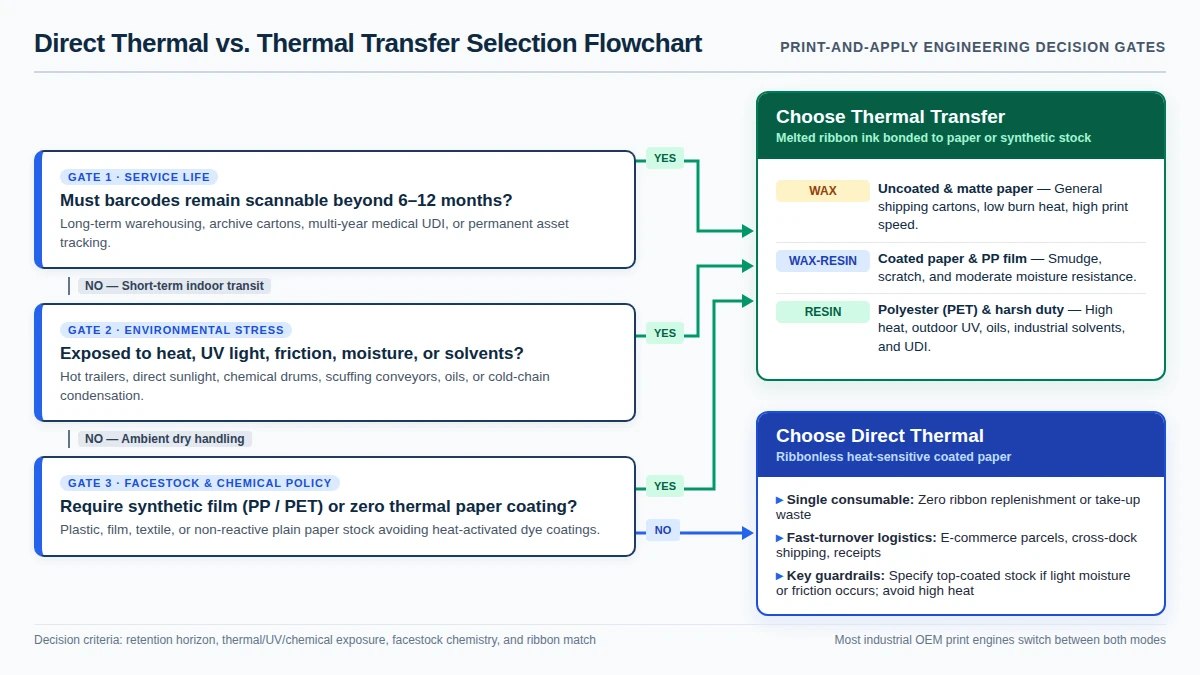
Use three sequential engineering checks before locking consumable mode on a print-and-apply line:
- Audit label retention time: If cartons ship out within days or weeks and exit the supply chain inside six months, ribbonless direct thermal minimizes operator reload steps and keeps consumable stocking simple. If inventory sits in distribution centers beyond six months—or carries multi-year regulatory traceability—specify thermal transfer.
- Audit heat, UV, moisture, and chemical contact: Any exposure to warm shipping environments, direct sunlight, cold-storage condensation, conveyor friction, grease, or industrial solvents rules out uncoated direct thermal and requires wax-resin or full resin thermal transfer on paper, polypropylene, or polyester stock.
- Verify print engine width, resolution, and actuator pairing: Confirm whether 4, 6, or 8 inch (100, 150, or 200 mm) print width and 203, 300, or 600 dpi dot density match your barcode format, then align left- or right-hand web orientation and PLC signals using our Zebra and Sato print engine integration guide and labeling machine RFQ checklist.
Technical references
- U.S. EPA ENERGY STAR Imaging Equipment Version 3.2 Final Specification (PDF) — Federal marking technology definitions for Direct Thermal (DT), Thermal Transfer (TT), Small Format, and Continuous Form devices.
- Sun et al. (2025), Barcoded labels as potential source of zinc contamination in trace metal testing (PubMed Central / NIH) — Peer-reviewed ICP-MS/MS comparison of four direct thermal barcode labels versus a thermal transfer barcode label.
- Dermal Exposure to Bisphenols and Their Analogs: A Systematic Review and Narrative Synthesis (PubMed Central / NIH) — Synthesis of surface-accessible thermal paper developer transfer to skin during handling.
- U.S. EPA — Risk Management for Bisphenol A (BPA) — EPA TSCA overview and 2014 Design for the Environment alternatives assessment for BPA in thermal paper.
- U.S. FDA — 21 CFR § 801.40 Form of a Unique Device Identifier (eCFR) — Mandatory plain-text and AIDC machine-readable labeling format for medical device UDI production identifiers.
- U.S. OSHA — 29 CFR § 1910.1200 Hazard Communication Standard (eCFR) — Federal legibility, prominent display, and non-defacement mandates for hazardous chemical container labels.
- Thermal-transfer printing — Overview of stationary printhead resolution tiers, one-trip ribbon transfer, standardized industrial print widths, and wax versus resin durability.
- Thermal paper — Summary of leuco dye, organic acid developer, ~100 °C sensitizer, stabilizer, protective top-coating, and phenol-free coating chemistry.
Frequently asked questions
How can I quickly tell if an existing label is direct thermal or thermal transfer?
Scrape a fingernail briskly across the face of the label. Friction heat darkens the heat-sensitive coating on a direct thermal label and leaves a black streak, whereas a thermal transfer label shows no black mark because its face stock contains no heat-activated dye layer.
Can thermal transfer printers print colors other than black?
Yes. Thermal transfer printers readily print in black or alternate colors by loading a colored wax, wax-resin, or resin transfer ribbon. Standard direct thermal printers produce black images only unless fed specialized pre-coated thermochromic stock.
Why does direct thermal printing cause more printhead wear than thermal transfer?
Direct thermal media rubs directly against the heated printhead elements without an intervening ribbon film, allowing paper fibers and reactive coating residue to accumulate on the head. Specifying direct thermal paper with a protective top-coating reduces both printhead abrasion and coating buildup.
Which thermal transfer ribbon should I pair with polypropylene or polyester labels?
Pair polypropylene (PP) and coated paper labels with a wax-resin ribbon for improved resistance to smudging, abrasion, and moisture. Pair polyester (PET) and heavy-duty synthetic labels with a full resin ribbon for applications facing heat, grease, industrial solvents, or outdoor conditions.
Are BPA-free direct thermal labels available for shipping and retail lines?
Yes. Phenol-free direct thermal papers formulate the reactive developer layer with urea-based compounds or vitamin C instead of Bisphenol A (BPA) or Bisphenol S (BPS), achieving comparable or better print quality at a higher per-roll material cost than conventional thermal paper.
Related Guides & Specifications
Box and Carton Labeling Machines: Top-Surface, Side Wipe-On & Corner-Wrap Guide
Select box and carton labeling machines across split-belt top labelers, side wipe-on case applicators, corner-wrap systems, and GS1 barcode clearance rules.
Learn moreAutomatic Pallet Labelers: GS1 SSCC-18 Placement, Swing-Arm Reach & Throughput
Specify automatic pallet labelers for 1-side, 2-side, and 3-side GS1 SSCC-18 labeling, 400 to 800 mm placement zones, retailer mandates, and pallets/hour math.
Learn moreTamp vs Wipe-On vs Blow-On Applicators and Print-and-Apply Systems
Engineering comparison of wipe-on, tamp-blow, and air-blow label applicators versus print-and-apply systems across speed, stroke distance, accuracy, and air use.
Learn moreIndustrial Label Printer and OEM Print Engine Integration Guide
How industrial label printer OEM engines from Zebra, Sato, and Datamax integrate into print-and-apply systems across DPI, Left/Right web paths, and PLC I/O.
Learn moreMaster Carton Labeling After Case Sealing: Line Layout & GS1-128
Engineering guide to master carton labeling downstream of tape and hot-melt case sealers: pitch spacing, tape-tab avoidance, GS1-128 zones, and scan reject.
Learn moreWax vs Resin Ribbon: Durability, Melting Points, and Label Stock Match
Wax ribbons print fast on paper at low energy, wax-resin bridges coated stock and matte film, and full resin resists heat and solvents on synthetics.
Learn moreRelated Equipment & Guides
Label Applicators & Print-and-Apply Systems: Actuation, Speed & Retrofit Guide
Compare pre-printed label applicators and print-and-apply systems across wipe-on, tamp-blow, air-blow, and corner-wrap actuation, web speed, and retrofits.
Learn morePrint and Apply Labeling Systems: Thermal Engines, DPI, and PLC Integration
Select print and apply labeling machines across Zebra, Sato, and Datamax engines, 203 to 600 DPI printheads, EtherNet/IP handshakes, and ISO/IEC 15416 grading.
Learn moreLabel Roll Unwind Direction Chart (#1 to #8) and Roll Length Calculator
Interactive #1 to #8 label winding direction chart (wound out vs wound in), eye-mark guide, and roll length, OD, core size, and shift roll calculator.
Learn moreIndustrial Labeling Machine Price and Total Cost of Ownership Guide
Transparent industrial labeling machine price breakdown from $2,000 semi-automatics to $500,000+ high-speed lines, plus hidden TCO drivers and payback math.
Learn moreLabeling Machine RFQ Checklist and User Requirement Specification (URS)
Engineering labeling machine RFQ checklist and User Requirement Specification (URS) template covering container drawings, roll unwind #1-#8, CPM, and FAT rules.
Learn more