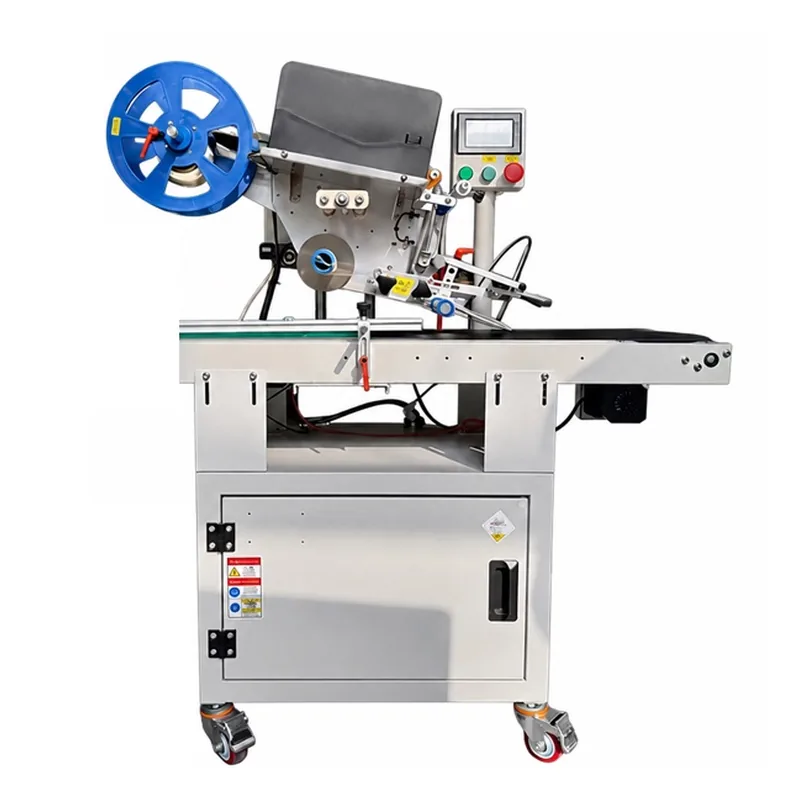
In automated secondary packaging lines, master carton labeling takes place in the critical conveyor window immediately downstream of the automatic case sealer and upstream of the checkweigher and palletizer. Choosing the right label applicator or print-and-apply system for this zone requires solving mechanical and regulatory constraints that do not exist on primary bottle lines: cartons exit side-belt case sealers back-to-back or at irregular intervals, freshly applied BOPP/PVC sealing tape or hot-melt glue creates raised center seams and 50 to 75 mm end-panel tape tabs, and retail distribution centers reject any outer case whose barcode falls below ISO/IEC 15416 Grade C (1.5).
Integrating a post-sealer print-and-apply labeling system or pre-printed outer-case applicator requires coordinating five line elements: upstream case erector and sealer discharge velocity, pitch-gapping conveyor separation, tape-tab and flap-seam exclusion zones, GS1-128 versus ITF-14 barcode symbology selection, and closed-loop barcode verification with automatic reject diversion before palletizing.
The End-of-Line Secondary Packaging Sequence
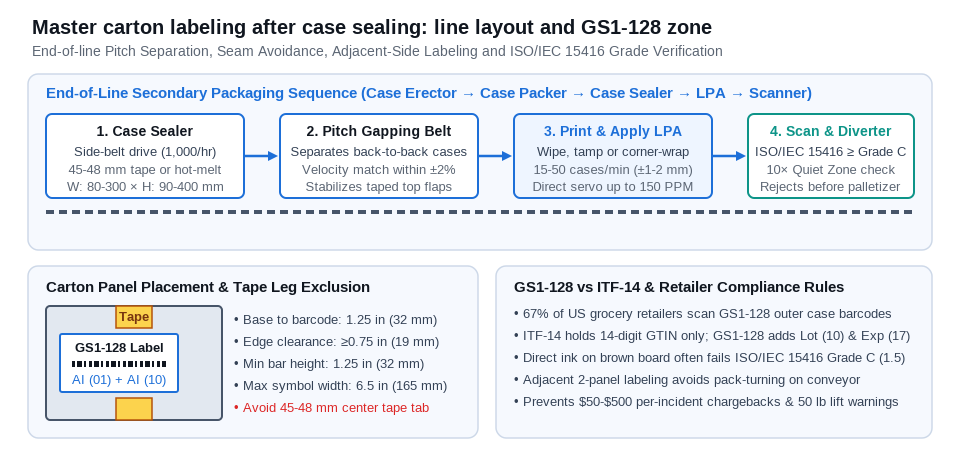
A complete secondary packaging line follows a strict mechanical sequence: Case Erector → Case Packer → Case Sealer → Master Carton Labeler → Checkweigher / Vision Verification → Palletizer. Understanding how the upstream erector and sealer form and close the corrugated box is essential before specifying the labeler stand and actuator.
- Case Erecting and Bottom Sealing: Horizontal or vertical servo case erectors pull flat corrugated blanks from a magazine, square the walls, fold the minor (leading and trailing) bottom flaps followed by the major bottom flaps, and seal the bottom seam.
- Case Packing: Primary bottles, pouches, or cartons are loaded into the open case by drop packers, side-load pushers, or robotic pick-and-place cells.
- Top Flap Closing and Case Sealing: The filled carton enters an automatic case sealer where plows fold the top minor and major flaps and side drive belts carry the box past top and bottom taping heads or hot-melt adhesive nozzles.
- Master Carton Labeling and Verification: Immediately after the top flaps are sealed and squared, the carton enters the labeling zone to receive its single-panel, dual-panel, or adjacent corner-wrap identification label before inline barcode grading and palletization.
Tape Case Sealers vs Hot-Melt Glue Case Sealers: Impact on Label Placement
The closure method used on the upstream case sealer directly alters the surface topology of the front, rear, and top panels of the master carton.
| Case Sealer Parameter | Adhesive Tape Case Sealer (BOPP / PVC) | Hot-Melt Glue Case Sealer |
|---|---|---|
| Closure Mechanism | Top and bottom tape heads apply 30, 45, or 48 mm pressure-sensitive tape | Heated tank, hoses, and nozzles extrude hot-melt glue onto inner flaps |
| Representative Line Envelope | Side-belt sealers (e.g. LINEVO LV-FXC4030X) run ~1,000 pcs/hr (~16.7 cases/min) on cases 80-300 mm W × 90-400 mm H |
High-speed continuous lines running heavy export cases, beverage shippers, or display trays |
| End-Panel Surface Obstruction | Leaves a 50 to 75 mm vertical tape leg (tab) centered on both leading and trailing end panels | Zero exterior tape tab on end panels; full end panel remains bare corrugated board |
| Top & Bottom Flap Seam Profile | Flexible tape strip bridges the center major-flap gap; flaps can flex slightly under pressure | Rigid bonded flap closure with high structural stiffness for pallet stacking |
| Labeling Zone Rule | Never bridge a barcode label over the slick 45 to 48 mm center tape tab on end panels | End-panel labeling can use the center zone, provided major flaps meet flush without step-off |
When a side-belt tape sealer such as the LV-FXC4030X applies 45 mm or 48 mm BOPP tape to a master carton, the tape rollers wipe a vertical tape tab down the center of the leading and trailing panels. If a print-and-apply labeler places a paper or film barcode label directly over that slick polypropylene tape leg, two failure modes occur:
- There is a physical thickness step-off at the edges of the 45 mm tape strip where air becomes trapped underneath the label, causing edge lift and wrinkling.
- Standard corrugated box adhesives bond aggressively to porous kraft linerboard but exhibit lower peel adhesion on siliconized or release-coated BOPP carton sealing tape, leading to label flagging in cold storage or high-humidity transit.
To prevent tape-tab overlap on taped master cartons, engineers either apply the label to the long side panel (which has no tape leg), offset the end-panel label to the left or right of the center tape strip on wide boxes, or use an adjacent-panel corner-wrap applicator that places the barcode on the side panel and wraps the human-readable text onto the leading panel beside the tape tab.
Pitch Spacing Control and Conveyor Synchronization After Case Sealing
Side-belt case sealers grip the left and right walls of the carton at a fixed belt speed to pull the box through the taping heads. However, cases often enter the sealer at irregular intervals or exit with insufficient spacing for a print-and-apply tamp cycle or corner-wrap swing arm to clear the trailing edge of one box before the leading edge of the next box arrives.
- Pitch Gapping Conveyor: Install a dedicated metering or pitch-spacing belt between the case sealer discharge and the labeler infeed. Running the labeling conveyor slightly faster than the case sealer side belts pulls a consistent longitudinal gap (typically 150 to 300 mm) between consecutive cartons.
- Guide Rail Referencing: Because corrugated cases vary slightly in width and squareness, a fixed reference guide rail on the labeler side (opposed by spring-loaded or pneumatic centering guides on the opposite side) holds the target carton face at a constant 3 to 5 mm standoff from the peel plate on wipe-on systems or at a fixed stroke depth for tamp-blow pads.
- Closed-Loop Velocity Matching: On wipe-on and corner-wrap applicators, label dispense speed must match conveyor belt velocity within ±2%. Adding a shaft encoder to the labeling conveyor tracks belt speed variations during accumulation recovery and prevents barcode compression, ladder-bar distortion, or label skew exceeding 2°.
| Actuator Configuration | Speed Envelope (Cases/Min) | Placement Accuracy | Best-Fit Master Carton Application |
|---|---|---|---|
| Wipe-On (Direct Merge) | 20 to 60 cases/min (up to 150 PPM on direct-apply servo LPA) | ±2 to 3 mm (±1 to 2 mm on direct servo) | Single side or top panel on uniform, well-guided corrugated cases; zero plant air required |
| Tamp-Blow (Linear Stroke) | 30 to 80 cases/min | ±1.5 to 2 mm | End-panel labeling, mixed case widths, or slightly recessed corrugated panels |
| Air-Blow (Non-Contact) | 40 to 100+ cases/min | ±2 to 3 mm | High-speed top or side labeling on light or thin-walled cartons where contact could crush flaps |
| Print-and-Apply (Standard / Corner-Wrap) | 15 to 50 cases/min | ±1 to 2 mm (±1 mm on corner-wrap) | Real-time GS1-128 batch/expiry printing and two-panel adjacent front-and-side compliance |
GS1-128 vs ITF-14 Barcodes and Direct Ink vs Pressure-Sensitive Labels
A frequent strategic question in master carton engineering is whether to print barcodes directly onto the brown corrugated board with large-character inkjet or to apply a white pressure-sensitive thermal transfer/direct thermal label, and whether to encode data in ITF-14 or GS1-128 format.
Why GS1-128 Replaces ITF-14 in Modern Supply Chains
While ITF-14 (Interleaved 2 of 5) encodes only a static 14-digit Global Trade Item Number (GTIN), GS1-128 (introduced in 1989 as a subset of Code 128 defined under ISO/IEC 15417:2007 with a Function 1 / FNC1 start character) encodes up to 48 characters per symbol and supports more than 100 GS1 Application Identifiers (AIs). On a single master carton label, GS1-128 combines:
- AI (01): 14-digit GTIN item identification
- AI (10): Batch or lot number for instant recall isolation
- AI (11) / (15) / (17): Production date, best-before date, or expiration date for FEFO (First-Expired, First-Out) warehouse rotation
- AI (00): 18-digit Serial Shipping Container Code (SSCC) when the carton serves as a logistics unit
Published industry surveys report that 67% of US grocery retailers scan GS1-128 barcodes on incoming cases, and 49% of fresh meat, poultry, produce, and seafood suppliers rely on GS1-128 to automate cold-chain traceability.
Why White Pressure-Sensitive Labels Outperform Direct Ink on Brown Corrugated Board
GS1 specifications require GS1-128 symbols to achieve a minimum print quality grade of ANSI Grade C (1.5) under ISO/IEC 15416 verification. Direct liquid-ink printing onto brown kraft corrugated board suffers from ink absorption into porous paper fibers and low reflectance contrast between dark ink and brown background board, frequently failing Grade C verification.
Applying a bright white pressure-sensitive label printed at 203 or 300 DPI via a thermal transfer or direct thermal print-and-apply system guarantees maximum bar-to-space reflectance contrast and crisp edge definition. Moreover, applying pressure-sensitive labels to two adjacent panels (one short end panel and one long side panel) via an L-panel corner-wrap or dual-head system ensures the barcode is always visible after pallet stacking without installing expensive mechanical pack-turning devices that slow down the conveyor.
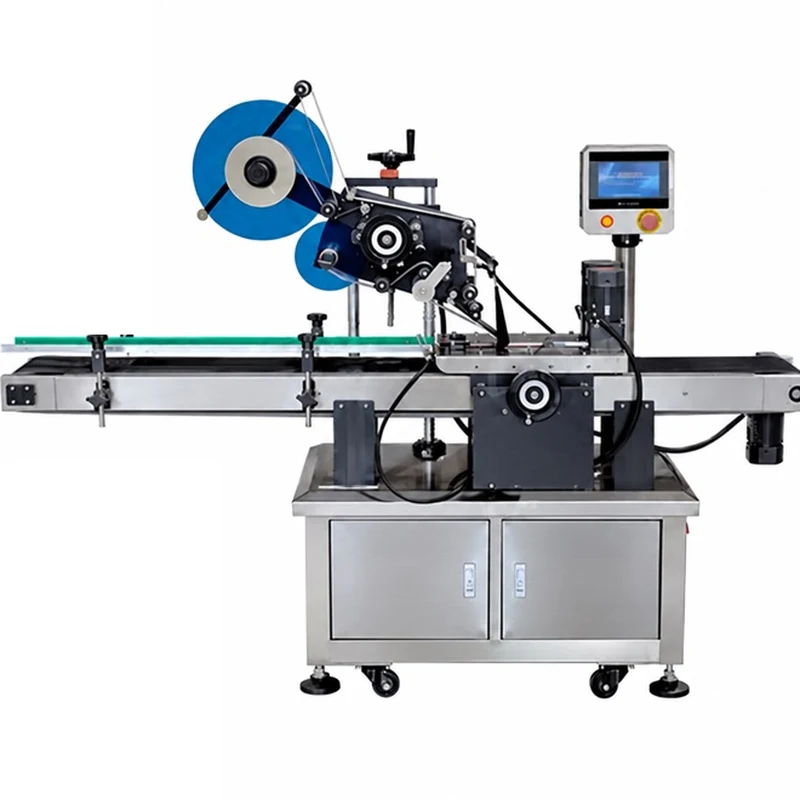
GS1 Master Carton Placement Zones and Retailer Compliance Rules
To guarantee 99.5%+ first-pass read rates on automated warehouse tunnel scanners and avoid retailer non-compliance chargebacks ranging from $50 to $500 per incident, master carton labels must adhere to published GS1 placement tolerances:
- Vertical height from carton base: Position the bottom edge of the barcode symbol at 1.25 inches (32 mm) above the bottom edge of the container. Never place the label lower than 25 mm from the base, where bottom flap seams, tape legs, or conveyor rail scuffs damage the bars.
- Horizontal edge clearance: Maintain at least 0.75 inches (19 mm) clearance from any vertical corner edge (keeping the barcode symbol between 0.30 in and 4.0 in from the nearest vertical edge). On corner-wrap labels, never place barcode bars across the 90° box crease; place the barcode entirely on the flat side panel and place human-readable text on the adjacent front panel.
- Minimum bar height and Quiet Zones: Use a minimum barcode bar height of 1.25 inches (32 mm) for automated fixed conveyor scanners (or at least 0.500 in / 12.7 mm for handheld scanning). Maintain a clear, unprinted Quiet Zone at least 10 times the narrowest bar width (10X) on both left and right ends of the barcode, and keep total symbol width including Quiet Zones at or below 6.5 inches (165 mm).
- Heavy carton safety icons: Major retailers such as Kroger require “Dual lift” safety warning labels on any master carton weighing more than 50 lbs (22.7 kg) in addition to adjacent-side GS1-128 identification.
Closed-Loop Barcode Verification and Reject Diversion Before Palletizing
Once a misprinted or skewed master carton is stacked onto the middle layer of a 60-case pallet and wrapped in stretch film, correcting that single unreadable label requires tearing down the entire pallet. Every post-sealer master carton labeling station should include a fixed-mount laser or 2D camera barcode verifier mounted 300 to 600 mm downstream of the wipe roller or tamp pad:
- Every carton is scanned immediately after application to verify valid GS1 Application Identifier syntax, check-digit math, 10X Quiet Zone integrity, and ISO/IEC 15416 Grade C (1.5) or higher contrast.
- If a carton fails verification due to a wrinkled label, ribbon crease, or blocked sensor, the PLC triggers a pneumatic pusher or roller diverter to route the defective case onto a rework accumulation spur before it reaches the palletizer.
- If three consecutive cartons fail verification (indicating a fouled printhead dot or empty media web), the PLC halts the case sealer discharge and alerts the operator via the PackML fault stack.
How LINEVO Engineers Post-Sealer Master Carton Labeling Cells
LINEVO supplies standalone box applicators, high-speed print-and-apply systems, and complete post-sealer pitch-gapping and adjacent corner-wrap labeling cells tailored to your case sealer discharge height and speed. Machine throughput, actuator stroke, print engine width, power, and footprint dimensions are confirmed on buyer corrugated case samples and set out in the engineering quotation.
For deeper technical specifications on related secondary packaging systems, review our guides on box and carton labeling machines, pallet labeling machines for GS1 SSCC compliance, tamp vs wipe-on vs blow-on applicators, and Zebra and Sato OEM print engine integration. To start a line layout review, consult our labeling machine RFQ checklist and message LINEVO engineers on WhatsApp.
Related Guides & Specifications
Box and Carton Labeling Machines: Top-Surface, Side Wipe-On & Corner-Wrap Guide
Select box and carton labeling machines across split-belt top labelers, side wipe-on case applicators, corner-wrap systems, and GS1 barcode clearance rules.
Learn moreAutomatic Pallet Labelers: GS1 SSCC-18 Placement, Swing-Arm Reach & Throughput
Specify automatic pallet labelers for 1-side, 2-side, and 3-side GS1 SSCC-18 labeling, 400 to 800 mm placement zones, retailer mandates, and pallets/hour math.
Learn moreTamp vs Wipe-On vs Blow-On Applicators and Print-and-Apply Systems
Engineering comparison of wipe-on, tamp-blow, and air-blow label applicators versus print-and-apply systems across speed, stroke distance, accuracy, and air use.
Learn moreIndustrial Label Printer and OEM Print Engine Integration Guide
How industrial label printer OEM engines from Zebra, Sato, and Datamax integrate into print-and-apply systems across DPI, Left/Right web paths, and PLC I/O.
Learn moreDirect Thermal vs Thermal Transfer: Durability, Costs, and Line Fit
Direct thermal prints ribbonless on heat-sensitive paper for short-term shipping, while thermal transfer melts ribbon ink for durable industrial barcodes.
Learn moreWax vs Resin Ribbon: Durability, Melting Points, and Label Stock Match
Wax ribbons print fast on paper at low energy, wax-resin bridges coated stock and matte film, and full resin resists heat and solvents on synthetics.
Learn moreRelated Equipment & Guides
Label Applicators & Print-and-Apply Systems: Actuation, Speed & Retrofit Guide
Compare pre-printed label applicators and print-and-apply systems across wipe-on, tamp-blow, air-blow, and corner-wrap actuation, web speed, and retrofits.
Learn morePrint and Apply Labeling Systems: Thermal Engines, DPI, and PLC Integration
Select print and apply labeling machines across Zebra, Sato, and Datamax engines, 203 to 600 DPI printheads, EtherNet/IP handshakes, and ISO/IEC 15416 grading.
Learn moreBox and Carton Labeling Machines: Top-Surface, Side Wipe-On & Corner-Wrap Guide
Select box and carton labeling machines across split-belt top labelers, side wipe-on case applicators, corner-wrap systems, and GS1 barcode clearance rules.
Learn moreAutomatic Pallet Labelers: GS1 SSCC-18 Placement, Swing-Arm Reach & Throughput
Specify automatic pallet labelers for 1-side, 2-side, and 3-side GS1 SSCC-18 labeling, 400 to 800 mm placement zones, retailer mandates, and pallets/hour math.
Learn moreTamp vs Wipe-On vs Blow-On Applicators and Print-and-Apply Systems
Engineering comparison of wipe-on, tamp-blow, and air-blow label applicators versus print-and-apply systems across speed, stroke distance, accuracy, and air use.
Learn moreEditorial Policy and Engineering Verification Standards
How IndustrialLabelingMachine.com compiles engineering guides, attributes standards and OEM benchmarks, and verifies labeling specifications during FAT.
Learn more