Linerless labels are self-adhesive or dry-adhesive roll labels built without a disposable release liner backing sheet. Instead, a silicone release coating is applied directly onto the top of the printable facestock, or a silicone-free dry adhesive is misted with water at application, letting the continuous roll wind onto itself and cut to length on dedicated cutter-equipped printers or applicators.
On automated packaging lines evaluating label applicators and print-and-apply systems, removing the carrier liner fits up to 50% more labels onto a single roll while eliminating backing-paper disposal. However, exposed adhesive changes how webs track across rollers and blades, making equipment compatibility and adhesive chemistry the deciding factors before switching from a traditional print-and-apply labeling system.
How do linerless labels work without a release liner?
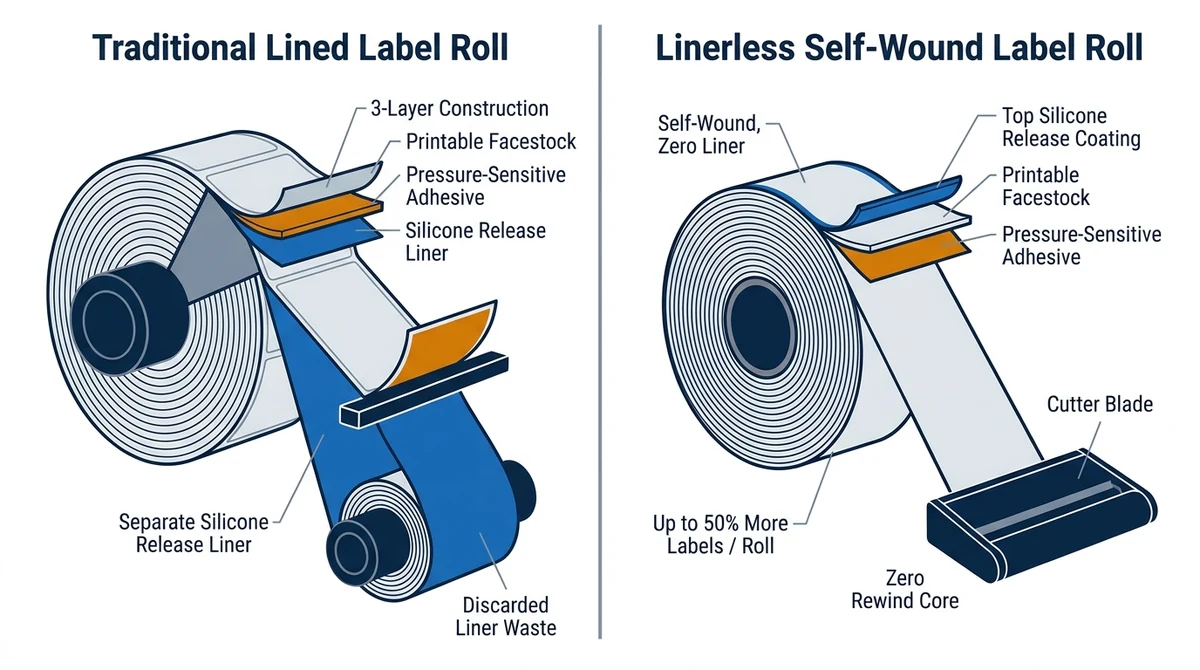
Linerless labels replace the separate backing sheet with a self-wound roll architecture where each wrap protects the adhesive layer directly above it. By moving the low surface energy silicone release coating onto the printed face of the label stock—or replacing tacky pressure-sensitive adhesive with a dry water-activated coating—the roll unwinds smoothly without sticking permanently to itself.
Traditional pressure-sensitive labels consist of three functional layers: a printable facestock, a pressure-sensitive adhesive layer, and a separate silicone-coated release liner. The release liner—typically super calendered Kraft (SCK) paper in the United States, polyvinyl alcohol (PVOH) top-coated glassine paper in Europe, or plastic films such as biaxially oriented PET (BO-PET) and biaxially oriented polypropylene (BOPP)—protects the adhesive during manufacturing and handling before becoming waste immediately after dispensing.
Silicone topcoat chemistry and curing stability
Conventional linerless constructions rely on crosslinkable silicone applied directly over the printable top surface. Silicone release coatings provide a low surface tension between 18 and 22 mN/m, allowing the underlying pressure-sensitive adhesive to peel cleanly as the roll unwinds.
Because the silicone sits directly on the finished label rather than on a discarded carrier web, converting tolerances are tighter than on standard lined stock. The silicone release formulation must match the specific adhesive and application speed, and complete crosslinking during curing is essential because incomplete curing can cause silicone migration, uneven release forces, and contamination defects during converting and dispensing.
Water-activated silicone-free linerless systems
A newer industrial variant eliminates both the backing liner and the top silicone coating altogether. In water-activated linerless systems, the dry adhesive stays non-tacky while wound onto the roll, allowing the face stock to be printed freely without a silicone barrier. Immediately before application onto a shipping carton, a dedicated multi-nozzle activation unit sprays a fine water mist onto the underside to activate adhesion on demand.
How do linerless labels compare to traditional lined label rolls?
Eliminating the backing paper increases label yield per roll by up to 50%, cuts roll weight and shipping costs by up to 40%, and removes liner disposal waste and slip hazards from the plant floor. Traditional lined rolls still lead where intricate die-cut shapes, standard non-cutter applicators, or complex multi-layer prime decorations are required, so linerless systems complement rather than universally replace lined labels.
First created in the mid-1980s, early linerless labels struggled with custom printer expense, silicone coating costs, and rigid sizing. Modern converting, variable-length cutters, and multi-layer adhesives have shifted the operational balance across high-volume shipping and food lines.
| Comparison Dimension | Traditional Lined Label Roll | Linerless Label Roll | Operational Impact on Packaging Lines |
|---|---|---|---|
| Layer construction | Three functional layers: facestock, adhesive, and separate silicone-coated release liner (SCK, glassine, or BO-PET) | Self-wound facestock with top silicone release coating and underside adhesive, or silicone-free water-activated dry adhesive | Removes the entire backing carrier web from purchasing, transport, and waste streams |
| Labels per roll | Baseline roll capacity constrained by backing liner thickness | Up to 50% more labels per roll at comparable roll diameter | Fewer roll changeovers and lower line stoppage downtime during shifts |
| Reel weight and shipping freight | Heavier rolls due to backing paper or PET film carrier | Reels up to 40 percent lighter; shipping cost savings up to 40% | Lower inbound freight mass and smaller warehouse storage footprint |
| Label length flexibility | Fixed pre-cut die dimensions (for example, printing 4-inch data onto a 6-inch pre-cut label wastes blank stock) | Continuous web cut on demand to variable label lengths matching actual printed content | Eliminates unused blank label stock on variable-content orders |
| Backing waste and floor safety | Release liner becomes waste immediately after dispensing; loose strips create slip-and-fall hazards | Zero release liner waste on the floor or in disposal bins | Supports source reduction and keeps packing stations cleaner and safer |
| Printing and design capability | Wide support for custom die-cut shapes, intricate prime finishes, and standard applicators | Supports variable lengths, die-cut formats, and double-sided printing directly onto the adhesive layer | Fits continuous logistics, weigh-price, and tray formats; complements lined prime labels |
| Hardware compatibility | Runs on standard peel-bar applicators and conventional thermal printers | Requires dedicated linerless printers or applicators equipped with a cutter and compatible adhesive handling | Prevents drop-in use on unmodified lined printers without hardware retrofit |
Quantified waste reduction and source-reduction alignment
Under the U.S. EPA Non-Hazardous Materials and Waste Management Hierarchy, source reduction—preventing waste at the source and lightweighting packaging—ranks as the most environmentally preferred strategy ahead of recycling, energy recovery, and landfill disposal. According to U.S. EPA containers and packaging waste data, containers and packaging accounted for 82.2 million tons of municipal solid waste generation in 2018, representing 28.1 percent of total generation. While conventional release liners can be collected for dedicated recycling programs—such as a UK depot repurposing trial that diverted 25 tonnes of liner waste from landfill—linerless conversion prevents backing waste from entering the facility in the first place.
Published logistics benchmarks illustrate the material scale of source reduction. Across 1.5 million standard 105 x 148.5 mm logistics labels, switching to linerless stock saves around 1.37 tons of material and reduces CO2 emissions by 1.42 tons while maintaining identical label output.
What printer and cutter hardware do linerless labels require?
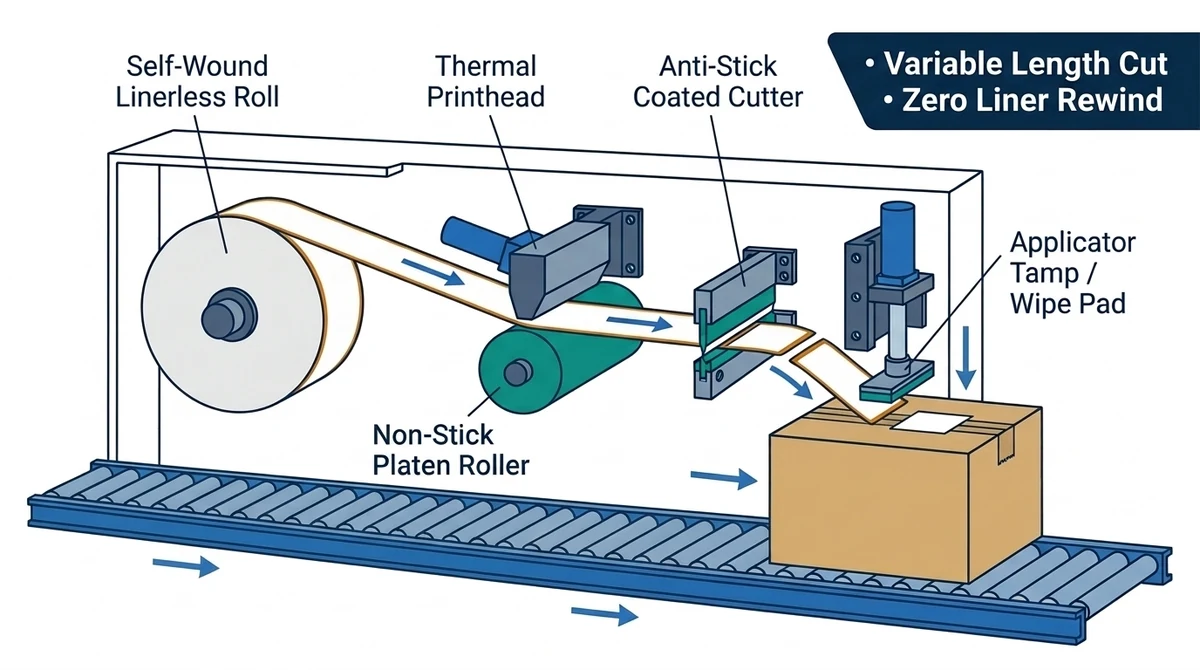
Linerless labels cannot run safely on an unmodified standard lined label printer or peel-plate applicator; they require dedicated linerless hardware equipped with an integrated cutting mechanism and adhesive-tolerant web path components. Loading exposed-adhesive linerless stock onto a standard printer leads to adhesive accumulation on rollers and blades, print voids, and jam-related downtime.
In standard direct thermal printing architecture, a printer pairs a heated printhead—available at resolutions up to 1,200 dpi—with a rubber platen roller that feeds the web and a spring that holds the label stock against the heating elements. On traditional lined media, the release liner shields the platen roller from the adhesive. Once that backing sheet is removed, the tacky adhesive rides directly over the feed path and passes straight through the cut station.
Managing roller buildup, print voids, and cutter contamination
Adhesive behavior at the cutter and platen is the primary engineering trade-off in linerless automation. Early linerless materials relied on single-formula adhesives that created recurring line failures: if an adhesive lacked tack for the package surface, labels detached; if it was too aggressive, it disrupted the top release coating, caused print voids, and built up on rollers to trigger unplanned stoppages.
Cutting mechanisms face a parallel conflict. Delivering high holding power on rough cartons requires sufficient adhesive coat weight, yet heavy exposed adhesive contaminates cutter blades and forces frequent cleaning and component replacement. Some conventional linerless webs leave adhesive-free zones across the cut line to protect blades, but those unglued bands increase the risk of label edges lifting or sticking to adjacent packages during conveyance.
Two modern engineering paths resolve that blade-fouling trade-off:
- Full-surface multi-layer pressure-sensitive adhesives: Multi-layer PSA constructions such as 62Dps prevent adhesive bleeding across the entire label surface, removing the need for adhesive-free cut zones while reducing cutter contamination and extending printer cleaning intervals.
- Water-activated dry-adhesive print-and-apply: Systems pairing dry linerless stock with a multi-nozzle water-mist activation module keep the web dry and non-tacky through the printhead and cutter, activating adhesion only during final transfer onto the carton.
Thermal durability and print-mode checks
Because most inline linerless shipping and weigh-scale printers use direct thermal imaging without a transfer ribbon, confirm both label retention life and coating chemistry before converting a line. Modern thermochromic coatings are substantially more stable than early thermal stocks and keep printed text legible for at least 50 days in practice, making them well suited to fast-turnover fulfillment and fresh food distribution; for operator-contact safety on direct thermal paper coatings, the U.S. EPA Risk Management program for BPA released its Design for the Environment alternatives assessment, Bisphenol A (BPA) Alternatives in Thermal Paper, on January 29, 2014. When shipping labels face extended warehousing, heat, UV exposure, or chemical abrasion, review our direct thermal vs thermal transfer comparison to verify whether ribbonless direct thermal meets scan retention targets.
What are linerless labels used for on automated packaging lines?
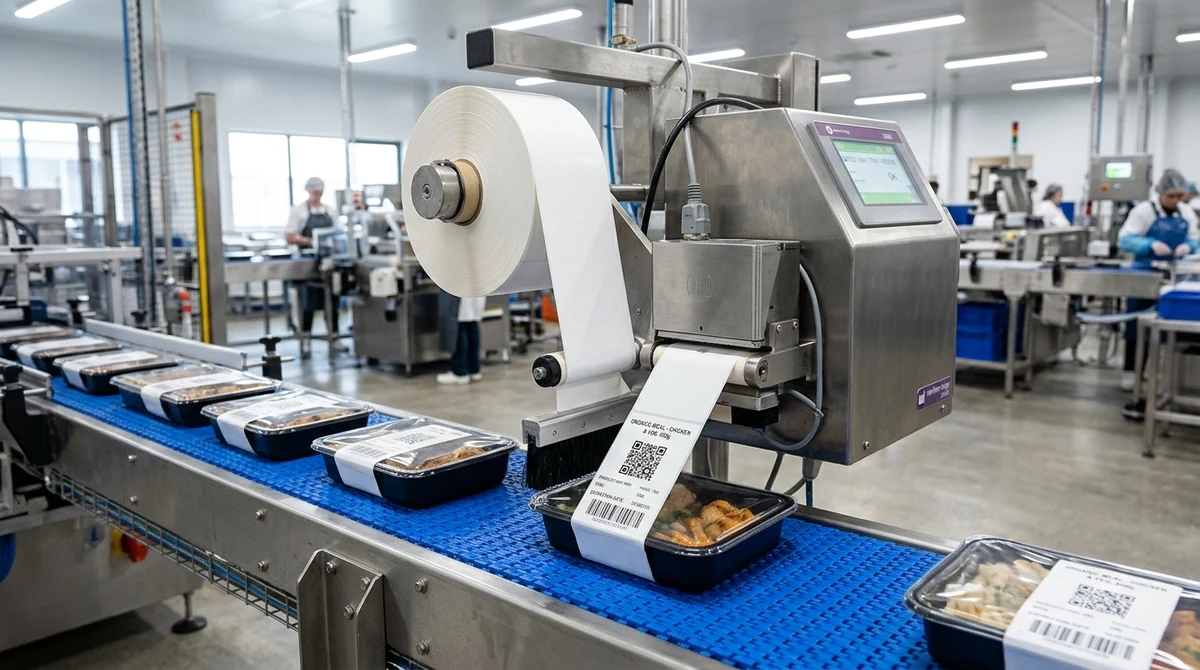
Automated packaging lines deploy linerless labels primarily across high-volume logistics cartons, fresh produce and ready-meal trays, and airless wrap-around bottle stations where roll changeover downtime, backing waste, and variable label lengths drive operating costs. They perform reliably across challenging packaging substrates including rough corrugated cardboard, plastic pallet wrap, chilled trays, and rigid consumer bottles.
| Packaging Line Sector | Common Linerless Format | Verified Equipment & Deployment Benchmarks | Primary Operational Advantage |
|---|---|---|---|
| Logistics, distribution, and e-commerce cartons | Standard shipping formats (such as 105 x 148.5 mm) and variable-length barcode labels | DHL Nohra, Germany facility serving more than 25,000 internal customers switched to water-activated linerless print-and-apply (Hermes Q platform) | Eliminates backing waste and adheres to rough corrugated board and plastic pallet wrap |
| Fresh produce and chilled food trays | Wraparound, C-wrap, and top-surface tray labeling | CE-compliant automated applicators such as the M360+ support wraparound, C-wrap, and top labeling with reels up to 40 percent lighter | Removes liner disposal from hygienic food rooms while cutting reel weight and changeovers |
| Beverages, personal care, and household containers | Continuous wrap and patch formats on rigid bottles | Airless linerless applicators such as the Nobac 40B apply labels up to 200 mm long by 40 mm wide at speeds up to 75 bottles per minute | Airless mechanical transfer with FSC and PEFC certified linerless materials and fewer reel changes |
| Variable-length shipping, retail, and traceability stations | On-demand direct thermal barcode, pricing, and batch labels | Dedicated cutter-equipped desktop, mobile, and inline thermal printers | Cuts exact length needed instead of wasting fixed pre-cut stock (such as 4-inch print on 6-inch labels) |
For secondary shipping cases that still run lined thermal transfer media, compare carton handling requirements in our box and carton labeling machine guide and review actuator stroke kinematics in tamp vs wipe-on vs blow-on applicators.
How do linerless labels fit among self-adhesive label types?
Linerless labels are a carrier-free branch of pressure-sensitive labels—the dominant industrial label attachment family used in more than 80% of all labels in the market today, according to peer-reviewed acrylic PSA research in Polymers. They rely on the same viscoelastic polymer bonding physics and cold-temperature grading as lined pressure-sensitive stock, while sitting alongside heat-activated, shrink-sleeve, wet-glue, and static-cling alternatives. For food packaging applications where adhesives touch poultry, dry food, or produce surfaces, U.S. FDA food-contact pressure-sensitive adhesive regulations specify approved safe adhesive substances and conditions of use.
In pressure-sensitive adhesive engineering, PSAs are nonreactive viscoelastic polymers that bond under light contact pressure without heat, water, or solvents. Rather than lap shear strength alone, PSA performance is defined by the balance of initial tack, peel resistance, and shear resistance—properties governed by polymer chemistry, coat weight, rub-down pressure, and temperature.
| Self-Adhesive Grade or Attachment Class | Core Mechanism & Service Boundary | Representative Industrial Fit |
|---|---|---|
| Permanent PSA (lined or linerless) | Bonds with light pressure; service temperature limit of -10 degrees Celsius; cannot be removed cleanly without tearing stock | Shipping cartons, logistics barcodes, consumer product containers, and industrial identification |
| Peelable and ultra-peelable PSA | Removes cleanly without tearing base stock or leaving adhesive residue; ultra-peelable leaves zero residue on glass or book covers | Reusable distribution totes, temporary instructional labels, and clean-peel retail items |
| Freezer (frost-fix) PSA | Formulated for deep-freeze service down to -40 degrees Celsius where standard adhesives lose tack below -10 degrees Celsius | Frozen food trays, cold-chain cartons, and sub-zero warehouse logistics |
| High-tack PSA | Permanent adhesive applied at higher coat weights for high initial grab on rough, dirty, or low-energy substrates | Recycled corrugated cases, textured shippers, and demanding industrial surfaces |
| Non-PSA attachment alternatives | Heat-activated or in-mold adhesives, PVC/PETG shrink-wrap sleeves, wet glue (starch, dextrin, or PVA), and static cling | High-speed beverage sleeving, wet-glue glass bottling, and full 360-degree contoured containers |
Laboratory test standards and geometric checks for linerless selection
When qualifying a linerless adhesive and facestock for an automated packaging line, request supplier test data anchored to standard laboratory conditions and ASTM methods:
- Standard ambient conditioning: Most PSA test methods run at 23 degrees Celsius and 50% relative humidity, supplemented by cold or elevated temperature testing because cold stiffens adhesives and reduces tack while heat softens adhesives and lowers shear holding power.
- Peel, tack, and shear test protocols: Peer-reviewed acrylic PSA evaluations measure 180-degree peel resistance after 20 minutes and 24 hours on 275 x 25 mm PET and paper strips pulled at 300 mm/min, loop tack on 175 x 25 mm loops at 300 mm/min, and static shear holding a 1 kg load on a 25 x 25 mm contact area angled 2 degrees from vertical until failure.
- ASTM label benchmarks: Use ASTM D6252 for 90-degree peel adhesion of pressure-sensitive label stocks, ASTM D7932 for printed PSA labels exposed to extreme distribution environments, and ASTM D5375 when benchmarking high-speed release liner removal on legacy lined rolls.
- Corner geometry: Label shape affects long-term bond stability because pointed corners begin detaching first, whereas rounded corners resist edge lifting on curved containers and fast conveyors.
Before scheduling a line trial or issuing equipment specifications, assemble your substrate samples, cold-storage temperature floor, target label lengths, and shift volume using our labeling machine RFQ checklist.
Technical references
- Márquez et al., Influence of Acrylic Acid and Tert-Dodecyl Mercaptan in the Adhesive Performance of Water-Based Acrylic PSAs (Polymers / PubMed Central NIH) — Peer-reviewed PSA market share (>80% of all labels) and standardized 180-degree peel, loop tack (300 mm/min), and 1 kg static shear test protocols.
- U.S. EPA — Sustainable Materials Management: Non-Hazardous Materials and Waste Management Hierarchy — Federal ranking placing source reduction and packaging lightweighting above recycling and landfill disposal.
- U.S. EPA — Containers and Packaging: Product-Specific Data — Federal municipal solid waste statistics reporting 82.2 million tons of containers and packaging generated in 2018 (28.1 percent of total MSW).
- U.S. FDA — Pressure-Sensitive Adhesives for Food-Contact Labels (eCFR) — Federal conditions of safe use for pressure-sensitive adhesives applied as food-contact surfaces of labels and tapes.
- U.S. EPA — Risk Management for Bisphenol A (BPA) — Federal TSCA overview and January 29, 2014 Design for the Environment alternatives assessment for BPA in thermal paper coatings.
Frequently asked questions
Can I run linerless labels in a standard label printer or applicator?
No. Standard label printers and applicators rely on a release liner to shield the rubber platen roller and peel bar from tacky adhesive. Running linerless labels requires a dedicated linerless printer or applicator equipped with an integrated cutter and compatible web-path components; otherwise adhesive builds up on rollers and blades, causing print voids and jam downtime.
How many more labels fit on a linerless roll compared to a lined roll?
Removing the release liner allows up to 50% more labels to fit on a roll of the same outer diameter while making reels up to 40 percent lighter. Higher label counts per roll directly reduce roll changeovers, operator downtime, and inbound shipping costs by up to 40%.
How do linerless labelers prevent adhesive buildup on the cutter blade?
Modern systems control blade fouling through two mechanisms: pairing anti-stick cutting hardware with full-surface multi-layer pressure-sensitive adhesives (such as 62Dps) that prevent adhesive bleeding and extend cleaning intervals, or switching to water-activated linerless stock that stays dry through the cutter and activates via a fine water mist only at application.
Do linerless labels work in cold storage and freezer environments?
Yes, when matched to the right adhesive grade. Standard permanent and peelable pressure-sensitive adhesives have a service temperature limit of -10 degrees Celsius, whereas freezer (frost-fix) adhesives extend service down to -40 degrees Celsius, and modern linerless adhesive portfolios cover cold, moist, and rough corrugated surfaces.
When should a packaging line stay with traditional lined labels instead of switching to linerless?
Stay with traditional lined labels when your line requires intricate custom die-cut prime shapes, relies on existing non-cutter peel-bar applicators that cannot be retrofitted, or cannot support the tighter silicone curing and adhesive-maintenance requirements of linerless hardware. Industry converters treat linerless as a high-efficiency complement to lined stock rather than a universal replacement for every application.
Related Guides & Specifications
Related Equipment & Guides
Label Applicators & Print-and-Apply Systems: Actuation, Speed & Retrofit Guide
Compare pre-printed label applicators and print-and-apply systems across wipe-on, tamp-blow, air-blow, and corner-wrap actuation, web speed, and retrofits.
Learn morePrint and Apply Labeling Systems: Thermal Engines, DPI, and PLC Integration
Select print and apply labeling machines across Zebra, Sato, and Datamax engines, 203 to 600 DPI printheads, EtherNet/IP handshakes, and ISO/IEC 15416 grading.
Learn moreBox and Carton Labeling Machines: Top-Surface, Side Wipe-On & Corner-Wrap Guide
Select box and carton labeling machines across split-belt top labelers, side wipe-on case applicators, corner-wrap systems, and GS1 barcode clearance rules.
Learn moreTamp vs Wipe-On vs Blow-On Applicators and Print-and-Apply Systems
Engineering comparison of wipe-on, tamp-blow, and air-blow label applicators versus print-and-apply systems across speed, stroke distance, accuracy, and air use.
Learn moreLabeling Machine RFQ Checklist and User Requirement Specification (URS)
Engineering labeling machine RFQ checklist and User Requirement Specification (URS) template covering container drawings, roll unwind #1-#8, CPM, and FAT rules.
Learn moreDirect Thermal vs Thermal Transfer: Durability, Costs, and Line Fit
Direct thermal prints ribbonless on heat-sensitive paper for short-term shipping, while thermal transfer melts ribbon ink for durable industrial barcodes.
Learn more