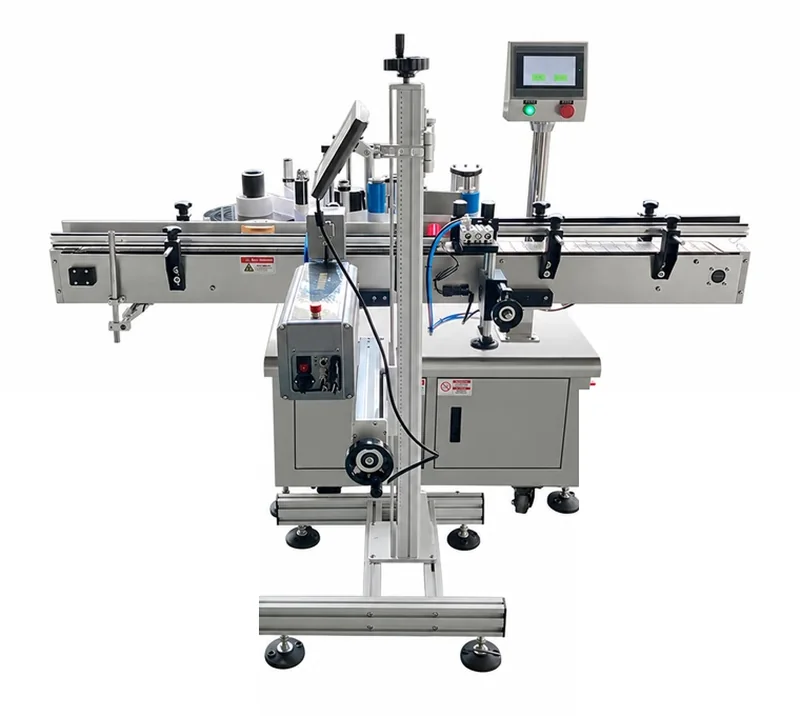
Switching an industrial labeling machine from opaque paper labels to transparent BOPP or PET (“no-label look”) film immediately exposes the physical limitations of standard label gap sensors. A standard infrared (IR) photoelectric fork sensor detects the edge of a die-cut label by measuring the light opacity step between the two-layer label-plus-liner stack and the single-layer siliconized backing liner across the 3 mm inter-label gap. When both the clear film facestock and a clear PET release liner transmit infrared light almost identically, an optical fork sensor fails to see the gap, resulting in double-dispensed labels, erratic stop positions on the peel plate, or continuous web runaway.
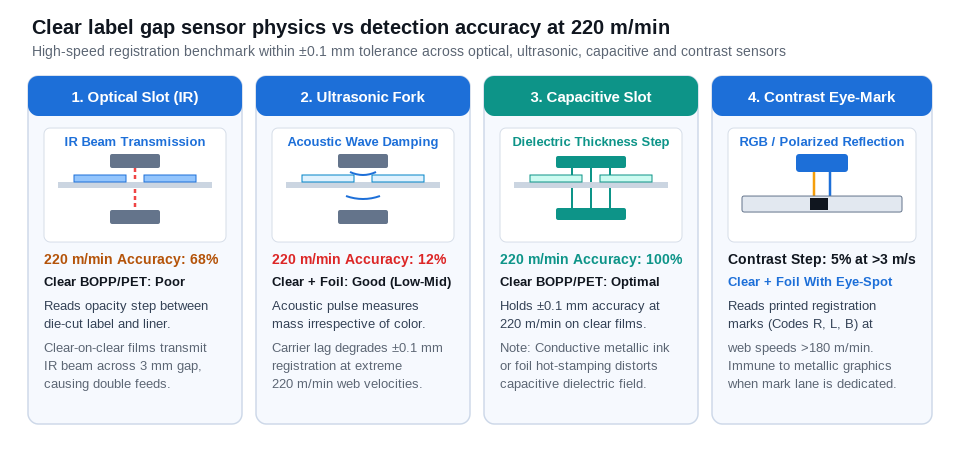
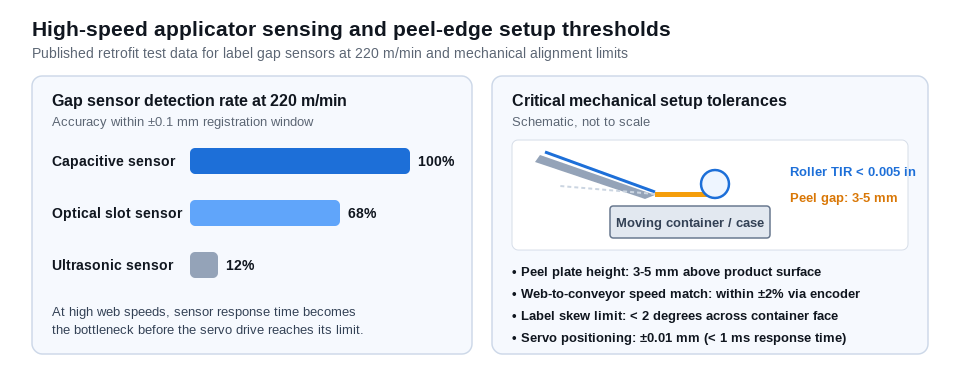
High-speed web registration testing shows that when linear web velocity reaches 220 m/min under a strict ±0.1 mm registration tolerance, standard optical slot sensors drop to 68% detection accuracy, ultrasonic gap sensors drop to 12% accuracy, and differential capacitive gap sensors maintain 100% detection accuracy. Whether you are upgrading semi-automatic and tabletop labelers for craft cosmetic jars or specifying a 600-container-per-minute rotary beverage line, selecting and calibrating the right clear label sensor requires matching sensor physics (optical, differential capacitive, ultrasonic, or RGB contrast eye-mark) to your facestock opacity, metallic ink coverage, and maximum web speed.
Why Clear BOPP and PET Labels Challenge Standard Gap Sensors
Clear-on-clear pressure-sensitive labels carry a 15% to 25% material cost premium over paper labels because they require optically clear biaxially oriented polypropylene (BOPP) or polyester (PET) facestocks paired with smooth, non-textured film liners that prevent adhesive “orange peel” appearance on glass and clear plastic bottles. Across industrial packaging lines, transparent labels exhibit a 6.1% baseline defect rate when run without specialized gap and vision sensing (compared to 1.9% on flat opaque labels and 2.8% to 3.2% on standard round bottle labels). Pairing the correct gap sensor with downstream optical/AI verification reduces transparent label defect rates from 6.1% down to 0.42%, a 93.1% reduction in scrap and rework.
On the dispensing head itself, the label gap sensor must detect the trailing edge of each label as it advances toward the peel plate tip (which sits 3 to 5 mm from the container wall) and command the servo or stepper drive to decelerate to a precise stop within ±0.1 mm on high-speed primary lines or ±0.5 to 1.0 mm on standard inline applicators. Four physical variables complicate that measurement on clear films:
- Minimal optical attenuation across the gap: A 50-micron clear BOPP film on a 30-micron clear PET liner attenuates less than 5% to 8% more infrared light than the bare liner alone. Any smudge of adhesive, splice tape, or printed text passing through an optical beam looks darker than the clear label edge itself.
- High web velocity vs sensor switching frequency: At 600+ containers per minute, web speeds routinely reach 180 to 220 m/min (3.0 to 3.67 m/s). At 220 m/min, the web travels 3.67 mm per millisecond (or 0.1 mm every 27.3 microseconds). A sensor whose internal signal conditioning lags by even 100 microseconds introduces nearly 0.4 mm of registration jitter.
- Metallic foil and conductive ink graphics: Cosmetic, wine, and spirits labels frequently combine clear BOPP films with metallic hot-stamping, silver foil borders, or high-density opaque flood coats. Metallic/reflective labels exhibit the highest baseline defect rate in packaging at 7.4%.
- Container detection vs label gap detection: In addition to the fork sensor reading the label web, the product sensor mounted on the conveyor must detect clear glass or transparent PET bottles without false walk-through triggers.
Physics of the Four Label Sensor Technologies
Every label gap or registration sensor operates on one of four physical principles: optical light transmission, acoustic wave damping, dielectric capacitance, or reflected chromatic contrast.
| Sensor Technology | Physical Measurement Principle | Detection Accuracy at 220 m/min (±0.1 mm) | Clear Film on Paper Liner | Clear Film on Clear PET Liner | Clear Film With Metallic Foil / Conductive Ink |
|---|---|---|---|---|---|
| Optical Slot (Infrared / Red LED) | Through-beam light opacity attenuation between emitter and receiver | 68% | Poor; triggers falsely on dark print graphics | Fails; IR beam passes straight through clear film and liner | Fails when opaque print and clear window alternate in sensor lane |
| Ultrasonic Fork Sensor | High-frequency acoustic wave attenuation through material mass | 12% | Good at low-to-medium web speeds (<60-100 m/min) | Good at low-to-medium web speeds; completely color-immune | Excellent at low-to-medium speeds; unaffected by foil or ink |
| Differential Capacitive Slot | High-frequency electrical field shift from dielectric thickness step | 100% | Excellent across all web speeds up to 220 m/min | Optimal; reads physical thickness step within ±0.1 mm at 220 m/min | Poor if metallic foil or conductive carbon ink crosses the electrode slot |
| RGB Contrast / Eye-Mark Sensor | Reflected white/RGB light intensity step (down to 5% contrast difference) | High (>180 m/min / >3 m/s rated) | Requires printed registration bar in dedicated lane | Excellent when reading printed eye-mark on back or edge of web | Optimal solution for clear + metallic labels using a dedicated eye-spot lane |
1. Optical Slot (Photoelectric Fork) Sensors
An optical slot sensor projects a focused infrared or visible red LED beam across a 2 to 5 mm fork throat onto a phototransistor receiver. On opaque paper or white BOPP labels backed by translucent glassine liner, the label blocks 60% to 90% of the beam while the 3 mm die-cut gap transmits light, creating a sharp voltage step.
When clear BOPP or PET labels are threaded through an optical slot sensor, the clear film transmits almost the entire beam, and dark printed text or barcodes inside the label absorb far more light than the label edge itself. Even on high-gain optical sensors with digital teach-in, web flutter and variable ink density cause detection accuracy within ±0.1 mm to fall to 68% at 220 m/min. Optical slot sensors should be restricted to opaque paper, white synthetic, and thermal transfer shipping labels where no transparent windows cross the sensor path.
2. Differential Capacitive Gap Sensors
A differential capacitive slot sensor passes the label web between two precision-machined flat electrodes separated by a narrow air gap (typically 0.5 to 1.0 mm). Instead of shining light through the web, the sensor generates a high-frequency electrical field and measures the change in dielectric capacitance caused by the physical thickness and mass step between the single-layer liner and the two-layer label-plus-liner composite.
Because capacitance responds to dielectric thickness at electronic oscillator speeds (response times of 10 to 30 microseconds) rather than optical opacity or acoustic travel time, differential capacitive sensors achieve 100% detection accuracy within ±0.1 mm at 220 m/min. They are the primary engineering choice for high-speed clear-on-clear BOPP and PET film labels.
However, capacitive sensors have one strict exclusion rule: conductive materials. If a clear label features hot-stamped metallic gold/silver foil, metallized film backing, or carbon-heavy conductive black ink that passes directly between the capacitive electrodes, the metal alters the dielectric field far more than the film thickness step and causes false edge triggers.
3. Ultrasonic Fork Sensors
An ultrasonic fork sensor mounts a piezoelectric ultrasonic transmitter in one arm of the fork and an acoustic receiver in the opposite arm. As the web passes through the slot, the two-layer label-plus-liner stack damps and reflects more ultrasonic sound energy than the single-layer liner gap. Because sound waves respond to mechanical layer impedance rather than color, transparency, or electrical conductivity, an ultrasonic sensor detects clear-on-clear film, opaque paper, and metallic foil labels alike without recalibration when graphics change.
Why, then, does ultrasonic sensor accuracy within ±0.1 mm drop to 12% at 220 m/min at 220 m/min web speeds? Sound travels through air at approximately 343 m/s (0.343 mm per microsecond), and ultrasonic carrier frequencies (typically 300 to 500 kHz) require multiple acoustic wave cycles plus envelope filtering to confirm a gap edge, yielding sensor response times of 200 to 500 microseconds. At a moderate tabletop or semi-automatic dispense speed of 15 to 40 m/min (0.25 to 0.67 m/s), a 300-microsecond ultrasonic response delay shifts the stop position by only 0.075 to 0.20 mm, which is well within standard ±0.5 to 1.0 mm tolerances. At 220 m/min (3.67 m/s), that same acoustic carrier lag translates into more than 1.1 mm of positional uncertainty, failing the ±0.1 mm high-speed cutoff.
4. RGB Contrast Sensors and Printed Eye-Marks
When a high-speed clear film label (>100 to 220 m/min) carries heavy metallic hot-stamping or foil blocks that would trip a capacitive sensor, while running too fast for an ultrasonic fork sensor, packaging engineers specify a printed registration eye-mark read by a high-speed optical contrast sensor.
Industrial contrast sensors project a broadband white or automatic RGB LED spot onto a dedicated track along the back of the release liner or the edge of the film web. High-speed contrast sensors resolve contrast differences as small as 5% at web velocities exceeding 3 m/s (180 m/min) with switching response times down to 10 to 50 microseconds. When ordering rolls from your label converter, specify the exact unwind direction (Standard Unwind Positions #1 through #8) together with the converter eye-spot location code:
- Code R: Eye-spot printed on the right edge of the web
- Code L: Eye-spot printed on the left edge of the web
- Code B: Eye-spot printed on both edges
- Code N: No eye-spot (for standard capacitive or ultrasonic gap sensing)
Calculating Sensor Response Time vs Maximum Web Speed
To verify whether a candidate sensor can hold your target placement tolerance before ordering hardware, calculate the web travel distance during one sensor response cycle:
$$\text{Positional Jitter (mm)} = \frac{\text{Web Speed (m/min)}}{60} \times \frac{\text{Sensor Response Time (\mu s)}}{1000}$$
- At 30 m/min (typical semi-automatic or tabletop wrap labeler) with a 300 µs ultrasonic sensor: $\frac{30}{60} \times 0.3 = 0.15\text{ mm}$ travel per response cycle (passes ±0.5 mm tolerance easily).
- At 180 m/min (3 m/s high-speed rotary/inline bottle labeler) with a 300 µs ultrasonic sensor: $\frac{180}{60} \times 0.3 = 0.90\text{ mm}$ jitter before mechanical drive variance is even added (fails ±0.25 mm prime label tolerance).
- At 220 m/min (3.67 m/s) with a 25 µs differential capacitive or high-speed RGB contrast sensor: $\frac{220}{60} \times 0.025 = 0.092\text{ mm}$ travel per response cycle (holds the ±0.1 mm high-speed registration envelope).
Sensing Transparent Containers on the Conveyor
Clear label dispensing also requires reliable product arrival sensing on the conveyor belt. Standard diffuse photoelectric sensors shoot a beam straight through flint glass jars, clear PET beverage bottles, and transparent cosmetic vials without reflecting back to the receiver. Specify one of two container sensors for transparent packaging:
- Polarized retro-reflective photoelectric sensor with coaxial optics: Uses a corner-cube reflector on the opposite conveyor rail and polarizing filters that detect the phase depolarization and dual-wall attenuation of clear glass or PET containers.
- Ultrasonic proximity sensor: Detects the front wall of any glass, plastic, or metal container via acoustic echo time-of-flight with complete immunity to container transparency or liquid fill color, paired with a rotary shaft encoder for microsecond-level tracking at 600+ containers per minute.
Step-by-Step Calibration Procedure for Clear Label Sensors
- Thread the web tightly through the sensor guide slot: Ensure the web runs flat against the reference baseplate of the capacitive or ultrasonic fork without flutter. A loose web that wanders diagonally or flaps vertically inside a capacitive slot changes air-gap capacitance and causes false triggers.
- Position the sensor lane away from metallic foil (for capacitive sensors): Slide the fork bracket laterally across the web width so the sensing electrodes pass over clear film and non-metallic ink only.
- Teach the single-liner vs label-plus-liner states:
- Remove one label from the backing liner so a bare liner section sits inside the sensor slot, and press the Liner / Gap Teach button (or static teach step 1).
- Advance the web so the clear label body sits inside the sensor slot, and press the Label Teach button (step 2) so the amplifier sets the switching threshold mid-way between the two dielectric or acoustic levels.
- Alternatively, on dynamic teach sensors, hold the teach button while jogging 3 to 5 consecutive labels and 3 mm gaps through the slot at constant speed.
- Set the peel-tip stop offset: Jog three labels at operating speed and verify that each peeled label tip stops uniformly 1 to 2 mm proud of the sharp peel edge (with the peel plate positioned 3 to 5 mm from the container wall).
How LINEVO Equips Labelers for Clear and Metallic Films
LINEVO equips its automatic inline bottle labelers, rotary wrap-around systems, and semi-automatic tabletop machines with application-matched differential capacitive, ultrasonic fork, or high-speed RGB contrast sensors based on your roll samples. Sensor model, web speed limit, unwind chart specification, and placement accuracy are verified on buyer containers and labels and set out in the quotation.
Continue exploring our engineering guides on fixing label wrinkling, bubbling, and flagging, label roll unwind direction (#1-#8) and core sizes, how to choose an industrial labeling machine, and front-and-back labeling machines. To get a sensor and machine recommendation for your clear film rolls, check the labeling machine RFQ checklist and message LINEVO engineers on WhatsApp.
Related Guides & Specifications
Industrial Labeling Machine Price and Total Cost of Ownership Guide
Transparent industrial labeling machine price breakdown from $2,000 semi-automatics to $500,000+ high-speed lines, plus hidden TCO drivers and payback math.
Learn moreHow to Choose an Industrial Labeling Machine: 7-Gate Selection Guide
Step-by-step labeling machine buying guide: 7 engineering gates from container geometry, surface energy, and unwind #1-#8 to speed headroom and line utilities.
Learn moreHow to Fix Label Wrinkling, Bubbling, Flagging, and Axial Skew
Engineering troubleshooting guide to fix pressure-sensitive label wrinkling, air bubbling, edge flagging, and axial skew across bottle and carton labelers.
Learn moreLabeling Machine RFQ Checklist and User Requirement Specification (URS)
Engineering labeling machine RFQ checklist and User Requirement Specification (URS) template covering container drawings, roll unwind #1-#8, CPM, and FAT rules.
Learn moreRelated Equipment & Guides
Automatic Labeling Machines: How to Choose by Container, Label and Speed
Choose an automatic labeling machine by container shape, label type and speed. Compare labeler types, accuracy tiers and the checks to run on your samples.
Learn moreLabel Applicators & Print-and-Apply Systems: Actuation, Speed & Retrofit Guide
Compare pre-printed label applicators and print-and-apply systems across wipe-on, tamp-blow, air-blow, and corner-wrap actuation, web speed, and retrofits.
Learn moreSemi-Automatic & Tabletop Labelers: Benchtop Selection & ROI Crossover
Compare semi automatic labeling machines and tabletop bottle labelers (10-40 BPM) against automatic inline payback, cradle vs. tamp fixtures, and TCO math.
Learn moreHow to Fix Label Wrinkling, Bubbling, Flagging, and Axial Skew
Engineering troubleshooting guide to fix pressure-sensitive label wrinkling, air bubbling, edge flagging, and axial skew across bottle and carton labelers.
Learn moreEditorial Policy and Engineering Verification Standards
How IndustrialLabelingMachine.com compiles engineering guides, attributes standards and OEM benchmarks, and verifies labeling specifications during FAT.
Learn more