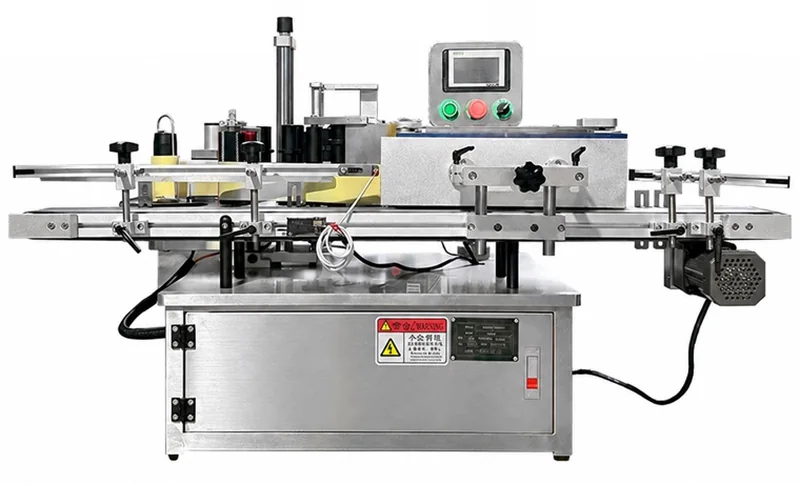
Across high-speed packaging plants, pressure-sensitive labeling defects account for 15% to 20% of all beverage and consumer-goods line stoppages. When an industrial labeling machine begins producing creased labels, trapped air blisters, lifting trailing edges, or crooked wrap seams, operators frequently respond by cranking down wipe-roller pressure or raising web brake tension. Without diagnosing whether the root cause lies in container geometry, facestock stiffness, adhesive surface-energy wetting, or mechanical speed synchronization, ad-hoc adjustments accelerate roller wear and increase scrap.
Production line quality audits demonstrate how container geometry and label substrate govern baseline defect rates: flat or square bottles experience a 1.9% baseline defect rate, standard round bottles experience 2.8% to 3.2%, oval and tapered containers jump to 5.6%, transparent (“no-label look”) films hit 6.1%, and metallic or foil labels reach 7.4%. Whether you operate semi-automatic and tabletop labelers on short specialty runs or 300-bottle-per-minute automatic inline systems, executing a systematic label wrinkling bubbling fix requires isolating four distinct failure modes: wrinkling (creasing), bubbling (silvering), flagging (edge lift), and axial skew (dog-earing).
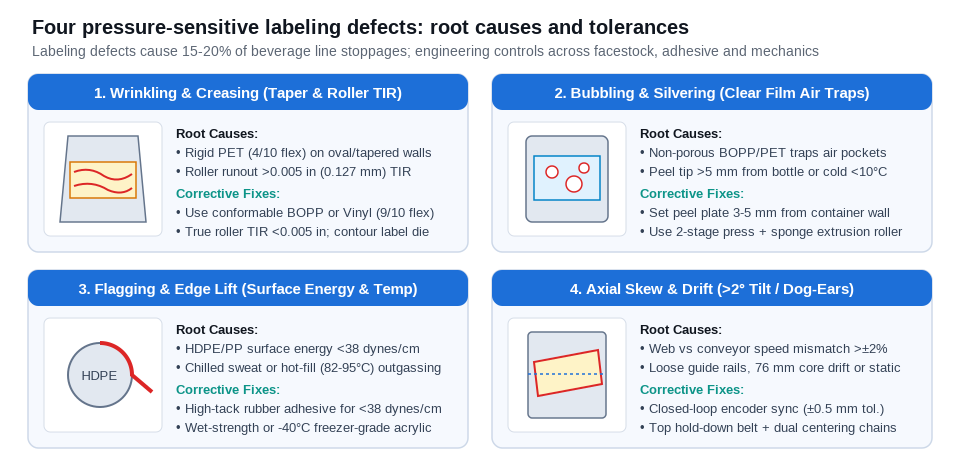
Quick-Reference Diagnostic Matrix: Symptom to Root Cause
Before adjusting machine settings, inspect three to five defective containers consecutively pulled from the discharge conveyor. If the defect appears in the exact same position on every container, the cause is a fixed mechanical setup or facestock-geometry mismatch; if the defect wanders randomly from bottle to bottle, look for container dimensional variation, loose guide rails, or web-to-conveyor speed drift.
| Defect Mode | Visual Symptom on Container | Primary Mechanical Causes | Primary Material & Environment Causes | Quantitative Engineering Target |
|---|---|---|---|---|
| 1. Wrinkling & Creasing | Horizontal or diagonal ridges folded across the label body | Application roller runout >0.005 in TIR; uneven wrap belt angle; excessive wipe pressure | Rigid polyester (PET, 4/10 flexibility) applied to tapered or compound-curve walls | Roller TIR <0.005 in (0.127 mm); switch to conformable BOPP or vinyl (9/10 flexibility) |
| 2. Bubbling & Silvering | Circular air blisters or milky haze under clear film labels | Peel plate >5 mm from bottle; single-stage hard roller trapping air pockets | Non-porous film trapping air; paper moisture absorption; cold adhesive (<10°C) | Peel gap 3 to 5 mm; two-stage press plus secondary sponge extrusion wipe |
| 3. Flagging & Edge Lift | Leading or trailing label edge wings outward after 1 to 48 hours | Insufficient wrap-belt dwell time or weak trailing-edge wipe roller | Low-surface-energy HDPE/PP (<38 dynes/cm); wet chilled glass; hot-fill (82-95°C) | High-tack/rubber adhesive for <38 dynes/cm; wet-strength or -40°C freezer acrylic |
| 4. Axial Skew & Dog-Ears | Label tilts >2° up/down or wrap ends fail to meet flush | Web speed vs conveyor mismatch >±2%; loose guide rails; off-center 76 mm core; static | Stretched film from excessive unwind brake tension; nicked peel-bar edge | Velocity match within ±2%; encoder sync (±0.5 mm accuracy); skew <2° |
Defect 1: How to Fix Label Wrinkling and Creasing on Tapered and Oval Containers
Wrinkling occurs when one edge of the label is forced to travel a shorter circumferential path than the opposite edge during wipe-down, causing the excess facestock to buckle into horizontal or diagonal creases.
Root Cause A: Container Taper and Compound Curves vs Facestock Flexibility
Even nominally cylindrical glass jars and blow-molded plastic bottles frequently have a slight draft angle (taper) from shoulder to base, while oval personal-care bottles (5.6% baseline defect rate) present compound curvature in two planes. When a rectangular die-cut label wraps around a tapered cone, the top edge of the label attempts to follow a smaller diameter than the bottom edge, creating slack across the narrower diameter that folds into a wrinkle.
Material stiffness determines how much taper a pressure-sensitive label can absorb without buckling. In published substrate flexibility ratings:
- Polyester (PET) rates 4 out of 10 in flexibility (high tensile strength of 9 out of 10, zero stretch). A rigid PET label cannot stretch or compress around a tapered or squeezable wall and immediately creases.
- Paper rates 7 out of 10 in flexibility (low tensile strength of 3 out of 10).
- Biaxially Oriented Polypropylene (BOPP) and Vinyl (PVC) both rate 9 out of 10 in flexibility (8 out of 10 tensile strength).
Engineering Fix:
- Replace rigid PET or heavyweight paper facestocks on oval, squeezable, or lightly tapered bottles with conformable BOPP or cast vinyl (9/10 flexibility).
- If container taper exceeds the elastic limit of rectangular BOPP film, ask your label converter to die-cut a contoured (arch-shaped) label matched to the cone geometry of the bottle, or transition steep full-body tapers to a steam or heat shrink-sleeve labeler.
Root Cause B: Application Roller Runout (>0.005 in TIR) and Wrap Belt Angle
If wrinkling appears on straight-walled cylindrical bottles, measure the mechanical concentricity and alignment of the application roller and wrap station. Published integration standards specify that application roller runout must remain below 0.005 inches (0.127 mm) total indicator reading (TIR). A bent roller shaft, worn bearing, or uneven foam sleeve with >0.005 in TIR pinches the top of the label harder than the bottom, driving a diagonal wave across the facestock.
Engineering Fix:
- Check application and drive rollers with a dial indicator; true or replace any roller exceeding 0.005 in (0.127 mm) TIR.
- On wrap-around belt stations, calibrate the vertical squareness of the wrap belt against the backing pad so contact pressure is uniform from the top edge to the bottom edge of the label.
Defect 2: How to Fix Label Bubbling and Clear-Film Silvering
Bubbling appears as trapped domes of air beneath the label face, while silvering appears as a frosty, metallic-looking cloudiness under transparent BOPP or PET labels (6.1% baseline defect rate) caused by thousands of microscopic air pockets trapped in the adhesive texture.
Root Cause A: Excessive Peel-Plate Distance and Single-Stage Wiping
When the sharp tip of the peel plate sits too far from the passing container, the peeled leading edge of the label hangs unsupported in the air, curls slightly, and slaps onto the bottle surface ahead of the wipe roller, trapping a pocket of air behind the leading tack line. Once air is sealed beneath non-porous BOPP or PET film, it cannot escape through the facestock.
Engineering Fix:
- Position the sharp peel-plate tip exactly 3 to 5 mm from the passing container surface so the wipe roller presses the leading edge down at the exact line of peel transfer.
- Specify a two-stage press and extrusion covering-label mechanism (standard on high-precision flat and round labelers such as the LINEVO
LV-620architecture): the primary press assembly secures initial registration accuracy, and a secondary compliant sponge extrusion roller wipes progressively from the center/leading edge toward the trailing tail to squeeze out all entrapped air. - For clear-on-clear “no-label look” films, always specify labels converted on a smooth clear PET film liner rather than a fibrous paper liner; paper liner texture embosses microscopic valleys into the adhesive coat that trap air and cause silvering until the adhesive flows out over 24 to 48 hours.
Root Cause B: Paper Moisture Absorption and Cold Application (<10°C)
If paper labels develop bubbles several hours after application, check roll storage humidity. Uncoated paper labels stored in damp warehouse areas absorb moisture and expand; when applied and moved into dry retail air, or when dry labels absorb condensation on a cold line, differential expansion lifts the label into blisters. Similarly, applying standard general-purpose acrylic adhesive at container temperatures below 10°C (50°F) prevents adhesive wet-out and leaves micro-bubbles across the bond interface.
Defect 3: How to Fix Label Flagging, Edge Lift, and Peeling
Flagging occurs when the leading or trailing 3 to 10 mm of a label detaches from a curved container wall and stands straight out like a tangent flag. It is driven by the competition between the elastic memory (hoop stress) of the bent facestock trying to flatten itself out and the shear/peel tack of the adhesive holding it to the container wall.
Root Cause A: Low-Surface-Energy Plastics (<38 dynes/cm)
Not all plastics allow standard pressure-sensitive adhesives to wet out and bond. Container surface energy (measured in dynes/cm) governs molecular adhesion:
- Glass and clean metal offer high surface energy (>45 to 100+ dynes/cm).
- PET and PVC bottles offer moderate-to-high surface energy (40 to 44 dynes/cm), where standard permanent acrylic adhesives bond cleanly.
- High-Density Polyethylene (HDPE) and Polypropylene (PP) jars, jugs, and tubes exhibit low surface energy below 38 dynes/cm (typically 30 to 36 dynes/cm). When a standard acrylic adhesive is applied to an untreated <38 dynes/cm HDPE bottle, especially on a small-diameter curve, the label edge lifts and flags within 24 to 72 hours.
Engineering Fix:
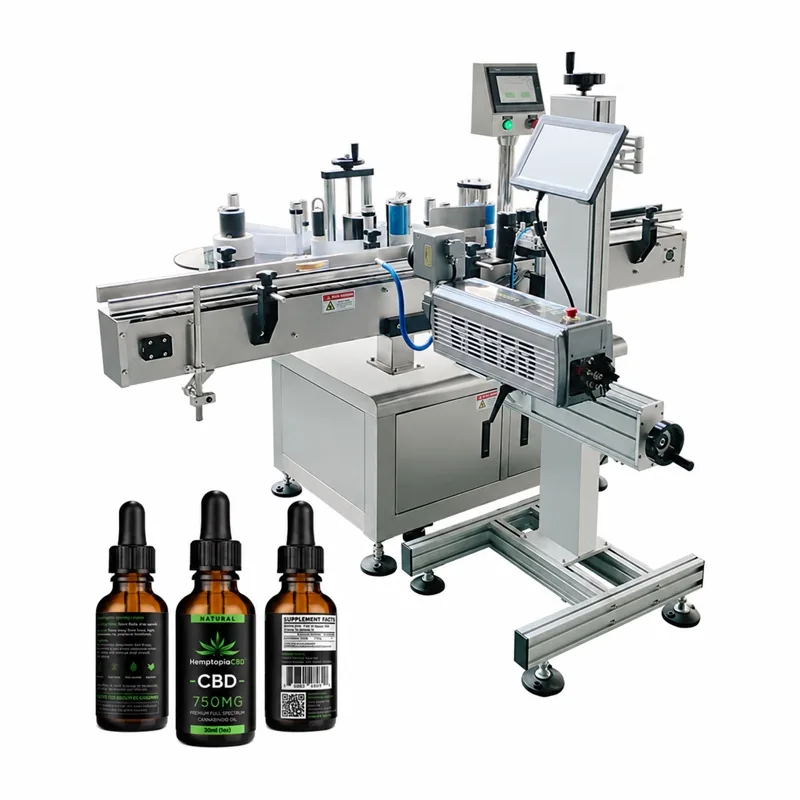
- For untreated HDPE and PP containers (<38 dynes/cm) or small-radius vials and dropper bottles, specify a high-tack rubber-based adhesive or modified aggressive mandrel-hold acrylic formulated specifically for low-surface-energy polyolefins.
- Wipe new moldbatches with isopropyl alcohol during troubleshooting to verify that silicone mold-release agents from the blow-molder are not contaminating the bottle surface.
Root Cause B: Condensation, Freezing (-40°C), and Hot-Fill Thermal Distortion (82-95°C)
Thermal and moisture mismatches at the moment of application are the second major cause of flagging and peeling:
- Chilled Beverage Condensation: Standard acrylic adhesives fail on wet surfaces because a microscopic water film blocks contact between adhesive and glass. In a documented craft brewery case study, switching from standard paper/acrylic to a wet-strength acrylic adhesive combined with vision inspection reduced labeling defect rates from 4.8% down to 0.18% across 24,000 bottles per day. Always install a high-velocity air knife tunnel upstream of the labeler to strip surface droplets.
- Freezer Cold-Chain Storage: Standard acrylic adhesives crystallize and lose tack at sub-zero temperatures. Specify freezer-grade acrylic adhesives rated down to -40°C when applying labels to cold or frozen packs.
- Hot-Fill Sauces and Juices (180 to 203°F / 82 to 95°C): Labeling plastic or glass jars immediately after hot-fill at 82 to 95°C before the cooling tunnel softens standard adhesives and causes plastic outgassing or vacuum paneling as the container cools, leading to severe flagging and blistering. Either place the labeler downstream of the cooling and drying tunnel or specify a heat-resistant cross-linked acrylic adhesive.
Defect 4: How to Fix Axial Skew, Dog-Earing, and Misalignment (>2°)
Industrial quality standards define label skew exceeding 2° as a rejectable defect. On wrap-around cylindrical bottles, even a 1.5° axial tilt causes the trailing end of a long label to miss the leading end vertically (a defect known as dog-earing or barber-poling).
Root Cause A: Web Dispense Speed vs Conveyor Speed Mismatch (>±2%)
The single most common mechanical cause of label skew and inconsistent registration is a velocity mismatch between the label dispensing head and the product conveyor. Published line-integration standards require label web dispense speed to match conveyor velocity within ±2%:
- If web speed is >2% slower than the container, the moving bottle drags the label off the peel plate, stretching flexible films and skewing the leading edge.
- If web speed is >2% faster than the container, the label buckles in the 3 to 5 mm gap before touching the bottle.
Engineering Fix: Coupled closed-loop shaft encoder synchronization resolves velocity drift across speed changes. In a documented pharmaceutical bottle line upgrade using a Trio Motion Euro404 controller to synchronize the stepper/servo dispense head with a conveyor encoder, placement accuracy tightened from ±1.0 mm down to ±0.5 mm while usable throughput increased by more than 25%. On beverage lines running round bottles, combining matched materials with inline vision/encoder control reduces round-bottle defect rates from 3.2% down to 0.15%, preventing 30,500 defective units per million containers produced.
Root Cause B: Container Rotation, Guide Rail Play, Core Drift, and Static
Four mechanical setup checks eliminate the remaining causes of axial skew:
- Positive container stabilization: A bottle that twists or rocks as it touches the peel brush will always receive a skewed label. Use double-sided synchronous centering chains to align flat or oval bottles on the conveyor centerline, and engage a spring-loaded top hold-down belt synced with the main conveyor to lock vertical orientation through the wipe station.
- Unwind mandrel centering and web tension: Verify that the 76 mm (3 in) inner-diameter label roll core is locked concentrically on the unwind mandrel and that all guide collars sit flush with the web edges. Calibrate dancer-arm brake tension so the web neither stretches (too tight) nor wanders diagonally across the idle rollers (too loose).
- Peel-bar squareness and static elimination: Inspect the sharp peel-bar edge for nicks or adhesive buildup that drag one side of the liner. On high-speed BOPP/PET film lines in dry winter air, install an ionizing static elimination bar near the peel plate so electrostatic charge does not pull the peeled label tip prematurely toward plastic bottles.
- Preventive maintenance schedule: Clean the peel plate, sensors, and rollers daily with isopropyl alcohol; inspect guide rail spacing, belt tension, and roller TIR (<0.005 in) weekly; and recalibrate dancer-arm web tension and encoder scaling monthly.
How LINEVO Prevents Labeling Defects Before Shipment
Every LINEVO wrap-around, front-and-back, and tabletop labeling system is factory-tested on buyer container and label roll samples to verify peel-plate standoff (3 to 5 mm), roller concentricity (<0.005 in TIR), two-stage sponge wipe pressure, and closed-loop encoder synchronization before shipment. Machine speed, placement tolerance, power, and physical dimensions are confirmed on your actual packaging samples and set out in the quotation.
For related troubleshooting and setup guides, read our articles on ultrasonic vs capacitive vs optical clear label sensors, label roll unwind direction (#1-#8) and core sizes, round bottle labeling machines, and front-and-back labeling machines for flat and oval bottles. To submit your containers and label rolls for an engineering evaluation, review the labeling machine RFQ checklist and message LINEVO engineers on WhatsApp.
Related Guides & Specifications
Industrial Labeling Machine Price and Total Cost of Ownership Guide
Transparent industrial labeling machine price breakdown from $2,000 semi-automatics to $500,000+ high-speed lines, plus hidden TCO drivers and payback math.
Learn moreHow to Choose an Industrial Labeling Machine: 7-Gate Selection Guide
Step-by-step labeling machine buying guide: 7 engineering gates from container geometry, surface energy, and unwind #1-#8 to speed headroom and line utilities.
Learn moreClear Label Sensor Selection: Capacitive vs Ultrasonic vs Optical
Engineering guide to clear label sensors on BOPP and PET films: why optical slot sensors drop to 68% and ultrasonic to 12% vs 100% capacitive accuracy at 220 m/min.
Learn moreLabeling Machine RFQ Checklist and User Requirement Specification (URS)
Engineering labeling machine RFQ checklist and User Requirement Specification (URS) template covering container drawings, roll unwind #1-#8, CPM, and FAT rules.
Learn moreRelated Equipment & Guides
Automatic Labeling Machines: How to Choose by Container, Label and Speed
Choose an automatic labeling machine by container shape, label type and speed. Compare labeler types, accuracy tiers and the checks to run on your samples.
Learn moreWrap-Around and Pressure-Sensitive Labeling Machines: Web Kinematics & Line Selection
Engineering guide to wrap-around and pressure-sensitive labeling machines: web tension, peel plate geometry, wrap belt vs 3-roller kinematics, and line selection.
Learn moreShrink Sleeve Labeling Machines: How to Match Applicator, Film and Shrink Tunnel
Specify a shrink sleeve labeling machine by sleeve format, layflat width, film shrink ratio and steam or electric tunnel. Compare speeds and sample test steps.
Learn moreSemi-Automatic & Tabletop Labelers: Benchtop Selection & ROI Crossover
Compare semi automatic labeling machines and tabletop bottle labelers (10-40 BPM) against automatic inline payback, cradle vs. tamp fixtures, and TCO math.
Learn moreClear Label Sensor Selection: Capacitive vs Ultrasonic vs Optical
Engineering guide to clear label sensors on BOPP and PET films: why optical slot sensors drop to 68% and ultrasonic to 12% vs 100% capacitive accuracy at 220 m/min.
Learn more