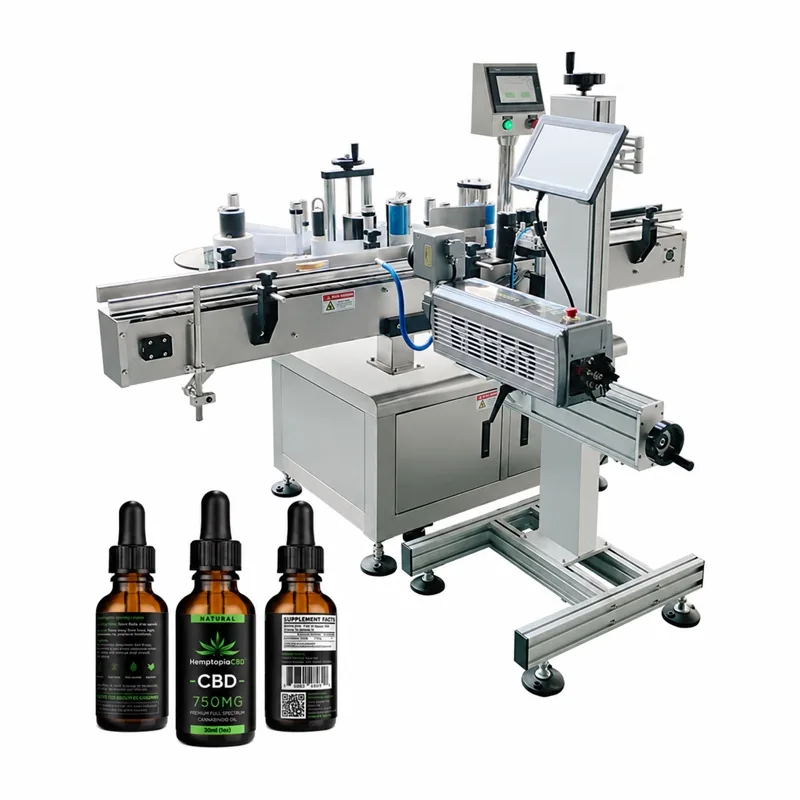
How our engineering guides are structured
industriallabelingmachine.com publishes technical selection guides, sizing calculators, and line-integration references for packaging engineers, plant managers, and procurement teams evaluating automatic labeling machines and label applicators. Relying on unverified speed claims or generic brochure averages causes undersized drive motors, chronic label skew, and failed barcode audits on the shop floor—so every guide on this platform separates general industry benchmarks from project-specific Factory Acceptance Test (FAT) commitments.
| Technical Information Category | Primary Reference Basis | How Operating Conditions Are Stated | Project Verification Gate |
|---|---|---|---|
| Machine Speed & Placement Envelopes | Industrial equipment specifications and FAT engineering baselines | Stated alongside container diameter, label length, and pitch assumptions | Confirmed on buyer containers and label rolls during sample trial and FAT |
| Barcode, Film & Regulatory Rules | International and federal standards (ISO/IEC 15416, GS1, 21 CFR Part 211) |
Cited by standard clause, symbol grade threshold, or placement zone | Verified with inline vision/scanner grading reports before shipment |
| Sizing & Throughput Formulas | Kinematic equations for web speed, roll OD, layflat, and OEE surge capacity | Input variables and units (mm, m/min, BPM) explicitly defined |
Cross-checked against upstream filler/capper and downstream packer speeds |
| LINEVO Equipment Configurations | LINEVO labeling equipment catalog (21 application configurations, family T11) |
Matched to container geometry, label material, and line layout | Itemized in the formal written quotation and engineered drawing package |
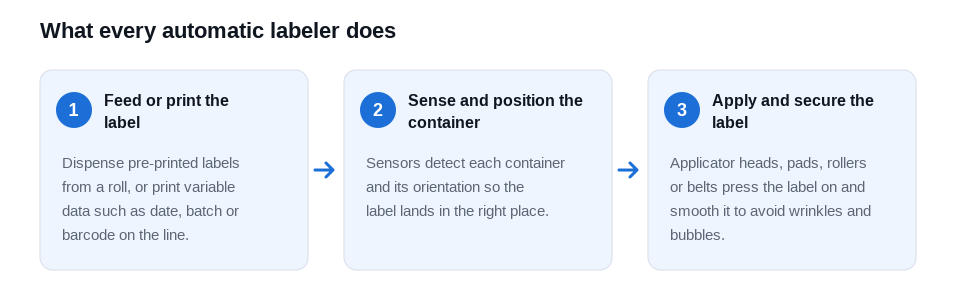
Attribution of standards and representative benchmarks
Industrial labeling spans primary container decoration, pharmaceutical serialization, and end-of-line logistics compliance. To keep technical comparisons verifiable across machine categories:
- International and Federal Standards: When a guide references barcode print quality (
ISO/IEC 15416for linear symbols,ISO/IEC 15415for 2D symbols), logistics label placement (GS1 General Specifications), or pharmaceutical packaging controls (21 CFR § 211.130and§ 211.132), we cite the exact standard and state the physical measurement requirement (such asGrade 1.5 / Cminimum symbol quality or400–800 mmpallet label height). - Equipment Class Envelopes: Where engineering specifications illustrate how a machine architecture performs—such as linear vs. rotary bottle speeds (
50–150 BPMvs.150–600+ BPM), steam shrink tunnel steam consumption (24 kg/hat0.4 MPa), or print-and-apply swing-arm reach—we state the exact mechanical configuration and operating conditions under which those figures apply. - Explicit Engineering Formulas: Calculators and sizing sections—such as the label roll unwind direction chart—show the complete mathematical formula and a worked example using realistic container and label dimensions so engineers can audit every step of the calculation before issuing a User Requirement Specification (URS).
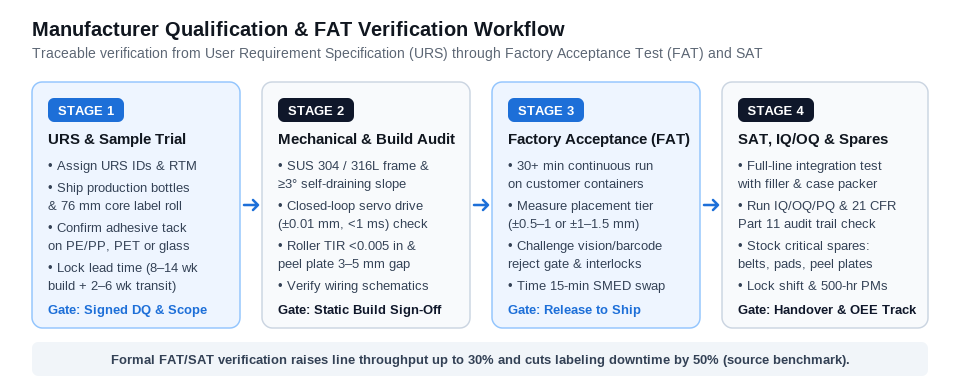
Why physical sample testing governs final specifications
No technical article can substitute for running your actual containers and label rolls through a dispensing head and conveyor transport system. Minor variations in glass mold seams, HDPE wall thickness, silicone liner release force, or cold-fill surface condensation can shift effective throughput by 15–30% or require a 3-roller indexing station in place of a continuous wrap belt.
For that reason, all LINEVO labeling configurations treat published speed ranges and placement tolerances as selection baselines. Exact line speed (BPM), registration tolerance (±mm), format changeover parts, and utility schedules are established on the buyer’s physical samples and written into the formal quotation and Factory Acceptance Test protocol.
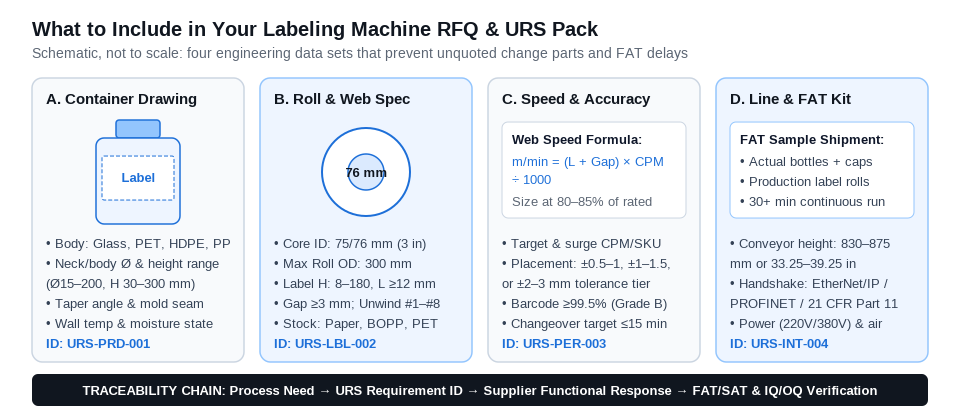
Corrections, updates, and engineering contact
We review and update our technical guides, comparison tables, and interactive calculators as packaging film formulations, print engines, and barcode standards evolve. Each page displays its most recent revision date (UpdatedAt) in the header metadata.
To report a technical correction, discuss an application requirement with our LINEVO engineering team, or submit container and label parameters using our labeling machine RFQ checklist, message our engineers directly on WhatsApp at +86 15338888949.
Related Equipment & Guides
Automatic Labeling Machines: How to Choose by Container, Label and Speed
Choose an automatic labeling machine by container shape, label type and speed. Compare labeler types, accuracy tiers and the checks to run on your samples.
Learn moreLabel Applicators & Print-and-Apply Systems: Actuation, Speed & Retrofit Guide
Compare pre-printed label applicators and print-and-apply systems across wipe-on, tamp-blow, air-blow, and corner-wrap actuation, web speed, and retrofits.
Learn moreHow to Qualify an Industrial Labeling Machine Manufacturer
How to evaluate an industrial labeling machine manufacturer: OEM vs integrator comparison, mechanical build audit, servo vs stepper drives, and FAT checklist.
Learn moreHow to Choose an Industrial Labeling Machine: 7-Gate Selection Guide
Step-by-step labeling machine buying guide: 7 engineering gates from container geometry, surface energy, and unwind #1-#8 to speed headroom and line utilities.
Learn moreLabeling Machine RFQ Checklist and User Requirement Specification (URS)
Engineering labeling machine RFQ checklist and User Requirement Specification (URS) template covering container drawings, roll unwind #1-#8, CPM, and FAT rules.
Learn moreAbout IndustrialLabelingMachine.com: LINEVO's Labeling Equipment Platform
How IndustrialLabelingMachine.com, a specialized LINEVO vertical platform, helps packaging engineers specify, test and quote automatic labeling systems.
Learn more