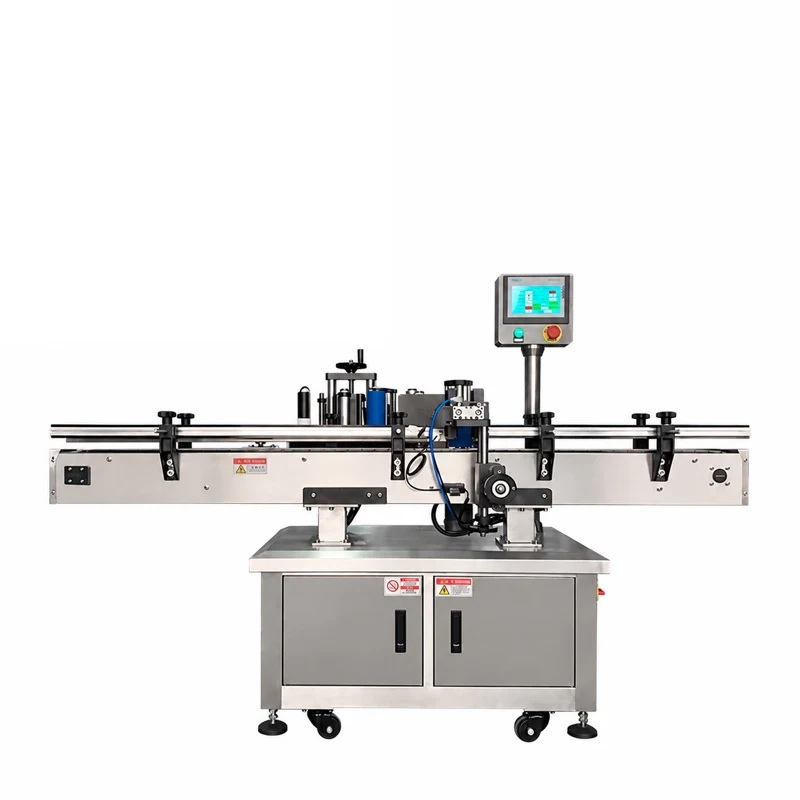
Selecting an e liquid bottle labeling machine or a dropper bottle labeling machine requires engineering around four failure drivers unique to 5 mL to 120 mL personal-care, vape, nutraceutical, and OTC liquid packaging: top-heavy container tipping on narrow 15–45 mm bases, thin-wall polymer deformation on squeezable unicorn bottles, oily fill residue that ruins adhesive bond, and thick multi-layer booklet or tactile labels that resist wrapping around small radii. When a generic round-bottle labeler is deployed without positive centering guides or two-stage extrusion wiping, lines suffer skewed overlap seams, trapped air bubbles, lifted label tails (flagging), and costly batch rework.
Within the broader scope of industrial labeling machines and our vial and pharmaceutical labeling machines hub, dropper and e-liquid systems bridge the gap between pharmaceutical vial precision and high-SKU cosmetic flexibility. This guide details the mechanical architecture of 80–220 BPM dropper and e-liquid labelers, how to coordinate them with upstream 15–50 BPM rotary filling-plugging-capping monoblocks, and how to handle oily container walls, 10 mL and 30 mL tight mandrels, and regulatory peel-and-reseal labels.
1. Container Format Matrix: 5 mL to 120 mL Dropper & E-Liquid Bottles
Although glass tincture droppers and plastic vape juice bottles share similar volume brackets (5 mL, 10 mL, 15 mL, 30 mL, 60 mL, 100 mL, and 120 mL), their wall rigidity, surface energy, and cap geometry demand distinct mechanical setups at the labeling station.
| Container Format | Common Volumes & Diameters | Wall Material & Closure Profile | Primary Labeling Failure Mode | Required Mechanical & Sensor Configuration | Published Speed & Accuracy |
|---|---|---|---|---|---|
| Amber / Flint Glass Boston Round Dropper | 5 mL (~20 mm OD), 10 mL (~25 mm OD), 15 mL (~28.5 mm OD), 30 mL (~33 mm OD), 60 mL (~39 mm OD), 120 mL (~48 mm OD) | Rigid Type III/I glass; rubber bulb + glass pipette + ribbed screw collar (high center of gravity) | Bottle jump or tilt at peel tip; tail flagging on 5–15 mL sizes; MCT/terpene oil film on glass | Double-sided rigid centering chain + spring-loaded top press + 2-stage extrusion rollers + BOPP (9/10 flex) | 80–220 vials/min; ±1.0 mm |
| PET / LDPE Unicorn & Chubby Squeeze Bottles | 10 mL (~21 mm OD), 30 mL (~22–30 mm OD), 60 mL (~30–36 mm OD), 100–120 mL (~40–45 mm OD) | Thin squeezable PET or low-surface-energy LDPE; narrow dropper tip plug + child-resistant (CRC) tall cap | Bottle squeezes into oval under wrap belt, causing diagonal wrinkles and trapped air pockets | Calibrated sponge wrap belt + spring top press (prevents vertical jump without crushing sidewall) + high-tack acrylic adhesive | 80–200 bottles/min; ±1.0 mm |
| Essential Oil Euro-Dropper Bottles | 5 mL (~22 mm OD), 10 mL (~25 mm OD), 15 mL (~28 mm OD), 30 mL (~33 mm OD) | Glass bottle with recessed orifice reducer plug + tamper-evident break-ring cap | Volatile citrus/terpene oil vapor degrades standard rubber adhesives; multi-ply CLP booklet tail lifts | Solvent-resistant acrylic tight-mandrel adhesive + ultrasonic gap sensor + duplicate pressing rollers | 80–220 vials/min; ±1.0 mm |
| Ophthalmic & Nasal Squeeze Droppers | 2 mL to 30 mL (14–28 mm OD) | Semi-permeable white/natural LDPE; sterile dropper tip + tamper-evident overcap | Extractables migration through thin LDPE wall; small-mandrel wing-up | Low-migration pharmaceutical adhesive + ultrasonic clear-label sensor + online vision OCV + single-bottle reject | 60–200 pcs/min; ±0.5 to ±1.0 mm |
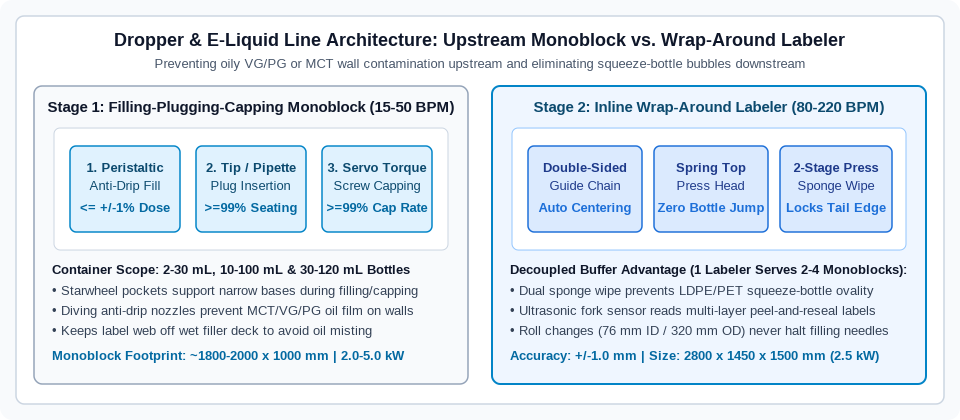
2. Mechanical Architecture of an 80–220 BPM Dropper & E-Liquid Labeler
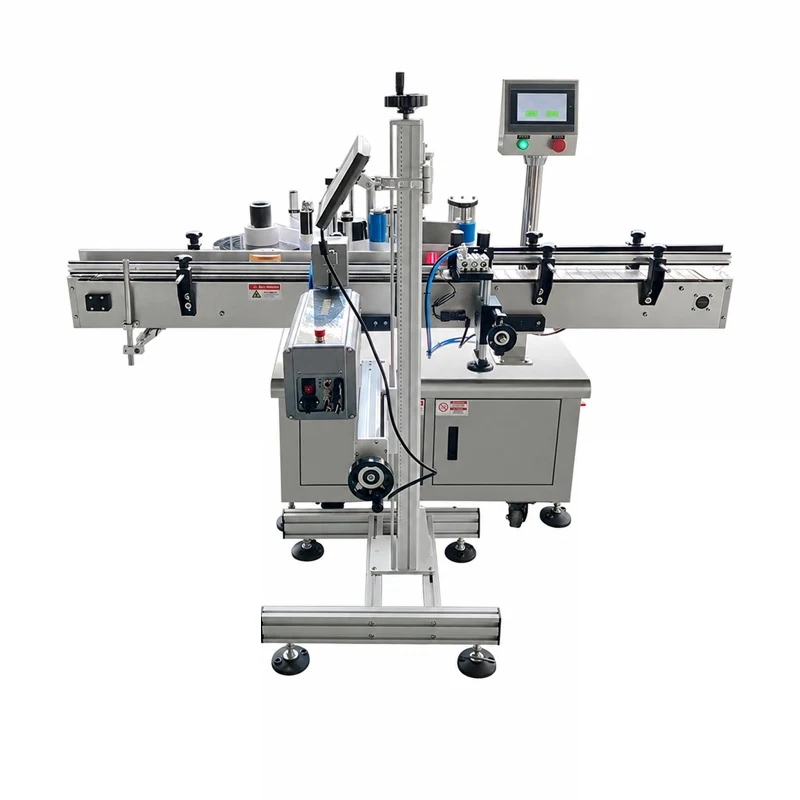
On standard automatic dropper and essential oil labeling machines (2800 × 1450 × 1500 mm, 2500 W at AC220V 50/60Hz, 310 kg machine weight, built on a SUS 304 stainless-steel and anodized aluminum frame), achieving ±1 mm vertical and overlap accuracy at 80–220 vials/min relies on four synchronized mechanical assemblies.
Double-Sided Rigid Synchronous Centering Chain
When 10 mL or 30 mL bottles transition from an upstream rotary turntable or capping starwheel onto the labeling conveyor, minor variations in bottle trajectory cause entry-angle skew. Rather than relying on passive side guide rails, a dedicated 10ml 30ml bottle labeler uses a double-sided rigid plastic synchronous guide chain. Opposing twin guide chains automatically center each bottle along the exact conveyor centerline before it reaches the peel plate, ensuring the bottle axis is perpendicular (90.0°) to the incoming label web.
Spring-Loaded Top Pressing Mechanism
Dropper bottles fitted with heavy rubber-bulb pipette caps (or tall child-resistant e-liquid closures) have an elevated center of gravity, while empty or partial-fill plastic squeeze bottles weigh only a few grams. As the leading edge of the label peels off the sharp stripping plate (using 76 mm ID cores and up to 320 mm max roll OD), web peel tension can jerk an unrestrained bottle upward by 0.5–2.0 mm. A spring-loaded overhead pressing mechanism rides on the top of the cap, keeping the bottle base firmly seated on the conveyor without deforming squeezable PET or LDPE sidewalls.
Two-Stage Duplicate Extrusion Pressing Rollers
Standard single-stage wrap belts often fail to lock down the trailing edge of stiff or multi-ply labels on 15–30 mm diameters. Dedicated tincture bottle labeling machine platforms incorporate a two-stage duplicate pressing structure:
- Primary peel-tip sponge wipe initiates contact across the front panel and rolls the container smoothly without trapping central air pockets.
- Secondary extrusion press rollers apply targeted radial pressure across the head-to-tail overlap seam, ironing out micro-bubbles and preventing delayed edge lift (flagging) on narrow mandrels.
High-Response Servo Drive & PLC Synchronization
Closed-loop Siemens PLC and servo drive configurations on dropper labelers reach reaction rates up to 600 times/min, locking web feed velocity (v_web), conveyor chain speed, centering-chain speed, and top-press belt speed into a single electronic cam profile. Operators can store multi-SKU recipes on the touchscreen HMI and switch between 10 mL, 30 mL, and 60 mL bottle heights via handwheel lead-screw adjustments without mechanical gear changes.
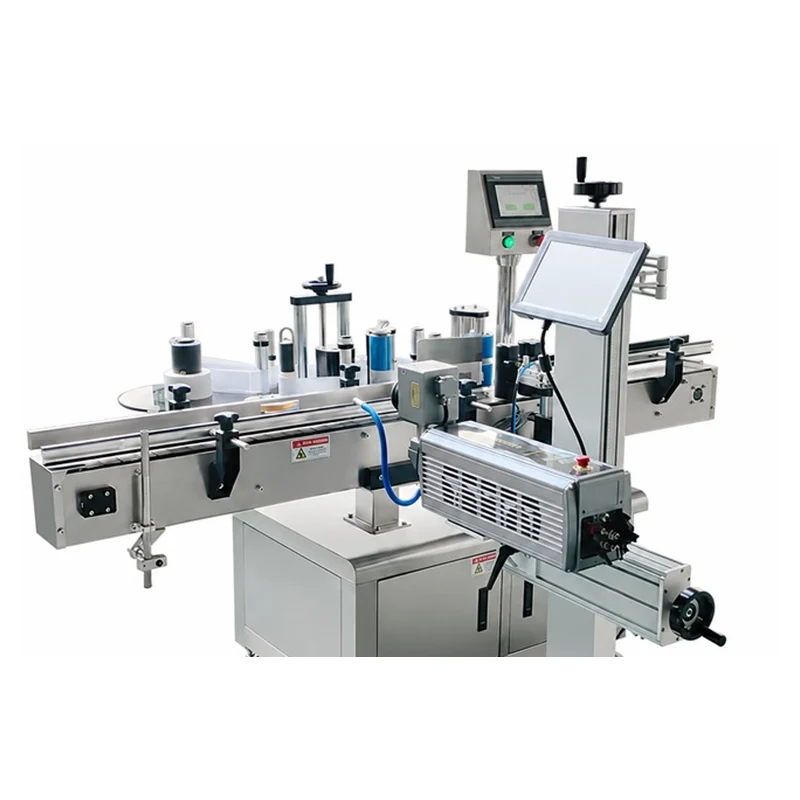
3. Standalone Wrap-Around Frame vs. Combined Filling-Plugging-Capping Monoblock
Buyers setting up a new CBD tincture, essential oil, or vape e-liquid packaging line must decide how to connect their liquid filling, dropper/tip plugging, screw capping, and wrap-around labeling operations.
Upstream Monoblock Capabilities & Speeds (15 to 50 BPM)
Engineering specifications for automatic e-liquid and dropper filling-plugging-capping monoblock series (such as LINEVO LV-FC30 through LV-FCZ40 and LV-JFC101S rotary starwheel monoblocks) show how upstream wet operations are structured:
- Container volume brackets are grouped by starwheel mould size: 2–30 mL, 10–100 mL, 30–120 mL, and 50–250 mL.
- Mechanical throughput on single-starwheel rotary monoblocks (2–4 peristaltic or servo piston filling nozzles + vibratory inner-plug / dropper-pipette inserter + servo torque screw capper) is 15–50 pcs/min (up to 2,000 BPH / ~33 BPM), consuming 2.0–5.0 kW (220V/380V) and 1.3 m³/h of compressed air at 0.4–0.8 MPa on an 1800–2000 × 1000 × 1500–1700 mm (550–850 kg) frame.
- Volumetric dosing via ceramic piston or peristaltic tubing pumps holds ≤±1% filling precision, while mechanical cam/servo pick-and-place heads achieve a ≥99% inner-plugging rate and ≥99% screw-capping rate.
Why Decoupling the Labeler Outperforms a Wet All-in-One Turret
Because a single rotary filling-capping monoblock runs at 15–50 BPM while an inline essential oil bottle labeler runs at 80–220 BPM, mounting the label head directly onto the wet filling starwheel creates two operational penalties:
- Oil misting and web contamination occur because high-speed filling and vibratory plugging of MCT oils, essential oils, or 70/30 VG/PG e-liquids generate fine aerosol droplets inside the monoblock enclosure even with a dust cover. If the exposed siliconized release liner and peel plate sit inches from the filling nozzles, oil mist coats the drive rollers, causing web slip and registration drift.
- Zero buffer during roll splices means that whenever a 320 mm OD label roll runs out or a thermal transfer coder ribbon needs replacement (a 2 to 4 minute stop), a hard-coupled monoblock must stop filling and capping immediately. By placing the standalone wrap-around labeler 1.5–3.0 meters downstream of the monoblock (separated by a rotary accumulation table or low-friction conveyor buffer), the filler continues running uninterrupted during label splices, and a single 80–220 BPM labeler can merge and label the output of two to four parallel filling monoblocks.
4. Preventing Oily Wall Residue, Bubble Trapping & Tight-Mandrel Flagging
In tincture and vape production, 90% of field adhesion failures trace back to container surface contamination or mismatched facestock stiffness rather than applicator motor error.
Eliminating VG/PG & MCT Oil Film Before the Peel Plate
Pressure-sensitive acrylic adhesives cannot wet out a glass or PET surface coated with a microscopic film of medium-chain triglyceride (MCT) oil, hemp extract, citrus terpenes, or vegetable glycerin (VG). To guarantee clean container exteriors entering the dropper bottle labeling machine:
- Specify peristaltic pumps with anti-drip diving nozzles and vacuum suck-back on the upstream filler so liquid never strings across the bottle shoulder during indexing.
- Verify that the upstream servo capper uses a non-marring clutch or closed-loop torque limit (≥99% capping qualification) so over-torqued caps do not crack glass necks or squeeze liquid out of unicorn tips.
- If bottles undergo external rinse/wash after filling (common when packaging sticky botanical extracts), install an high-velocity air-knife drying tunnel ahead of the labeler; residual moisture under clear BOPP film forms milky white water blisters (“clouding”).
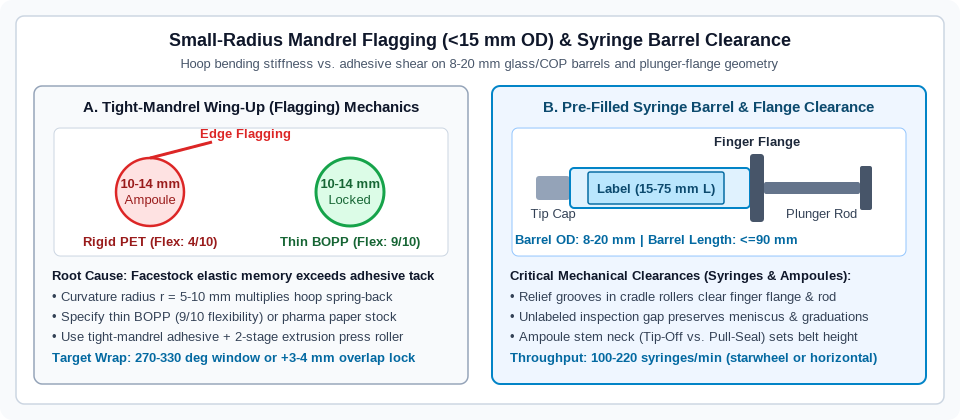
Worked Engineering Calculation: Wrap Coverage & Seam Overlap on 10 mL vs. 30 mL Bottles
Dropper and e-liquid brands must decide between a partial wrap with a liquid viewing gap (270°–330° coverage) and a full 360° overlap wrap (which locks the trailing edge onto the leading edge of the label to prevent flagging on small diameters).
$$C = \pi \times D$$
$$L_{\text{partial}} = C - W_{\text{gap}}, \qquad L_{\text{overlap}} = C + W_{\text{lock}}$$
Example calculation (comparing a 10 mL PET unicorn bottle with $D_{10} = 21.0\text{ mm}$ and a 30 mL amber glass Boston round tincture bottle with $D_{30} = 33.0\text{ mm}$):
- 10 mL Unicorn Bottle ($D_{10} = 21.0\text{ mm}$):
- Circumference: $C_{10} = \pi \times 21.0\text{ mm} = 65.97\text{ mm}$ (66.0 mm).
- For a partial wrap leaving a 3.0 mm vertical gap to check e-liquid level: $L_{\text{partial}} = 65.97\text{ mm} - 3.0\text{ mm} = 62.97\text{ mm}$ (63 mm nominal label length, or 95.5% coverage).
- For a full 360° self-locking wrap with a 4.0 mm overlap zone (recommended when using multi-ply CLP peel-back labels on low-surface-energy LDPE): $L_{\text{overlap}} = 65.97\text{ mm} + 4.0\text{ mm} = 69.97\text{ mm}$ (70 mm nominal label length).
- 30 mL Boston Round Tincture Bottle ($D_{30} = 33.0\text{ mm}$):
- Circumference: $C_{30} = \pi \times 33.0\text{ mm} = 103.67\text{ mm}$.
- For a partial wrap leaving a 4.7 mm vertical gap to avoid overlapping the two vertical glass mould seams: $L_{\text{partial}} = 103.67\text{ mm} - 4.7\text{ mm} = 98.97\text{ mm}$ (99 mm nominal label length, or 95.5% coverage).
- Check your exact bottle diameter and maximum straight sidewall height (between the bottom heel radius and the shoulder taper) using our container label size and coverage calculator, and review mechanical remedies for seam wrinkles in fix label wrinkling, bubbling, and flagging.
- When sizing line capacity between rotary filling monoblocks (Q_filler = 35 BPM) and a downstream dropper labeler (Q_labeler = 150 BPM), the number of upstream filling turrets supported by one labeler with a 1.15 surge buffer factor is N_monoblock = Q_labeler / (Q_filler * 1.15) = 150 / 40.25 = 3.7 (3 rotary monoblocks feeding 1 inline wrap-around labeler).
5. Tactile Warnings, Multi-Layer Booklet Labels & Tamper-Evident Compliance
Nicotine e-liquids, cannabis/CBD tinctures, essential oils, and OTC medicinal drops face strict regional labeling rules (such as EU CLP/TPD regulations and U.S. FDA 21 CFR 211.132) that pack extensive warning text, ingredient tables, and child-safety indicators onto tiny 10 mL and 30 mL cylinders:
- Multi-layer peel-and-reseal (booklet or extended-content) labels are used whenever regulatory text in multiple languages cannot fit on a 63 × 30 mm single-ply label. Because the two- or three-ply laminated booklet section is 2–3× thicker than a single film layer, standard photoelectric gap sensors frequently false-trigger on internal print edges. Always specify an ultrasonic or capacitive fork sensor (ultrasonic vs. optical clear label sensors) and a slightly larger 1.5–2.0 mm peel-plate tip radius so the booklet laminate does not delaminate during stripping.
- Raised tactile warning triangles (ISO 11683) are required on nicotine and hazardous essential oil bottles in European and UK markets. If the tactile triangle is pre-embossed on the primary label web, the labeler’s wrap belt and secondary pressing rollers must use compliant closed-cell sponge foam so wiping pressure does not crush the raised apex. Alternatively, a secondary applicator head can apply a clear circular tactile sticker downstream of the primary wrap station.
- Tamper-evident closures and neck bands under 21 CFR § 211.132 govern retail OTC and CBD dropper bottles. Manufacturers achieve visible tamper evidence via a ratcheting break-away plastic ring molded into the dropper cap, a lollipop tamper-evident seal strip extending from the side label over the cap, or a full perforated PVC/PETG shrink band applied by a downstream tamper-evident neck band applicator.
6. Specifying & Quoting Your Dropper or E-Liquid Labeling Line
LINEVO’s equipment catalog lists dedicated automatic labeling systems for CBD oil, essential oil, and e-liquid vape juice bottles (including catalog series dession-197 and dession-198, as well as small-bottle series dession-207). Because dropper bulb heights, squeezable PET/LDPE wall stiffness, and multi-ply label constructions vary widely across brands, all conveyor guide profiles, sponge-belt durometers, and throughput guarantees are engineered and verified on your physical bottle and label samples during quotation.
Compare standard cylindrical bottle architectures in our round bottle labeling machine guide, or if you also package fragile glass ampoules and pre-filled syringes, review our sibling guide to the ampoule and syringe labeling machine. Before requesting a proposal, confirm your roll winding orientation in the label roll unwind direction chart, assemble your sample specs with the labeling machine RFQ checklist, and message LINEVO engineers on WhatsApp for a standalone labeler or complete filling-capping-labeling line.
Common questions
Should I buy an all-in-one filling-capping-labeling monoblock or a standalone dropper bottle labeler?
Separate the rotary filling-plugging-capping monoblock (which runs at 15–50 bottles/min on 2–120 mL bottles) from the downstream inline wrap-around labeler (which runs at 80–220 bottles/min) connected by a short accumulation conveyor. Keeping the label dispenser off the wet filling deck prevents VG/PG or essential oil aerosol mist from contaminating the peel plate and ensures that a 2-minute label roll splice never halts your peristaltic filling nozzles.
How do you prevent air bubbles and bottle ovality when labeling soft PET or LDPE e-liquid squeeze bottles?
Squeezable 10 mL to 120 mL chubby gorilla and unicorn bottles collapse into an oval cross-section if pinched too hard by a rigid wrap belt, trapping air pockets beneath film labels. Specify a spring-buffered top hold-down mechanism paired with a calibrated two-stage sponge extrusion press roller that progressively wipes the label from the center outward without crushing the thin polymer wall.
Why do essential oil and CBD tincture labels peel off amber glass Boston round bottles?
Two factors cause edge lift on 10 mL and 30 mL amber glass dropper bottles: microscopic MCT oil or essential oil film on the glass exterior from filling splash, and high hoop spring-back stress when rigid PET label stock is wrapped around an 18–33 mm diameter cylinder. Using peristaltic diving nozzles with vacuum suck-back upstream and specifying conformable 50 µm BOPP facestock (9/10 flexibility rating) with a high-tack tight-mandrel adhesive eliminates peeling.
What sensor is required for e-liquid peel-and-reseal booklet labels and raised tactile warning triangles?
Standard optical fork sensors fail on multi-layer peel-and-reseal (CLP) booklet labels and clear tactile warning labels because variable ply thickness and transparent film confuse light transmission. Specify an ultrasonic or capacitive fork sensor that detects the physical thickness step at the 3 mm gap between labels, paired with a blunt peel plate and dual-stage press rollers.
Related Guides & Specifications
Related Equipment & Guides
Automatic Labeling Machines: How to Choose by Container, Label and Speed
Choose an automatic labeling machine by container shape, label type and speed. Compare labeler types, accuracy tiers and the checks to run on your samples.
Learn moreVial & Pharmaceutical Labeling Machines: Vertical vs. Horizontal Selection
Select a vial labeling machine or pharmaceutical labeler for 8-30 mm vials, ampoules, syringes, and dropper bottles with cGMP 21 CFR 211.130 controls.
Learn moreRound Bottle Labeling Machines: Continuous Wrap Belt vs. 3-Roller Indexing
Select a round bottle labeling machine by comparing continuous wrap belts vs 3-roller indexing, web speed equations, bottle pitch spacing, and machine parameters.
Learn moreTamper-Evident Neck Band Applicator: Overhang Geometry, Perforation & Line Integration
Specify automatic tamper-evident shrink neck band applicators for jars and bottles: cap overhang rules, vertical/T-perforation blades, and 21 CFR 211.132 compliance.
Learn moreAmpoule & Syringe Labeling Machine: Horizontal Cradle & Starwheel Guide
Specify an ampoule labeling machine or pre-filled syringe labeler for 1-20 mL thin-wall glass ampoules and 8-20 mm syringe barrels with zero glass breakage.
Learn moreClear Label Sensor Selection: Capacitive vs Ultrasonic vs Optical
Engineering guide to clear label sensors on BOPP and PET films: why optical slot sensors drop to 68% and ultrasonic to 12% vs 100% capacitive accuracy at 220 m/min.
Learn moreHow to Fix Label Wrinkling, Bubbling, Flagging, and Axial Skew
Engineering troubleshooting guide to fix pressure-sensitive label wrinkling, air bubbling, edge flagging, and axial skew across bottle and carton labelers.
Learn moreLabeling Machine RFQ Checklist and User Requirement Specification (URS)
Engineering labeling machine RFQ checklist and User Requirement Specification (URS) template covering container drawings, roll unwind #1-#8, CPM, and FAT rules.
Learn more