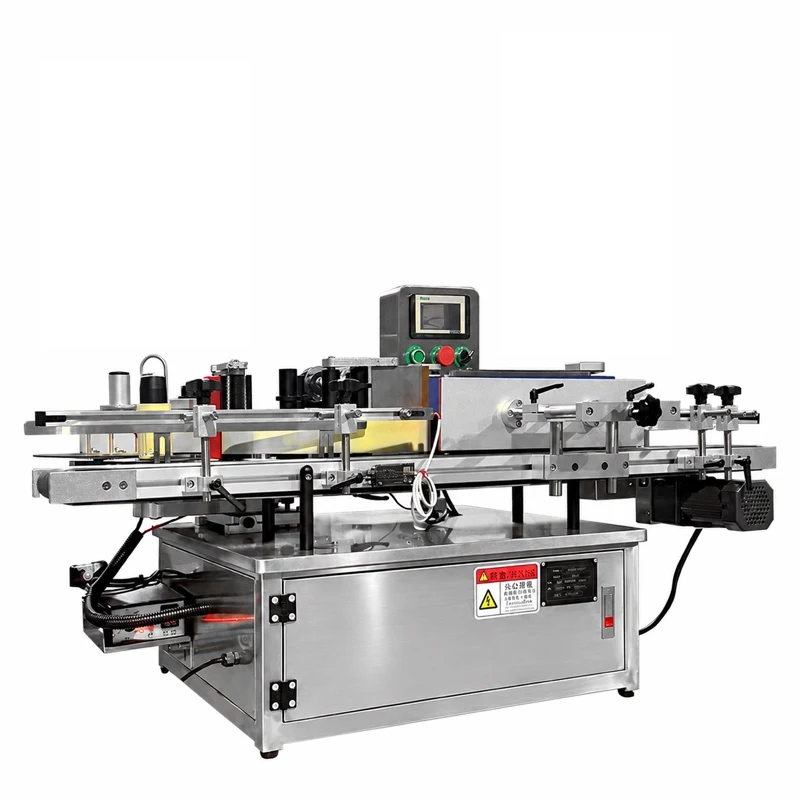
Specifying an ampoule labeling machine or a syringe labeling machine requires mechanical handling designed specifically for fragile, unstable, small-radius parenteral containers that cannot stand upright on a conventional flat conveyor. When a 1 mL to 20 mL thin-wall borosilicate glass ampoule or a 0.5 mL to 10 mL pre-filled syringe is subjected to excessive peel-plate wipe force or unguided vertical conveying, lines suffer severe glass breakage, bent plunger rods, lifted label tails (flagging), and costly batch rejections.
As a specialized branch of industrial labeling machines and our vial and pharmaceutical labeling machines hub, ampoule and syringe systems replace flat conveyor belts with horizontal roller-chain trunnion cradles or flange-supporting starwheel turrets. This guide covers published equipment architectures, crush-prevention mechanics for tip-sealed and pull-sealed ampoules, tray-to-tray cassette feeding versus inline sterile line integration, tight-mandrel (<15 mm OD) facestock selection, and graduation-scale clearance on pre-filled syringes.
1. Published Ampoule & Syringe Labeling Machine Architectures
Because parenteral facilities process batches ranging from clinical-trial compounding lots of a few thousand syringes to commercial vaccine runs at 300+ containers/min, manufacturers build five distinct machine classes for ampoules and syringes.
| Equipment Configuration | Target Container Scope | Transport & Rotation Mechanism | Published Throughput & Accuracy | Published Power, Weight & Footprint | Typical Line Deployment |
|---|---|---|---|---|---|
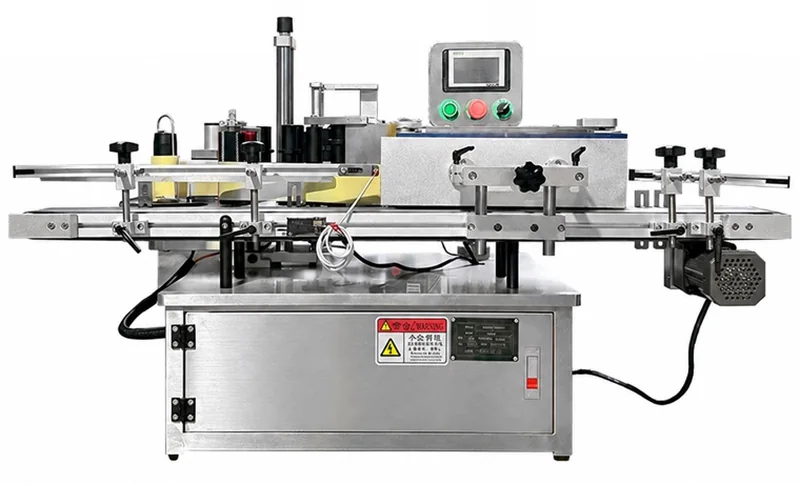
| Standard Horizontal Ampoule Labeler | 1–20 mL glass ampoules & tubular vials (φ10–φ30 mm OD) | Inclined tray hopper + eccentric separator + horizontal roller-chain cradle + sponge top belt | 100–300 pcs/min (or 80–220 vials/min); ±1.0 mm | 1.5–2.5 kW (220V 50/60Hz); 200–310 kg; 2040 × 690 × 1370 mm to 2800 × 1450 × 1500 mm | Offline tray-to-tray finishing after autoclave & leak test |
| High-Speed Horizontal Ampoule System | 1–10 mL glass ampoules & small vials (φ10–φ22 mm OD) | Continuous servo feed screw + high-pitch roller chain or rotary starwheel turret | 350–600 ampoules/min; ±0.5 to ±1.0 mm | 2.5 kW (220V 50/60Hz); 350 kg N.W. (450 kg G.W.); 2500 × 1650 × 1300 mm | High-volume commercial parenteral lines with inline cartoning |
| Starwheel Syringe Label Applicator | Pre-filled glass/COP syringes (φ8–φ20 mm OD, total length ≤90 mm) | Vertical indexing starwheel supporting barrel/flange + wrap wipe station (label 20–60 mm L × ≤80 mm H) | 100–220 syringes/min (0–200 to 0–220 pcs/min); ±1.0 mm | Servo drive; 1150 × 1000 × 1400 mm compact sanitary frame | De-nested syringe tub lines & inline plunger-rod assembly |
| Horizontal Roller Syringe Labeler | Pre-filled syringes & small cylindrical tubes (label length 15–75 mm) | Horizontal grooved roller-chain conveyor clearing finger flange and plunger rod (300 mm max roll OD, 76 mm ID) | 0–200 syringes/min; ±1.0 mm | 1100 W (220V 50/60Hz); 200 kg; 2900 × 550 × 1300 mm | Horizontal inline transfer to thermoformed blister packaging |
| Semi-Automatic Benchtop Syringe Station | Clinical trial & compounding syringes (0.5–20 mL) | Hand-loaded two-roller recessed cradle + pneumatic press arm (0.6–0.8 MPa air supply) | 10–25 syringes/min; ±1.0 mm | 100 W (220V); benchtop footprint | Hospital pharmacies, R&D stability lots, small-batch contract runs |
2. Preventing Glass Breakage: Ampoule Sealing Geometry & Peel-Plate Mechanics
Form-fill-seal glass ampoules Manufactured under ISO 9187 feature thin borosilicate walls (0.4–0.7 mm thickness on 1–5 mL sizes) and a constricted break-ring or colour-break (OPC) neck. Unlike heavy moulded beverage bottles, an ampoule will shatter if pinched between a rigid metal drive roller and an unyielding peel plate, or if its elongated stem strikes an adjacent container during infeed singulation.
How Tip-Sealing vs. Pull-Sealing Affects Infeed Singulation
Upstream ampoule filling and sealing lines close the glass stem using one of two flame-sealing methods, each creating a distinct top profile that the glass ampoule labeler must accommodate:
- Tip sealing (tip-off) melts the top rim of the open ampoule stem in an oxygen-gas flame to form a smooth, rounded bead at the tip. While rapid for low-viscosity aqueous solutions, tip sealing can occasionally leave a slightly wider glass bead or micro-bubble dome if fill droplets splash near the flame zone.
- Pull sealing (drawn-out sealing) heats the stem slightly below the top rim while mechanical grippers pull the waste glass crown upward, twisting and fusing a symmetrical, conical dome. Pull sealing provides high hermetic integrity for oxygen-sensitive drugs, powders, and viscous oils, but requires precise flame control so the drawn tip does not form a fragile hair-thin tail (whisker).
Because container overall height and dome profile vary slightly between tip-sealed and pull-sealed batches, a horizontal vial and ampoule labeler must never push or index the ampoule by its sealed tip. Instead, the infeed separating wheel and side guide rails contact only the cylindrical lower body below the neck constriction, leaving at least 5–10 mm of axial clearance past the tip dome.
Three-Point Crush Prevention on Horizontal Roller Chains
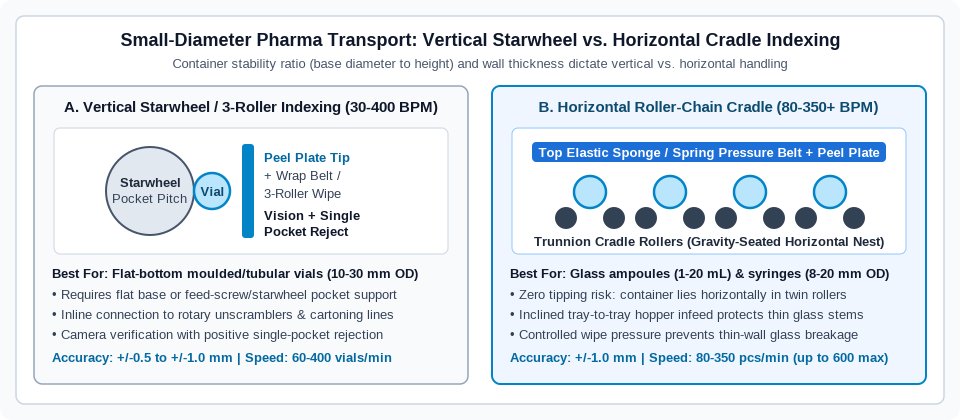
To maintain 100–350+ pcs/min throughput with near-zero glass breakage, horizontal ampoule machines control radial force across three mechanical zones:
- Soft-polymer eccentric singulation at the base of the inclined cassette hopper uses a starwheel or eccentric cam wheel machined from low-friction ultra-high-molecular-weight polyethylene (UHMW-PE) or POM acetal. A slip-clutch torque limiter stops the wheel within milliseconds if a dimensional outlier or broken glass fragment enters the pocket, preventing cascade crushing in the hopper.
- Twin-roller trunnion cradles support each ampoule horizontally between two parallel free-spinning stainless-steel or polyurethane-coated rollers (pitch-matched to 10–30 mm diameters). Because the rollers contact the full length of the straight barrel wall, radial load is distributed evenly rather than concentrated at a point.
- Spring-loaded elastic sponge wiping replaces rigid nip rollers at the peel plate. An overhead synchronous sponge belt backed by leaf springs or micro-adjustable compression screws presses the ampoule downward into its twin cradle rollers just enough to generate rotational traction (V_belt matched to roller chain advance) without exceeding the hoop crush threshold of thin-wall glass.
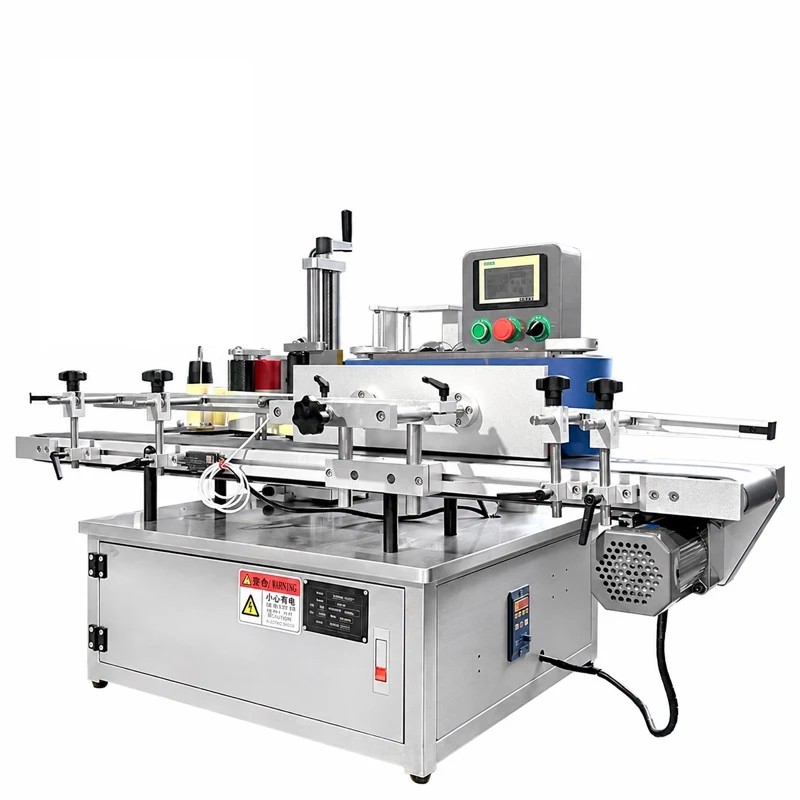
3. Tray-to-Tray Cassette Hoppers vs. Inline Sterile Line Integration
Pharmaceutical manufacturers deploy ampoule and syringe labelers in one of two material-flow layouts depending on whether containers undergo offline quarantine inspection between filling and packaging.
Offline Tray-to-Tray Ampoule Labeling
In many parenteral plants, sealed glass ampoules are unloaded from the filler-sealer into stainless-steel or polypropylene open-front cassette trays for terminal steam sterilization (autoclaving), high-voltage pinhole leak testing, and quarantine storage. When batch release is approved, the tray to tray ampoule labeling workflow operates as a self-contained finishing cell:
- An operator slides a full cassette tray (typically 100 to 400 ampoules depending on 1 mL to 20 mL diameter) onto the inclined infeed ramp (15°–25° slope) and removes the tray front gate.
- Gravity slides the bank of upright ampoules gently toward the separating wheel, which transitions each ampoule from a tilted upright posture in the hopper into a horizontal pocket on the roller chain (or keeps it upright on vertical starwheel tray-to-tray models).
- After coding, vision verification, single-unit fault rejection, and wrap-around labeling, the discharge elevator re-stands the labeled ampoules in a tight row and pushes them into a clean receiving tray—allowing one operator to sustain 100–300 pcs/min without touching individual ampoules.
Inline Connection to Upstream Washers, Fillers & Downstream Blister Packers
For high-volume biologics, vaccines, and pre-filled syringes, the labeler integrates directly into a continuous packaging line:
- On inline ampoule lines, containers exit the Automated Visual Inspection (AVI) & leak-testing machine via a single-file dead-plate transfer and enter the labeler’s feed screw or horizontal transfer wheel, discharging directly into the bucket chain of a thermoforming tray packer or horizontal cartoner.
- On pre-filled syringe lines (ISO 11040 nested tubs), an upstream robotic de-bagger and de-nesting unit lifts 100 or 160 syringes from their sterile matrix nest, inserts and torques the plastic plunger rod, and feeds the assembled syringes into the syringe labeling machine at 100–220 syringes/min. Low-friction accumulation sensors (minimum-load and maximum-backpressure photoeyes) modulate the labeler’s servo speed so the peel plate never stalls with a syringe half-wrapped. Review line-buffering and handshaking signals in our custom labeling line integration guide.
4. Small-Radius Flagging Control (<15 mm Mandrel) & Inspection Windows
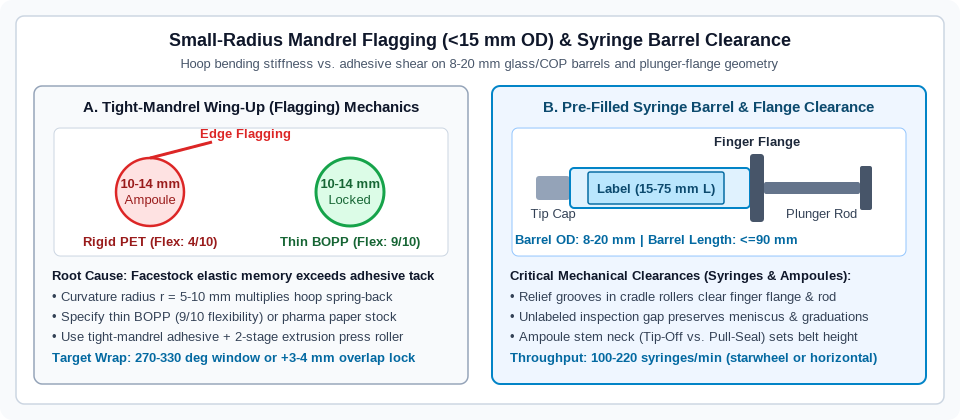
A 1 mL glass ampoule or 0.5 mL tuberculin/vaccine syringe has an outside barrel diameter of only 8 mm to 10.75 mm, while 2 mL to 5 mL ampoules measure 11.5 mm to 16.5 mm. Wrapping a pressure-sensitive label around a mandrel under 15 mm diameter creates severe hoop bending strain in the facestock.
Solving Delayed Edge Lift (Flagging) on 8–16 mm Barrels
When a stiff label facestock is wrapped around a 10 mm cylinder, its internal elastic restoring force acts like a coiled spring trying to flatten the label back out. If that spring-back force exceeds the shear and peel adhesion of the pressure-sensitive adhesive, the trailing 2–4 mm tail lifts off the glass within minutes or during refrigerated storage (2°C–8°C):
- Avoid standard 50 µm polyester (PET, rated 4/10 for flexibility in published label material benchmarks) on 8–15 mm barrels unless an ultra-thin 23–36 µm gauge is specified.
- Specify conformable biaxially oriented polypropylene (BOPP, rated 9/10 for flexibility) or 60 g/m² cast-coated pharmaceutical paper (6/10 flexibility), which yield over a sharp 1.0–1.5 mm peel tip with minimal elastic memory.
- Pair the facestock with a high-initial-tack tight-mandrel pharmaceutical emulsion acrylic or rubber-resin adhesive designed for low-surface-energy Type I borosilicate glass and silicone-lubricated COP/COC syringe barrels.
- Configure the labeler with a two-stage duplicate pressing mechanism (an initial peel-tip sponge wipe followed by a secondary extrusion press roller or extended overhead sponge belt) so the label tail remains under positive radial pressure for at least 1.5 to 2.0 full container rotations. For deeper troubleshooting of tail lift and seam bubbles, consult fix label wrinkling, bubbling, and flagging.
Worked Engineering Calculation: Inspection Window Width & Label Length on a 1 mL Syringe
Clinical safety guidelines for pre-filled syringes and ampoules require an unobstructed vertical viewing window so healthcare workers can check liquid clarity, air bubbles, and plunger meniscus alignment against printed dose graduations before injection.
$$C = \pi \times D$$
$$L_{\text{label}} = C - W_{\text{window}}$$
Example calculation (assuming a 1 mL long pre-filled glass syringe with barrel outside diameter $D = 8.15\text{ mm}$ and a required clear visual inspection window of $W_{\text{window}} = 4.5\text{ mm}$):
- Total barrel circumference: $C = \pi \times 8.15\text{ mm} = 25.60\text{ mm}$.
- Maximum opaque label length to preserve a 4.5 mm viewing window: $L_{\text{label}} = 25.60\text{ mm} - 4.5\text{ mm} = 21.10\text{ mm}$ (21 mm nominal die-cut length, representing an 82.4% or 297° wrap).
- Alternatively, if the regulatory text requires a full 360° overlap lock to prevent flagging on the 8.15 mm mandrel, specify a 29 mm long clear-on-clear BOPP label (25.6 mm circumference + 3.4 mm overlap zone) printed with a 19 mm white opaque text panel and a 10 mm transparent unprinted tail that overlaps the leading edge while leaving a clear window over the barrel graduations.
- Because clear-on-clear syringe labels have no opacity contrast at the 3 mm web gap, the applicator must use an ultrasonic or capacitive fork sensor (ultrasonic vs. optical clear label sensors). You can verify wrap percentages across all ampoule and syringe sizes in the container label size and coverage calculator.
5. Pre-Filled Syringe Mechanics: Finger Flange, Plunger Rod & Graduation Clearance
Labeling a pre-filled syringe (PFS) introduces three mechanical interferences that do not exist on standard vials or ampoules:
- Finger-flange radial projection requires recessed roller channels because the glass or clip-on plastic finger flange at the rear of the barrel extends 3–6 mm radially beyond the 8–20 mm cylinder wall, while the Luer-lock tip cap or rigid needle shield (RNS) projects from the front shoulder. On horizontal roller-chain machines (2900 × 550 × 1300 mm, 1100 W, 0–200 syringes/min), each cradle roller is precision-machined with stepped relief grooves so only the smooth cylindrical barrel contacts the roller surface while the finger flange and tip cap ride freely in recessed channels.
- Plunger-rod axial overhang and deflection must be isolated from wiping pressure. Assembled syringes carry a threaded plastic plunger rod extending 40–70 mm behind the barrel (total length ≤90 mm on compact starwheel applicators, or up to 140 mm on horizontal beds). The peel plate width (label height ≤80 mm) and overhead sponge press pad must be narrower than the distance between the barrel shoulder and the finger flange (typically 15–75 mm label length) so wiping pressure never bends the plunger rod or accidentally depresses the stopper.
- Color-coding, safety-device, and autoinjector clearances govern final label thickness. Hospital anesthesia and emergency syringes frequently combine barrel wrap labeling with color-coded tamper-evident Luer-cap seals or snap-on needle-stick safety guards. When high-viscosity biologics are packaged in syringes destined for spring-driven autoinjectors, barrel label thickness and overlap seam placement must be controlled within ±0.5 to ±1.0 mm so the labeled syringe slides freely into the autoinjector housing without friction binding.
6. Online Serialization, Vision Verification & Single-Unit Rejection
Under 21 CFR § 211.130 and global serialization mandates, every ampoule and syringe label must undergo automated verification before leaving the machine:
- High-resolution thermal transfer or UV laser coding uses a 300 dpi thermal transfer overprinter (TTO) or UV laser mounted ahead of the peel plate to print the batch lot number, expiration date, and 2D DataMatrix code onto each label while the web is tensioned flat over the print platen (achieving ISO/IEC 15415 Grade A or B contrast).
- OCV/OCR and barcode vision checks run immediately after printing, where a high-speed camera verifies character legibility (OCV/OCR) and 2D matrix decodability before the label reaches the peel tip.
- Missing-label and positive reject tracking relies on a post-application luminescence or optical sensor that checks every roller-chain pocket or starwheel slot for confirmed label presence. If a label fails OCV verification or fails to transfer, the PLC shift register tracks that exact pocket and actuates a single-pocket pneumatic ejector into a locked reject drawer, confirmed by a bin-entry photoeye. Audit trails and batch reject tallies are logged under 21 CFR Part 11 user-access controls.
7. How to Specify & Quote an Ampoule or Syringe Labeling System
LINEVO’s pharmaceutical catalog lists dedicated ampoule and small-vial labeling machines (including catalog configurations dession-205, dession-206, and dession-207) engineered around customer container samples. Because ampoule neck profiles (tip-off vs. pull-seal), cassette tray dimensions, and syringe flange/plunger geometries vary across glass tubing converters, cradle roller grooves and starwheel pockets are custom-machined to your exact container drawings and validated during Factory Acceptance Testing (industrial labeling machine FAT and troubleshooting manual).
If your facility also packages oral drops, CBD tinctures, or squeezable dropper bottles, compare vertical centering-chain architectures in our sibling guide to the e-liquid and dropper bottle labeler. To prepare your technical specification package, calculate your required web speed in the labeling speed BPM and pitch calculator, review the labeling machine RFQ checklist, and message LINEVO engineers on WhatsApp with your ampoule or syringe dimensional drawings.
Common questions
How does a horizontal ampoule labeling machine prevent thin-wall glass breakage?
A horizontal ampoule labeler eliminates glass crushing at three mechanical points: an eccentric or soft-polymer separating wheel gently meters ampoules from an inclined tray hopper without stem-to-stem impact, twin trunnion rollers support the main cylindrical body across its full length rather than loading the fragile neck constriction, and a spring-buffered elastic sponge belt applies controlled radial wiping pressure across the peel plate.
What is the difference between tray-to-tray ampoule labeling and inline sterile filling integration?
Tray-to-tray ampoule labeling uses an inclined cassette hopper and a vertical re-stacking discharge tray so quarantined ampoules (stored in trays after autoclave sterilization and visual leak inspection) can be labeled offline by a single operator at 80–300 pcs/min. Inline integration connects the labeler directly downstream of a tunnel washer, filler-sealer, and pinhole leak detector via a continuous transfer starwheel or conveyor buffer.
How do syringe labeling machines clear the finger flange and plunger rod?
Pre-filled syringes have an 8–20 mm barrel diameter flanked by a wider finger flange and a projecting plunger rod that cannot roll flat on standard conveyor rollers. Syringe labelers use either grooved horizontal cradle rollers that support only the cylindrical barrel while leaving a recessed clearance channel for the flange and plunger, or a vertical starwheel turret that suspends the syringe by its finger flange while spinning the barrel past the peel plate.
Why must ampoule and syringe labels leave an unprinted gap or transparent window?
Clinicians and automated vision systems must inspect parenteral solutions for particulate matter, discoloration, and exact meniscus volume against barrel graduation marks before administration. Specifying a 270° to 330° partial wrap (or a clear-on-clear BOPP label with an unprinted window) preserves a 4 to 8 mm vertical inspection strip along the barrel.
Related Guides & Specifications
Related Equipment & Guides
Automatic Labeling Machines: How to Choose by Container, Label and Speed
Choose an automatic labeling machine by container shape, label type and speed. Compare labeler types, accuracy tiers and the checks to run on your samples.
Learn moreVial & Pharmaceutical Labeling Machines: Vertical vs. Horizontal Selection
Select a vial labeling machine or pharmaceutical labeler for 8-30 mm vials, ampoules, syringes, and dropper bottles with cGMP 21 CFR 211.130 controls.
Learn moreIndustrial Labeling Machine FAT Checklist, Maintenance, and Troubleshooting Manual
Execute a 30-minute Factory Acceptance Test (FAT), follow a 6-tier preventive maintenance schedule, and resolve 12 common labeling machine defects.
Learn moreE-Liquid & Dropper Bottle Labeler: 5–120 mL Tincture & Vape Guide
Select an e liquid bottle labeling machine or dropper bottle labeler for 5-120 mL Boston round glass tinctures and PET/LDPE unicorn squeeze bottles.
Learn moreClear Label Sensor Selection: Capacitive vs Ultrasonic vs Optical
Engineering guide to clear label sensors on BOPP and PET films: why optical slot sensors drop to 68% and ultrasonic to 12% vs 100% capacitive accuracy at 220 m/min.
Learn moreHow to Fix Label Wrinkling, Bubbling, Flagging, and Axial Skew
Engineering troubleshooting guide to fix pressure-sensitive label wrinkling, air bubbling, edge flagging, and axial skew across bottle and carton labelers.
Learn moreLabeling Machine RFQ Checklist and User Requirement Specification (URS)
Engineering labeling machine RFQ checklist and User Requirement Specification (URS) template covering container drawings, roll unwind #1-#8, CPM, and FAT rules.
Learn more